The Complete Deregistration System for Northern Ireland — From Letter to EA Response
You've made the decision. Your child is in distress — the SEN support never materialised, the EBSA has reached the point where they physically cannot walk through the school gate, or the SEAG Transfer Test pressure is crushing your Primary 6 child. You want to withdraw and start home educating. But when you searched for help, every guide you found talked about "deregistration," the Education Act 1996, and Local Authorities. None of that applies in Northern Ireland. And then you discovered the real complication: the advice that works in England is legally hazardous here, because Northern Ireland has its own legislation, its own Education Authority, and its own rules.
That confusion — between English law and Northern Irish law — is where parents get into trouble. They send a deregistration letter citing Section 7 of the Education Act 1996 to a school in Belfast. The principal immediately sees that the parent doesn't understand their own legal position. The letter gets forwarded to the Education Authority with a note. And instead of a clean, immediate deregistration, the parent is now dealing with unnecessary scrutiny, requests for meetings, and veiled threats about School Attendance Orders — all because the template they downloaded was written for a different jurisdiction.
The Northern Ireland Legal Withdrawal Blueprint is a complete Deregistration System — the Article 45 notification letters, the EA response templates, the Special School pathway, and the School Attendance Order defence — so you're never improvising during the most stressful week of the process.
What's Inside the Deregistration System
Five Deregistration Letter Templates — because your school type determines your pathway
Controlled school withdrawal, Catholic Maintained school withdrawal, Integrated school withdrawal, Irish-Medium school (Gaelscoil) withdrawal, and the separate Special School pathway that requires EA involvement. Most NI parents use the wrong template because generic UK guides don't distinguish between school management types — and in Northern Ireland, who manages the school determines who receives your letter and what happens next. Each template cites Article 45 of the Education and Libraries (NI) Order 1986 and DENI Circular 2017/15 — the exact statutory language that establishes your legal position from the first sentence.
The Special School Deregistration Pathway — because withdrawing from a Special School is a completely different legal process
If your child attends a Special School, you cannot simply send a letter and walk away. Under Northern Irish law, the Education Authority must be notified and involved before deregistration can proceed. This is the single most dangerous gap in every generic UK guide — they treat all schools as identical. The Blueprint provides the separate EA notification letter, explains what the Authority can and cannot require during this process, and covers how to protect your child's Statement of SEN throughout the transition. No other guide addresses this pathway.
The EA Response Protocol — because the deregistration letter is the easy part
Within 4-8 weeks of deregistration, the EA's Elective Home Education Team will write to you. When they request a "home visit" to assess your provision, most parents comply because they believe it's mandatory. It isn't. When they ask for detailed curriculum plans, parents panic and over-commit to a rigid timetable they'll regret. When they mention "School Attendance Orders" in their first letter, parents freeze. The Blueprint gives you copy-and-paste reply templates — citing the specific provisions of the 1986 Order and DENI Circular 2017/15 that the EA is misapplying — so you can respond within minutes without composing anything under pressure.
The School Attendance Order Defence — because understanding the EA's enforcement power removes its ability to intimidate you
Under Article 46 of the 1986 Order, the EA can issue a School Attendance Order if it believes a child is not receiving suitable education. This is the nuclear option — and the EA's biggest leverage. But most parents don't know that the burden of proof falls on the EA, not on them. The Blueprint explains the exact legal threshold the EA must meet, the procedural steps required before an SAO can be issued, the appeal process, and the template letter that demonstrates your provision meets the "efficient full-time education" standard. This section alone transforms the dynamic from "please leave us alone" to "here is why our provision is lawful."
The CCEA Reality Check and Alternative Qualifications — because the exam situation in NI is worse than anyone tells you
Northern Irish students sit CCEA exams — but sitting CCEA GCSEs and A-Levels as a private home-educated candidate is extraordinarily difficult. Exam centres that accept private candidates are scarce, previously relied-upon centres have closed, and the EA's promised solutions have faced chronic delays. The Blueprint provides the unvarnished truth about CCEA private candidacy in NI, then pivots to the viable alternatives: Pearson Edexcel IGCSEs (no coursework), Cambridge IGCSEs, Open University modules, and Further Education college enrolment at 14+. It covers UCAS applications to Queen's University Belfast and Ulster University, and explains Student Finance NI eligibility — because home-educated NI students retain full access to maintenance loans and tuition fee loans.
The SEAG Transfer Test Opt-Out — because you don't have to subject your child to academic selection at eleven
Northern Ireland is the only part of the UK that still selects children for grammar school at age 11. The SEAG assessments — held across two Saturdays in November — create enormous pressure on Primary 6 and 7 children, often involving expensive private tutoring and months of intense preparation. The Blueprint covers the specific timeline for withdrawing before the SEAG cycle begins, how to transition into Key Stage 3 learning without a transfer test score, and why grammar school is not the only route to academic achievement.
Who This Blueprint Is For
- Parents whose child is experiencing EBSA, school refusal, severe anxiety, or bullying — and who need to deregister this week, not after months of piecing together forum advice that might be English law in disguise
- Parents who searched for "how to deregister from school UK" and realised none of the advice applies in Northern Ireland — and who need the correct NI legal process under Article 45 of the 1986 Order, not English templates citing Section 7
- Parents of children with Statements of Special Educational Needs who need to withdraw without losing SEN support or triggering an adversarial response from the EA
- Parents of children in Special Schools who need the separate deregistration pathway that requires EA involvement — the one that no generic UK guide covers
- Parents whose Primary 6 or 7 child is being crushed by SEAG Transfer Test pressure — who want to opt out of academic selection entirely rather than watch their child labelled a failure at eleven
- Parents navigating the sectarian school system who want a secular, neutral, or cross-community education that the Controlled/Catholic Maintained divide cannot provide
- Families in Belfast, Derry/Londonderry, Lisburn, Newry, Craigavon, or anywhere in NI who need Northern Irish legal guidance rather than English advice repackaged as "UK-wide"
After Using the Blueprint, You'll Be Able To
- Submit a legally precise deregistration letter to your child's school this week — with the correct statutory citations, the right addressee for your school type, and the tone that signals you understand Northern Irish law
- Respond to every EA enquiry with pre-written templates that cite the specific provisions of the 1986 Order and DENI Circular 2017/15 the Authority is overstepping — without hiring a solicitor
- Navigate the Special School pathway safely if your child has a Statement of SEN — without accidentally surrendering support services or triggering an SAO
- Handle every EA interaction — from the initial enquiry letter through to the annual written report — with documented, legally compliant responses
- Understand exactly what the EA can and cannot require: no mandatory home visits, no mandatory curriculum plans, no mandatory testing of your child
- Plan your child's qualification pathway — whether through CCEA private candidacy, Edexcel IGCSEs, Cambridge IGCSEs, or FE college entry — with realistic expectations about exam centre availability
Why Not Just Use the Free Resources?
You can. HEdNI has FAQ pages. The EA publishes EHE guidelines. Facebook groups have hundreds of threads from parents who've done it. Here's what actually happens when you try to build a deregistration strategy from these sources:
- HEdNI is a wonderful charity — but their information is scattered across dozens of separate FAQ pages. When your child is in distress and you need to send a deregistration letter tonight, you don't have the cognitive bandwidth to click through twenty different pages to piece together a chronological strategy. Their template exists — but it's a single generic letter, not five school-type-specific templates with the EA response protocol that follows.
- The EA's guidelines are written to protect the Authority's statutory duties, not your rights. They frame the process as if the EA holds all the power — suggesting home visits, requesting detailed educational plans, and implying a level of oversight that the law doesn't actually require. The Blueprint shows you exactly what the EA is legally entitled to ask for, and more importantly, what they are not entitled to demand.
- Facebook groups accidentally share English law with NI parents — constantly. Because UK home education communities overlap, well-meaning parents post advice about the Education Act 1996, Local Authorities, and Ofsted in NI groups. An NI parent who follows English advice sends the wrong letter, uses the wrong legal terminology, and immediately signals to the school that they don't understand the law — which is exactly the kind of confusion that triggers unnecessary EA scrutiny.
- Education Otherwise costs £17 per year and is primarily England-focused. Their NI-specific guidance is buried in their archives — much of it referencing information sheets from the year 2000. A parent in crisis at 10pm on a Tuesday doesn't need a membership portal spread across dozens of separate fact sheets; they need a single, linear document that tells them exactly what to send, what to say when the EA pushes back, and what to expect in every week of the process.
Free resources give you fragments. The Deregistration System gives you the complete sequence — from the notification letter through to the EA's annual enquiry — including the counter-moves for when the Authority doesn't cooperate.
— Less Than One Hour of a Family Solicitor
A family law solicitor in Belfast charges upwards of £150 per hour. An Education Otherwise membership costs £17 per year. A School Attendance Order can result in a fine, court proceedings, and months of stress. The Blueprint costs less than two coffees — and it gives you the complete Deregistration System that would take a solicitor an hour to draft from scratch.
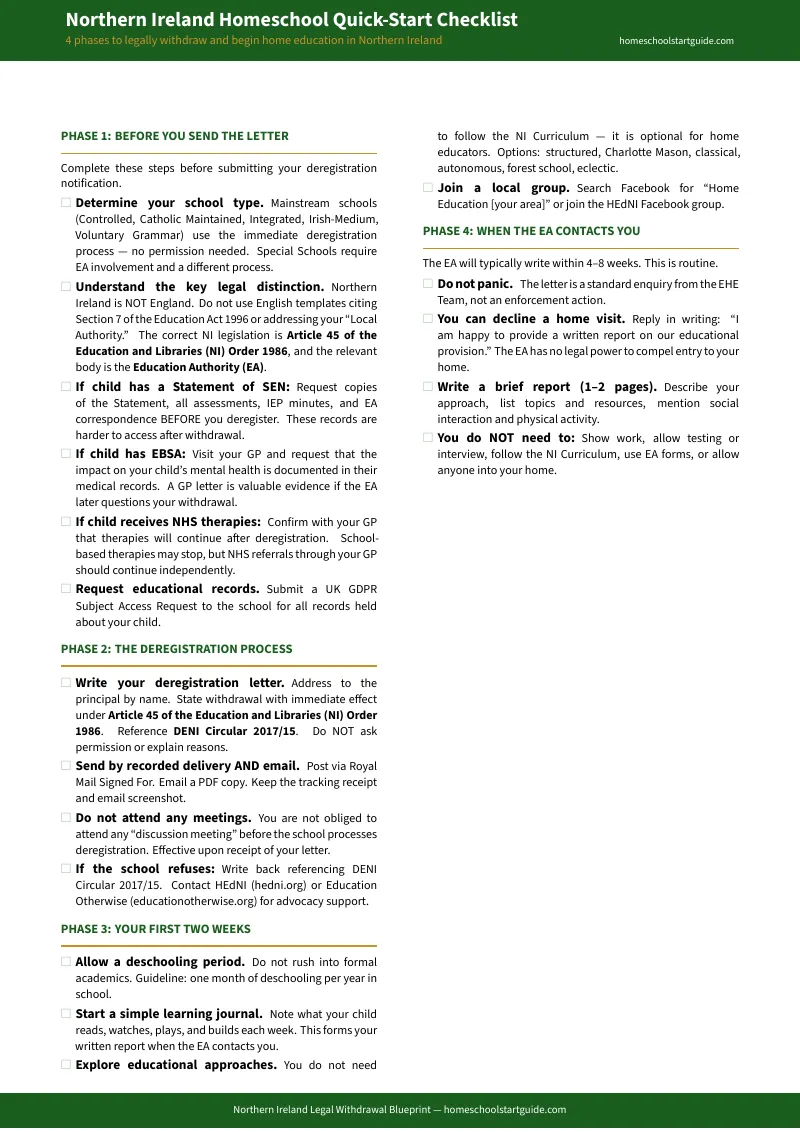
Your download includes the complete guide plus standalone printables ready to use immediately: guide.pdf (the full Northern Ireland Legal Withdrawal Blueprint — 18 chapters covering the complete legal framework, deregistration process for all school types, EA interactions, SEN pathways, qualifications, university access, and your first 30 days), checklist.pdf (the Northern Ireland Homeschool Quick-Start Checklist — a one-page action plan with the four phases from pre-letter preparation through handling EA contact), deregistration-letters.pdf (fill-in-the-blank templates for every school type), ea-response-scripts.pdf (word-for-word reply templates for EA enquiries), special-school-pathway.pdf (the four-step Special School process), sao-defence.pdf (School Attendance Order legal threshold and prevention), ccea-private-candidate.pdf (CCEA reality check and alternative qualifications), and first-30-days.pdf (week-by-week timeline after deregistration). Instant download, no account required.
30-day money-back guarantee. If the Blueprint doesn't give you the confidence and legal clarity to navigate the deregistration process, email us and we'll refund you. No questions asked.
Not ready for the full Blueprint? Download the free Northern Ireland Homeschool Quick-Start Checklist — a one-page overview of your legal right to home educate in Northern Ireland, the difference between mainstream and Special School deregistration, and the key statutory citations that must appear in your notification letter. It's enough to understand your rights, and it's free.
Your child doesn't have to go back. Northern Irish law protects your right to educate them at home — the Education Authority just hasn't told you that yet. The Deregistration System makes sure they can't pretend otherwise.