The EA Letter Arrived. You Have No Idea What They're Actually Allowed to Ask For.
Your child has been learning brilliantly at home — reading widely, building projects, exploring subjects that school never had time for. Then the letter arrives from the Education Authority. They want to "satisfy themselves" that the education you're providing is "efficient and suitable." It's phrased politely, but the implication is clear: prove it, or we escalate under Schedule 13.
You start searching. The HEdNI Facebook group tells you to send a written report — but no one provides a template for actually writing one. The EA's own guidelines are dense and written for officers, not parents. Education Otherwise covers England primarily. Etsy has hundreds of "homeschool portfolio templates" — but they use English terminology. Key Stages, GCSEs via AQA, SEN, Ofsted, National Curriculum. Submit that to an EHE officer in Belfast and you've just signalled that you don't understand the system your child is being educated under. Worse, you've used "EHCP" when Northern Ireland uses Statements of SEN. You've tracked "Science" when the NI Curriculum calls it "The World Around Us." Every wrong term invites deeper scrutiny.
The Northern Ireland Portfolio & Assessment Templates are built around a principle we call Structured Sufficiency: demonstrate exactly enough to satisfy the legal standard of "efficient full-time education" under Article 45 of the Education and Libraries (Northern Ireland) Order 1986 — in the exact language the EA's EHE officers use — without sharing a single thing more than required. Every template uses Northern Irish terminology, is structured around the NI Curriculum's Areas of Learning, and is designed to close EA enquiries in a single written exchange. Plus, it includes the two things no other guide covers: a CCEA modular progression tracker for private candidates and a complete UCAS pathway guide covering Queen's University Belfast, Ulster University, Student Finance NI, and cross-border CAO applications to universities in the Republic of Ireland.
What's Inside
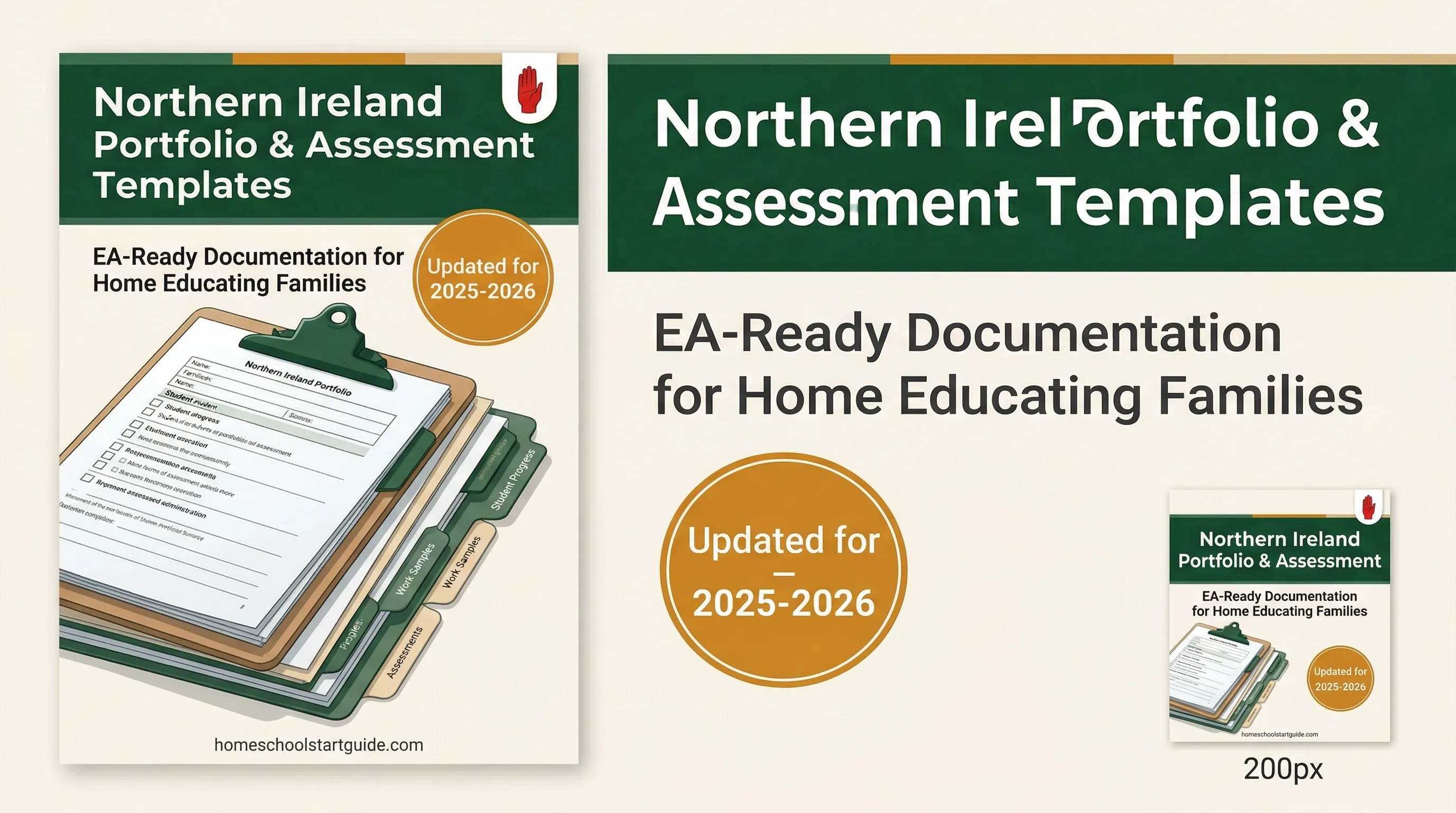
The Annual Education Report Template
The EA sends their informal enquiry. The HEdNI group tells you to send a written report — but what goes in it? The EA's own form is designed to extract maximum information, because they wrote it for their benefit, not yours. This template gives you the alternative: a structured report organised around the NI Curriculum's six Areas of Learning (Language and Literacy, Mathematics and Numeracy, The World Around Us, The Arts, Personal Development and Mutual Understanding, Physical Education) and the three Cross-Curricular Skills — using exact Northern Irish terminology — while deliberately avoiding rigid timetables or internal "grades" that have no legal standing. It's the document that satisfies the enquiry and ends the conversation.
The CCEA Modular Progression Tracker
A single CCEA GCSE costs £135 to £225 as a private candidate. Finding an exam centre willing to accept an external candidate is the hard part — schools are not obliged to take you. The tracker covers every variable: qualification level (GCSE, AS, A2), module accumulations for CCEA's modular structure, exam centre contact log, the English Language speaking component requirements, Essential Skills registrations, registration deadlines (entries for the May/June series close in February), and costs. Because one missed deadline or one rejected entry means your teenager loses an entire exam sitting.
The UCAS, Student Finance NI & CAO Pathway Guide
Northern Irish students access Student Finance NI — separate from England's SFE, Scotland's SAAS, and Wales's SFW. How do you write a UCAS personal statement without a school behind you? How do you provide predicted grades when there's no teacher to predict them? How do you satisfy Student Finance NI's evidence requirements? The guide covers the complete process for Queen's University Belfast, Ulster University, and the cross-border CAO route for applications to universities in the Republic of Ireland — including documentation for families with connections on both sides of the border.
The NI Curriculum Translation Matrix
Your child spent the morning building a fort in the Mourne Mountains, the afternoon reading about the Titanic, and the evening writing a story about Irish mythology. How do you translate that into the language an EHE officer expects? The matrix maps everyday learning activities — structured curriculum, Charlotte Mason nature study, unschooling, project-based learning — directly to the NI Curriculum's six Areas of Learning and three Cross-Curricular Skills. You focus on the education. The matrix handles the bureaucratic translation.
The Weekly Learning Log
The parents who panic when the EA letter arrives are the ones with learning happening everywhere but evidence organised nowhere. This simple weekly template captures what your child is actually doing — activities, resources, outings, and progress — without imposing a school-style timetable. Ten minutes per week, any educational philosophy, and it compounds into an archive that makes your next Annual Report a 20-minute exercise instead of a weekend of anxiety.
The SEN Documentation Framework
Northern Ireland uses Statements of SEN — not England's EHCPs or Wales's IDPs. The recent shift from Individual Education Plans (IEPs) to Personal Learning Plans (PLPs) under the SEND Act (NI) 2016 means most existing templates are already outdated. If your child has Special Educational Needs — autism, ADHD, dyslexia, sensory processing differences — this framework helps you maintain the rigorous records that demonstrate appropriate support using the current PLP format with Achievable, Relevant, and Time-limited (ART) targets, even without a Statement or school involvement.
Who This Is For
- Parents who received an Education Authority enquiry letter and need to respond with professional documentation that demonstrates "efficient education" under Article 45 of the 1986 Order without conceding more oversight than is legally required
- Parents of teenagers approaching CCEA GCSEs or A-Levels who need to navigate the private candidate system, track modular accumulations, manage February registration deadlines, and find a willing exam centre — all in one place
- Parents preparing a UCAS application for a home-educated child and realising they need predicted grades, a personal statement framework, Student Finance NI evidence, and CAO documentation for cross-border applications — none of which free resources provide together
- Newer home educators who want to establish a simple, sustainable documentation routine from the start — especially in the weeks after deregistration when the first EA enquiry is most likely to arrive
- Families who use any educational philosophy — from structured curricula to autonomous education — and need documentation templates that flex to their approach rather than forcing a school-at-home framework
- Parents of children with SEN who are documenting support and progress using the current PLP framework without a Statement or school involvement
- Families navigating Transfer Test documentation (AQE or GL Assessment) who want to keep the grammar school option open for their child
Why Not Just Use the Free Resources?
You can. HEdNI publishes exceptional legal guidance. The EA has its own EHE guidelines. Facebook groups have thousands of threads. Here's what happens when you try to assemble a portfolio strategy from free sources:
- HEdNI tells you what the law says — not what to write. Their FAQ explains that the EA can make informal enquiries and that a written report is sufficient. That's essential legal knowledge. But it leaves you staring at a blank Word document at 10pm trying to figure out how to structure a report that will satisfy the EHE officer reading it next week.
- The EA's guidelines are written for officers, not parents. They explain what the Authority should look for — "evidence of a broad and balanced education" — without showing you what that evidence should look like in practice. The guidelines create the anxiety; they don't resolve it.
- Facebook groups give you contradictory strategies. Veterans say "send the bare minimum — engaging with the EA beyond a brief letter is risky." Parents who've been through a School Attendance Order say "send everything and hope for the best." The real answer — a calibrated written report that demonstrates sufficiency without over-sharing — requires a template, not more opinions.
- Etsy templates are English. Over 95% of "homeschool portfolio templates" online use English terminology — Key Stages, GCSEs via AQA, SEN/SEND, EHCP, Ofsted, National Curriculum. Submitting that to an NI Education Authority officer signals that you don't understand the Northern Irish system. It actively undermines your credibility and invites further scrutiny.
- Charity memberships cover rights, not tools. Education Otherwise offers report checking and legal advice — but not fillable NI Curriculum-aligned portfolio templates, CCEA modular trackers, or Student Finance NI pathway guides. HEdNI provides superb peer support but not formatted, "done-for-you" documentation. Neither provides an integrated system for both.
- Nothing covers CCEA logistics and UCAS together. The single biggest gap is the combination of CCEA private candidate modular tracking and Northern Irish university admission pathways with Student Finance NI and cross-border CAO access. No free website, charity, or Facebook group provides editable tools for both — and these are the two highest-stakes administrative tasks in NI home education.
— Less Than One CCEA Exam Entry Fee
A single CCEA GCSE as a private candidate costs £135 to £225. An Education Otherwise membership costs more per year. And a School Attendance Order — triggered when the EA decides your documentation doesn't demonstrate suitable education under Schedule 13 of the 1986 Order — results in your child being legally compelled to attend a named school. That's the machinery this documentation is designed to prevent.
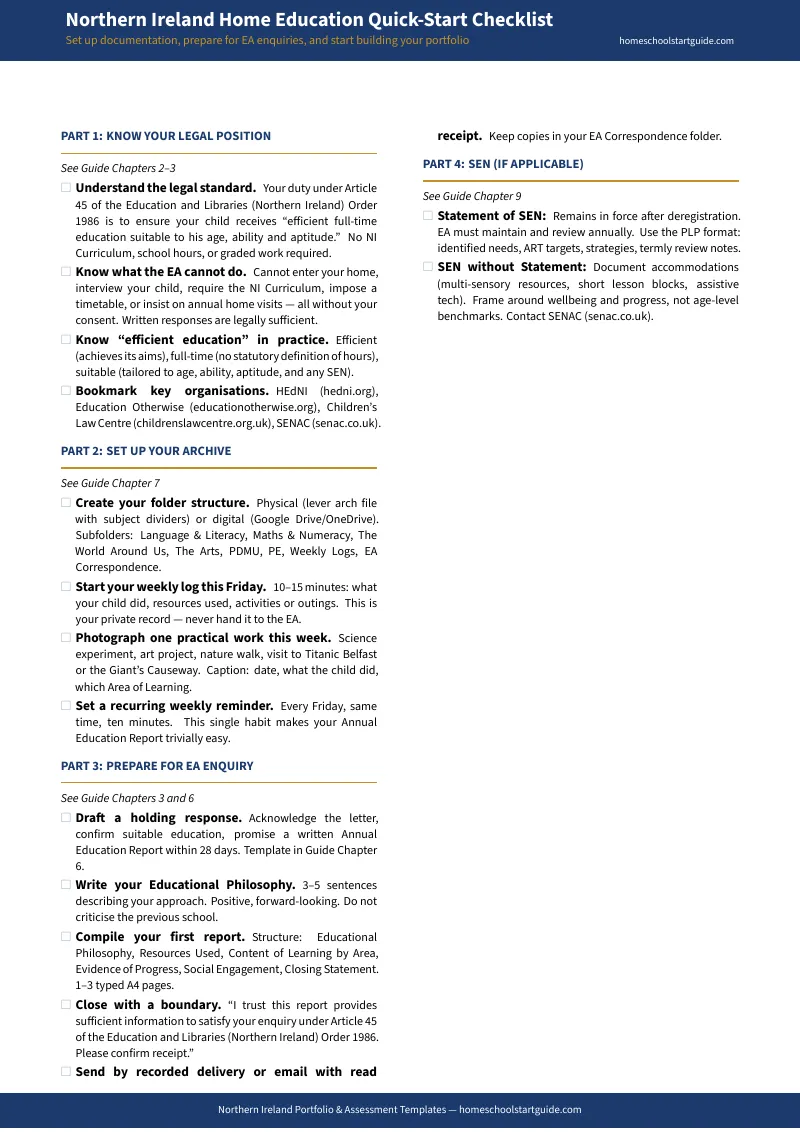
Your download includes the complete 19-chapter guide plus standalone fillable templates: the Annual Education Report, NI Curriculum Translation Matrix, CCEA Modular Progression Tracker, Weekly Learning Log, SEN Documentation Framework, and Annual Summary — each a separate PDF you can print and use independently. Plus the free Northern Ireland Homeschool Quick-Start Checklist — a one-page summary of your legal rights under the 1986 Order, the most common ultra vires EA demands, and the key documentation principle to include in any enquiry response. Instant download, no account required.
30-day money-back guarantee. If the templates don't give you the confidence and legal clarity to document your home education, email us and we'll refund you. No questions asked.
Not ready for the full toolkit? Download the free Northern Ireland Homeschool Quick-Start Checklist — a one-page overview of your legal right to home educate under Article 45 of the Education and Libraries (Northern Ireland) Order 1986, the things the EA cannot legally demand from you, and the key documentation principle that underpins every template in this guide. It's enough to understand your rights, and it's free.
Your child's education is already excellent. The only thing missing is the documentation that proves it — in the exact language your Education Authority expects. These templates make that effortless.