The Local Authority Wants Proof. Most Parents Don't Know What's Enough.
You've been home educating for months. Your child is thriving — reading voraciously, building projects, exploring subjects that school never touched. Then the letter arrives. The Local Authority wants to know what education you're providing. They've phrased it politely, but the implication is clear: prove it, or we escalate.
You start searching. Facebook groups tell you to send nothing — "the less the LA knows, the better." The council's own handbook expects a structured timetable, National Curriculum coverage, and work samples. Etsy has hundreds of "homeschool portfolio templates" — but they're all American, full of "Middle School Transcripts" and "GPA calculators" that don't exist in English law. Education Otherwise provides excellent legal defence, but no fillable templates for actually building the documentation. You're stuck between militant refusal and servile over-compliance, with no practical middle ground.
The England Portfolio & Assessment Templates are built around a principle we call Structured Sufficiency: demonstrate exactly enough to satisfy the law, in the exact language the law uses, without sharing a single thing more than required. Every template uses DfE terminology, is structured around the legal standard of "suitable education" under the Education Act 1996, and is designed to close LA enquiries firmly and professionally — not invite deeper scrutiny. Plus, it includes the two things no other guide covers: a complete GCSE private candidate logistics tracker and a UCAS Academic Reference framework for home-educated university applicants.
What's Inside
The Educational Provision Report Template
The LA sends an informal enquiry under s.436A. Facebook tells you to ignore it. The council's own form is designed to extract maximum information from you — because they wrote it for their benefit, not yours. This template gives you the third option: a fillable report structured around your educational philosophy, resources used, and progress demonstrated — using exact DfE terminology — while deliberately avoiding National Curriculum grids or internal "grades" that have no legal standing. It's the document that satisfies the enquiry and ends the conversation.
The GCSE Private Candidate Logistics Tracker
A single GCSE costs between £150 and £300 as a private candidate. Science subjects requiring Practical Endorsements and Art requiring portfolio authentication can exceed £400 per subject. Miss the mid-March entry deadline and you're paying 50-100% late fees — or a £150 punitive charge for very late entries in April. Five to eight GCSEs means dozens of moving deadlines across different exam boards, each with different NEA and coursework rules. The tracker covers every variable: exam board (AQA, Edexcel, OCR, CIE), specification code, NEA requirements, centre booking deadlines, JCQ authentication rules, and costs — because losing track of one deadline can cost you hundreds of pounds or an entire exam sitting.
The UCAS Academic Reference Framework
UCAS recently reformed the academic reference into a rigid three-section format. Section 1 demands "Establishment Details" — the context, demographic profile, and qualification portfolio of the educational setting. How do you write an objective, professional establishment description for home education without sounding like a parent defending their own child? The framework provides fillable boilerplate phrasing that translates home education pedagogies into the institutional language university admissions tutors expect — so your teenager's application reads like it came from a confident educational establishment, not an anxious family.
The CNIS Register Compliance Guide
The Children's Wellbeing and Schools Bill has introduced mandatory Children Not in School registers across every local authority in England. Even veteran "off-grid" home educators who've never engaged with the council are now formalising their record-keeping. The guide maps out exactly what data you must provide under the new register, what remains strictly optional, and how to respond to any LA request that overreaches the statutory boundary. Templates written before 2025 don't account for this. Yours will.
The Weekly Learning Log
The parents who panic when the LA letter arrives are the ones with learning happening everywhere but evidence organised nowhere. This simple weekly template captures what your child is actually doing — activities, resources, outings, and progress — without imposing a school-style timetable. Ten minutes per week, any pedagogy (structured, Charlotte Mason, classical, or fully autonomous), and it compounds into a portfolio that makes your next LA response a 20-minute exercise instead of a weekend of anxiety.
The Annual Summary Template
A one-page year-end overview that pulls together your child's learning across the year — subjects covered, key topics and resources, notable progress, achievements, social development, and plans for next year. Professional enough to send to an EHE officer; flexible enough to reflect home education rather than a school report card. Use it for your own records, for LA correspondence, or as the foundation for your Educational Provision Report.
Who This Is For
- Parents who received a Local Authority enquiry letter and need to respond with professional documentation that satisfies the law without conceding more oversight than is legally required
- Parents of teenagers approaching GCSEs who are navigating the complex logistics of private candidate registration, NEA coursework authentication, and exam centre bookings — and need every deadline tracked in one place
- Parents preparing a UCAS application for a home-educated child and realising they need to write an Academic Reference that sounds institutional, not parental
- Newer home educators who want to establish a simple, sustainable documentation routine from the start — especially with the new CNIS register making formal record-keeping more important than ever
- Families who use any pedagogy — from structured curricula to autonomous unschooling — and need documentation templates that flex to their approach rather than forcing a school-style framework
Why Not Just Use the Free Resources?
You can. The DfE publishes statutory guidance. Facebook groups have thousands of threads. Education Otherwise offers legal fact sheets. Here's what happens when you try to assemble a portfolio strategy from free sources:
- The DfE guidance tells you what the law permits — not what to write. It states there's "no specific legal requirement as to the content of home education." That's legally correct and practically useless when you're staring at a blank page trying to format something that will satisfy the EHE officer reading it on Tuesday. You need the execution, not the theory.
- Facebook groups give you contradictory strategies. Veterans say "send nothing — accepting visits is dangerous for all home educators." Parents who've been through a School Attendance Order say "send everything and pray." The Ombudsman found councils at fault 91% of the time — but that doesn't help you when you're the one getting the letter. You need the calibrated middle ground.
- LA forms are designed for the council's benefit, not yours. Your Local Authority probably sent you a "welcome pack" with forms. Those forms are engineered to extract maximum information from you. As one parent told a parliamentary committee: "Local authorities are exceptionally disingenuous in the information they provide." Using their forms means playing on their pitch.
- Etsy templates are American. Over 95% of "homeschool portfolio templates" online use US terminology — Middle School, Transcripts, Report Cards, GPA calculators. Submitting an Americanised report card to an English EHE officer signals that you don't understand the UK system. It actively undermines your credibility.
- Charity memberships cover rights, not tools. Education Otherwise provides excellent legal defence guidance and template refusal letters — but not fillable portfolio templates, GCSE logistics trackers, or UCAS reference frameworks. HEAS guidance packs cost more and are physical booklets, not digitally native fillable tools. Neither covers the new CNIS register requirements.
- Nothing covers GCSEs and UCAS together. The single biggest gap is the combination of GCSE private candidate logistics and UCAS reference formatting. No free website, charity, or Facebook group provides editable tracking tools for both — and these are the two highest-stakes administrative tasks in the entire home education journey.
— Less Than One Hour of Private Tutoring
A private tutor costs £25 to £50 per hour. A single GCSE as a private candidate costs £150 to £300. A HEAS guidance pack costs more than this entire toolkit. An Education Otherwise membership costs more per year. And a School Attendance Order — triggered when the LA decides your documentation doesn't demonstrate suitable education — results in fines, court proceedings, and months of stress that no amount of money can recover.
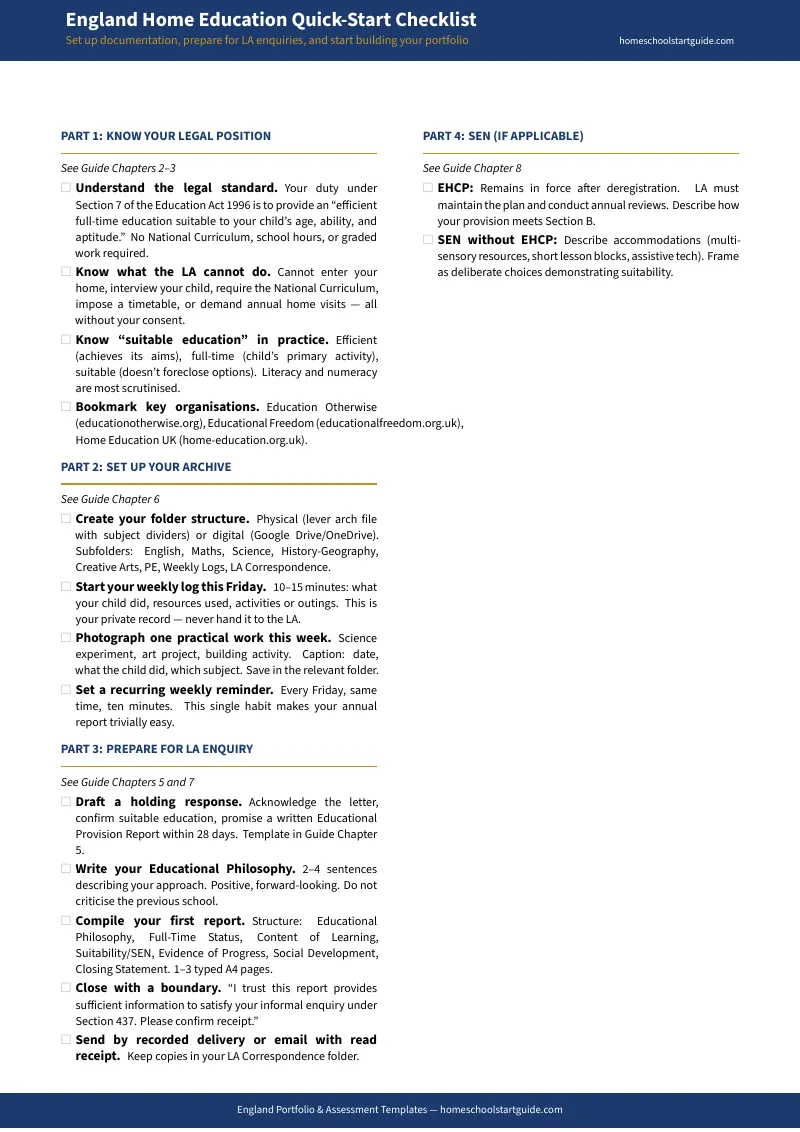
Your download includes the complete 65-page guide plus standalone fillable templates: the Educational Provision Report, GCSE Private Candidate Tracker, UCAS Reference Framework, Weekly Learning Log, and Annual Summary. Plus the free England Homeschool Quick-Start Checklist — a one-page summary of your legal rights, the most common illegal LA demands, and the single most important paragraph to include in any provision report. Seven PDFs, instant download, no account required.
Money-back guarantee, no time limit. If the templates don't give you the confidence and legal clarity to document your home education, email us and we'll refund you. No questions asked.
Not ready for the full toolkit? Download the free England Homeschool Quick-Start Checklist — a one-page overview of your legal right to home educate, the three things the LA cannot legally demand from you, and the key documentation principle that underpins every template in this guide. It's enough to understand your rights, and it's free.
Your child's education is already excellent. The only thing missing is the documentation that proves it — in the exact language the Local Authority expects. These templates make that effortless.
Frequently Asked Questions
What if the rules change after I buy?
We update the guide when the rules change. Email us any time, even years later, and we'll send you the current edition free.