You Want to Start a Learning Pod. Ofsted Wants to Shut Down Illegal Schools. Here's How to Do It Legally.
You've pulled your child out of school — or you're about to. Maybe the 20% VAT on private school fees made the numbers impossible. Maybe the state system failed your SEND child and you've been home educating alone for months, burning out. Maybe you've found three other families who feel the same way, and someone said "let's just pool our kids and hire a tutor." It sounds simple. It isn't.
Between January 2016 and March 2025, Ofsted opened over 1,500 investigations into suspected unregistered schools. They've secured 21 criminal convictions. The threshold for operating an illegal school is shockingly low: gather 5 children for more than 18 hours a week — or include just one child with an EHCP on a full-time basis — and you're on the wrong side of the law. The parents who get investigated aren't running dodgy operations in industrial units. They're well-meaning families who organised a learning pod in a village hall and didn't know the rules.
The England Micro-School & Pod Kit is your Ofsted-Proof Blueprint — the complete legal framework, operational templates, and step-by-step guidance to start and run a learning pod in England without crossing the line into unregistered school territory.
What's Inside the Ofsted-Proof Blueprint
The Legal Threshold Guide & Compliance Matrix
The line between a learning pod and an illegal school is shockingly easy to cross — and Ofsted doesn't care that you didn't know. This is the centrepiece of the kit: a clear, visual breakdown of the two rules that determine legality (the 18-hour weekly limit and the 5-pupil registration threshold), plus the "substance test" that most free advice ignores entirely. A pod running 15 hours a week can still be classified as full-time if those hours cover the core of a child's structured learning — Ofsted looks at what you're providing, not just the clock. This guide walks you through every variable so you know exactly where you stand before you open your doors.
The Pod Parent Agreement Template
Money and scheduling disagreements kill more pods than Ofsted does. This is a fill-in-the-blank contract for every family in your pod — covering financial contributions, tutor hiring arrangements, venue responsibilities, term dates, withdrawal notice periods, and dispute resolution. Sign it before the first session, not after the first crisis.
The UK Safeguarding Policy Template
The church hall won't give you a regular booking without one. The tutor you want to hire will ask for one. Other parents will want to see one before they commit their children. This is a ready-to-use policy covering DBS checks for any adults working with children, reporting procedures, online safety protocols, and the specific safeguarding requirements that venue managers demand before approving recurring educational bookings.
The Health & Safety Risk Assessment
Your insurance company will ask for it. The venue manager will ask for it. The next family considering joining your pod will ask for it. This is a practical, UK-compliant risk assessment designed for the spaces where pods actually meet: living rooms, gardens, rented halls, outdoor areas, and community centres. It covers fire safety, first aid provision, allergies, supervision ratios, and the specific hazards that need documenting. Complete it once, update it termly, keep it in your pod folder.
The SEND & EHCP Compliance Module
If any child in your pod has an Education, Health and Care Plan, everything you just read about the 5-pupil threshold no longer applies. The registration requirement drops to just one child attending full-time — and your informal pod is legally an unregistered school, even if only three children are enrolled. This module explains exactly how local authorities view EOTAS arrangements, how to structure a SEND-inclusive pod without triggering registration, and what documentation you need to demonstrate that the child's EHCP outcomes are being met outside the school system.
The Pod Budget Calculator & Cost-Sharing Framework
The first question every prospective family asks is "how much will this cost me?" — and if you can't answer clearly, they won't join. This spreadsheet models different pod sizes (3 families through to 8) and breaks down every shared cost: tutor fees, venue hire, materials, insurance, and administration. When five families share a qualified tutor at a village hall, the per-child cost is a fraction of private school fees — and this calculator proves it in black and white.
The Venue Booking & Insurance Guide
Your home insurance is almost certainly voided the moment you run regular educational sessions with other people's children on your property — and most parents don't discover this until they need to make a claim. This guide walks through the practical differences between meeting at home, renting a community hall, using a church space, or booking outdoor venues. It covers public liability insurance requirements, what your existing policies actually cover, and the specific questions venue managers will ask before approving a recurring educational booking.
Who This Kit Is For
- Parents who've been priced out of private school by the 2025 VAT increase and want to replicate small-class, high-quality education by pooling resources with other families — legally and affordably
- Home-educating parents who are exhausted from solo teaching and want to share the instructional load with 3-5 other families in a structured, sustainable pod arrangement
- Parents of SEND or EBSA children who need a small, low-arousal learning environment but are terrified of accidentally triggering an Ofsted investigation by including an EHCP child in a group setting
- Ex-teachers or qualified tutors who want to set up a small private teaching pod but need to understand the exact legal boundary between tutoring and operating an unregistered school
- Parents who've already started an informal co-op and realise they have no written agreements, no safeguarding policy, and no idea whether their current setup is technically legal
- Anyone forming a learning pod in England who wants the administrative foundation handled properly from day one — before the first disagreement about money, scheduling, or whose turn it is to host
After Using the Kit, You'll Be Able To
- Structure your pod's schedule and pupil numbers to stay within the legal threshold — with a clear, documented basis you can show to anyone who asks
- Have every family sign a binding parent agreement covering finances, responsibilities, and withdrawal terms before the first session
- Present a written safeguarding policy and risk assessment to any venue manager, tutor, or concerned local authority officer
- Include SEND children in your pod safely, understanding exactly when an EHCP changes the legal status of your arrangement
- Calculate the true per-family cost of your pod and demonstrate to prospective families exactly what they're paying for
- Book venues, arrange insurance, and hire tutors with confidence — knowing you've covered the administrative and legal requirements that most pod founders don't discover until it's too late
Why Not Just Use the Free Resources?
You can. Education Otherwise has excellent factsheets on the law. The DfE publishes statutory guidance on independent school registration. Facebook groups have thousands of threads from parents running co-ops. Here's what actually happens when you try to build a pod from free sources:
- Free resources tell you what the law is — not how to comply with it. Education Otherwise will explain the 18-hour rule and the 5-pupil threshold. They will not give you a parent agreement template, a safeguarding policy, or a cost-sharing spreadsheet. You'll know the rules and still have no operational documents to follow them.
- The DfE guidance is written for regulators, not parents. The statutory guidance on independent school registration runs to 50 pages of dense bureaucratese — and the critical details are scattered across three separate documents. The 5-pupil rule is in one. The EHCP exception is in another. The "substance test" for what counts as full-time education is in a third. Miss any one of them and your pod could be operating illegally without you knowing.
- Facebook advice is unverified and frequently dangerous. "My friend runs a pod with 8 kids four days a week and the council doesn't care" is not legal advice. It's a parent who hasn't been investigated yet. With Ofsted referrals reaching 330 per year — more than double the historical average — the enforcement net is tightening, and anecdotal reassurance will not protect you if your pod is flagged.
- The free templates are American and legally wrong for England. Parent agreement templates on Etsy and Pinterest overwhelmingly reference US state liability laws. Under the Unfair Contract Terms Act 1977, you cannot use a liability waiver to exclude negligence claims in England — something most American templates assume you can do. Using one doesn't just fail to protect you; it could leave you more exposed than having no agreement at all.
- Assembling it yourself takes weeks. A motivated parent can piece together the legal framework from government documents, draft their own agreements, and improvise a safeguarding policy from charity factsheets. It will take 30-40 hours and the result will still have gaps — especially since most free resources predate the 2025 VAT change and the recent surge in Ofsted enforcement. The kit gives you everything in one download, already adapted for English law and current for 2025/2026.
Free resources give you the rules. The Ofsted-Proof Blueprint gives you the documents to follow them — ready to fill in and use tonight.
— Less Than One Hour of Private Tutoring
A qualified private tutor in England charges upwards of £30 per hour. A family solicitor drafting a group agreement and safeguarding policy would bill hundreds. Private school fees — even before the 20% VAT — average over £15,000 per year. The kit costs less than a single tutoring session, and it gives you the legal framework, operational templates, and compliance guidance that would take a professional days to assemble from scratch.
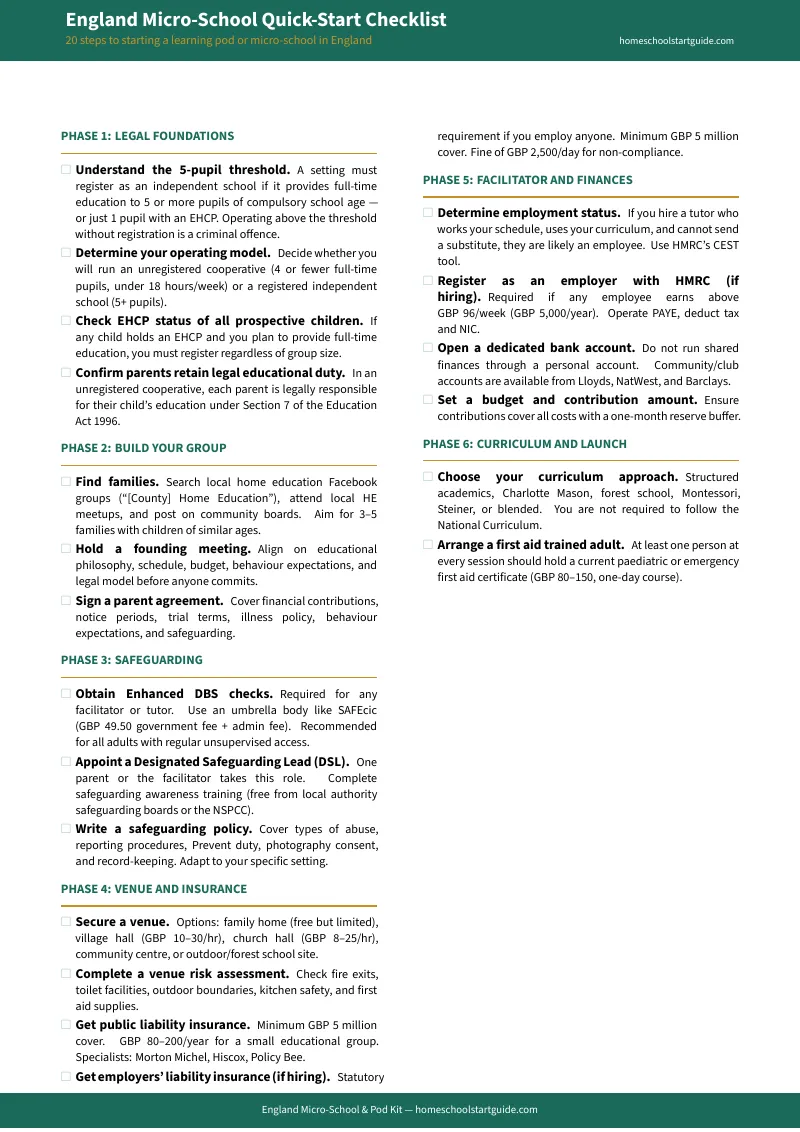
Your download includes 12 PDFs: the complete 87-page Pod Kit guide, plus 10 standalone printable templates — parent agreement, budget tracker, facilitator agreement, safeguarding policy, venue risk assessment, forest school risk assessment, legal threshold reference card, model decision matrix, tutor hiring checklist, and weekly timetable planner. Every template is a separate PDF you can fill in, print, and share without opening the main guide. Plus the England Homeschool Quick-Start Checklist — a one-page overview of your legal right to home educate, the key things your school cannot demand from you, and the first steps to take after deregistration. Instant download, no account required.
Money-back guarantee, no time limit. If the kit doesn't give you the confidence and legal clarity to launch your pod, email us and we'll refund you. No questions asked.
Not ready for the full Kit? Download the free England Homeschool Quick-Start Checklist — a one-page overview of your legal right to home educate, the Ofsted thresholds every pod founder needs to know, and the single most important question to answer before your first session. It's enough to understand the legal landscape, and it's free.
Your children deserve better than a system that failed them. English law gives you the right to build something better — the Ofsted-Proof Blueprint makes sure you do it properly.
Frequently Asked Questions
What if the rules change after I buy?
We update the guide when the rules change. Email us any time, even years later, and we'll send you the current edition free.