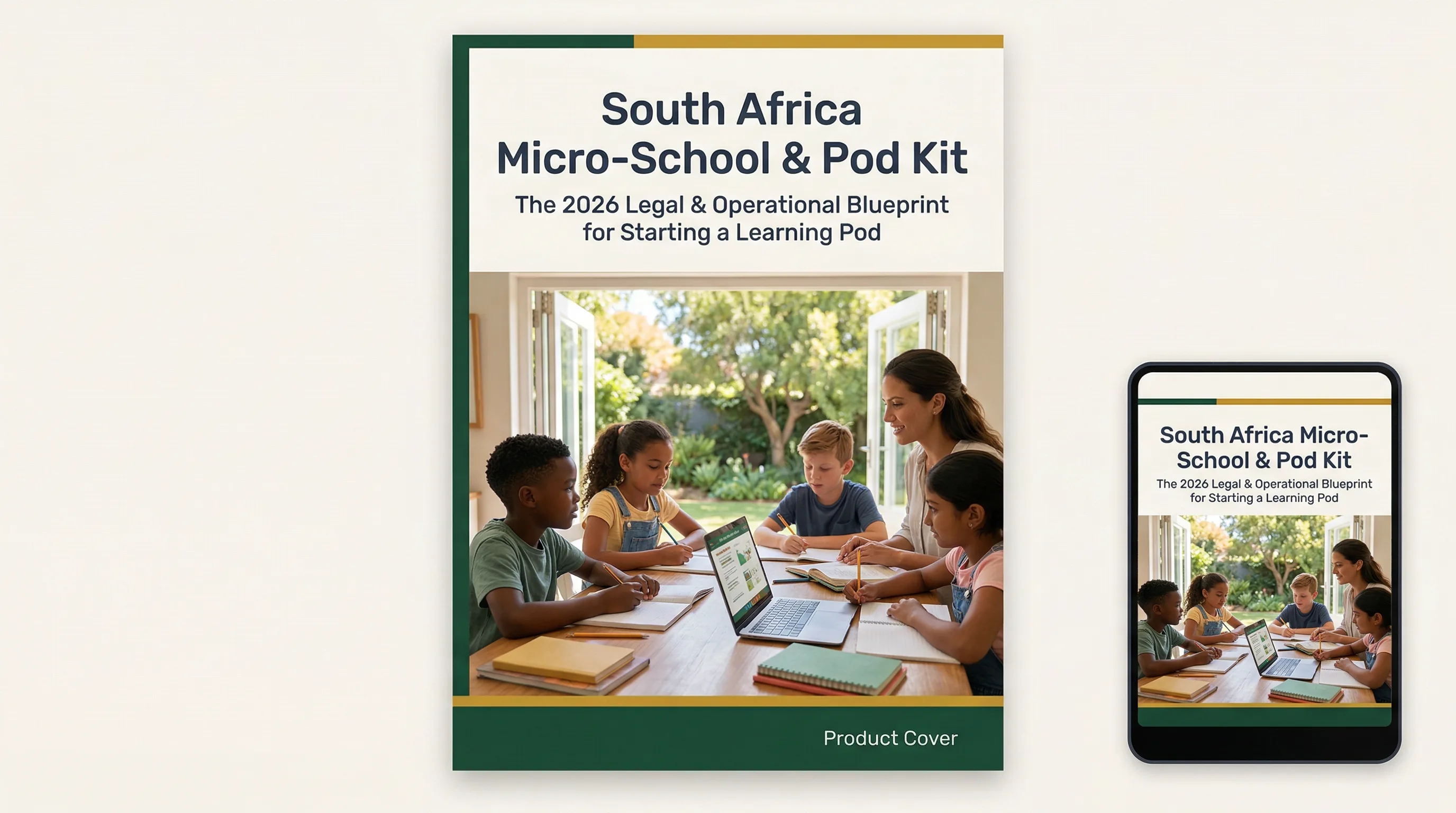
Build a Learning Pod That Gives Your Child What South African Schools Cannot.
The South Africa Micro-School & Pod Kit is the BELA-Proof Pod System — a legal-first operational framework for starting, running, and growing a learning pod or micro-school under the 2026 BELA Act. It starts where every other resource skips: the compliance structure. Registration pathway, criminal liability classification, municipal zoning, parent agreements — sorted before the first day of teaching. Then it builds everything else (budgets, facilitator hiring, curriculum selection, community recruitment) on top of a legal foundation that actually holds up. Built from South African law, not adapted from an American template. Built for the parent who has decided to build something better and needs to know exactly how to do it without ending up on the wrong side of the Schools Act.
Here is the reality that brought you to this page: South Africa's public schools are in structural collapse. 81% of Grade 4 learners cannot read for meaning in any language. The "real" matric pass rate — measured against the cohort that entered Grade 1 twelve years ago — is closer to 58% than the 88% the government reports. 74% of public schools have no library. 83% have no laboratory. And the private alternative? Mid-tier private school fees run R3,000 to R5,000 per month. Elite institutions exceed R20,000. Once you add uniforms, transport, levies, and the annual above-inflation fee increase, the total cost puts quality education firmly out of reach for most middle-class families.
So you start looking at alternatives. You find the Pestalozzi Trust — exceptional legal defence, but no operational templates. You find SA Homeschoolers — vast directories, but scattered across dozens of pages with no single narrative from concept to execution. You find Facebook groups oscillating between BELA Act panic and unregulated idealism. And then you find the BELA Act itself, which threatens up to 12 months imprisonment for operating an "illegal independent educational institution" — a classification that applies to your living room the moment you start teaching someone else's child without the right paperwork.
You are not looking for more opinions. You need the operational blueprint. The BELA-Proof Pod System is that blueprint — legal compliance first, then operations, then growth.
What's Inside the Kit
- The BELA-Proof Legal Pathway Flowchart — The BELA Act threatens up to 12 months imprisonment for operating an "illegal independent school," but the line between a home education co-op and an independent school is buried in cross-references between Section 51 of SASA and Section 46. This binary decision tree resolves it in fifteen minutes: your specific setup either qualifies as home education or requires independent school registration. That single classification determines your entire registration pathway, your tax treatment, your insurance obligations, and your criminal liability. Get it wrong and you are operating illegally. Get it right and you are protected by the Constitution.
- The "Pod Pre-Nup" Parent Agreement Templates — The number one reason learning pods collapse isn't curriculum disagreements or government interference — it's money, expectations, and exits. One family stops paying but expects the same access. Another wants out mid-term and demands their contribution back. A host family decides to sell. These templates cover fee-sharing formulas, facilitator salary contributions, dispute resolution protocols, withdrawal notice periods, behavioural codes, and division of shared assets if the pod dissolves. Written for SA law and Consumer Protection Act compliance. No attorney required. The documents that prevent a three-family friendship from becoming a three-family lawsuit.
- Municipal Zoning & Consent Use Checklist — The risk nobody on Facebook talks about. Operating a "Place of Instruction" on residential property triggers municipal by-laws in every South African metro — and your neighbour's complaint to the municipality doesn't require the BELA Act to shut you down. The checklist walks you through the Consent Use application process, the specific thresholds for student numbers before triggering full commercial rezoning, fire clearance, health inspections, and space-per-child ratios. Built from actual municipal frameworks including the City of Cape Town's overlay zoning rules.
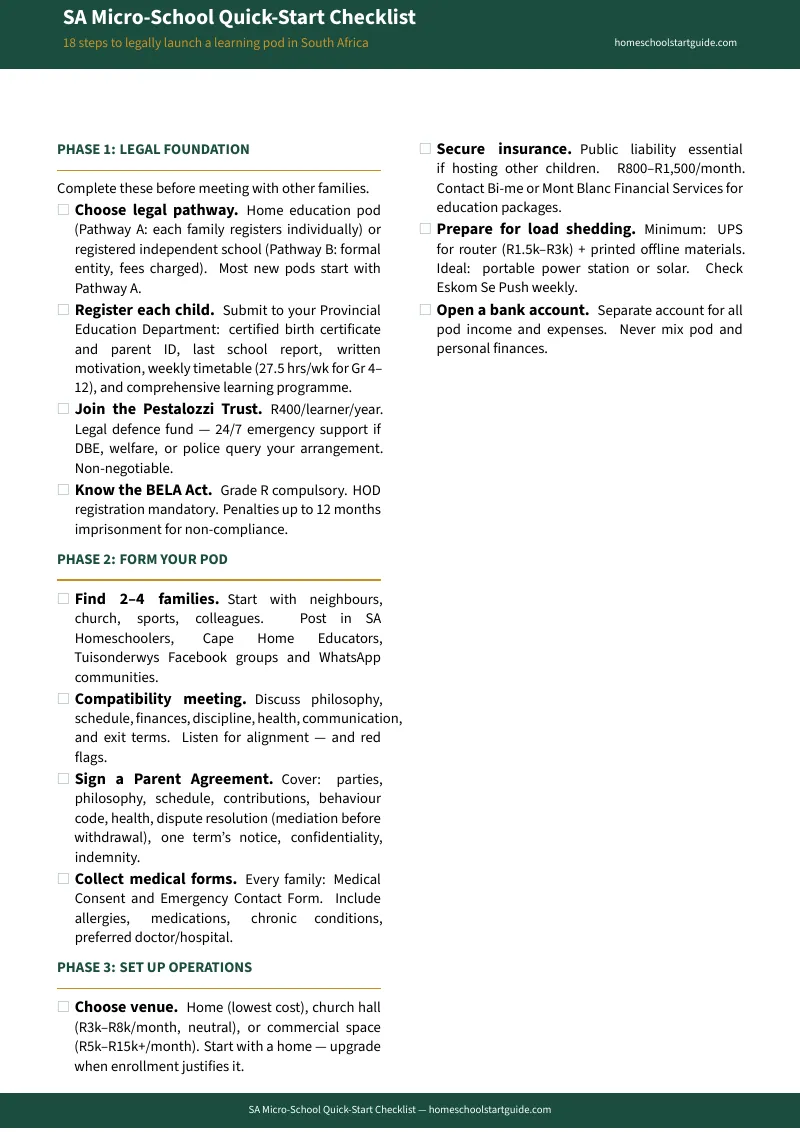
- Facilitator Hiring & SACE Compliance Guide — Most pod parents have never hired an educator, and in South Africa the process involves SACE registration, NQF Level 4 qualifications, a mandatory SAPS police clearance (R190 fee, six-month validity), and an employment structure that determines whether SARS treats you as an employer or a client. The guide covers recruitment, vetting, realistic salary benchmarks by region (R12,000 to R25,000 per month), the interview framework, reference check template, and employment contract clauses that protect both the pod and the facilitator.
- Budget Planning & Cost-Sharing Templates — "How much does a micro-school actually cost?" is the question every parent asks, and the answer from Facebook groups is always incomplete — they forget venue insurance, assessment body fees, load-shedding backup infrastructure, and the Pestalozzi Trust membership that experienced pod parents quietly recommend. The full financial model covers a 5-to-15 learner pod: facilitator salary, venue rental, insurance, curriculum licensing, utilities, and every hidden cost. Transparent per-learner breakdowns so every family knows exactly where their money goes, plus a 12-month cash flow projection and break-even analysis.
- Insurance & Liability Framework — Your homeowner's policy does not cover you when someone else's child gets hurt on your property during a scheduled learning activity. The kit explains Commercial School Insurance (Public Liability and Employers' Liability), why the Consumer Protection Act limits the effectiveness of indemnity clauses for minors, and the specific policy structure your pod needs. A child gets hurt in your garage-turned-classroom. You are either insured or you are personally liable. This section ensures you are insured.
- SARS Tax-Exemption & PBO Registration Guide — Most pods leave thousands of rands on the table because they don't know their micro-school can register as a Public Benefit Organisation. The guide covers PBO registration under Section 30 of the Income Tax Act, tax-exempt status on educational income under Section 10(1)(cA)(i), Section 18A tax-deductible receipts for donors, and the Section 6B disability rebate for parents of neurodivergent learners — a deduction most families don't know they qualify for.
- Curriculum Selection Matrix for Group Settings — Facebook groups will give you fifteen different opinions on which curriculum to use, and most of them are based on what worked for one family's solo homeschooling arrangement — not a multi-age, multi-family pod. This structured comparison evaluates CAPS, Cambridge International (IGCSE/AS/A Level), IEB, and eclectic approaches specifically for small-group instruction. Covers registration requirements, exit qualification pathways (NSC, Cambridge Foreign Conditional Exemption, GED via SAQA), online providers (CambriLearn, Impaq, Wingu Academy), and cost per learner per year. A decision framework, not a curriculum recommendation.
- The Pestalozzi Trust Integration — The Trust provides 24/7 emergency legal intervention if the DBE, welfare agencies, or police overreach — R400 per learner per year. But they're a legal defence fund, not an operational consultant. They protect your constitutional rights; they don't provide fee-sharing spreadsheets or municipal zoning checklists. The Kit handles the operational architecture. The Trust handles the constitutional artillery. You want both.
- Load-Shedding Contingency Planner — A micro-school without a Stage 4+ backup plan isn't a micro-school — it's a hope. This covers UPS systems for routers and workstations, solar PV and battery storage amortisation into parent levies, and scheduling frameworks that flex around load-shedding stages. Built for the reality that South Africa's grid is unreliable — not the hope that it will improve.
- Community Building & Marketing Playbook — The hardest part of starting a pod isn't the paperwork — it's finding three to five families who share your educational philosophy, financial expectations, and disciplinary approach. One misaligned family can fracture the group within weeks. The playbook covers recruitment from Facebook groups, WhatsApp networks, and community boards, plus the family vetting interview script, information session agenda, and philosophical alignment questionnaire that prevents catastrophic mismatches before money changes hands.
Who This Kit Is For
- Parents who are paying R3,000 to R15,000 per month in school fees and watching their child's educational quality decline every year — and who want to pool resources with three to five families for genuinely personalised education at a fraction of the cost
- Parents who have already withdrawn their child from school (or are about to) and need an immediate operational framework for a structured learning environment — not a solo homeschooling arrangement but a proper small-group pod with a facilitator, a schedule, and documented compliance
- Parents terrified of the BELA Act's criminal penalties who need the exact legal pathway to operate a micro-school lawfully — distinguishing between a home education co-op and an independent school, and ensuring every piece of paperwork is in order before the first day of teaching
- Parents of neurodivergent children (ADHD, autism, dyslexia) whose children are being failed by the rigid structures of mainstream classrooms and who need a low-arousal, flexible learning environment with accommodations that public schools cannot or will not provide
- Existing homeschooling families who are exhausted by the isolation of solo home education and want to share the facilitation, cost, and social burden with other families — without losing control of their child's learning
- Community leaders, church groups, or parent collectives who want to establish a registered, compliant micro-school serving 10-15 learners as a sustainable community resource — and who need the administrative architecture to do it professionally from day one
After Using the Kit, You'll Be Able To
- Determine in fifteen minutes whether your specific pod setup legally constitutes home education or an independent school — and follow the correct registration pathway for your classification, avoiding the criminal liability that traps thousands of unregistered cottage schools
- Hold your first parent planning meeting with signed agreements covering fees, dispute resolution, withdrawal, and behavioural expectations — before anyone's child walks through the door
- Navigate your municipality's Consent Use application process for operating a "Place of Instruction" on residential property — including the student number thresholds, fire clearance, and health inspection requirements specific to your metro
- Hire a SACE-registered facilitator with a valid SAPS clearance certificate and an employment contract that protects both the pod and the educator — at a salary that is realistic for your region and your budget
- Build a 12-month budget that every contributing family understands, with transparent per-learner cost breakdowns and a cash reserve strategy that absorbs the inevitable enrollment fluctuations
- Choose between CAPS, Cambridge, IEB, or eclectic curriculum approaches based on your learners' exit qualification needs — not based on which Facebook group shouts loudest
- Register your micro-school as a Public Benefit Organisation with SARS and apply for tax-exempt status — converting your pod from an informal arrangement into a professionally structured educational institution
- Sleep knowing that your micro-school is BELA-compliant, municipally authorised, properly insured, and legally defensible — because every document is in a folder, every agreement is signed, and every registration is filed
Why Not Just Use the Free Resources?
The Pestalozzi Trust provides unparalleled legal authority and will defend you in court. But they are a defensive organisation, not an operational incubator. They explain what not to do to avoid prosecution. They do not provide fee-sharing spreadsheets, parent agreements, municipal zoning checklists, or facilitator employment contracts. Their guidance is adversarial and legalistic — invaluable for constitutional defence, but it won't help you build a budget or hire a tutor.
SA Homeschoolers is a vast directory and community hub with hundreds of resources scattered across dozens of pages, FAQ sections, and external links. There is no singular, chronological narrative from "I want to start a pod" to "the first day of teaching." A parent must toggle between twenty different pages and still emerge without a single usable template.
The Department of Basic Education publishes registration guidelines that treat a five-student pod identically to a five-hundred-student academy. The bureaucratic forms are designed for institutional administrators, not parents starting a kitchen-table learning community. And provincial implementation varies wildly — some provinces haven't issued updated BELA Act guidance, while others process only 20% of registration applications within the mandated 60-day window.
Facebook and WhatsApp groups provide exceptional emotional support and secondhand textbook trading. They also circulate legally inaccurate advice, province-specific interpretations presented as universal law, and emotional reactions to the BELA Act that range from paralysed panic to reckless dismissal. Nobody in those groups mentions municipal zoning — and that's the risk that can shut you down without the BELA Act ever being involved.
Free resources give you fragments. The BELA-Proof Pod System assembles them into a single, step-by-step operational manual that assumes zero prior knowledge of education law, municipal zoning, or small-business administration.
— Less Than One Week of Private School Fees
Compare it to the alternatives:
- Mid-tier private school fees: R3,000-R5,000 per month, plus uniforms, transport, levies, and annual above-inflation increases
- A single hour of legal consultation with an educational compliance firm: more than this entire kit
- A Consent Use application submitted incorrectly, resulting in a municipal rejection and restart: months of delay and hundreds of rands in resubmission fees
- Operating an unregistered cottage school and facing prosecution under the BELA Act: up to 12 months imprisonment and a fine — the cost of getting the paperwork wrong is not a fee, it is a criminal record
For , you get the complete BELA-Proof Pod System — tested against the actual statutory requirements, not assembled from contradictory Facebook posts.
Money-back guarantee, no time limit. If the Kit does not give you the legal clarity and operational confidence to move forward with your micro-school, email us at [email protected] and we will refund in full. No questions asked.
This kit is an administrative, operational, and legal-reference resource for parents establishing learning pods and micro-schools. It is not legal advice. For active legal disputes with provincial departments or constitutional challenges, contact the Pestalozzi Trust. For questions about specific departmental requirements in your province, consult your Provincial Education Department directly.
The BELA Act changed everything. Schools are failing. Fees are climbing. But three families, one facilitator, and the right paperwork can build something extraordinary. Get the South Africa Micro-School & Pod Kit and stop waiting for a system that isn't coming to save your child.
Frequently Asked Questions
What if the rules change after I buy?
We update the guide when the rules change. Email us any time, even years later, and we'll send you the current edition free.