
The Compliance-First Blueprint: Launch Your Pennsylvania Learning Pod Without the Zoning Fines, DHS Investigations, or $2,199 Franchise Fees.
Pennsylvania requires every homeschooling family to file a notarized affidavit by August 1, submit an annual evaluator certification, and administer standardized testing at grades 3, 5, and 8. Each family in a micro-school must do this individually — the state does not recognize a "group homeschool." At the same time, DHS regulations under 55 Pa. Code cap in-home care of unrelated children at four to six — meaning a living room pod of eight kids technically triggers childcare licensing requirements. And local zoning ordinances can classify your educational gathering as a prohibited commercial activity in a residential zone.
You want to gather three to five neighborhood families, share the teaching load, and build something that actually fits your children. Maybe you're a Philadelphia parent whose child is languishing in a cyber charter staring at a screen six hours a day — and you want a hands-on environment where real learning happens. Maybe you're a solo homeschooler in Lancaster County drowning in evaluator reviews, testing logistics, and portfolio documentation for multiple children. Maybe you have a neurodivergent child who needs a calmer, sensory-aware setting with a 5:1 student-teacher ratio that no public school will provide. Maybe you're secular, and every established co-op in your area operates through CHAP with a statement of faith. Whatever the reason, you've arrived at the same conclusion: I need to build this myself.
The problem is that Pennsylvania has two distinct legal pathways — and the internet gives you fragments. The PDE defines Home Education Programs under 24 Pa. C.S. §13-1327.1 and Private Academic Schools under Act 170, but doesn't explain how five families gathering in a church classroom fits into either framework. CHAP provides convention resources and co-op directories but is geared toward traditional solo homeschoolers with a Christ-centered lens. Prenda charges $2,199 per student per year in platform fees. KaiPod Catalyst takes 10% of your revenue, capping at $10,000 annually. You need the operational playbook without the institutional overhead and without surrendering your tuition to a network.
The Pennsylvania Micro-School & Pod Kit — the Compliance-First Blueprint — is that operational framework.
What's Inside the Compliance-First Blueprint
The Two-Pathway Decision Framework
Because choosing the Private Academic School pathway when you should be operating under Home Education Program means requiring a certified principal, filing with PDE, and meeting the 180-day/900-hour instructional mandate — when your three-family pod could be running under individual affidavits with zero institutional oversight. Pennsylvania has two distinct legal pathways — Home Education Program (24 Pa. C.S. §13-1327.1, maximum autonomy, each family files individually) and Private Academic School (24 P.S. §13-1327, Act 170, formal school registration with PDE, certified principal required, institutional compliance). This section walks you through each with a plain-English decision tree so you choose the right structure for your pod's size, ambition, and regulatory tolerance.
The DHS and Zoning Compliance Guide
Because "can the state reclassify my living room as an unlicensed daycare?" is the question that stops most pod founders before their first meeting. Pennsylvania's 55 Pa. Code limits in-home care of unrelated children to four to six — and municipal zoning ordinances can prohibit commercial activity in residential zones. This is a detailed breakdown of how to structure your pod to legally avoid DHS childcare licensing and zoning violations — including the rotating-location strategy, the parent-present model, the church/community space solution, and the classification strategies that keep your educational gathering from being treated as a commercial daycare facility.
Family Agreement and Liability Waiver Templates
Because the most common reason pods collapse isn't bad curriculum — it's undefined expectations between adults about money, scheduling, and what happens when someone wants to leave mid-year. Customizable templates covering cost-sharing, curriculum authority, health policies, behavioral expectations, dispute resolution, and withdrawal terms. Written from scratch without religious language or ideological prerequisites. Every participating family signs before the first day.
EITC/OSTC Scholarship Funding Playbook
Because the difference between your families receiving thousands of dollars in state-funded scholarships and receiving nothing is understanding which legal structure qualifies — and most families don't find out until after they've chosen the wrong pathway. Pennsylvania's Educational Improvement Tax Credit (EITC) and Opportunity Scholarship Tax Credit (OSTC) programs fund scholarships for families earning under $116,055 (plus $20,428 per dependent). Special needs students can receive up to $15,000 per year. This section explains how to partner with approved Scholarship Organizations like Bridge Educational Foundation and ACSI Children's Tuition Fund to channel tax credit funding directly to your pod families — effectively subsidizing tuition.
Evaluator Coordination and Testing Logistics
Because coordinating annual evaluator reviews and standardized testing across five families — each with their own portfolio, their own testing schedule, and their own superintendent deadline — is the administrative nightmare that sinks micro-schools in their first year. This section covers how to find a pod-friendly evaluator (with a vetting script to screen out evaluators who illegally demand PSSA scores when CAT or Stanford 10 results are legally sufficient), how to schedule group testing sessions, and how to build a shared documentation system that makes portfolio preparation automatic instead of a scramble every July.
Facilitator Hiring and Background Check Guide
Because hiring someone to teach other people's children in Pennsylvania without running the correct background checks isn't just risky — it's a criminal liability. Pennsylvania requires Act 34 (criminal records), Act 151 (child abuse), and Act 168 (sexual misconduct/employer history) clearances for any non-parent adult working with children. This section covers exactly how to run the checks, what the disqualifying offenses are, how to classify facilitators correctly (W-2 vs. 1099 — misclassification carries IRS penalties), and real PA pay benchmarks so you can budget accurately.
Budget Planning and Cost-Sharing Frameworks
Because splitting costs "evenly" between a family with three kids and a family with one sounds fair until the first invoice arrives — and financial resentment is the second most common reason pods dissolve. Real Pennsylvania benchmarks for space rental ($200–$800/month for a church classroom), liability insurance ($500–$1,500/year for $1M CGL coverage), curriculum ($200–$600/student/year), and facilitator compensation ($35,000–$45,000/year full-time). Plus cost-sharing formulas for equal-split, per-child, and sliding-scale models — with worked examples showing how a 6-student pod achieves a 6:1 ratio at a fraction of private school tuition.
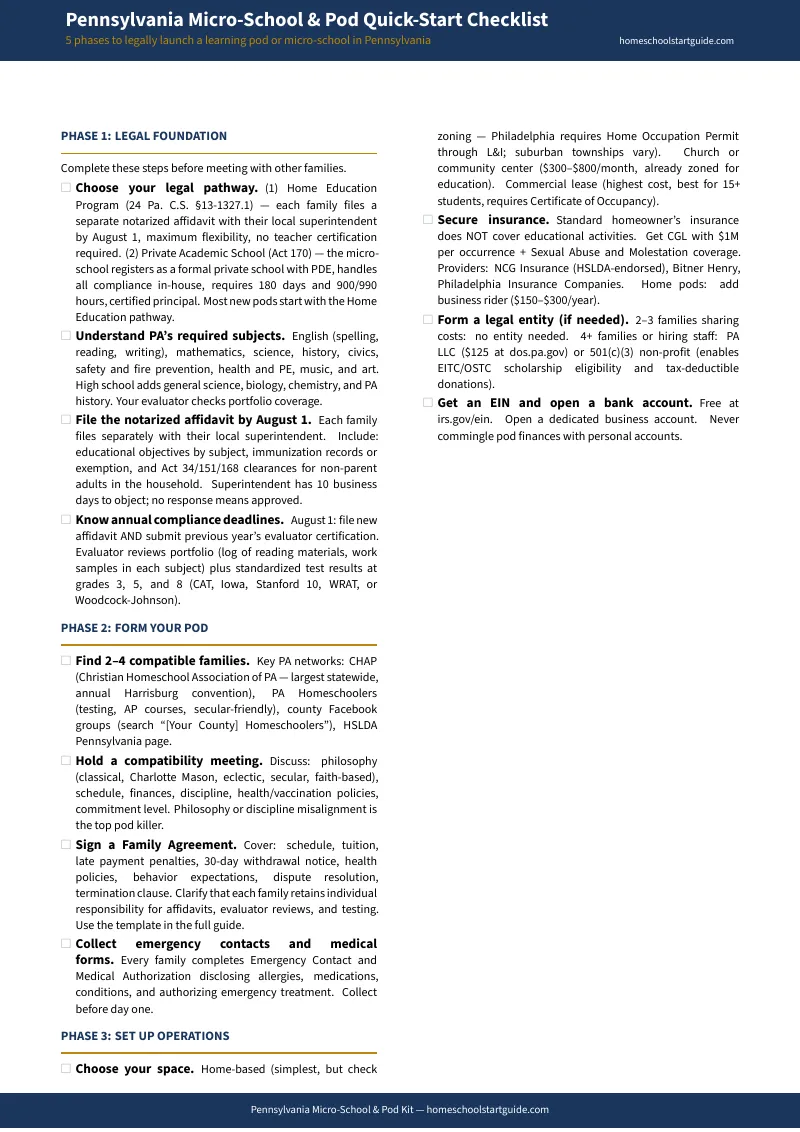
The PA Pod Launch Checklist
Because most parents spend forty-plus hours stitching together the launch sequence from the Pennsylvania School Code, PDE policy documents, CHAP directories, and scattered Facebook threads — and still aren't sure they got the order right. A single-page, print-and-pin document that walks you from "I have an idea" to "the first day of pod school" — covering legal foundation, pod formation, operations, curriculum, staffing, funding, and launch week in the correct sequence.
Who This Kit Is For
- Parents who want to form a small learning community of 3–8 students with two to four families — sharing the teaching load, splitting costs, and building something intentional rather than defaulting to institutions that can't serve their children
- Philadelphia, Pittsburgh, Lehigh Valley, Lancaster, and Harrisburg families priced out of private schools who want a high-quality 5:1 student-teacher ratio at a fraction of the $12,000–$18,000 annual private school tuition
- Current homeschoolers drowning in PA's evaluator reviews, testing logistics, and portfolio documentation who want to share that compliance burden with other families and a dedicated facilitator
- Secular or inclusive families who've been turned away from established co-ops that require CHAP statements of faith, and who need a legally sound framework for building a non-denominational pod
- Parents of neurodivergent children (autism, ADHD, dyslexia, twice-exceptional) who are exhausted by IEP advocacy and want a calmer, self-paced environment — with EITC/OSTC scholarship funding (up to $15,000/year for special needs) to support it
- Former educators who want to serve their community by running a small pod or micro-school — without the overhead and control of a Prenda, KaiPod, or Acton franchise
After Using the Kit, You'll Be Able To
- Choose the right legal pathway for your pod — Home Education Program for maximum autonomy or Private Academic School for formal state recognition — using the decision framework instead of guessing
- Structure your pod to legally avoid DHS childcare licensing triggers and municipal zoning violations — using the compliance strategies that keep your educational gathering classified as education, not commercial daycare
- Run your first parent meeting using a signed family agreement and liability waiver that protects every family in the pod — without spending $200+ on an education attorney consultation
- Navigate the EITC/OSTC scholarship process with the specific eligibility requirements, income thresholds, and Scholarship Organization partnerships for each program — so you make financial decisions based on accurate numbers
- Hire a facilitator with the correct Act 34/151/168 background checks, proper W-2 classification, and competitive PA pay benchmarks — avoiding the liability and IRS issues that sink underprepared pods
- Coordinate evaluator reviews and standardized testing across multiple families without the administrative chaos — using the evaluator vetting script, group testing logistics, and shared documentation system
- Build a budget that every family agrees on — using real Pennsylvania cost benchmarks and a cost-sharing formula that prevents resentment and financial surprises
Why Not Just Use the Free Resources?
The PDE defines the two legal pathways. CHAP provides co-op directories. Homeschool blogs explain the affidavit process. Here is exactly what you run into when you try to build a pod from those sources alone:
- PDE defines the pathways but provides zero guidance on pods. You learn that Home Education Programs require a notarized affidavit and that Private Academic Schools need a certified principal. You do not learn which pathway fits five families sharing a church classroom, a facilitator, and a budget. No family agreements, no budget templates, no decision tree.
- CHAP is built for traditional solo homeschoolers with a faith-based lens. Their convention and legislative tracking are excellent, but most listed co-ops require families to agree to a statement of faith. If you're secular, progressive, or non-Christian, you're functionally excluded — and there's no operational infrastructure for multi-family pods regardless.
- Generic Etsy templates are legally dangerous in Pennsylvania. A $12 "Learning Pod Agreement" from Etsy gives you a three-page waiver written for a different state — no PA-specific legal guidance, no DHS unrelated-children analysis, no Act 169 vs. Act 170 distinction, no evaluator coordination framework. Many Etsy kits don't even mention the August 1 affidavit deadline or the standardized testing requirement at grades 3, 5, and 8.
- Franchise networks withhold the operational details deliberately. Prenda, KaiPod, and Acton Academy webinars give you the vision. The granular how — the legal structuring, budget templates, scheduling frameworks — is what they sell for $2,199–$12,300 per student per year in platform fees and tuition.
- Facebook groups dispense conflicting and sometimes illegal advice. County-specific homeschool groups routinely mix up the two pathways, understate the DHS unrelated-children risk, and share outdated evaluator recommendations. Following bad advice costs you a zoning fine ($500+), a DHS investigation, or a year of unnecessary compliance theater.
Free resources give you the legal baseline and the inspiration. The Compliance-First Blueprint gives you the templates, checklists, and decision frameworks to execute this week.
— Less Than One Hour with an Education Attorney
A single consultation with a Pennsylvania education attorney costs $200–$400 per hour. Prenda charges $2,199 per student per year in platform fees. Acton Academy charges $12,000–$18,000 per year. KaiPod Catalyst takes 10% of your revenue for years, capping at $10,000 annually. The Kit costs less than a single attorney consultation and gives you the legal clarity, operational templates, and funding guidance those alternatives are designed to sell piecemeal.
Your download includes the complete 21-chapter guide, the Quick-Start Checklist, and standalone printable templates: a Parent Agreement, a Liability Waiver with emergency contact form, a Home Education Affidavit template, and a Facilitator Independent Contractor Agreement. Instant download, no account required.
30-day money-back guarantee. If the Kit doesn't give you the legal clarity and operational confidence to move forward with your pod, email us and we'll refund you. No questions asked.
Not ready for the full Kit? Download the free Pennsylvania Homeschool Quick-Start Checklist — a one-page summary of the two legal pathways, the DHS compliance strategies, and the key legal references that apply to your pod from day one. It's enough to understand your rights tonight.
Pennsylvania parents have the right to build this. The Compliance-First Blueprint makes sure you build it correctly — legally, financially, and operationally.