RSA 193-A Says "Maintain a Portfolio for Two Years." Your Participating Agency Says "Show Us Your Curriculum Plan, Daily Schedule, and Testing Results." One of Them Is Making Things Up.
You pulled your daughter from a Manchester elementary school after a year of anxiety-driven absences. Or you've been homeschooling in the Seacoast for three years and your June evaluation is approaching with a knot in your stomach. Or your son is entering tenth grade and you just discovered that UNH requires a parent-issued transcript, course descriptions, and graded writing samples — and you've been keeping a half-finished reading log and a box of loose worksheets. In every case, you've hit the same wall: New Hampshire's homeschool law is genuinely parent-friendly, but the paperwork everyone says you need doesn't match what the statute actually requires.
Here's the core problem. RSA 193-A requires you to file a one-time Notice of Intent, provide instruction in eleven subjects, conduct one annual evaluation using a method you choose from four options, and retain a portfolio for two years. That's it. No curriculum approval. No mandatory testing. No government review of your portfolio. But districts across New Hampshire — from Concord to Nashua to the Upper Valley — routinely send new homeschool families packets requesting curriculum plans, textbook lists, and detailed daily schedules. Ed 315 explicitly does not require any of this. The Dual-Track Compliance System inside this toolkit maps every piece of your documentation directly to what RSA 193-A and Ed 315 actually require — for both traditional homeschoolers and EFA families — so you never overshare, never underprepare, and never hand a sceptical superintendent ammunition he shouldn't have.
What's Inside the Toolkit
The RSA 193-A Subject Tracker
A tracking sheet with eleven pre-built columns — one for each subject the statute names: science, mathematics, language, government, history, reading, writing, spelling, US and NH constitutions, health, and art and music. Instead of guessing whether your nature walks count as "science" or your baking project covers "mathematics," the tracker gives you the exact statutory language and shows how to map any curriculum style — traditional, eclectic, Charlotte Mason, or unschooling — into the eleven required buckets. One sheet per child, per year. Fill it in as you go, and your compliance documentation is done before you realise you've been doing it.
The Grade-Band Portfolio Frameworks (K–2, 3–5, 6–8, 9–12)
A kindergartner's portfolio should not look like a high schooler's transcript. Each framework specifies exactly what evidence to collect at each developmental stage — the types of work samples, the number to save per subject (three per year is legally sufficient), and how to organise them so a certified teacher evaluator sees sustained progress without you saving every worksheet your child has ever touched. The K–2 framework is built for play-based and experiential learning. The 9–12 framework is built for college admissions officers at UNH, Keene State, and Plymouth State.
The Four Evaluation Methods Decision Guide
New Hampshire gives you four choices: portfolio review by a certified teacher, a national standardized test (Iowa, CAT, Stanford), the state assessment, or a mutually agreed-upon alternative method. Every family picks one per year — and every family agonises over which one. The decision guide walks through each method's preparation requirements, approximate costs, and which learner types each serves best. Test-anxious children thrive with portfolio review. Academic-track students aiming for UNH benefit from standardized test scores. The guide removes the paralysis.
The High School Transcript Template
Formatted specifically for UNH's admissions process and the NH university system — Keene State College, Plymouth State University, and Granite State College. Maps to New Hampshire's suggested 20-credit graduation standard: 4 English, 3 math, 2 science (including biology), 2 social studies, 0.5 civics (US/NH government), 0.5 economics, 1 arts, 0.5 health, 0.5 computer literacy, 0.5 physical education, and electives. Includes Carnegie Unit calculation (120 hours = 1 credit), GPA conversion, course description templates, and the self-certification of secondary school completion verbiage that FAFSA requires. Most Etsy transcript templates are designed for states with different credit structures. This one is designed for New Hampshire admissions offices.
The EFA Compliance Checklist
If you're on the Education Freedom Account program, your documentation requirements are fundamentally different from traditional homeschoolers under RSA 193-A. You must track every ClassWallet expenditure, maintain per-pupil invoices, and upload your Annual Record of Educational Attainment to the Children's Scholarship Fund portal by July 15 — or you lose your approximately $5,255 grant. The EFA checklist provides a month-by-month timeline, receipt organisation system, and the exact upload format the CSF portal expects. Traditional homeschool families can ignore this section entirely. That separation is the point.
The Evaluator Preparation Guide
Most New Hampshire families choose the certified teacher portfolio review for their annual evaluation. The evaluator preparation guide covers how to find and vet an evaluator (GSHE maintains the best list), what to present and what to withhold, how to organise your portfolio binder for maximum evaluator confidence in minimum review time, and what happens if the evaluation finds "inadequate progress" under RSA 193-A:6,II — including the remediation timeline and your rights during the process.
Who This Toolkit Is For
- First-year homeschool parents in New Hampshire who need a documentation system that maps directly to the eleven required subjects — not a generic Etsy planner designed for a different state's laws
- Parents approaching their annual evaluation who need to choose between the four methods and prepare with confidence — whether it's their first evaluation or their fifth
- Parents of high schoolers who need a transcript that UNH, Keene State, Plymouth State, or CCSNH will accept — formatted to New Hampshire's suggested 20-credit graduation standard, not a national template
- EFA families who need to keep their approximately $5,255 grant by meeting the July 15 Annual Record of Educational Attainment deadline — and who need their EFA documentation kept completely separate from their RSA 193-A portfolio
- Unschooling and eclectic families in the Seacoast or Upper Valley who need to translate experiential learning into the statutory language of RSA 193-A without compromising their educational philosophy
- Parents in Manchester, Nashua, Concord, or Portsmouth — districts where superintendent expectations vary and documentation demands sometimes exceed what the law requires
- Military families at Pease International Tradeport or families relocating to the Granite State who need NH-specific compliance before the next PCS cycle
- Secular families who need New Hampshire-specific guidance without the religious worldview that permeates some national organisations
Why Not Just Use NHHA's Free Resources?
You can. The New Hampshire Homeschooling Alliance has excellent legal summaries, portfolio advice, and evaluation guidance. Here's what actually happens when you try to build a portfolio system from free sources:
- NHHA tells you what to include but doesn't give you the forms. They explain that your portfolio should contain a reading log, subject summaries showing "concepts learned and skills mastered," and work samples. They recommend "one or two pages of work in each subject area, taken at three different times of the year." Excellent advice. But you still have to open a word processor and build every form yourself — the reading log, the subject summary sheet, the table of contents, the progress tracker. That formatting work takes hours most families don't have.
- GSHE curates evaluator lists and external links — but doesn't consolidate them. Need a transcript? GSHE sends you to a dozen national transcript generators, none of which map to NH's 20-credit standard or include the self-certification language FAFSA requires. Need an evaluation prep guide? They link to HSLDA, A2Z Homeschool, and several Facebook groups. The information is out there. It's scattered across fifteen different websites, and none of it is New Hampshire-specific.
- Etsy planners track metrics NH doesn't require. Generic homeschool planners include daily attendance logs, hourly instruction trackers, and detailed lesson planners. Ed 315.03 explicitly exempts home education from public school scheduling requirements. No 180-day minimum. No hourly logs. Tracking these wastes your time and sets a precedent that future evaluators might expect you to maintain.
- Subscription software charges $60–$120/year for features you don't need. Homeschool Tracker and My School Year micro-schedule daily assignments and calculate fractional grade points. None of them auto-generate an RSA 193-A compliant portfolio, separate EFA from traditional documentation, or format a transcript for UNH. You get a scheduling app, not a compliance tool.
— Less Than a Single Evaluator Session
A certified teacher evaluation costs $50–$150 per child. Homeschool Tracker costs $65/year. A single hour with an education attorney costs $250–$400. A panicked weekend assembling a portfolio from NHHA text descriptions, GSHE link lists, and Facebook advice costs you the weekend — and still leaves you guessing whether the evaluator will find it sufficient.
Your download includes the complete 14-chapter guide, the New Hampshire Homeschool Quick-Start Checklist, and five standalone printable templates: the RSA 193-A Subject Tracker, the High School Transcript Template (formatted for UNH and the NH university system), the Evaluation Method Decision Guide, the EFA Compliance Checklist, and the Evaluator Preparation Checklist. Seven documents total. Instant download, no account required.
30-day money-back guarantee. If the toolkit doesn't give you the documentation system and legal clarity to confidently manage your New Hampshire homeschool portfolio, email us and we'll refund you. No questions asked.
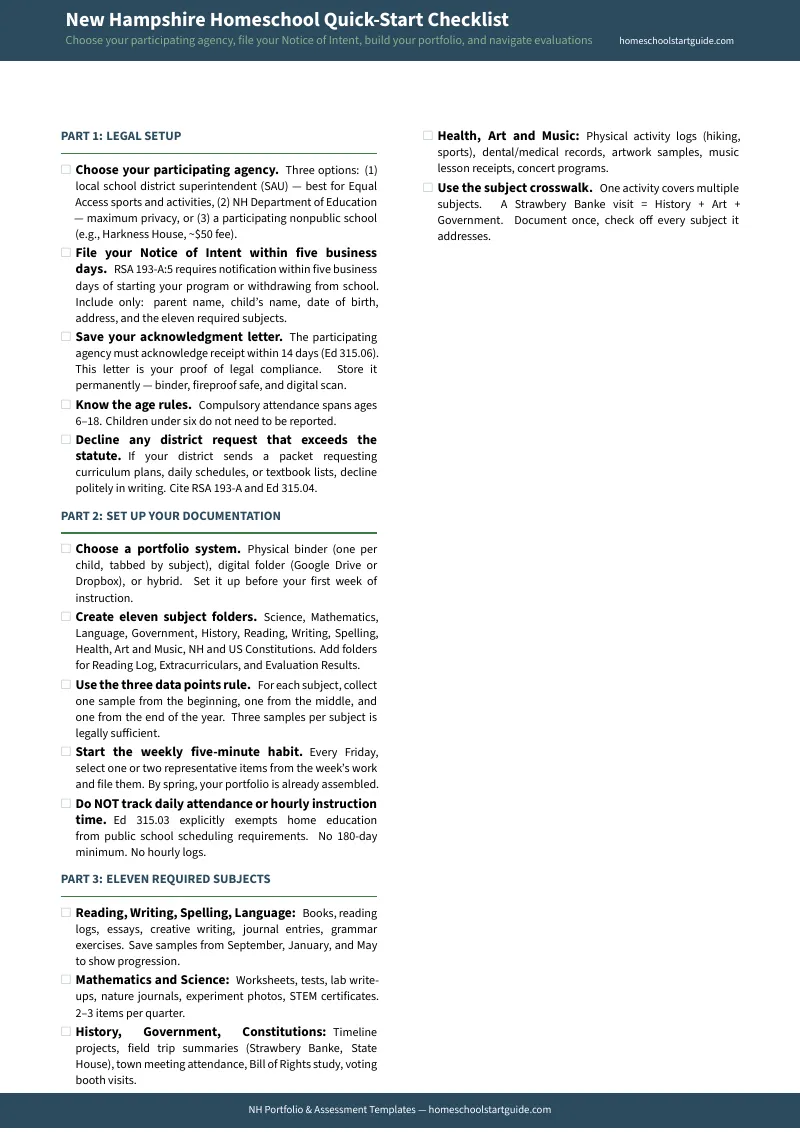
Not ready for the full toolkit? Download the free New Hampshire Homeschool Quick-Start Checklist — a one-page guide covering legal setup, the eleven required subjects, documentation basics, and your first-week action plan. It's enough to get started, and it's free.
New Hampshire gave you the right to educate your children at home under RSA 193-A. The law is on your side. Your documentation system should be too.