Your Child Spent a Month on the Land and the Annual Report Is Due in Three Weeks
You registered with Aurora Virtual School last year. You submitted your home education plan, agreed to annual reporting, and started documenting your child's learning. Since then, your family has tracked moose through the Takhini Valley, studied salmon spawning at Wolf Creek, built snow shelters during a two-week winter camp, and worked through a full year of mathematics. The education has been extraordinary — Northern, land-based, culturally grounded, and academically rigorous.
But the annual report is approaching and you have a phone full of unsorted photos, a half-finished binder, and no idea how to translate a month of land-based learning into the subject-area language that AVS expects to see. "Two weeks at fish camp" is deep, real education — but it does not look like Science, Social Studies, and Physical Education on paper. Not yet.
So you went looking for help. The Department of Education website has the Education Act and the AVS Home Education Guidelines but no portfolio templates, no sample annual reports, no guidance on what "adequate progress" actually looks like to your program coordinator. The BC curriculum website — which Yukon follows for learning outcomes — is a labyrinth of competencies and PLOs written for classroom teachers. HSLDA Canada has generic templates behind a membership paywall. Etsy has "homeschool portfolio planners" with American Common Core alignment and 180-day attendance trackers — products that do not know the Yukon has no attendance requirement, follows BC curriculum standards, and has a groundbreaking policy for accrediting First Nations Traditional Knowledge for high school credit. Generic BC templates ignore your $1,200 resource reimbursement, your AVS submission deadlines, and your cultural documentation obligations entirely. And cloud-based tracking apps assume reliable internet — not something you can count on in Dawson City or Old Crow.
The Yukon Portfolio & Assessment Templates is a Northern Documentation System — not a generic planner borrowed from the south. It gives you the BC Curriculum Translation Matrix that maps your child's learning to the prescribed learning outcomes AVS expects, First Nations Traditional Knowledge credit trackers aligned with the September 2024 accreditation policy, the $1,200 Resource Fund Expense Tracker that links purchases to your education plan, annual report frameworks calibrated for your AVS submission, and the 15-minute weekly documentation habit adapted for families with limited or no internet. You spend 15 minutes every Friday filing the week's work. When the annual report is due, you open your portfolio and the report writes itself.
What's Inside the Northern Documentation System
The BC Curriculum Translation Matrix
Yukon follows the BC curriculum for educational outcomes — but translating a week of trapping, a Charlotte Mason nature study, or a child-led science project into the "Know-Do-Understand" framework that AVS expects is an exhausting exercise. The BC Curriculum Translation Matrix is a ready-to-use reference that maps your child's daily learning activities to specific prescribed learning outcomes, core competencies, and subject areas. No cross-referencing ministry websites. No guessing which PLO a salmon-counting expedition satisfies. Print it, keep it in your binder, and stop spending Sunday nights decoding curriculum documents.
First Nations Traditional Knowledge Credit Tracker
The September 2024 Accreditation of Yukon First Nations Traditional Knowledge Policy formally recognises Elder-led teachings, language immersion, seasonal camps, and land-based learning for up to 12 elective credits toward the BC Dogwood Diploma. But earning those credits requires precise documentation — student identification, activity descriptions, accumulated hours at approximately 30 hours per credit, Knowledge Keeper signatures, and the exact statutory language for the "Notice of Completion." The credit tracker is a fillable framework that organises this documentation as it happens, so families are not scrambling to reconstruct three months of cultural learning the week before the submission deadline. No other portfolio tool in Canada has this tracker.
The $1,200 Resource Fund Expense Tracker
Yukon provides up to $1,200 per child in annual resource reimbursement through Aurora Virtual School — but only if expenses are properly correlated to the specific learning outcomes declared in your home education plan. Parents who cannot demonstrate alignment between their purchases and their plan risk denied claims or partial reimbursement. The Expense Tracker creates an auditable paper trail linking every resource purchase to the relevant subject area and learning outcome, ensuring frictionless reimbursement approval. You spent $14 on this documentation system. The tracker helps you claim up to $1,200.
Annual Report Frameworks
The year-end annual report is the moment your documentation matters most. AVS reviews it to determine whether your child has made adequate progress and whether your program approval should be renewed. The guide gives you pre-formatted frameworks with sample narrative language for each subject area. Not too sparse (which triggers requests for additional evidence) and not too detailed (which volunteers information you are not required to provide). "We spent a month at fish camp" becomes "Extended field-based inquiry into aquatic ecosystems, traditional harvesting methods, food preservation techniques, and Yukon First Nations land-based knowledge." You fill in the specifics. The structure and language are already done.
Grade-Banded Portfolio Frameworks — K Through 12
A kindergarten portfolio looks nothing like a Grade 10 portfolio. Early years evidence is observational and play-based — photo journals, narrations, art samples, and nature logs. Middle years introduce structured academic output and subject specialisation. Senior years require credit-level documentation, course descriptions, and transcript-ready records aligned with the BC Dogwood Diploma. Each developmental stage gets its own chapter with age-appropriate evidence checklists, sample organisation structures, and the minimum viable portfolio that satisfies AVS without burying you in paperwork.
The 15-Minute Weekly Documentation Habit
Every Friday: sort the week's evidence (2 minutes), select 1–2 pieces per subject (3 minutes), file with dates (3 minutes), photograph any hands-on projects (2 minutes), write a brief weekly log entry (5 minutes). This routine is designed for families with limited or no internet — everything works with a physical binder, a phone camera, and a pen. No cloud accounts, no app subscriptions, no bandwidth requirements. The habit keeps your portfolio in a permanent state of readiness.
High School Credits, Transcripts, and the Dogwood Diploma
This is where Yukon homeschool families hit a wall. The 80-credit BC Dogwood Diploma, challenge exams, and the reality that most post-secondary institutions have never seen a homeschool transcript from the territories. The guide covers credit tracking and accumulation pathways, transcript frameworks that universities recognise, Yukon University admissions, UBC and University of Alberta requirements, and the Yukon Grant and other territory-specific financial aid. Your child's Northern education opens every door — the transcript just needs to speak the language admissions officers understand.
The Annual Compliance Calendar
Every critical Yukon homeschool deadline on one page — May 15 returning student registration, September 15/30 plan submissions, resource reimbursement claim windows, and the year-end annual report. Plus a monthly documentation rhythm showing what to collect, file, and prepare each month so nothing arrives as a surprise.
Works Offline — Built for Northern Communities
Internet is unreliable in communities across the Yukon. Cloud-based portfolio tools fail when your bandwidth does. This entire system is a self-contained, offline-capable PDF designed to be printed, filled in by hand, and stored in a binder. It works in Whitehorse and it works in Old Crow. No internet required.
Who This Documentation System Is For
- Families registered with Aurora Virtual School who need a documentation system that satisfies the annual report without last-minute panic
- Parents doing land-based, cultural, and experiential education who need to translate activities into portfolio evidence that AVS accepts
- First Nations families documenting Traditional Knowledge, Elder teachings, and language revitalization for formal high school credit under the 2024 accreditation policy
- Parents who have been teaching effectively but documenting poorly — who need to assemble a credible portfolio from what they already have before the next annual report
- Parents of high schoolers navigating the BC Dogwood Diploma, credit accumulation, and post-secondary applications to Yukon University, UBC, and western Canadian universities
- Families in rural communities who need a documentation system that works without reliable internet — print-ready, binder-based, fully offline
- Military and transient families posted to the Yukon who need standardised documentation that transfers seamlessly when they move to another province
Why Not Just Use the AVS Guidelines and HSLDA Templates?
You can. The Department of Education website has the legislation and the AVS Home Education Guidelines. HSLDA Canada has generic templates. Here is what happens when you try to build a documentation system from free sources:
- The AVS guidelines give you the requirements, not the templates. The 21-page handbook exhaustively outlines what the Education Act requires. It tells you to submit an annual report demonstrating adequate progress. It does not give you a checklist for translating a trapping trip into a progress report. It does not show you what a coordinator-approved annual report actually looks like.
- HSLDA Canada gives you generic templates behind a paywall. Their high school transcript template is useful. Their planner pages are generic. Neither addresses BC curriculum alignment, the $1,200 resource reimbursement, or the First Nations Traditional Knowledge credit documentation that makes Yukon portfolios unique. You get legally informed but practically unsupported.
- BC templates are close but not right. Yukon follows the BC curriculum, but the bureaucracy is entirely different. BC templates are built for BC residents interacting with BC school districts. They do not account for Aurora Virtual School's submission process, the $1,200 resource reimbursement that has no BC equivalent, or the integration of First Nations cultural credits under the September 2024 policy. Using a BC template in the Yukon is an exercise in forcing a square peg into a round hole.
- Etsy templates are American. "School districts," "Common Core alignment," "180-day attendance requirements" — American terminology signals to your AVS coordinator that you do not understand Yukon requirements. The territory has no attendance mandate and a unique dual-curriculum framework. Using the wrong format invites follow-up questions that lead to closer scrutiny.
— Less Than a Single Textbook
A disorganised portfolio does not just cause stress — it risks AVS recommending a review or remediation of your program, which jeopardises both your homeschool approval and your $1,200 resource reimbursement. This documentation system costs a fraction of that funding — and it is the tool that ensures your portfolio is approved, your funding is secured, and your child's education is properly recognised.
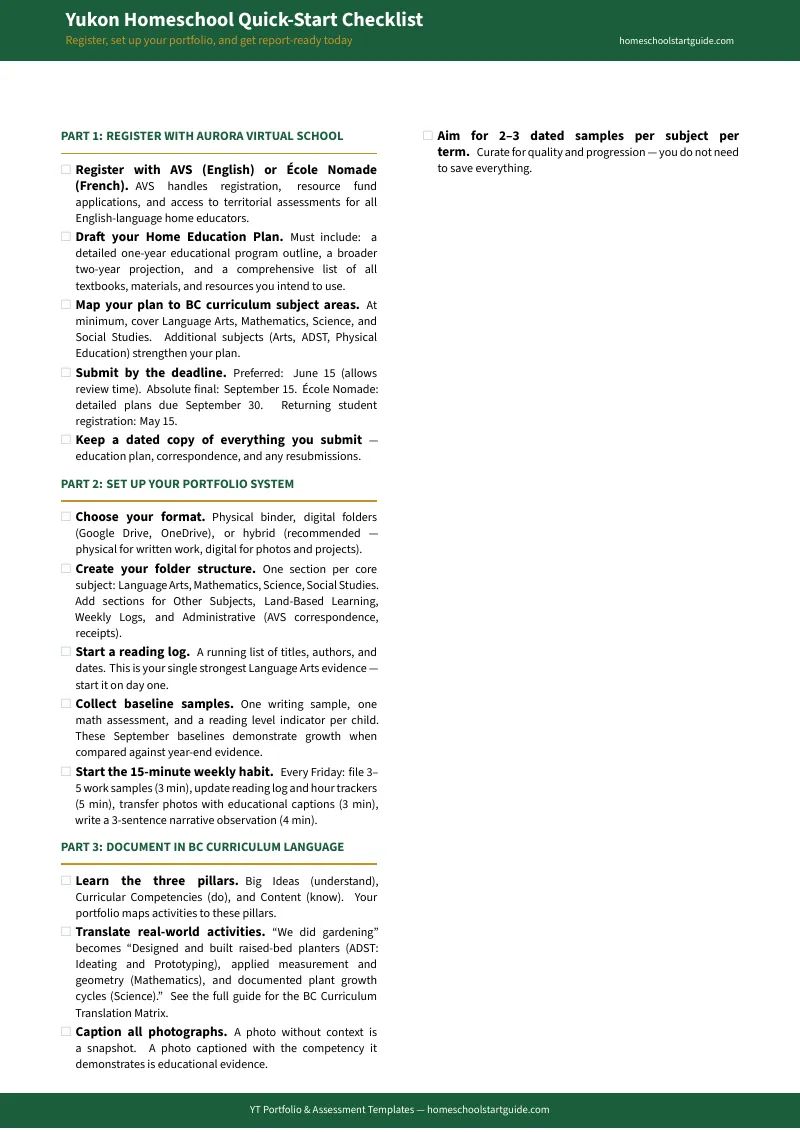
Your download includes the complete 14-chapter guide, the Yukon Homeschool Quick-Start Checklist, and standalone printable tools: the BC Curriculum Translation Matrix (prescribed learning outcomes mapped to everyday learning activities), the First Nations Traditional Knowledge Credit Tracker (aligned with the 2024 accreditation policy), the $1,200 Resource Fund Expense Tracker (purchases mapped to your education plan), a Weekly Documentation Log (print one per week for the 15-minute Friday habit), the Annual Compliance Calendar (every Yukon homeschool deadline on one page), and a fillable Transcript Template with credit tracking for the BC Dogwood Diploma. The guide covers the full Yukon regulatory framework, grade-banded portfolio strategies (K–3, 4–6, 7–9, 10–12), documenting diverse educational philosophies, First Nations cultural credits, high school transcripts and diploma requirements, Yukon University and western Canadian university admissions, and the 2025/2026 curriculum alignment.
30-day money-back guarantee. If the documentation system does not give you the confidence and structure to handle your next annual report, email us and we will refund you. No questions asked.
Not ready for the full system? Download the free Yukon Homeschool Quick-Start Checklist — a step-by-step overview of registering with Aurora Virtual School, setting up your portfolio, and preparing for the annual report. It is enough to get oriented, and it is free.
The Department gives you a 21-page handbook written for bureaucrats. HSLDA gives you generic templates behind a membership. This documentation system gives you the exact tools to translate Northern learning into AVS-approved portfolios — in fifteen minutes a week, from kindergarten through university.