Your School Division Just Requested Work Samples and Your Portfolio Is a Stack of Undated Workbooks on the Kitchen Table
You registered with your local school division in September. You submitted your Written Educational Plan with three broad annual goals per subject, just like the regulations require. You've been teaching — read-alouds, nature walks, math at the kitchen table, science experiments in the garden. Your child is learning more than they ever did in a classroom of thirty.
But you haven't been documenting. Not the way the division wants. Your liaison needs a periodic log, summative records, and evidence of progress against your WEP goals. You have a phone full of photos with no dates, workbooks with no labels, and a reading list that exists only in your memory. The June 15 progress report deadline is approaching and you're not sure what to submit — or whether what you submit will be enough to keep your funding.
So you went looking for help. SHBE has free forms, but they're blank administrative boxes with no guidance on what to put in them. The Ministry's policy manual is 80 pages of regulatory language. Etsy has "homeschool portfolio templates" that reference Common Core standards and school districts — American products dressed up for a Canadian search result. Facebook groups gave you fifty opinions about Charlotte Mason narration versus unit studies when all you needed was "what does my school division actually want to see?"
The Saskatchewan Portfolio & Assessment Templates is a division-ready documentation system — not a generic planner with a maple leaf on the cover. It gives you WEP templates with pre-written broad annual goal exemplars across all four required subject areas, portfolio frameworks for every grade band from Kindergarten through Grade 12, periodic log and summative record templates that give your division exactly what the Regulations 2015 require, and progress report frameworks pre-formatted for Regina Public Schools, Saskatoon Public Schools, Prairie Spirit, and other Saskatchewan divisions. You spend 15 minutes every Friday filing the week's work. When reporting season arrives, you open your portfolio and it's already done.
What's Inside the Documentation System
WEP Templates with Broad Annual Goal Exemplars
The Regulations 2015 require a minimum of three broad annual goals in each of four subject areas — Language Arts, Mathematics, Science, and Social Studies. "Broad" is the operative word, but nobody tells you how broad is broad enough. Too specific and you've accidentally committed to a rigid curriculum you can't deviate from. Too vague and your division sends it back for revision. The guide includes fillable WEP templates with pre-written goal exemplars for every grade band — competency-based goals that satisfy your division without over-committing your year, plus philosophy-specific examples for Charlotte Mason, classical, unschooling, and eclectic approaches.
Grade-Banded Portfolio Frameworks — K Through 12
A Kindergarten portfolio looks nothing like a Grade 10 portfolio. Early years evidence is observational and play-based — narrations, photos of block constructions, nature journal entries. Junior high introduces structured academic output and subject specialisation. High school requires credit-level documentation, course descriptions, and transcript-ready records. Each grade band gets its own chapter with age-appropriate evidence checklists, sample organisation structures, and the minimum viable portfolio that satisfies division reviews without burying you in paperwork you don't need.
The 15-Minute Weekly Filing Routine
Every Friday: sort the week's work (2 minutes), file 1–2 pieces per subject (8 minutes), write a brief documentation log entry (5 minutes). That's it. This single habit — built around the guide's weekly documentation log template — keeps your portfolio in a permanent state of readiness. No more May panic. No more reconstructing a semester from memory the night before the June 15 deadline.
Periodic Log and Summative Record Templates
The Regulations 2015 give you a choice for your annual progress report: standardised test results or a portfolio of work. Most Saskatchewan families choose the portfolio route — which requires a periodic log and either a detailed summative record or sufficient samples of work. The templates give your division exactly what the regulation specifies. If your division requests excessive physical samples beyond what the regulation requires, the guide includes the exact regulatory citations and a response template so you can push back with confidence.
Division-Specific Progress Report Frameworks
Regina Public Schools expects different formatting than Saskatoon Public Schools. Prairie Spirit's requirements differ from North East School Division. Living Sky operates differently from Prairie South. The guide includes pre-formatted progress report frameworks for the major Saskatchewan divisions, plus a generic framework that works with any registering authority. Copy the structure, fill in your child's work, and submit a report that matches exactly what your division's liaison expects to see.
Documenting Every Philosophy
Charlotte Mason families narrate, not test. Unschoolers document emergent learning, not lesson plans. Classical families track the Trivium. Eclectic families mix everything. The guide shows how to translate each philosophy into portfolio evidence that satisfies Saskatchewan's regulatory framework — so your school division sees "progress against broad annual goals" regardless of whether your child wrote an essay, built a catapult, or spent the afternoon at Wanuskewin Heritage Park.
High School Credits, Transcripts, and the University Bridge
This is where most Saskatchewan homeschool families hit a wall. The guide covers three post-secondary pathways: Saskatchewan Distance Learning Centre course enrolment for official credits, departmental exam registration for challenge credits, and the portfolio-and-transcript route for alternative admission. Includes a four-year transcript template, course description templates, and university-specific admissions requirements for University of Saskatchewan (home-based school transcript + educational portfolio + SAT/ACT), University of Regina, and Saskatchewan Polytechnic (ACCUPLACER pathway). Your child's homeschool education doesn't close doors — it opens them, with the right documentation.
Annual Compliance Calendar
Every deadline, every deliverable, every season. Division registration deadlines (September 15 for most, August 15 for Prairie South). WEP submission windows. Funding disbursement dates. The June 15 progress report deadline. Saskatchewan Distance Learning Centre enrolment dates. University application timelines. One calendar view so nothing catches you off guard.
Who This Documentation System Is For
- Families registered with their local school division who need division-ready documentation that satisfies annual reporting requirements and protects their $800–$1,000 per student funding allocation
- Parents who have been teaching but not documenting — who need to assemble a credible portfolio from what they already have before the June 15 progress report deadline
- Parents whose school division has requested work samples or pushed back on their Written Educational Plan — who need to know exactly what the regulation requires and what is beyond the division's authority to demand
- Parents of high schoolers who need transcripts, course descriptions, and a post-secondary pathway — and who don't know where to start with Saskatchewan Distance Learning Centre credits, departmental exams, or university-specific portfolio requirements
- Military families posted to 15 Wing Moose Jaw or CFB Dundurn who need to set up Saskatchewan-specific documentation quickly during a relocation — without months of learning the local terminology
- Parents using Charlotte Mason, unschooling, classical, or eclectic approaches who need to translate their philosophy into evidence that Saskatchewan school divisions understand and accept
Why Not Just Use the Free SHBE Templates?
You can. SHBE has free forms for the Notice of Intent, Written Educational Plan, and Annual Progress Report. Your school division posts its own administrative procedures. Here's what happens when you try to build a documentation system from free sources:
- SHBE templates give you the boxes, not the answers. Their WEP form has a field for "broad annual goals" — but no examples of what a compliant broad annual goal actually looks like. You stare at a blank page wondering if "My child will develop reading comprehension skills" is too vague or "My child will read 20 chapter books and write book reports" is too specific. The result is three hours of anxious drafting that should have taken twenty minutes.
- Division forms are designed to protect the division, not you. Your school division's administrative procedures are structured for the division's internal audit requirements. They're designed to make the liaison's report easier to write — not to help you document efficiently. The result is you doing more work than the regulation requires.
- Etsy templates are American. "School districts," "Common Core alignment," "180-day attendance requirements" — if your documentation uses American terminology, it signals to your division that you don't understand Saskatchewan's framework. That invites exactly the kind of questions and scrutiny the regulation doesn't entitle them to ask.
- Facebook groups amplify anxiety. For every parent who answers your WEP question accurately, three more will tell you their division requires things it legally doesn't. What worked for a family in the Prairie Spirit division might trigger a pushback in the Regina Catholic division. When you can't distinguish between Regulations 2015 requirements and division culture, crowdsourcing your compliance strategy is a gamble with your funding.
— Less Than 2% of Your Annual Funding Grant
A single annual progress report that doesn't demonstrate adequate progress can put your $800–$1,000 per student funding under review. A missing transcript when your child applies to U of S means scrambling to build years of documentation in weeks. An SHBE membership is $35/year. An hour with an education consultant runs $150–$300. This documentation system costs a fraction of any of those — and under most divisions' funding rules, it qualifies as a reimbursable instructional resource against your annual allocation.
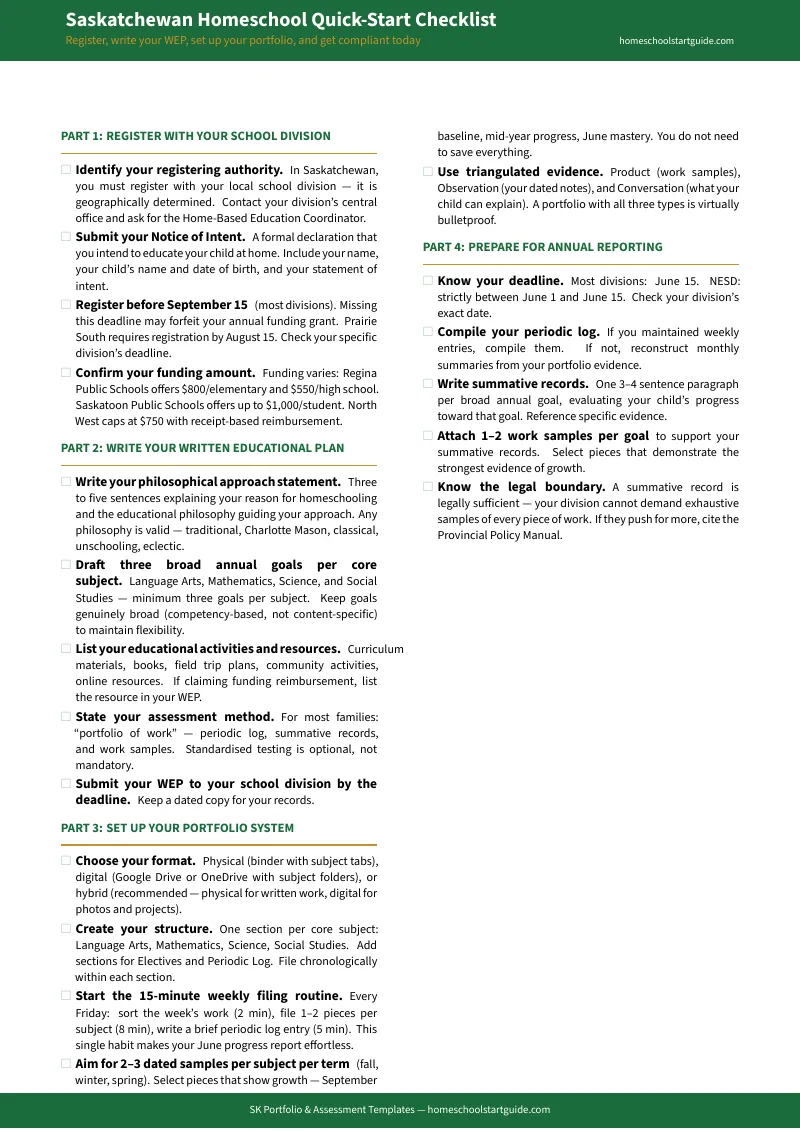
Your download includes the complete 15-chapter guide plus standalone printable tools: the WEP Templates (with broad annual goal exemplars for every grade band), Grade-Banded Portfolio Frameworks (K–3, 4–6, 7–9, 10–12 evidence checklists), Periodic Log & Summative Record Templates, Division-Specific Reporting Frameworks (Regina Public, Saskatoon Public, Prairie Spirit, North East, and generic), Parent-Generated Transcript Template (four-year fillable with Saskatchewan course naming and credit tracking), University Admissions Portfolios (U of S, U of R, Saskatchewan Polytechnic), Annual Compliance Calendar (every deadline on two printable pages), and the Saskatchewan Homeschool Quick-Start Checklist.
30-day money-back guarantee. If the documentation system doesn't give you the confidence and structure to ace your next division review, email us and we'll refund you. No questions asked.
Not ready for the full system? Download the free Saskatchewan Homeschool Quick-Start Checklist — a step-by-step overview of registering with your division, writing your WEP, setting up your portfolio, and preparing for annual reporting. It's enough to get oriented, and it's free.
Saskatchewan's documentation requirements aren't complicated — they're just poorly explained. The Documentation System turns your annual progress report from something you dread into something you finish in 15 minutes.