Your Evaluation Is in Eight Weeks and Your Portfolio Is a Phone Full of Undated Photos and a Stack of Worksheets with No QEP Labels
You registered with the DEM because the law requires it. You submitted your Learning Project in September. You've been teaching — field trips, read-alouds, science experiments, math lessons at the kitchen table, nature walks through Parc-Nature du Bois-de-Liesse. Your child is learning more than they ever did in a classroom of thirty-two.
But you haven't been documenting. Not the way the DEM wants. Your resource person needs traces of learning organised by QEP subject area, evidence of progress against cross-curricular competencies, and enough material to demonstrate your child's development across all five broad areas of learning. You have a phone full of photos with no dates, workbooks with no competency labels, and a reading list that exists only in your memory. The June 15 deadline is approaching and you need to assemble a Completion Report with an attached portfolio — not a scrapbook, not a Pinterest board, a compliant portfolio that speaks the MEQ's language.
So you went looking for help. The MEQ website gave you a sterile, intimidating fillable PDF that reads like a tax audit form. AQED's templates are deliberately blank — legally protective but functionally useless when you're staring at empty boxes at 11 pm wondering how to describe baking cookies in QEP Mathematics language. School board templates ask for more than the law requires, creating extra work that benefits their administration, not your family. Etsy has "homeschool portfolio templates" that reference Common Core standards and school districts — American products dressed up for a Canadian search result. Facebook groups gave you fifty conflicting opinions when all you needed was "what does my evaluator actually want to see?"
The Quebec Portfolio & Assessment Templates is a QEP Compliance Documentation System — not a generic planner with a fleur-de-lis on the cover. It gives you QEP-aligned portfolio templates mapped to all five broad areas of learning and all four cross-curricular competency domains, traces-of-learning layouts formatted to the DEM's "3 traces per subject" norm, phrasing banks that translate your everyday teaching into the exact bureaucratic language evaluators expect, and bilingual documentation frameworks for anglophone families navigating francophone evaluators. You spend 15 minutes every Friday filing the week's work. When June 15 arrives, you open your portfolio and it's already done.
What's Inside the QEP Compliance Documentation System
The QEP Translation Bank — Your Everyday Teaching in Bureaucratic Language
Your child spent Tuesday baking cookies and measuring ingredients. Thursday was a nature walk identifying local birds. Saturday was three hours of Minecraft. The DEM wants to see "Uses mathematical reasoning" and "Interacts with the natural world" and "Exercises critical judgement." The QEP Translation Bank provides pre-written phrasing that maps everyday homeschool activities to the specific QEP competencies and subject-area outcomes your evaluator expects. Stop rewriting your teaching to fit the QEP. Use the bank to translate what you already do into the language the government demands.
Traces of Learning Layouts — The 3-Trace Format That Satisfies Evaluators
The DEM's unofficial standard is three traces of learning per compulsory subject — one educational intent statement explaining what the child was learning, plus three pieces of evidence (photos, work samples, project documentation). The portfolio templates provide this exact layout, subject by subject, with annotation prompts so every trace connects back to QEP competencies. No over-reporting. No under-reporting. The exact amount that gets your portfolio approved without triggering requests for "more detail."
Cycle-Specific Templates — Elementary Through Secondary 5
A Cycle 1 portfolio for a six-year-old looks nothing like a Secondary 4 academic dossier. Elementary evidence is observational and activity-based — photographs, narrations, simple project outputs. Secondary documentation shifts to credit-level academic work, formal assignments, and exam preparation records. Each cycle gets its own chapter with age-appropriate evidence checklists, sample organisation structures, and the minimum viable portfolio for that stage.
The 15-Minute Weekly Documentation Habit
Every Friday: sort the week's work (2 minutes), file 1–2 traces per subject (8 minutes), write a brief annotation in the documentation log (5 minutes). That's it. This single habit — built around the guide's weekly documentation log template — keeps your portfolio in a permanent state of submission readiness. No more May panic. No more reconstructing a semester from memory the night before the June 15 deadline.
Bilingual Documentation Frameworks
If you're an anglophone family teaching in English, your DEM evaluator likely works in French. The bilingual frameworks provide portfolio section headings and competency labels in French — so your evaluator sees the professional, compliant structure they expect — with English instructions and annotation prompts for you. Your portfolio speaks the evaluator's language without forcing you to write in a language you're not confident in.
Annual Evaluation Preparation
Quebec offers five evaluation pathways: portfolio evaluation by the DEM, evaluation by the school service centre, evaluation by a private institution, evaluation by a licensed teacher, and ministerial examinations. The guide walks through each pathway with what-to-bring checklists, what evaluators actually look for (vs. what the regulation technically requires), and what to do if you receive an unfavourable evaluation. Your evaluator is one person with one set of expectations — this guide tells you exactly how to meet them.
DES Credit Tracker and CEGEP/University Admissions
This is where most Quebec homeschool families hit a wall. The guide covers the 54-credit DES requirement, mandatory ministerial exams for Secondary 4 and 5, registration through your school service centre, and how to build a post-secondary application that gets accepted. Includes institution-specific admissions requirements for SRAM/SRACQ, McGill, Concordia, Dawson College, Université de Montréal, Laval, UQAM, and Sherbrooke. Your child's homeschool education doesn't close doors — it opens them, with the right documentation.
Annual Compliance Calendar
Every deadline, every deliverable, every season. The July 1 notice of intent. The September 30 learning project. The mid-year status report window. Ministerial exam dates and registration deadlines. The June 15 completion report. CEGEP application timelines. One calendar view so nothing catches you off guard.
Who This Documentation System Is For
- Parents whose June 15 deadline is approaching and who have been teaching but not documenting — who need to assemble a compliant portfolio from what they already have, fast
- Parents who received a difficult evaluation or pushback from their resource person — who need a portfolio structure that satisfies the DEM's expectations without over-reporting
- Anglophone families in Montreal, Gatineau, or the Eastern Townships navigating francophone evaluators — who need bilingual documentation that bridges the language gap
- Parents of secondary students who need DES credit tracking, ministerial exam preparation, and a CEGEP/university admissions strategy — and who don't know where to start
- Unschooling, Charlotte Mason, classical, and eclectic families who need to translate their educational philosophy into QEP-compliant evidence — without changing how they actually teach
- New homeschool families who just withdrew their child and have 30 days to submit a Learning Project — who need a documentation system that works from day one
Why Not Just Use the Free MEQ Templates?
You can. The MEQ provides fillable PDFs. AQED offers member resources. School boards publish modalities documents. Here's what happens when you try to build a documentation system from free sources:
- MEQ templates are designed for the government's convenience, not yours. The DEM's fillable PDFs provide blank boxes and legal codes. They tell you what to submit but give you zero guidance on how to write it. You're left staring at an empty "Traces d'apprentissage" field at 11 pm wondering what language to use.
- AQED's templates are deliberately minimalist. AQED's legal strategy is to share the absolute minimum with the government — which is legally smart but leaves anxious parents without the phrasing banks and how-to examples they need to actually fill in the blanks. AQED protects your rights. This guide helps you actually do the work.
- School board templates ask for more than the law requires. LBPSB, EMSB, WQSB, and CQSB each publish their own guidelines. These routinely blur the line between what the DEM legally requires and what the board wants for its own administrative convenience — creating extra work and unnecessary scrutiny for your family.
- Etsy templates are American. "School districts," "Common Core alignment," "180-day attendance requirements" — if your portfolio uses American terminology, it immediately flags you as inexperienced and invites exactly the kind of follow-up questions you're trying to avoid.
- Facebook groups amplify conflicting advice. For every parent who answers your portfolio question accurately, three more will share outdated pre-2019 strategies that can get you flagged. When you can't distinguish between what the regulation requires and what someone's lenient evaluator accepted, crowdsourcing your compliance strategy is a gamble with your child's educational autonomy.
— Less Than an Hour with a Private Education Consultant
A portfolio evaluation from School Success Academy costs $250 CAD — and they don't even help you build the portfolio. An AQED membership runs $115–$150/year. An hour with a private education consultant is $150–$300. A failed evaluation triggers remediation, increased monitoring, and months of stress. This documentation system costs a fraction of any of those options — and it's yours to reuse every year, for every child.
Your download includes the complete 16-chapter guide plus standalone printable tools: the QEP Translation Bank (activity-to-competency phrasing for all five broad areas), Traces of Learning Layouts (subject-by-subject 3-trace portfolio pages), Cycle-Specific Portfolio Templates (Cycle 1–3 elementary and Secondary 1–5), Learning Project Templates (fillable QEP-aligned projet d'apprentissage), Status Report Frameworks (mid-year and completion report templates), Evaluation Preparation Sheets (all five pathways with checklists and pushback scripts), DES Credit Tracker (54-credit tracking with ministerial exam calendar), Annual Compliance Calendar (every deadline on two printable pages), and the Quebec Homeschool Quick-Start Checklist.
30-day money-back guarantee. If the documentation system doesn't give you the confidence and structure to pass your next DEM evaluation, email us and we'll refund you. No questions asked.
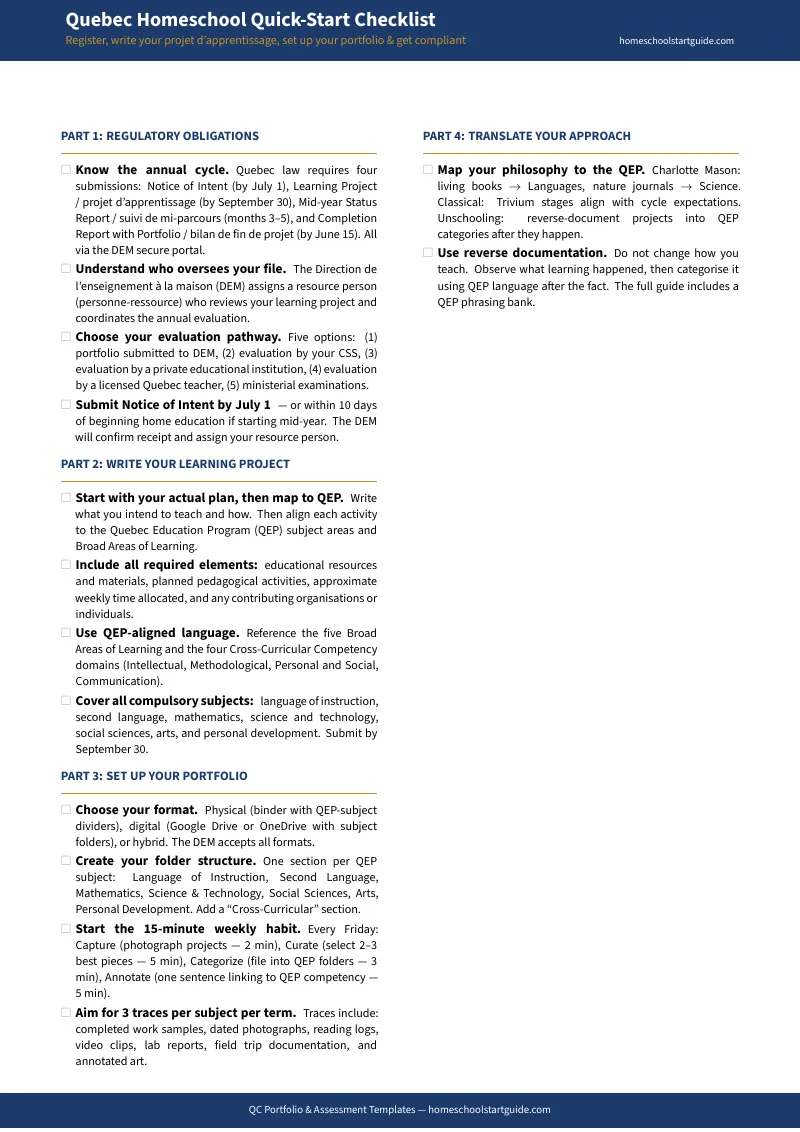
Not ready for the full system? Download the free Quebec Homeschool Quick-Start Checklist — a step-by-step overview of registration, your learning project, portfolio setup, QEP mapping basics, evaluation preparation, French documentation, and high school essentials. It's enough to get oriented, and it's free.
Quebec's documentation requirements aren't complicated — they're just poorly explained. The QEP Compliance System turns a June 15 deadline from something you dread into something you finish in 15 minutes.