PEI Is Notification-Based. One Form, No Approval Needed. So Why Are You Still Paralysed?
You've decided to homeschool. Maybe the bullying got bad enough that your child dreads the bus every morning. Maybe your son has ADHD and the overloaded classroom is turning every school day into a meltdown. Maybe the IEP meetings keep happening and nothing changes. Maybe you're a military family posted to CFB Summerside or Charlottetown and the curriculum mismatch from your last province is destroying your child's confidence. Maybe you're a seasonal worker whose family's life doesn't fit a September-to-June schedule.
So you went to the government website — and you found the Notice of Intent form. It looks simple enough. But then the questions started. Do I send this before or after telling the school? What if the principal demands a meeting? Can I pull my child out mid-year or do I have to wait until September? Everyone in Charlottetown knows everyone — will the school secretary tell the whole town? And if PEI doesn't issue diplomas to homeschoolers, did I just destroy my child's chance of getting into UPEI?
The Prince Edward Island Legal Withdrawal Blueprint is a small-province exit system — not just a letter template. It gives you the exact sequence for notifying the Department and the school on the same day (so there's no gap where your child gets flagged as absent), the word-for-word scripts for handling a principal who claims you need an "exit interview," and the UPEI and Holland College portfolio strategy that proves your child's university pathway is secure from Day One. Your child is legally home-educated before the school finishes debating whether to "approve" a decision they have no authority over.
What's Inside the Blueprint
The Legal Foundation — Section 95 and the Home Education Regulations
Your principal says "we need to discuss this before we can process your withdrawal." That's not how it works. Section 95 of the Education Act (R.S.P.E.I. 1988, Cap. E-.02) provides a statutory exemption from compulsory attendance for home-educated children. This section breaks down the hierarchy of PEI education law — the Act, the Home Education Regulations (EC526/16), and where school-level administrative policies actually sit — so you can tell the difference between what's legally required and what your school invented, and respond with the specific statute that proves it.
The Notice of Intent Guide
The government form asks basic information — your child's name, date of birth, last school attended, and your signed declaration of responsibility. But parents agonise over the details: Do I need to list curriculum? Should I describe my educational approach? What if I write too much and invite scrutiny? The guide explains exactly what to include on the form and — more importantly — what to leave off, so you submit a clean notification that satisfies the Department without volunteering information the law doesn't require.
The Step-by-Step Withdrawal Process
Sending your withdrawal letter to the classroom teacher instead of the principal means it sits unprocessed. The guide includes a ready-to-use withdrawal letter template that cites Section 95, explains exactly where to send it and why email with a timestamp matters, and covers the dual-submission strategy — Notice of Intent to the Department and withdrawal letter to the school on the same day — to eliminate any gap where your child might be flagged as truant.
The Pushback Script Library
When the principal calls demanding an "exit interview before we can release your child's records," you have about thirty seconds before the conversation goes somewhere you didn't plan. These are pre-written email responses for every common demand — exit interviews, curriculum review requests, claims that mid-year withdrawal "isn't allowed," guidance counsellors questioning your qualifications, and the school claiming you need board approval. Each script cites the specific section of the Education Act being overstepped. Copy, paste, send.
Special Situations Guide
A mid-year withdrawal isn't the same as a September one. Pulling a child from a French Immersion programme follows different considerations than an English school. Covers mid-year withdrawals, French Immersion exits, Acadian community considerations (CSLF withdrawal), children with special needs and IEPs, military families, seasonal workers, single-parent households, families with multiple children at different levels, Mi'kmaq families, and the specific social dynamics of withdrawing in a community of 182,000 where everyone knows everyone.
The Diploma Question and the University Pathway
The first thing your child's teacher will say is "they'll never get a diploma." They're half right — PEI explicitly refuses to issue high school graduation certificates to home-educated students. But UPEI has a documented admissions pathway for homeschooled applicants requiring a parent letter, course outlines, textbook lists, evaluation methods, and writing samples. Holland College has its own pathway through the CAEC (which replaced the GED for PEI residents). This section maps out both pathways in detail so withdrawing now doesn't close doors later — and gives you the portfolio tracking strategy to start building the required documentation from Day One.
Record-Keeping and Defensive Documentation
PEI law requires no progress reports, no portfolio submissions, and no standardised testing. But strategic record-keeping protects you in situations the law doesn't anticipate — custody disputes, re-enrolment decisions, university applications, or if regulations change in the future. This section provides a practical framework for maintaining records that serve you without becoming a burden.
Who This Blueprint Is For
- Parents staring at the Notice of Intent form who don't know whether to submit it before or after telling the school — and who are terrified of doing it in the wrong order and triggering a truancy investigation
- Parents whose child is being bullied, struggling with anxiety, or refusing to attend — who need their child legally home-educated this week, not after a month of bureaucratic back-and-forth with the principal
- Parents of children with IEPs whose school promised supports that never materialised — who need to know how to preserve assessment records and replicate accommodations at home
- Military families posted to PEI who need to bypass the provincial curriculum mismatch from their last posting and establish educational continuity without fighting the school system
- Secular families who want objective legal guidance without signing PEIHEA's Statement of Faith or paying $220 per year for HSLDA Canada
- Acadian and Francophone families withdrawing from the CSLF system — who need the specific notification pathway and French-language considerations
- Parents panicking about the diploma question — who need to see the exact UPEI and Holland College admissions pathways mapped out before they'll feel confident pulling their child
After Using the Blueprint, You'll Be Able To
- Submit your Notice of Intent to the Department and send your withdrawal letter to the principal on the same day — using templates that cite Section 95 and include exactly what the law requires and nothing that invites unnecessary scrutiny
- Decline every overreach from your principal or school staff with pre-written scripts that cite the specific section of the Education Act they're violating — without hiring a lawyer or paying $220 per year for HSLDA
- Navigate a mid-year withdrawal, French Immersion exit, or IEP transition with specific templates and instructions for each situation
- Understand the complete pathway from homeschool to university — the UPEI homeschooled applicant requirements, the Holland College CAEC pathway, and the portfolio tracking strategy that proves your child's credentials from Grade 8 onward
- Access the provincial curriculum through the $50 deposit programme — with a clear explanation of how the PLMDC system works and what materials are available
- Keep your transition completely private from neighbours and community members until you are legally secure — because on an island of 182,000, privacy isn't a luxury, it's a strategy
Why Not Just Use the Free Resources?
You can. The government posts the Notice of Intent form. HSLDA has a province summary. Facebook groups have threads from PEI parents. Here's what actually happens when you try to assemble a withdrawal strategy from free sources:
- The government website is clinically efficient and emotionally useless. It tells you to submit the Notice of Intent "before the school year starts" — with zero guidance for parents who need to extract their child in November. A parent reading the government site mid-year could easily conclude they're legally trapped until September. They're not.
- PEIHEA requires a signed Statement of Faith. If you're a secular family, a progressive local, or a Come From Away who doesn't align with the traditional religious homeschool community, PEIHEA's membership form is a barrier before you even get to the information. The Blueprint is 100% secular.
- HSLDA Canada costs $220 per year. Their legal protection model is designed for high-regulation jurisdictions and worst-case legal battles. PEI requires one form, no testing, no reporting, no curriculum approval, and no home visits. Paying $220 annually for legal insurance when your actual legal obligation is a single Notice of Intent is buying a fire engine to light a candle.
- Facebook groups sacrifice your privacy. On an island this small, asking about withdrawal procedures in a local group immediately alerts the community to your intentions — including parents who know your child's teacher, your neighbour, and your school board trustee. By the time you get three contradictory answers, half of Charlottetown knows you're pulling your child.
- Generic Etsy templates use American legal terminology. "School district," "superintendent," "state regulations" — none of which exist in PEI's system. Submitting a generic, US-styled letter to a PEI principal signals that you don't know your own province's law, potentially inviting the scrutiny you were trying to avoid.
— Less Than a Single Hour of a Family Lawyer
A PEI family law consultation runs $250–$400 per hour. An HSLDA Canada membership costs $220 per year. PEIHEA membership costs $40 per year plus a mandatory Statement of Faith. A panicked parent posting on a local Facebook group sacrifices their privacy in a province where everyone knows everyone. The Blueprint costs less than the gas money for a drive to the Department of Education office in Summerside you're not required to visit.
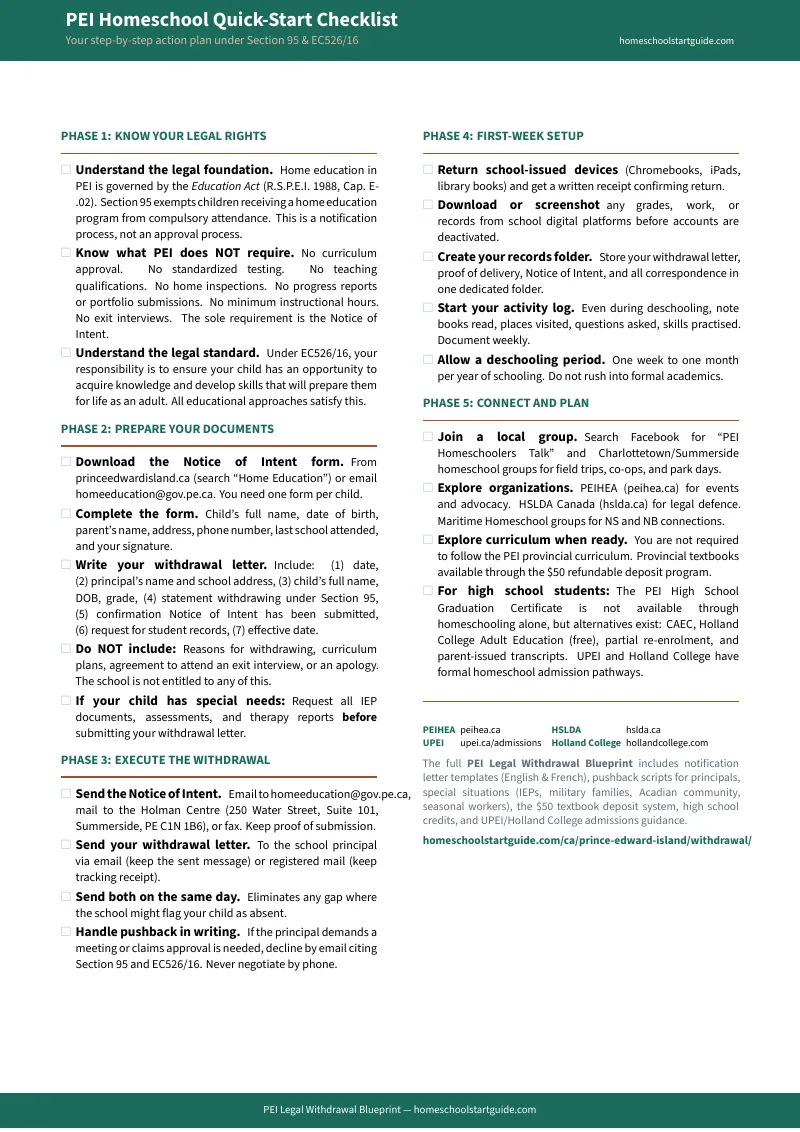
Your download includes 5 printable PDFs: the complete Blueprint guide (13 chapters covering the legal foundation, withdrawal process, pushback scripts, special situations, record-keeping, university pathways, and support networks), the Withdrawal Letter Templates (English and French, ready to fill in and send), the School Pushback Scripts (copy-paste email responses for every common demand), the Quick Reference Card (PEI law, key dates, and contacts on one page), and the Quick-Start Checklist (a one-page action plan covering legal rights, document preparation, withdrawal execution, first-week setup, and key contacts). Instant download, no account required.
30-day money-back guarantee. If the Blueprint doesn't give you the confidence and legal clarity to execute your withdrawal, email us and we'll refund you. No questions asked.
Not ready for the full Blueprint? Download the free Prince Edward Island Homeschool Quick-Start Checklist — a one-page overview of your legal rights under Section 95, the key steps in the notification process, and the single most important thing to know before contacting the school. It's enough to get oriented, and it's free.
PEI law says you don't need permission to homeschool your child. You just need to notify the Department — and do it in the right sequence. The Blueprint makes sure you do.