The Department of Education Sent You a Registration Form Asking for Your "Proposed Home Education Program." Nova Scotia Law Says You Can Describe It in Two Sentences.
You've decided to homeschool. Maybe the bus ride is two hours a day because the rural school closed. Maybe the bullying got bad enough that your child can't face Monday morning. Maybe the IPP meetings keep happening and the Educational Assistant still hasn't appeared. Maybe your child has autism or ADHD and the classroom has become a daily crisis. Maybe you're posted to CFB Halifax or 14 Wing Greenwood and the curriculum mismatch from your last province is destroying your child's confidence.
So you went to the government website — and suddenly you're staring at a registration form asking you to describe your "proposed home education program" and identify how you'll cover Language Arts, Mathematics, Science, and Social Studies. The form looks like it wants a curriculum plan. The Facebook group has three different answers about what to write. Your stomach tightens because you haven't picked a curriculum yet and the September 20 deadline is approaching. And somewhere in the back of your mind: What if the Regional Education Officer reads this and decides it's not enough?
The Nova Scotia Legal Withdrawal Blueprint is a registration-proof withdrawal system — not just a letter template. It gives you the exact phrasing that satisfies the Department of Education without trapping you in rigid curriculum commitments, the word-for-word scripts for handling a school principal who claims you need an "exit interview," and the anecdotal progress report framework that proves your child's growth in June without forcing letter grades onto a Charlotte Mason or unschooling approach. Your child is legally home-educated before the school finishes debating whether to "approve" a decision they have no authority over.
What's Inside the Blueprint
The Legal Foundation — Section 83 and the Education Reform (2018) Act
Your principal says "we need to discuss this before we can process your withdrawal." That's not how it works. Section 83 of the Education Reform (2018) Act grants you the explicit right to provide a home education program. This section breaks down the hierarchy of Nova Scotia education law — the Act, the Regulations (Sections 31–34), and where RCE administrative policies actually sit — so you can tell the difference between what's legally required and what your school invented, and respond with the specific statute that proves it.
The Registration Form Guide
The EECD registration form asks for your "proposed home education program" — and most parents assume they need to submit a detailed curriculum map. They don't. The guide includes annotated examples showing exactly what to write in the program description box to satisfy the Department without committing yourself to specific textbooks, daily schedules, or provincial curriculum outcomes. Brief, general, and legally sufficient — whether you're doing structured academics, Charlotte Mason, classical education, or full unschooling.
The Step-by-Step Withdrawal Process
Sending your withdrawal letter to the classroom teacher instead of the principal means it sits unprocessed. The guide includes a ready-to-use withdrawal letter template that cites Section 83, explains exactly where to send it and why email with a timestamp matters, and covers what happens after — including how to confirm the school has removed your child from the enrolment register.
The Pushback Script Library
When the principal calls demanding an "exit interview before we can release your child's records," you have about thirty seconds before the conversation goes somewhere you didn't plan. These are pre-written email responses for every common demand — exit interviews, curriculum review requests, claims that mid-year withdrawal "isn't allowed," guidance counsellors questioning your qualifications, and the RCE claiming you need board approval. Each script cites the specific section of the Education Act being overstepped. Copy, paste, send.
The Annual Progress Report Framework
In June, you must submit a progress report to the EECD. The government's sample template looks like a public school report card — subject headings, grade levels, implied letter grades. Parents practising unschooling, Charlotte Mason, or play-based learning look at that template and panic. The Blueprint provides an anecdotal narrative framework that satisfies the "reasonable educational progress" standard without forcing your family's organic, interest-led learning into a rigid grading system. Two to four sentences per subject area. Legally compliant. No fabricated percentages.
Special Situations Guide
A mid-year withdrawal isn't the same as a September one. Pulling a child from a CSAP Francophone school follows a different notification path than an English RCE school. Covers mid-year withdrawals, CSAP/Francophone exits, children with IPPs and special needs, African Nova Scotian and Mi'kmaw families, military families (CFB Halifax, CFB Shearwater, 14 Wing Greenwood), rural isolation strategies, single-parent households, and families with multiple children at different levels.
High School Credits and the University Pathway
The first thing your child's teacher will say is "they'll never get into university." This section covers how homeschooled students earn provincial credits through NSIOL (Nova Scotia Independent Online Learning), how to build transcripts, the CAEC pathway for high school equivalency, and specific admissions guidance for Dalhousie, Acadia, and Saint Mary's University — so withdrawing now doesn't close doors later.
The Regional Education Officer Guide
Nova Scotia assigns Regional Education Officers who review registrations and progress reports. Some parents lie awake worrying about what happens if the REO contacts them. This section explains exactly what the REO can and cannot legally ask for, how to prepare for a potential visit (rare but possible), and the precise boundary between cooperation and over-disclosure.
Who This Blueprint Is For
- Parents staring at the EECD registration form's "proposed program" box who don't know that two broad sentences are legally sufficient — and who are terrified of writing too much or too little
- Parents whose child is being bullied, struggling with anxiety, or refusing to attend — who need their child legally home-educated by the September 20 deadline, not after weeks of bureaucratic back-and-forth
- Parents of children with IPPs whose school promised supports that never materialised — who need to know how to preserve assessment records and replicate accommodations at home
- Rural families whose community school closed and whose children now spend two hours a day on a bus — who want to reclaim that time for actual learning
- Military families posted to CFB Halifax, CFB Shearwater, or 14 Wing Greenwood — who need to bypass the provincial curriculum mismatch from their last posting and establish educational continuity
- Francophone families withdrawing from a CSAP school — who need the specific notification pathway that differs from the English RCE process
- Parents dreading the June progress report — who need an anecdotal framework that satisfies the EECD without manufacturing grades for an unschooling or Charlotte Mason approach
After Using the Blueprint, You'll Be Able To
- Send a legally airtight withdrawal letter to your school principal tonight — using the template that cites Section 83 and includes exactly what the law requires and nothing that invites unnecessary scrutiny
- Fill out the EECD registration form's "proposed program" box with confidence — using the annotated examples that show you exactly how much to write to satisfy the Department without trapping yourself in rigid commitments
- Decline every overreach from your principal or RCE with pre-written scripts that cite the specific section of the Education Act they're violating — without hiring a lawyer or paying $220 per year for HSLDA
- Submit your June progress report using the anecdotal narrative framework — proving "reasonable educational progress" without forcing letter grades onto your family's approach
- Navigate a CSAP/Francophone exit, mid-year withdrawal, or IPP transition with specific templates and instructions for each situation
- Understand the complete pathway from homeschool to Nova Scotia university — NSIOL credits, transcript building, CAEC equivalency, and admissions at Dalhousie, Acadia, and Saint Mary's
Why Not Just Use the Free Resources?
You can. NSHEA has a helpful website. The EECD posts the registration form. Facebook groups have hundreds of threads from Nova Scotia parents. Here's what actually happens when you try to assemble a withdrawal strategy from free sources:
- NSHEA is a wonderful community, not an administrative toolkit. Their FAQ pages and web resources are spread across multiple sections, nested links, and archived posts. If your child is refusing to go to school on Monday morning, you need a printable withdrawal letter and a filled-out registration form — not three hours of tab-hopping to piece together what goes where.
- The government form is a trap in plain sight. The EECD registration form lists Language Arts, Mathematics, Science, and Social Studies with space for your "proposed program." Parents who don't know that two broad sentences are sufficient write detailed curriculum plans that lock them into commitments the law never required — and give the Regional Education Officer a detailed checklist to measure you against in June.
- HSLDA Canada costs $220 per year. Their legal protection model is designed for high-regulation jurisdictions and worst-case legal battles. Nova Scotia is a moderate-regulation, homeschool-friendly province. Paying $220 annually for legal insurance when your actual legal obligation is a registration form and a June progress report is buying a fire engine to light a candle.
- Facebook groups are anxiety amplifiers. For every accurate response, there are three telling you to write a five-page curriculum plan, or that the REO "always does home visits" (they rarely do), or confusing one RCE's internal policy with actual Nova Scotia law. When the consequence of bad advice is an over-documented registration that invites scrutiny you never needed — crowdsourcing your legal strategy is a gamble.
- Blog posts are warm but fragmented. Local blogs offer encouragement and snippets of useful advice, but you're still assembling a strategy from five different websites, three YouTube videos, and a two-year-old Facebook thread. The information exists — it just takes 5+ hours to find, verify, and organise into an actionable plan.
— Less Than a Single Hour of a Family Lawyer
A Nova Scotia family law consultation runs $250–$400 per hour. An HSLDA Canada membership costs $220 per year. A panicked parent writing a five-page curriculum plan on the registration form invites scrutiny that a two-sentence description would have avoided entirely. The Blueprint costs less than the gas money for a drive to the RCE office you're not required to visit.
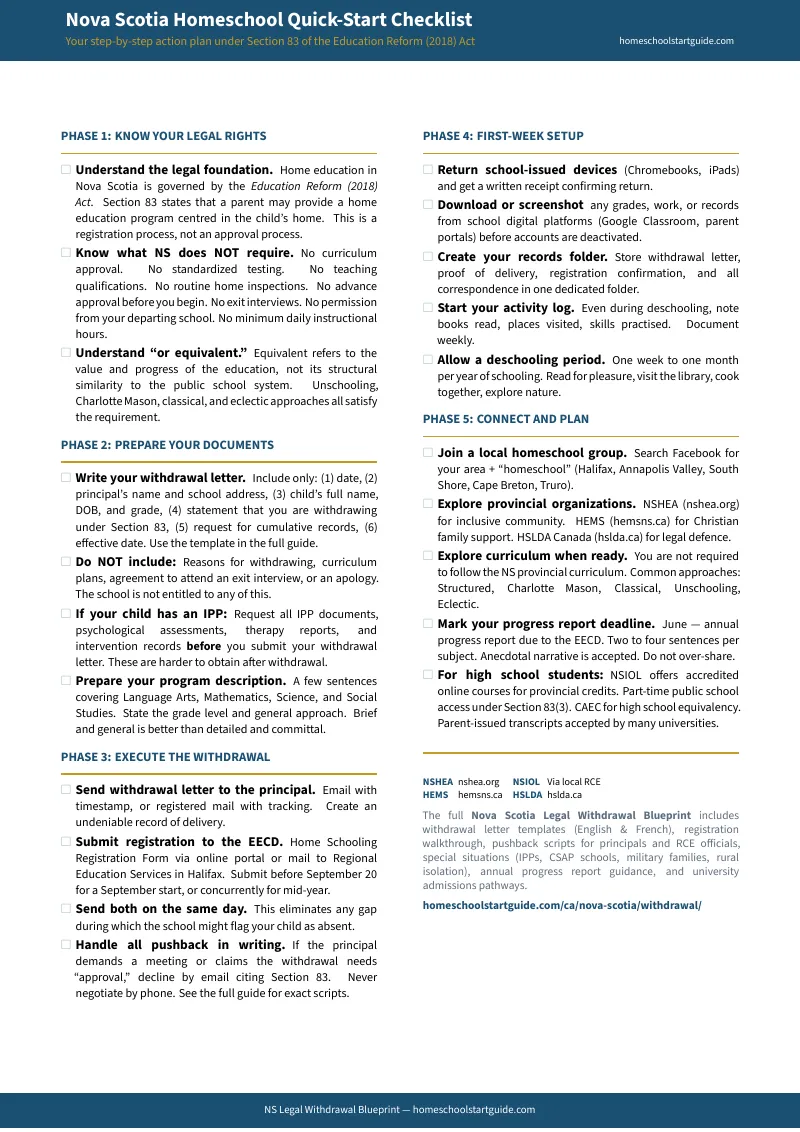
Your download includes the complete Blueprint PDF with the legal foundation, the step-by-step withdrawal process, the registration form guide with annotated examples, the pushback script library, the special situations guide (mid-year, CSAP/Francophone, IPP, military, rural, multiple children), the annual progress report framework, the REO preparation guide, the high school credentials pathway, and the university admissions guide for Dalhousie, Acadia, and Saint Mary's. Plus standalone printables: the Withdrawal Letter Templates (principal notification and CSAP notification, ready to customise and send), the School Pushback Scripts (all common scenarios on a desk reference), the Quick Reference Card (your legal rights, key deadlines, and contacts on a single page), and the Nova Scotia Homeschool Quick-Start Checklist. Instant download, no account required.
30-day money-back guarantee. If the Blueprint doesn't give you the confidence and legal clarity to execute your withdrawal, email us and we'll refund you. No questions asked.
Not ready for the full Blueprint? Download the free Nova Scotia Homeschool Quick-Start Checklist — a one-page overview of your legal rights under Section 83, the key steps in the registration process, the September 20 deadline, and the single most important thing to know before contacting the school. It's enough to get oriented, and it's free.
Nova Scotia law says you don't need permission to homeschool your child. You just need to register — and fill out the form in exactly the right way. The Blueprint makes sure you do.