The ECE Tells You to Register With Your DEA and Submit a Learning Plan — But Nobody Shows You What an Approved Plan Actually Looks Like
You've decided to homeschool. Maybe your child comes home from a Yellowknife classroom overwhelmed because the teacher has thirty students and no time for the one who learns differently. Maybe your son has ADHD and the school's inclusive education directive amounts to parking him at a desk with a worksheet. Maybe you live in Hay River or Fort Simpson and chronic teacher turnover means your child has had three different teachers this year, none of whom stayed long enough to learn their name. Maybe you're in a fly-in community — Paulatuk, Colville Lake, Wekweètì — and the local school doesn't offer courses past Grade 10, which means the system expects your fourteen-year-old to pack a bag and move to Yellowknife alone. Maybe you're a Dene, Inuvialuit, or Métis parent who wants your child to learn on the land, in your language, with your Elders, instead of sitting under fluorescent lights in a building that was never designed for your family's way of knowing. Maybe you're an RCMP officer or mining contractor posted to the North for two years and you need educational continuity that the territorial system cannot provide.
So you went to the ECE website — and found dense bureaucratic language about "registering with your local school," vague references to "curriculum standards established by the Minister," a mandate that the principal will assess your child's progress twice per year and report to the Superintendent, a warning that the DEA has the authority to terminate your program if progress is unsatisfactory, and zero templates for any of it. No example learning plans. No notification letter templates. No guidance on what a compliant portfolio review actually looks like. The Yellowknife Homeschool Community Facebook group has veteran parents offering helpful but conflicting advice scattered across three years of comment threads. HSLDA Canada summarises the law for $220 per year. And the NWT Department of Education, Culture and Employment provides rules without tools — telling you what to do without ever showing you how.
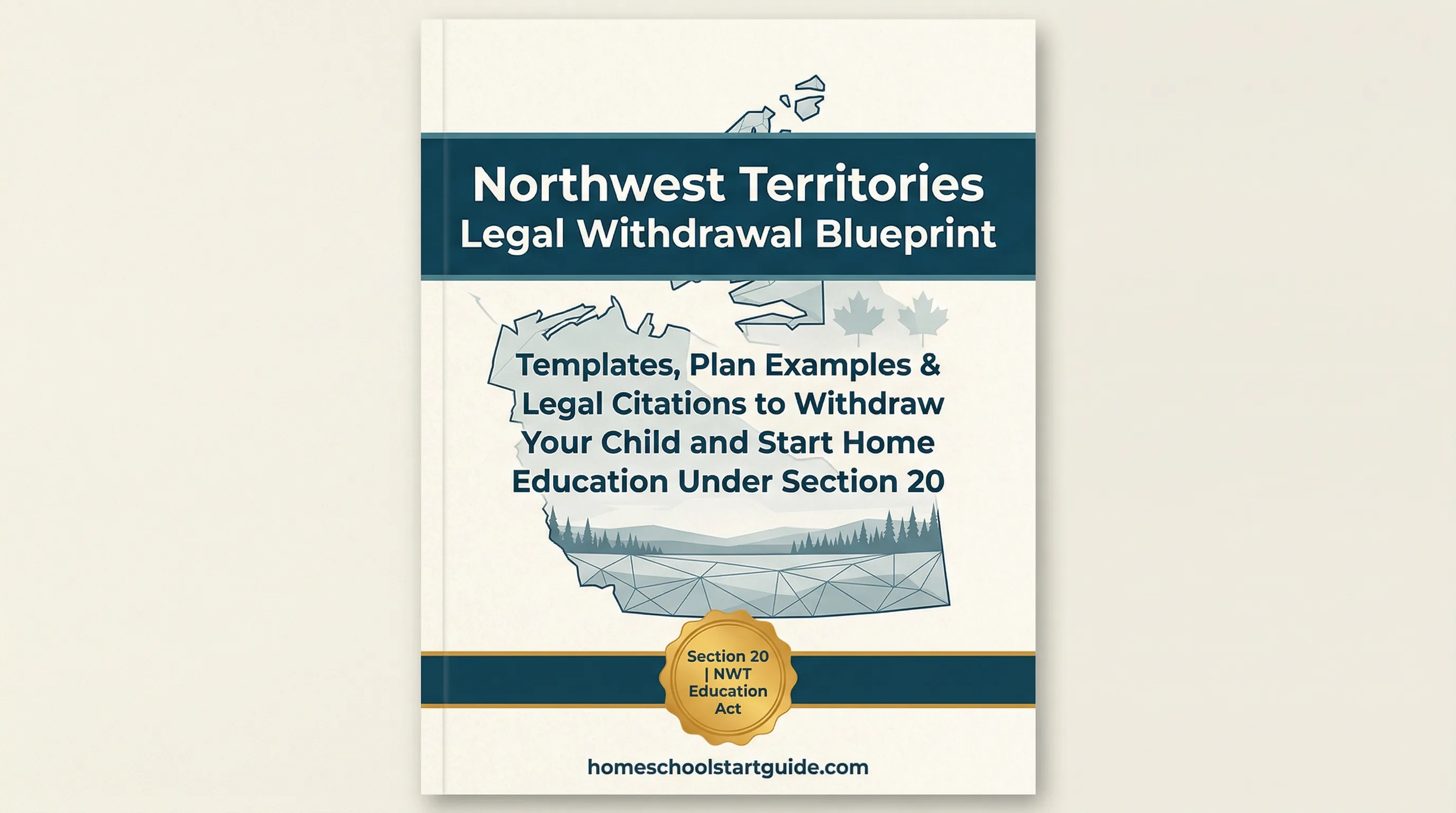
The Northwest Territories Legal Withdrawal Blueprint is a DEA-proof registration system — not just a letter template. It gives you the pre-filled learning plan examples that show exactly what approved submissions look like, the DEA-by-DEA registration guide for all eight education authorities, the biannual portfolio templates that satisfy principal review without over-documenting, the land-based learning translation matrix that maps traditional practices to territorial curriculum outcomes, and the pushback scripts for principals who overstep. Your registration gets accepted on the first submission because it's modelled on plans that already passed review.
What's Inside the Blueprint
The Legal Foundation — Section 20, the Education Act, and the Home Schooling Regulations
Your principal says you need "permission" to withdraw and the school claims your notification is "pending review." The principal has no authority to approve or deny your decision to home educate. This section breaks down the two legal instruments that protect you — the NWT Education Act (S.N.W.T. 1995, c.28) and the Home Schooling Regulations (R-090-96) — so you can tell the difference between what's legally required and what the school invented, and respond with the exact provision that proves it.
The Registration Process — DEA by DEA
The NWT requires you to register with a local school within your District Education Authority. But which DEA? Which school? What forms? The guide walks through registration procedures for all eight NWT education authorities — YK1, Yellowknife Catholic Schools, Beaufort-Delta, Sahtu, Dehcho, South Slave, Tłı̨chǫ Community Services Agency, and the Commission scolaire francophone des TNO — because each handles home education intake differently. Covers the September 30 funding deadline and tells you exactly what happens after you register.
Writing Your Learning Plan — The Document That Gets Approved on the First Try
This is where most families freeze. The regulations require a plan covering English or French Language Arts, Mathematics, Science, Social Studies, Arts, Physical Education, Health and Wellness, and Northern Studies — but the government provides blank forms and no examples. The Blueprint includes pre-filled learning plan examples for multiple grades and philosophies (eclectic, unschooling, Charlotte Mason, classical, land-based) showing exactly how to write each subject section. You're not guessing what the principal wants to see. You're modelling your plan on documents that already passed review.
The 25% FTE Funding System
The NWT provides funding for home-educated students based on a percentage of the full-time equivalent funding allocation — but eligibility requires flawless registration before the September 30 deadline, and each DEA administers reimbursement differently. The Blueprint explains the funding formula, eligible expenses (curriculum materials, consumables, educational resources), DEA-specific caps, and the receipt documentation system — so you don't accidentally forfeit funding because you registered late or claimed an ineligible expense.
Land-Based Learning Translation Matrix — Dene Kede and Inuuqatigiit
No existing resource shows Indigenous families how to translate land-based learning into DEA-compliant portfolio documentation. This dedicated chapter demonstrates how to document a multi-day moose hunt as Physical Education and Science outcomes, seasonal berry harvesting as Science and Northern Studies, trapping as Mathematics and Environmental Studies, and Elder-led cultural education as Language Arts and Social Studies. Everything maps directly to the themes of the Dene Kede and Inuuqatigiit curricula — the NWT's own mandated frameworks — so the administration is legally obligated to recognise these activities as valid educational progress.
Biannual Portfolio Review — What to Prepare and What to Refuse
NWT regulations require two portfolio reviews per year with your school principal, who then writes an annual report to the Superintendent. Most parents over-document because they're terrified of the word "termination." The Blueprint shows you exactly what constitutes a compliant portfolio, how to negotiate assessment methods (the law requires mutual agreement — the principal cannot unilaterally impose standardised testing), and what to do if a progress report flags concerns. Includes sample portfolio entries and scripts for assessment meetings.
Pushback Script Library
When the principal emails claiming you need an "exit interview before we can process your withdrawal," you have about thirty seconds before the conversation goes somewhere you didn't plan. These are pre-written email responses for every common demand — exit meetings, curriculum plans before you've registered, claims that your child must keep attending until the plan is reviewed, and the DEA demanding to see your program outline. Each script cites the specific section of the Education Act or Home Schooling Regulations being overstepped. Copy, paste, send.
Special Situations Guide
A mid-year withdrawal isn't the same as a September one, and pulling a child with special needs requires preserving assessment records before the school has a reason to restrict access. Covers mid-year withdrawals, children with special needs (IEP and inclusive education records), military and RCMP families posted to the NWT, Francophone families (Commission scolaire francophone pathway), blended programs (part-time school attendance), the digital divide in remote communities, and re-enrollment. Each situation gets its own templates and instructions.
Who This Blueprint Is For
- Parents who looked at the ECE website, found dense bureaucratic language about registering with a DEA and submitting a learning plan covering eight subject areas, and had no idea what to write — who need to see what an approved plan actually looks like before they can write their own
- Parents whose child is being bullied, struggling with anxiety, or refusing to attend — who need their child legally excused from attendance this week, not after weeks of back-and-forth with an administrator who doesn't know the regulations
- Parents in fly-in communities where the local school doesn't offer courses past Grade 10 — who refuse to send their teenager hundreds of kilometres away to Yellowknife for high school and need a legal alternative
- Dene, Inuvialuit, and Métis families who want to integrate land-based learning, cultural education, and language revitalization — and need to know how to document traditional practices as territorial curriculum outcomes without watering them down
- Parents who want to claim their 25% FTE funding but don't understand the September 30 deadline, the eligible expense categories, or the DEA-specific reimbursement caps
- Military, RCMP, and mining families posted to the NWT who need to set up home education quickly during a relocation — without waiting for DEA intake timelines
- Parents in Yellowknife who have multiple school options but none that work for their child's learning differences, schedule, or educational philosophy
After Using the Blueprint, You'll Be Able To
- Write a learning plan that gets approved on the first submission — using the pre-filled examples that show exactly what principals and DEAs want to see for each subject area, grade level, and educational philosophy
- Send a legally airtight withdrawal notification tonight — using the templates that include exactly what Section 20 requires and nothing that invites unnecessary scrutiny
- Decline every illegal demand from your principal with pre-written scripts that cite the specific section of the Education Act they're overstepping — without hiring an attorney or paying $220/year for HSLDA
- Claim your 25% FTE funding — understanding the September 30 deadline, eligible expenses, excluded items, and the DEA-specific reimbursement process
- Map any educational philosophy to NWT curriculum standards — whether you're unschooling, using Charlotte Mason, teaching classically, or running a land-based program on the land with your Elders
- Navigate a mid-year withdrawal, special needs exit, military relocation, Francophone pathway, blended program, or re-enrollment with specific templates and instructions for each situation
- Prepare for your biannual portfolio review with confidence — knowing exactly what to include, what to leave out, and how to handle a principal who tries to impose assessment methods the law doesn't require
Why Not Just Use the Free Resources?
You can. The ECE website has the regulations. HSLDA Canada summarises the law. The Yellowknife Homeschool Community has an active Facebook group. Here's what actually happens when you try to assemble a withdrawal strategy from free sources:
- The ECE website is bureaucratic language written for administrators, not parents. It clearly states that you must register with a local school, submit a learning plan, and agree on an assessment method with the principal — but it provides zero templates, zero examples, and zero guidance on what a compliant submission actually looks like. You're staring at a regulation that says "fulfil curriculum standards established by the Minister" and you have no idea what that means in practice for your Grade 4 daughter who learns through baking and bird-watching.
- HSLDA Canada costs $220 per year for legal insurance. Their NWT summary is accurate — it correctly identifies Section 20, the registration requirement, and the principal's assessment role. But it's informational, not operational. It tells you what the law requires without providing the pre-filled plan examples, withdrawal letter templates, or pushback scripts you need to actually execute the withdrawal.
- The Yellowknife Homeschool Community Facebook group is peer support, not a legal service. Veteran parents share experiences and coordinate gymnastics classes, pottery sessions, and playground meetups — exactly the socialization support your family needs. But critical legal advice is scattered across years of old comment threads, and a parent searching for a formal withdrawal template will find fragmented opinions rather than a definitive, printable document.
- Generic Canadian homeschool guides assume urban infrastructure. They assume Amazon Prime delivery, unlimited broadband, a local library, and a curriculum store within driving distance. This advice is functionally useless for a family in a fly-in community where shipping costs double the price of every textbook, satellite internet is throttled, and the nearest library is a 90-minute charter flight away.
- Alberta and BC guides will actively mislead you. Because the NWT has historically used Alberta curriculum standards and is transitioning toward BC frameworks, parents assume provincial guides apply. They don't. The NWT has its own Education Act, its own Home Schooling Regulations, its own DEA structure, and its own funding model. Following an Alberta or BC guide in the NWT means filing the wrong forms with the wrong authority.
— Less Than a Bag of Groceries in Yellowknife
An HSLDA Canada membership costs $220 per year. A single consultation with an NWT family lawyer runs $300-$500 per hour. The Blueprint costs less than a bag of groceries at the Yellowknife Co-op — and it's available right now.
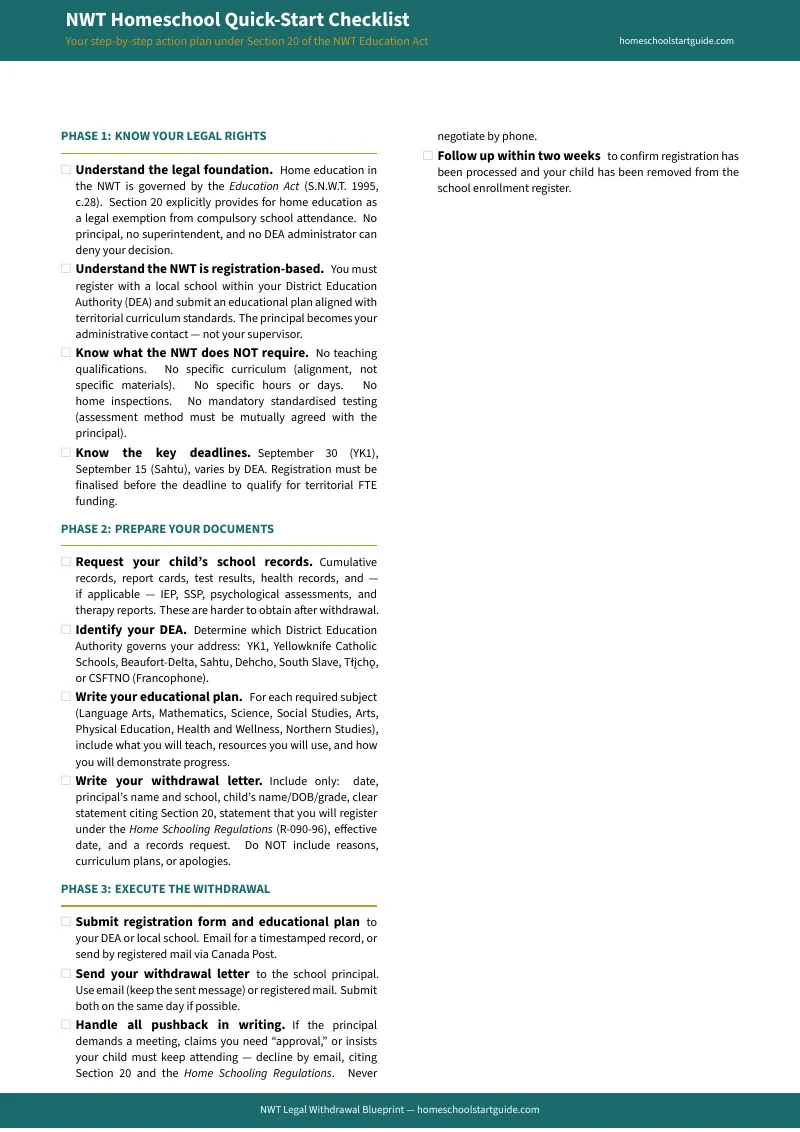
Your download includes six PDFs: the complete Blueprint guide, the standalone Withdrawal Letter Templates (standard and mid-year — fill in the brackets and send), the Pushback Scripts (six pre-written email responses citing the specific section of the Education Act being overstepped), the 25% FTE Funding Tracker (deadlines, eligible expenses, DEA-specific caps, and the receipt management system), the Land-Based Learning Translation Matrix (traditional activities mapped to Dene Kede and Inuuqatigiit curriculum outcomes, plus the Section 74 language exemption and the Hunter Education high school credit), and the Northwest Territories Homeschool Quick-Start Checklist — a printable overview of your legal rights, the registration steps, document preparation, and first-week setup actions. Instant download, no account required.
30-day money-back guarantee. If the Blueprint doesn't give you the confidence and legal clarity to execute your withdrawal, email us and we'll refund you. No questions asked.
Not ready for the full Blueprint? Download the free Northwest Territories Homeschool Quick-Start Checklist — a printable summary of your legal rights under Section 20, the key steps in the DEA registration process, and the document preparation sequence. It's enough to get oriented, and it's free.
NWT law protects your right to educate your child at home. The process is an administrative sequence, not a legal battle. You just need to know which DEA to register with, what to write in the plan, and what to say when the school pushes back. The Blueprint makes sure you do.