It's Late November and Your First Form 312B Is a Blank Government PDF with Four Empty Boxes
You submitted Form 312A in September. You described your program — English Language Arts, Mathematics, Science, Social Studies. You've been teaching beautifully since then: read-alouds by the woodstove, nature journaling along Conception Bay, a model of Signal Hill built from cardboard and paint, multiplication tables learned through baking. Your child is thriving in ways they never did in a class of twenty-six.
But the November progress report deadline is approaching and you haven't been documenting. Not in the way the Department of Education and Early Childhood Development expects. Form 312B is a sterile PDF with blank boxes for each subject area and a vague instruction to describe your child's progress and attach work samples. You have undated phone photos, half-labelled workbooks, and a reading list that exists only in your memory. The blank boxes are staring at you — and you don't know whether "she read lots of books and got better at math" satisfies the Homeschooling Coordinator or triggers a follow-up letter requesting more detail.
So you went looking for help. The NLESD website has the official forms but zero guidance on what to write in them. NLHEA is genuinely supportive — but they link you back to the same government forms and offer encouragement, not templates. Facebook groups gave you conflicting answers: "just write a paragraph per subject" versus "I submitted ten pages with outcome mapping." HSLDA Canada has professional templates — locked behind a $120/year membership, or $50–$75/hour for specific transcript consulting. Etsy has "homeschool portfolio planners" with Common Core alignment charts and 180-day attendance trackers — American products that don't know NL has no attendance requirement and no mandatory grading system.
The Newfoundland and Labrador Portfolio & Assessment Templates is a Coordinator-ready documentation system — not a generic planner with an iceberg on the cover. It gives you the Subject Translation Matrix that maps real-world activities to the Schools Act's four required subject categories, Form 312B frameworks with pre-written anecdotal phrasing calibrated for every reporting frequency, portfolio organisation for every grade band from Kindergarten through Grade 12, and the 15-minute weekly documentation habit that keeps your portfolio permanently ready. You spend 15 minutes every Friday filing the week's work. When the next Form 312B deadline arrives, you open your portfolio and the report writes itself.
What's Inside the Documentation System
The Subject Translation Matrix
The Schools Act evaluates progress across four core subjects: English Language Arts, Mathematics, Science, and Social Studies. But real learning doesn't sort itself into four boxes. Your child spent the afternoon exploring tide pools near Bay Roberts — is that Science or Social Studies? They kept a nature journal of marine species — is that Language Arts or Science? They calculated the distance between outport communities using a map scale — is that Mathematics or Social Studies? The Subject Translation Matrix shows you exactly how to categorise everyday activities — nature walks, fishing, building projects, museum visits, read-alouds — into the four categories the Department expects. No more guessing. No more staring at blank boxes wondering if your phrasing sounds "educational enough."
Form 312B Progress Report Frameworks — Every Reporting Frequency
NL's reporting burden depends on how long you've been homeschooling. First-year families submit three times: November, March, and June. Second-year families submit twice: January and June. Veterans submit once in June. The guide gives you pre-formatted frameworks with sample anecdotal language for each subject area — calibrated to the level of detail Homeschooling Coordinators expect at each reporting tier. Not too sparse (which triggers a follow-up from the Coordinator requesting more information) and not too detailed (which volunteers data the province has no right to demand and creates a documentation standard you can't maintain year after year). "We went to the beach" becomes "Conducted field observation of intertidal ecosystems along the Eastern coastline and documented marine species through observational sketching and journal entries." You fill in the specifics for your child. The structure and language are already done.
Grade-Banded Portfolio Frameworks — K Through 12
A Kindergarten portfolio looks nothing like a Grade 10 portfolio. Early years evidence is observational and play-based — narrations, photos of block constructions, nature journal entries, art samples. Middle years introduce structured academic output and subject specialisation. Senior years require credit-level documentation, course descriptions, and transcript-ready records. Each grade band gets its own chapter with age-appropriate evidence checklists, sample organisation structures, and the minimum viable portfolio that satisfies the Department of Education without burying you in paperwork you don't need.
The 15-Minute Weekly Filing Routine
Every Friday: sort the week's work (2 minutes), select 1–2 pieces per subject (3 minutes), file with dates (3 minutes), photograph any hands-on projects (2 minutes), write a brief weekly log entry (5 minutes). That's it. This single habit — built around the guide's weekly documentation log template — keeps your portfolio in a permanent state of readiness. No more November panic. No more reconstructing an entire term of learning from memory the night before the deadline.
Assessment Pathway Comparison — Portfolio Review vs. Standardised Testing
The Department "strongly advises" standardised testing for Grade 3 and above. But you have a choice: portfolio review or standardised testing. Each pathway has different documentation requirements, preparation timelines, and implications for how you teach. The guide breaks down both options side by side — accepted tests (CAT, CLT, TerraNova, PASS), registration procedures, preparation strategies, score interpretation, and which pathway fits your family's teaching philosophy — so you make an informed decision rather than a panicked one.
Documenting Every Philosophy
Charlotte Mason families narrate, not test. Unschoolers document emergent learning, not lesson plans. Classical families track the Trivium. Eclectic families mix everything. The guide shows how to translate each philosophy into portfolio evidence that satisfies the Schools Act's regulatory framework — so the Homeschooling Coordinator sees "satisfactory progress across core subject areas" regardless of whether your child wrote an essay, built a catapult, or spent the afternoon at The Rooms.
High School Credits, Transcripts, and the University Bridge
This is where most Newfoundland and Labrador homeschool families hit a wall. The Department of Education does not issue high school diplomas or evaluate homeschool coursework for credit. The burden of proof falls entirely on you. The guide covers the 36-credit graduation benchmark, CDLI (Centre for Distance Learning and Innovation) course enrolment for accredited credits, the parent-generated transcript route, and post-secondary pathways. Includes a four-year transcript template, course description templates that meet MUN's rigorous documentation requirements (personal statement covering curriculum overview, textbooks, instruction methods, and assessment procedures), and institution-specific admissions guides for Memorial University (St. John's campus, Grenfell Campus in Corner Brook, and the Marine Institute), the College of the North Atlantic, and trades apprenticeship pathways.
Handling Coordinator Communications
If the Homeschooling Coordinator contacts you requesting more information about your program, the guide explains exactly what they're asking for, what the Schools Act requires you to provide under Section 22, and how to respond confidently without panic. Includes response frameworks and the regulatory citations that define the boundaries of what the province can and cannot request.
Specialised Documentation Approaches
NL families incorporating Indigenous knowledge systems (Innu, Inuit/Nunatsiavut, Mi'kmaw), Labrador-specific land-based learning (hunting, fishing, trapping, berry picking), outport maritime and seasonal education, military family documentation (CFB St. John's, 5 Wing Goose Bay), or French-language CSFP programs deserve documentation strategies that honour these traditions while satisfying provincial requirements. The guide includes specific approaches for each — so a week of land-based learning in Labrador or outport fishing education in Twillingate is documented as the rich, substantive learning it is, not squeezed into generic subject boxes.
Who This Documentation System Is For
- Families who submitted Form 312A and now need a documentation system that satisfies the November, March, or June Form 312B deadline without last-minute panic
- Parents who have been teaching effectively but documenting poorly — who need to assemble a credible portfolio from what they already have before the next reporting deadline
- Parents whose Homeschooling Coordinator has requested "more detail" on their progress report — who need to know exactly what the Schools Act requires and how to respond confidently
- Parents deciding between portfolio review and standardised testing — who need a clear comparison of both assessment pathways before committing to one
- Parents of high schoolers who need transcripts, course descriptions, and a post-secondary pathway — and who don't know where to start with CDLI credits, standardised test registration, or MUN's admissions requirements
- Parents using Charlotte Mason, unschooling, classical, or eclectic approaches who need to translate their philosophy into evidence that the Department of Education understands and accepts
- Indigenous families (Innu, Inuit/Nunatsiavut, Mi'kmaw), Labrador families documenting land-based learning, and outport families incorporating maritime and seasonal education
- St. John's, Mount Pearl, Corner Brook, Happy Valley-Goose Bay, and rural Newfoundland families who want a professional documentation system beyond what's shared in Facebook groups
Why Not Just Use the Free NLHEA and Government Resources?
You can. NLHEA has excellent community support and links to all the legislation. The NLESD website has the official forms. Here's what happens when you try to build a documentation system from free sources:
- The government forms give you the boxes, not the answers. Form 312B is a PDF with blank boxes for each subject area. It tells you to describe progress and attach work samples. It doesn't show you how much to write, what language to use, or how to translate tide pool exploration into "Science" and nature journaling into "English Language Arts." For an anxious parent facing the November deadline — especially one submitting for the first time — that blank box produces administrative paralysis. Three hours of anxious drafting that should take twenty minutes.
- NLHEA guides you to the door, not through it. The Newfoundland and Labrador Home Education Association provides advocacy, networking, and high-level advice on interacting with school boards. They are an advocacy network, not a tool provider. NLHEA tells you the Schools Act requires a progress report. They don't give you the fill-in frameworks, the anecdotal phrase bank, or the weekly documentation system that prevents the problem from recurring every submission cycle.
- Etsy templates are American. "School districts," "Common Core alignment," "180-day attendance requirements" — if your documentation uses American terminology, it signals to your Homeschooling Coordinator that you don't understand NL's framework. The Department expects four core subjects, not six. They accept anecdotal reporting, not letter grades. Using the wrong format invites exactly the kind of follow-up questions the regulations don't entitle them to ask.
- Facebook groups amplify anxiety. For every parent in the NL homeschool groups who answers your Form 312B question accurately, three more will tell you their Coordinator requires things the Schools Act doesn't mandate. What worked for a family in Corner Brook might trigger a pushback letter from the St. John's Coordinator. When you can't distinguish between Schools Act requirements and individual Coordinator preferences, crowdsourcing your compliance strategy is a gamble with your peace of mind.
— Less Than a Single HSLDA Membership Month
A Homeschooling Coordinator who requests more detail on your progress report doesn't fine you — but the follow-up letter triggers weeks of anxiety and administrative rework. A missing transcript when your child applies to Memorial University means scrambling to build years of documentation in weeks. An HSLDA Canada membership runs $120/year. A private educational consultant charges $50–$75/hour for transcript preparation. This documentation system costs a fraction of any of those — and gives you the tools to handle every reporting deadline from Kindergarten through Grade 12.
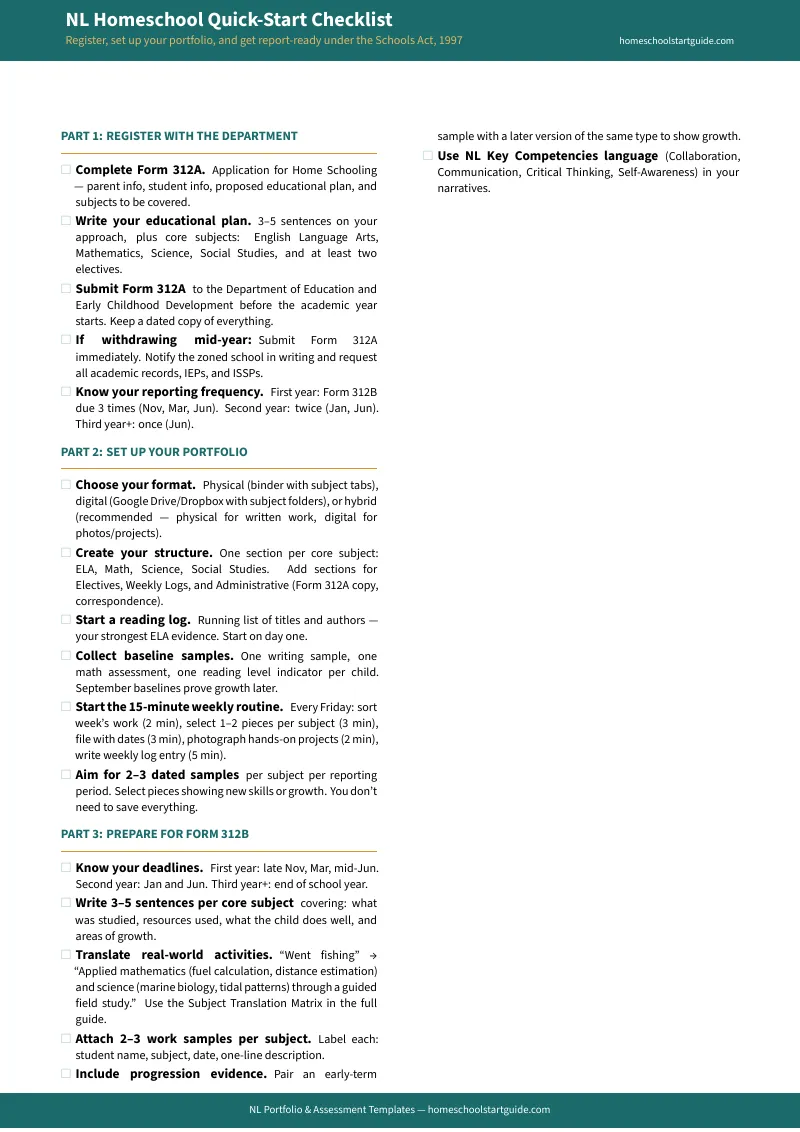
Your download includes the complete 17-chapter guide, the Newfoundland and Labrador Homeschool Quick-Start Checklist, and standalone printable tools: the Subject Translation Matrix (pin it to your wall), the Weekly Documentation Log (print one per week), Form 312B Progress Report Frameworks with sample anecdotal language for every reporting frequency, the Compliance Calendar with every NL deadline, the Assessment Pathway Comparison (portfolio review vs. standardised testing), a fillable Transcript Template with credit tracking toward the 36-credit graduation benchmark, and the Post-Secondary Admissions Guide covering Memorial University (St. John's, Grenfell, Marine Institute), College of the North Atlantic, and trades pathways. The guide covers NL's full regulatory framework, grade-banded portfolio strategies (K–3, 4–6, 7–9, 10–12), high school credits and CDLI guidance, Coordinator communication templates, specialised documentation approaches (Indigenous, Labrador, outport, military, CSFP), and the 2025/2026 curriculum alignment.
30-day money-back guarantee. If the documentation system doesn't give you the confidence and structure to handle your next Form 312B, email us and we'll refund you. No questions asked.
Not ready for the full system? Download the free Newfoundland and Labrador Homeschool Quick-Start Checklist — a step-by-step overview of submitting Form 312A, setting up your portfolio, and preparing for your first Form 312B submission. It's enough to get oriented, and it's free.
The Department of Education gives you blank boxes. NLHEA gives you links to those boxes. This documentation system gives you the exact words to fill them — in fifteen minutes, every week, from now through university.