The January 31 Deadline Is Two Weeks Away and Your Progress Report Is a Blank Text Box
You submitted your Student Notification Form in September. You wrote a program outline that mentioned Language Arts, Mathematics, Science, and Social Studies. You've been teaching — read-alouds, kitchen-table math, nature walks along the Red River, science experiments with baking soda. Your child is learning more than they ever did in a classroom of thirty.
But you haven't been documenting. Not the way the Homeschooling Office wants. The progress report form asks for a narrative update on each of the four core subjects — what was covered, what the child is doing well, what needs improvement, and next steps. You have a phone full of undated photos, workbooks with no labels, and a reading list that exists only in your memory. The blank text boxes on the government form are staring at you, and you don't know whether "She read a lot of books and got better at multiplication" is enough or if the Liaison Officer will send the form back asking for more detail.
So you went looking for help. MACHS has a 90-minute YouTube workshop on how to fill out the form — but you don't have 90 spare minutes and you'd still need to format everything yourself afterwards. HSLDA Canada has professional templates locked behind a $180/year membership. Etsy has "homeschool portfolio planners" that reference Common Core standards and US school districts — American products that don't know Manitoba requires four core subjects, not six. Facebook groups gave you fifty different answers when you asked "Do I just put a grade next to each subject or write a paragraph?" — and none of them agreed.
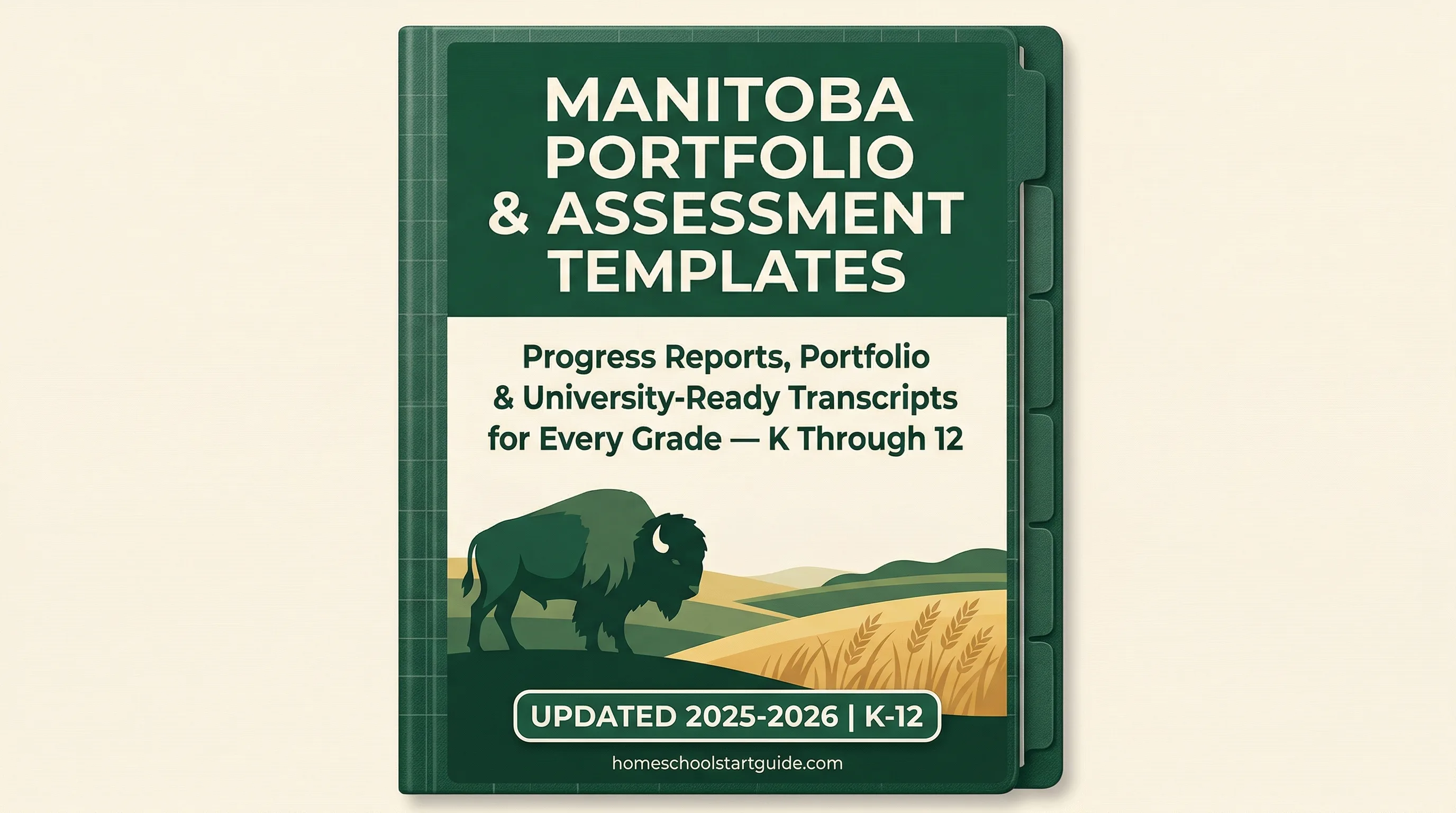
The Manitoba Portfolio & Assessment Templates is a liaison-ready documentation system — not a generic planner with a maple leaf on the cover. It gives you the Core-Four Translation Matrix that maps real-world activities to Manitoba's four required subject categories, progress report frameworks with pre-written phrasing that satisfies Liaison Officers, portfolio organisation for every grade band from Kindergarten through Grade 12, and the 15-minute weekly documentation habit that keeps your portfolio permanently ready. You spend 15 minutes every Friday filing the week's work. When the January 31 or June 30 deadline arrives, you open your portfolio and the report writes itself.
What's Inside the Documentation System
The Core-Four Translation Matrix
Manitoba Education requires progress updates on four core subjects: Language Arts, Mathematics, Science, and Social Studies. But real learning doesn't fit neatly into four boxes. Your child spent the afternoon at the Mennonite Heritage Village and you're not sure whether that counts as Social Studies, Language Arts, or both. They played grocery store and you don't know if that's Mathematics or Life Skills. The Core-Four Translation Matrix shows you exactly how to categorise everyday activities — nature walks, cooking, board games, field trips, read-alouds — into the four categories the Homeschooling Office expects. No more guessing. No more staring at blank boxes wondering if your phrasing sounds "educational enough."
Progress Report Frameworks — January and June
The January 31 progress report covers September through January. The June 30 report covers the full year. Each requires a different tone — January is a mid-year check-in, June is a summative overview. The guide gives you pre-formatted frameworks for both, with sample phrasing that satisfies Liaison Officers without over-sharing. "Played board games" becomes "Demonstrated proficiency in mental arithmetic and strategic reasoning through structured game-based learning." You fill in the specifics for your child. The structure and language are already done.
Grade-Banded Portfolio Frameworks — K Through 12
A Kindergarten portfolio looks nothing like a Grade 10 portfolio. Early years evidence is observational and play-based — narrations, photos of block constructions, nature journal entries. Junior high introduces structured academic output and subject specialisation. High school requires credit-level documentation, course descriptions, and transcript-ready records. Each grade band gets its own chapter with age-appropriate evidence checklists, sample organisation structures, and the minimum viable portfolio that satisfies the Homeschooling Office without burying you in paperwork you don't need.
The 15-Minute Weekly Filing Routine
Every Friday: sort the week's work (2 minutes), file 1-2 pieces per subject (5 minutes), write a brief weekly log entry (5 minutes), photograph any hands-on projects (1 minute). That's it. This single habit — built around the guide's weekly documentation log template — keeps your portfolio in a permanent state of readiness. No more January panic. No more reconstructing a semester from memory the night before the deadline.
Documenting Every Philosophy
Charlotte Mason families narrate, not test. Unschoolers document emergent learning, not lesson plans. Classical families track the Trivium. Eclectic families mix everything. The guide shows how to translate each philosophy into portfolio evidence that satisfies Manitoba's regulatory framework — so the Homeschooling Office sees "satisfactory progress in the four core subjects" regardless of whether your child wrote an essay, built a catapult, or spent the afternoon at FortWhyte Alive.
High School Credits, Transcripts, and the University Bridge
This is where most Manitoba homeschool families hit a wall. Manitoba Education does not issue high school diplomas for home-educated students. The burden of proof falls entirely on you. The guide covers three pathways: InformNet enrolment for accredited online courses, cross-enrolment with local schools for lab sciences and advanced math, and the parent-generated transcript route for alternative admission. Includes a four-year transcript template, course description templates that meet the University of Winnipeg's rigorous syllabus requirements (course description, objectives, textbooks with author and publisher, evaluation methodology, and assignment lists), and institution-specific admissions guides for the University of Manitoba, University of Winnipeg, Brandon University, and Canadian Mennonite University.
Handling Liaison Communications
If the Homeschooling Liaison Officer sends your notification back with a request for "more detail," the guide explains exactly what they're asking for, what the law requires you to provide, and how to respond confidently without panic. Includes response templates and the regulatory citations that define the boundaries of what the province can and cannot request.
The 2025/2026 Curriculum Changes
Manitoba Education is overhauling the ELA and Mathematics curricula. A renewed K-12 English Language Arts Framework launches for voluntary implementation in 2025/2026, with full mandatory implementation in 2026/2027. New Grade 9 Mathematics with financial literacy integration begins piloting in September 2026. The guide's outcome checklists are already aligned with the new provincial learning outcomes — including the new metacognitive ELA goals and the financial literacy math standards — so your documentation is future-proofed when these changes become mandatory.
Who This Documentation System Is For
- Families who submitted their Student Notification Form and now need a documentation system that satisfies the January 31 and June 30 progress report deadlines without last-minute panic
- Parents who have been teaching effectively but documenting poorly — who need to assemble a credible portfolio from what they already have before the next reporting deadline
- Parents whose Liaison Officer has requested "more detail" on their notification or progress report — who need to know exactly what the law requires and how to respond confidently
- Parents of high schoolers who need transcripts, course descriptions, and a post-secondary pathway — and who don't know where to start with InformNet credits, cross-enrolment, or university-specific portfolio requirements
- Parents using Charlotte Mason, unschooling, classical, or eclectic approaches who need to translate their philosophy into evidence that Manitoba Education understands and accepts
- Francophone families documenting in French through the DSFM framework who need templates aligned with Manitoba's bilingual documentation requirements
- Steinbach, rural southeast, and Mennonite community families who want a professional documentation system beyond what's shared in local co-op Google Drives
Why Not Just Use the Free MACHS Resources?
You can. MACHS has excellent free workshops and blank practice forms. The Manitoba Education website has the official forms. Here's what happens when you try to build a documentation system from free sources:
- The government forms give you the boxes, not the answers. The progress report form has a text box for each subject and a vague instruction to note "what a child is doing well, what they are struggling with, what needs improvement, and next steps." For an anxious parent already experiencing decision fatigue, that blank box and that directive produce administrative paralysis. Three hours of anxious drafting that should have taken twenty minutes.
- MACHS workshops teach the theory, not the system. The January Progress Report Workshop is excellent — but it's 90 minutes long, and when it's over you still need to open a blank Word document and format everything from scratch. You got the strategy. You didn't get the templates, the phrasing bank, or the weekly filing system that prevents the problem from recurring next semester.
- Etsy templates are American. "School districts," "Common Core alignment," "180-day attendance requirements" — if your documentation uses American terminology, it signals to your Liaison Officer that you don't understand Manitoba's framework. The Homeschooling Office expects the four core subjects, not six. They expect "satisfactory progress," not letter grades. Using the wrong format invites exactly the kind of follow-up questions the regulations don't entitle them to ask.
- Facebook groups amplify anxiety. For every parent who answers your progress report question accurately, three more will tell you their Liaison requires things the law doesn't mandate. What worked for a family in Steinbach might trigger a pushback letter from a Winnipeg Liaison. When you can't distinguish between Public Schools Act requirements and regional Liaison preferences, crowdsourcing your compliance strategy is a gamble with your peace of mind.
— Less Than a Single Tutoring Session
A Liaison Officer who rejects your progress report doesn't fine you — but the follow-up letter triggers weeks of anxiety and administrative rework. A missing transcript when your child applies to U of M means scrambling to build years of documentation in weeks. An HSLDA membership runs $180/year. A MACHS conference registration is $150-$170. A single hour with an education consultant costs $150-$300. This documentation system costs a fraction of any of those — and gives you the tools to handle every reporting deadline from Kindergarten through Grade 12.
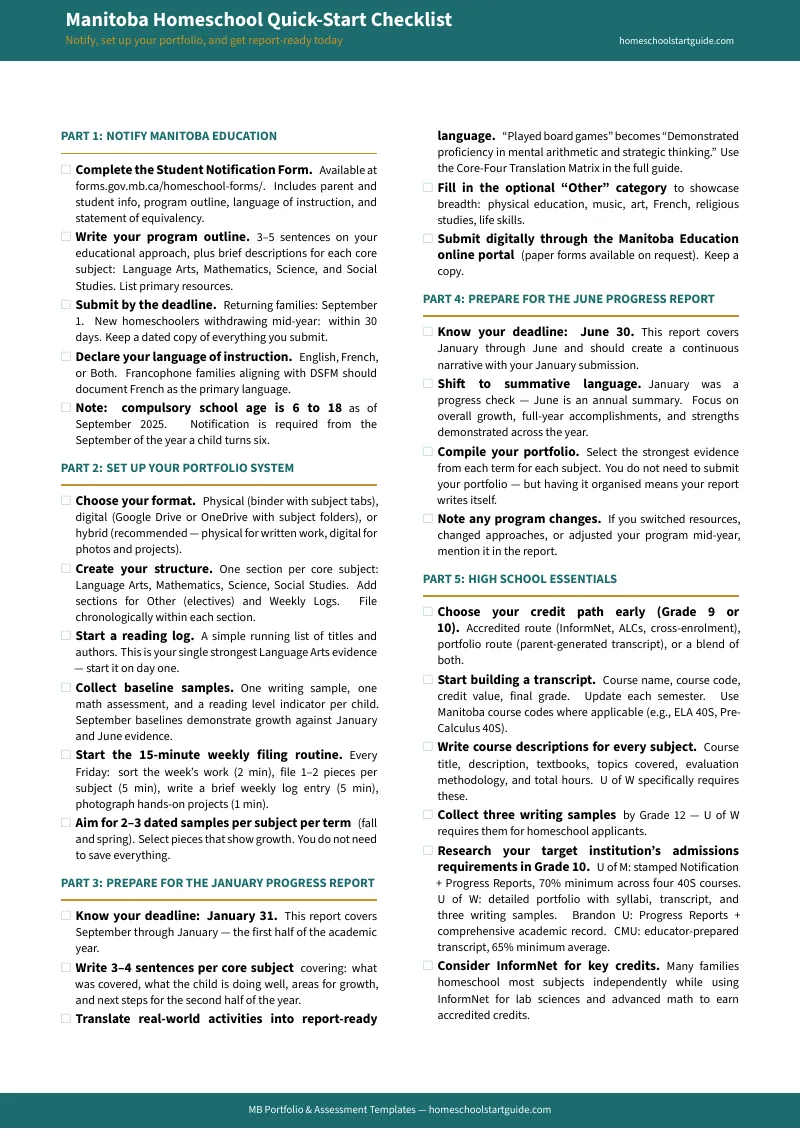
Your download includes the complete 16-chapter guide, the Manitoba Homeschool Quick-Start Checklist, and six standalone printable tools: the Core-Four Translation Matrix (pin it to your wall), the Weekly Documentation Log (print one per week), Progress Report Frameworks with sample language for January and June, the Compliance Calendar with every Manitoba deadline, a fillable Transcript Template with Manitoba course codes, and the University Admissions Guide covering U of M, U of W, Brandon, and CMU requirements. The guide covers Manitoba's full regulatory framework, grade-banded portfolio strategies (K-3, 4-6, 7-9, 10-12), high school credits and InformNet guidance, Liaison communication templates, and the 2025/2026 curriculum alignment.
30-day money-back guarantee. If the documentation system doesn't give you the confidence and structure to handle your next progress report, email us and we'll refund you. No questions asked.
Not ready for the full system? Download the free Manitoba Homeschool Quick-Start Checklist — a step-by-step overview of notifying Manitoba Education, setting up your portfolio, and preparing for both the January and June progress reports. It's enough to get oriented, and it's free.
Manitoba's documentation requirements aren't complicated — they're just poorly explained. The Documentation System turns your progress reports from something you dread into something you finish in 15 minutes.