Build Your Wyoming Micro-School Legally, Affordably, and Without a Franchise.
Wyoming homeschool law is simple — until you invite another family. W.S. §21-4-101(a)(v) defines a home-based educational program as instruction provided to children of "one family unit." The moment you teach children from a second family, you are no longer homeschooling in the eyes of Wyoming law. You are operating a private school. HB 46 eliminated the annual curriculum submission requirement for solo homeschoolers in 2025, but it changed nothing about the multi-family threshold. The Wyoming Department of Education is clear: more than one family unit means private school classification, which triggers registration with WDE, potential zoning complications, liability exposure, and — for secular pods — a regulatory pathway that most Wyoming parents don't even know exists.
You want to pull together three or four families in Casper, share the teaching load, and build something that actually fits your children. Maybe you are burned out on solo homeschooling sixty miles from the nearest co-op and need a shared-responsibility model. Maybe your rural school consolidated and the bus ride is now ninety minutes each way through Campbell County. Maybe you looked at Prenda's $2,199 per-student annual platform fee and decided you would rather keep the money and the autonomy. Maybe you are a military spouse who just PCS'd to F.E. Warren AFB and need a stable pod in Cheyenne before your child falls another semester behind. Maybe you are a ranching family near Sheridan whose work schedule makes rigid public school attendance impossible. Whatever the reason, you have arrived at the same conclusion: I need to build this myself.
The problem is that the internet gives you fragments. The Wyoming Department of Education provides a free homeschool information page — but it is a statutory summary that offers zero guidance on how to structure a multi-family pod as a private school, navigate zoning, secure liability insurance, or hire a facilitator legally. Homeschoolers of Wyoming (HOW) provides community support and advocated powerfully for HB 46, but their resources address single-family, parent-directed homeschooling — not multi-family, tuition-charging micro-schools. Facebook groups in Homeschoolers of Casper and Common Ground Homeschoolers of Laramie confidently declare that pods don't need insurance, that zoning doesn't apply if it's "just education," and that you can teach a dozen kids in your living room without any legal risk. You need a Wyoming Pod Founder's Blueprint — the complete operational framework without the dangerous legal guesswork, the franchise costs, or the ideological prerequisites.
The Wyoming Micro-School & Pod Kit is that Pod Founder's Blueprint.
What's Inside the Pod Founder's Blueprint
The One Family Unit Rule and Private School Threshold
Because the single most confusing question for every new pod founder is what happens when you cross the one family unit line under W.S. §21-4-101(a)(v). Operating within one family unit means you're homeschooling — no registration, no testing, no curriculum approval (especially after HB 46). But instructing children from two or more families legally reclassifies your operation as a private school. This framework walks you through both pathways: the homeschool cooperative model (where each family files individually and the pod provides only enrichment and socialization) and the private school model (where a hired facilitator teaches students from multiple families, requiring WDE registration for secular schools or religious exemption under W.S. §21-2-406). You choose the right legal structure before your first family meeting, not after the Wyoming Department of Education contacts you.
The Hathaway Scholarship Transcript Architecture
Because a single structural mistake on your child's transcript could permanently disqualify them from up to $13,440 in Hathaway Scholarship funding over eight semesters at the University of Wyoming or any Wyoming community college. The Hathaway Success Curriculum mandates four years of math, language arts, and science, three years of social studies, and sequenced electives including foreign language and CTE. Wyoming does not issue state diplomas to homeschooled or privately educated students — the burden of proof relies entirely on parent-generated transcripts. This section provides Hathaway-compliant transcript templates with proper course naming conventions, including guidance on documenting middle-school courses that qualify for high-school credit under HB 120.
The ESA Positioning Guide (Steamboat Legacy Scholarship Act)
Because Wyoming's $7,000 per-student Education Savings Account program is frozen under a Wyoming Supreme Court injunction — and most parents don't know whether to plan around it or ignore it entirely. This section explains what the ESA covers if it unfreezes, how to position your micro-school to accept ESA funds as a qualified provider, and — critically — how to build a pod that is financially sustainable without any state subsidy. The grassroots micro-school model works because of low overhead, not because of government funding.
The Zoning and Facility Navigator
Because Wyoming has minimal rules for education, but your city has rules for operating a group activity in a residential zone. Cheyenne requires home occupation registration for group activities. Casper's residential zones (R-1 through R-6) may restrict educational use. Laramie County unincorporated areas are largely deregulated. Jackson operates under Teton County's strict land development regulations. This navigator maps the key considerations for Cheyenne, Casper, Laramie, Gillette, Rock Springs, Sheridan, and Jackson — so you know your limits before the planning department tells you.
The Parent Agreement and Liability Waiver Templates
Because a child breaking an arm in your living room should not end the pod — and it will not, if you are prepared. Wyoming courts generally enforce liability waivers when the language is clear and specific. Customizable parent agreements covering educational philosophy, schedule, tuition, attendance, behavior, conflict resolution, withdrawal, and media privacy. Plus a standalone liability waiver with risk acknowledgment, release, indemnification, medical consent, and emergency contacts. Every family signs these before day one.
The Facilitator Hiring and Background Check Guide
Because hiring your first facilitator triggers employment classification decisions, payroll obligations, and non-negotiable background check requirements. Wyoming DCI criminal background check and sex offender registry search must be completed before any student contact. This section covers the W-2 vs. 1099 classification decision, Wyoming facilitator pay rates (Cheyenne/Casper $17–$19/hr, Jackson $34–$37/hr, statewide average $17.80/hr), contract templates, and scope of duties.
The Wyoming Regional Budget Planner
Because running a pod in Jackson costs nothing like running one in Gillette. Region-specific budget templates covering facilitator compensation, space rental, curriculum materials, insurance, and field trips — with real numbers for Jackson/Teton County (high-cost), Cheyenne/Casper/Laramie (moderate), and Gillette/Rock Springs/rural Wyoming (low-cost). Includes cost-sharing models for 3-family, 5-family, and 8-family pods.
The WHSAA Sports Access Guide
Because your child should not have to choose between the pod and Friday night football. Wyoming's Equal Opportunity for Student Athletes Act (W.S. §21-4-506) and the Wyoming High School Activities Association (WHSAA) legally permit homeschooled and privately educated students to participate in local public school sports and extracurricular activities. This section covers eligibility requirements, documentation, and the enrollment process — so your pod students access varsity athletics without re-enrolling in public school.
Who This Kit Is For
- Parents who have decided the public school system is not working for their child — whether because of school consolidation that turned a short commute into a ninety-minute bus ride, rigid curriculum, or safety concerns — and want to build a small, intentional alternative with a handful of like-minded families in Cheyenne, Casper, Laramie, Gillette, or Sheridan
- Solo homeschoolers who have reached the burnout threshold and need a shared-responsibility model where the instructional and social burden is distributed among trusted families — without losing control of their child's education. In Wyoming, your nearest homeschool family may be forty miles away, but a well-structured pod bridges that distance.
- Military families stationed at F.E. Warren AFB in Cheyenne who need a stable, legally compliant learning pod that provides academic continuity across PCS moves and variable deployment schedules — without starting from zero every time
- Ranching and energy sector families in the Powder River Basin, Sweetwater County, or the Wind River region whose non-traditional work schedules make rigid public school attendance impossible and who need a flexible, community-driven model that accommodates calving season, drilling rotations, and harvest schedules
- Parents of neurodivergent children (autism, ADHD, dyslexia, giftedness) who are exhausted by IEP battles and need an ultra-low-ratio, self-paced learning environment that public schools structurally cannot provide
- Former educators who have left the Wyoming public school system and want to serve their community by running a small paid micro-school — without the overhead, the revenue share, or the rigid pedagogy of a franchise network
- Families on or near the Wind River Reservation who want a micro-school that honors Eastern Shoshone or Northern Arapaho culture, language, and land-based learning while providing structured academic instruction in Wyoming's seven required subjects
After Using the Kit, You'll Be Able To
- Understand the one family unit rule under W.S. §21-4-101(a)(v) and know exactly when a learning pod crosses from homeschool territory into private school classification — and how to structure either pathway correctly using the decision flowchart in Chapter 2
- Navigate the HB 46 changes (effective July 2025) and understand what the Homeschool Freedom Act changed for solo homeschoolers and what it did not change for multi-family pods
- Build Hathaway-compliant transcripts using the included templates — protecting up to $13,440 in merit scholarship funding per child at UW or any Wyoming community college
- Run your first parent intake meeting using a signed Family Agreement and liability waiver — without spending $300 on a Cheyenne education attorney
- Choose the right space for your pod based on your city's zoning considerations — home, church, or community space — and know the key thresholds for Cheyenne, Casper, Laramie, Gillette, and Jackson
- Hire and background-check a facilitator legally, classify them correctly for Wyoming tax purposes, and pay them competitively using real local wage benchmarks
- Enroll pod students in dual enrollment at Casper College, Laramie County Community College, or any Wyoming community college — and access WHSAA-sanctioned sports through local public schools under the Equal Opportunity for Student Athletes Act
Why Not Just Use the Free Resources?
The Wyoming Department of Education provides a free homeschool information page. Homeschoolers of Wyoming (HOW) runs events and maintains community resources. Facebook groups across Wyoming have thousands of homeschool parents trading advice. Here is exactly what you run into when you try to build a pod from those sources alone:
- WDE gives you a statutory summary and walks away. The WDE homeschool page summarizes W.S. §21-4-102 and confirms the seven required subjects. For a solo homeschooler, that is all you need. For a pod founder hosting other families' children and collecting tuition, it tells you nothing about the one family unit threshold, private school registration, zoning, insurance, employment law, or Hathaway transcript formatting.
- HOW gives you community but not operations. Homeschoolers of Wyoming championed the Homeschool Freedom Act and their community events are excellent. But HOW's guidance centers on single-family, parent-directed homeschooling. They provide no templates, no legal frameworks, and no guidance on the operational mechanics of running a multi-family, tuition-charging pod.
- Facebook groups are an echo chamber of outdated legal advice. Parents confidently claim that HB 46 eliminated all oversight for pods, that zoning doesn't apply to education, and that the one family unit rule doesn't matter if you're not charging tuition. HB 46 removed the curriculum filing requirement for individual homeschoolers. It did not change the private school threshold, municipal zoning, or liability exposure.
- Etsy templates are generic planners with a micro-school label. Canva templates, minimalist worksheets, and generic enrollment forms priced at $4–$12. Not one references W.S. §21-4-101, the one family unit rule, the Hathaway Success Curriculum requirements, Wyoming's DCI background check process, or zoning restrictions in Cheyenne, Casper, or Jackson. They help you organize a schedule. They do not help you form a legally protected pod.
- Prenda and Acton solve the problem — and take your autonomy and revenue. Prenda charges $2,199 per student per year in platform fees — and Wyoming's ESA is frozen, so there is no state funding to offset the cost. Acton Academy demands roughly $20,000 in upfront franchise fees. Both require you to recruit the families, find the space, and build the community yourself. If you are doing the hard work of building local trust, you should keep 100% of the revenue and 100% of the curriculum control.
Free resources give you the inspiration and the legal baseline. The Pod Founder's Blueprint gives you the templates, checklists, and frameworks to execute this week.
— Less Than One Hour With a Cheyenne Education Attorney
A single consultation with a Wyoming education attorney costs $200 to $350 per hour. Prenda charges $2,199 per student per year in platform fees. Acton Academy demands roughly $20,000 in franchise fees. The Kit costs less than one hour of professional advice and gives you the operational independence those platforms are designed to prevent — plus the Hathaway transcript architecture and WHSAA sports access guide that protect your child's college funding and extracurricular access.
Your download includes the complete guide (14 chapters covering Wyoming's legal framework, the one family unit rule, private school classification, ESA positioning, pod formation, zoning, insurance, facilitator hiring, curriculum selection, dual enrollment, the Hathaway Scholarship, WHSAA sports access, specialized micro-school models for ranching families, military families, and Wind River communities, and operations and scaling), the Wyoming Pod Launch Checklist (print-and-pin), and four standalone printable templates — the Family Agreement, Liability Waiver, Facilitator Contract, and Wyoming Regional Budget Planner. Instant download, no account required.
30-day money-back guarantee. If the Kit does not give you the legal clarity and operational confidence to move forward with your pod, email us and we will refund you. No questions asked.
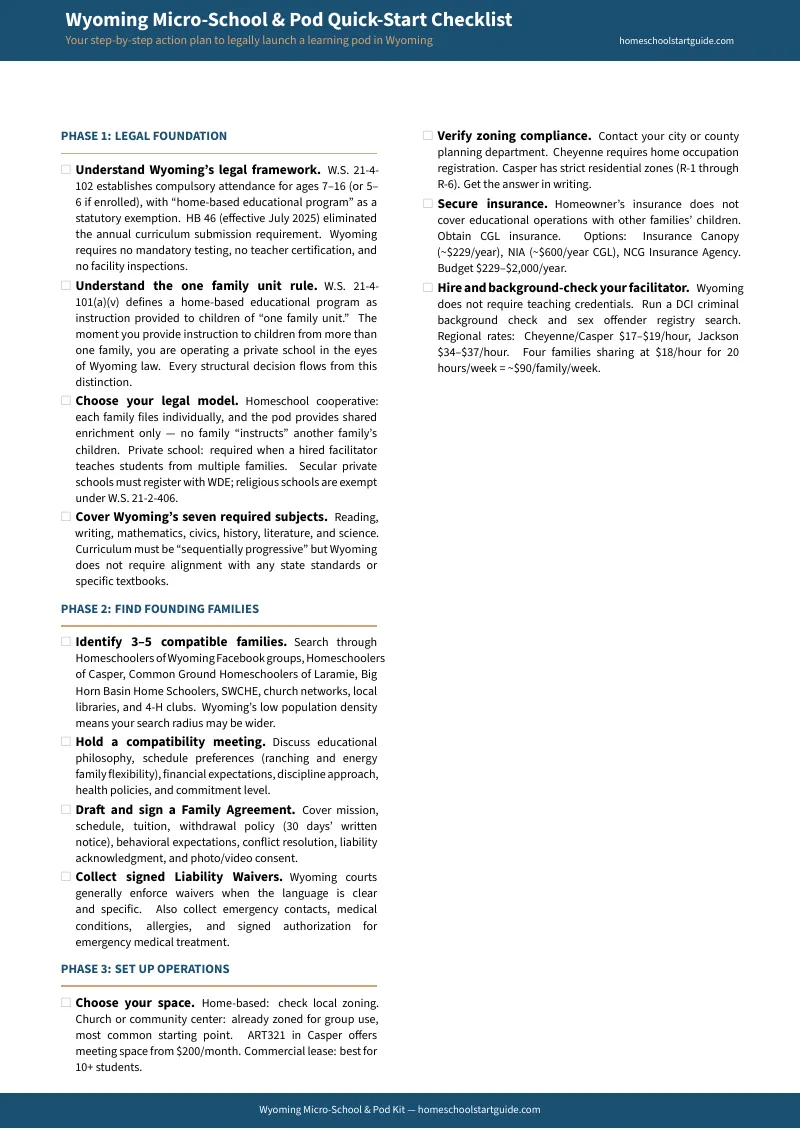
Not ready for the full Kit? Download the free Wyoming Homeschool Quick-Start Checklist — a one-page summary of the legal framework under W.S. §21-4-102, the one family unit rule, the private school threshold, the HB 46 changes, the ESA basics, and the key zoning considerations for Cheyenne, Casper, and Laramie. It is enough to understand your rights tonight.
Wyoming gave you the freedom. The Pod Founder's Blueprint makes sure you use it correctly.