Build Your Wisconsin Micro-School Legally, Confidently, and Without the One-Family Rule Destroying Your Pod.
Wisconsin is one of the easiest states to homeschool in — file a PI-1206, teach six subjects, log 875 hours. No testing. No portfolio reviews. No teacher qualifications. But the moment you invite another family to share instruction, you collide with statute §115.001(3g): "an instructional program provided to more than one family unit does not constitute a home-based private educational program." Violate this rule and every family in your pod loses their homeschool status overnight. That is not a warning from a Facebook group. That is the law.
You want to build a micro-school. Five to twelve kids from families in your neighbourhood, meeting four or five days a week with a facilitator, following a real curriculum, building real friendships — at a fraction of what Milwaukee or Madison private school tuition costs. So you went online. One parent in the Wisconsin Homeschool Support group says you just file PI-1206s and gather for enrichment and nobody cares. Another says you need to register as a private school the moment anyone teaches someone else's child. The WHPA website warns that micro-schools are NOT homeschools and tells you not to go "above and beyond what is required by law." The DPI says it "does not provide personal consultation" about home-based educational programmes. After weeks of contradictory advice across WHPA, the DPI homeschool page, Reddit, and half a dozen Facebook groups, you still do not know whether your pod needs individual PI-1206 filings or a single PI-1207 private school registration.
The Wisconsin Micro-School & Pod Kit is the Wisconsin Pod Compliance Blueprint — every legal pathway, operational template, and compliance tool you need to launch a legally sound learning pod in Wisconsin without paying $2,500 for an education consultant or $6,200 per child for a Prenda franchise.
What's Inside the Pod Compliance Blueprint
The PI-1206 vs PI-1207 Decision Framework
Because the single most confusing question for every new Wisconsin pod founder is whether each family files an individual PI-1206 as a home-based private educational programme or the micro-school registers as a PI-1207 private school under §118.167. The PI-1206 enrichment model is simpler and avoids the private school compliance burden — but it constrains how instruction is shared. The PI-1207 pathway eliminates the One-Family Rule entirely, unlocks the Schedule PS tuition tax deduction, and gives you formal school recognition — but adds staff-to-student ratios and curriculum documentation. This framework walks you through the exact criteria so you choose the right structure before your first family meeting, not after a DPI letter forces the question.
The One-Family Rule Compliance Strategy — §115.001(3g)
Because this is the single statute that can destroy a Wisconsin pod. If your facilitator is directly instructing children from multiple families during what counts as core 875 hours, every family's PI-1206 status is at risk. The Kit provides the enrichment classification framework — how to structure shared activities so they fall outside the legal definition of "instruction," how to maintain a clear line between each family's core single-family instruction and the pod's enrichment programming, and how to document both categories with a dual-ledger system that would survive scrutiny. This chapter alone is worth the price of the Kit.
The 875-Hour Dual-Ledger Tracking System
Because Wisconsin requires 875 hours annually across six mandated subjects — reading, language arts, mathematics, social studies, science, and health — and in a multi-family pod, you need a tracking system that cleanly separates each family's core single-family instruction from shared enrichment time. The Kit provides a pre-formatted dual-ledger tool with separate columns for PI-1206 core hours and pod enrichment hours, six-subject breakdowns, weekly and monthly roll-ups, and annual compliance verification. Each family gets their own ledger. The pod leader gets a coordination dashboard.
Parent Agreements That Prevent Pod Implosions
Because the number one reason micro-schools fail is not legal trouble — it is a family who stops paying, a parent who disagrees with the facilitator's discipline approach, or a philosophical clash that festers for months. Comprehensive parent agreement templates covering mission, schedule, tuition, payment terms, late penalties, withdrawal and refund policy, behavioural expectations, health exclusion, dispute resolution, liability, and termination. This document is what separates a pod that lasts three months from one that lasts three years.
Facilitator Hiring — Background Checks, Pay Rates, and the 1099 vs W-2 Question
Because Wisconsin does not require teacher qualifications for home-based programmes, but practical considerations apply when you entrust someone with multiple families' children. Wisconsin DOJ background check procedures, hiring channels, interview frameworks, and real compensation benchmarks: $25–$40/hour in Milwaukee metro, $22–$38/hour in Madison, $20–$32/hour in Green Bay/Appleton, $18–$28/hour in rural Wisconsin. Plus the critical employee vs. independent contractor classification — because getting this wrong creates tax liability for the entire pod.
The Wisconsin Regional Budget Planner
Because running a pod in Brookfield costs nothing like running one in Stevens Point. Region-specific budget models covering facilitator compensation, space rental, curriculum materials, insurance, and field trips — with real numbers for Milwaukee metro, Madison, Green Bay/Fox Valley, and rural Wisconsin. Includes cost-sharing models for 3-family, 5-family, and 8-family pods, with per-student breakdowns that you can hand to prospective families at your first parent meeting.
The Zoning and Space Compliance Guide
Because hosting eight children in your Brookfield home may trigger municipal zoning enforcement — and the rules vary sharply by municipality. Milwaukee DNS home occupation permit requirements, Madison's 2-client limit for home-based businesses, suburban municipality rules for Waukesha, Kenosha, and Green Bay, and alternative space options: church classrooms, community centres, co-working spaces, and library meeting rooms. Zoning confusion kills more pods at the planning stage than any other single issue.
The 30-Day Pod Launch Timeline
Because most parents spend months assembling the launch sequence from scattered forum posts, DPI factsheets, and WHPA newsletters. A single-page, print-and-pin document that walks you from "I have an idea" to "the first day of pod school" — legal structure, family recruitment, agreements, filings, space, curriculum, facilitator, insurance, and first-week operations in the correct order.
Who This Kit Is For
- Milwaukee and Waukesha County parents who are done with MPS safety concerns, lead paint closures, and chronic staffing shortages — and want to build a small, high-quality alternative with trusted families without paying $8,000–$13,000 per year in private school tuition or being locked out of the WPCP voucher programme by income limits
- Solo homeschoolers anywhere in Wisconsin who've hit the burnout wall and need a shared-responsibility model where the instructional and social burden is distributed among families — without losing curriculum control or legal compliance
- Madison-area parents of neurodivergent children (autism, ADHD, sensory processing) who need an ultra-low-ratio, sensory-friendly learning environment that public school classrooms structurally cannot provide — and who want a structured alternative to isolating solo homeschool
- Secular or progressive families who've found that Wisconsin's largest homeschool networks centre on religious orthodoxy — and need a legally sound charter for an inclusive, non-denominational pod
- Hispanic and Hmong families in Milwaukee who want a culturally responsive micro-school that integrates heritage language instruction with the six mandated DPI subjects
- Green Bay, Appleton, and Fox Valley families looking for a structured community learning model beyond the local co-op — with professional facilitation, parent agreements, and accountability
- Former educators who've left the public school system and want to serve their community by running a small paid pod — without the $6,200-per-student franchise fee, the revenue share, or the rigid pedagogy of a network model
- Families who looked at Prenda, KaiPod, or Acton Academy and decided they'd rather keep the autonomy and the $6,000–$13,000 per child per year — and build something that fits their community instead of fitting into a franchise
Why Not Just Use the Free Resources?
The DPI publishes the statute text. The WHPA runs a convention and a newsletter. Facebook groups have thousands of Wisconsin homeschool parents trading advice. Here is exactly what you run into when you try to build a pod from those sources alone:
- The DPI tells you to figure it out yourself. The Department of Public Instruction explicitly states it "does not provide personal consultation and technical assistance regarding home-based private educational programs." Parents reading the statute about the One-Family Rule, the 875-hour requirement, and the six-subject mandate are left panicked and confused about how any of this applies to a multi-family pod.
- The WHPA actively discourages micro-schools. They helped author the 1984 homeschool law and successfully opposed AB 122 / SB 201 — the bill that would have explicitly legalized micro-school pods. Their official position is that "micro education pods ARE NOT homeschools," and they warn parents not to go "above and beyond what is required by law." They offer zero templates, zero legal frameworks, and zero practical guidance for structuring a compliant pod.
- Facebook groups are an echo chamber of contradictory legal advice. One parent says your pod is fine as enrichment. Another says you need private school registration immediately. A third says just don't tell anyone. The emotional support is real. The legal guidance could trigger a truancy investigation.
- Prenda, KaiPod, and Acton solve the structure problem — at $6,200 to $13,000 per child per year. These franchise networks provide curriculum, software, and operational support — but the financial burden is enormous, the pedagogical control belongs to the franchise, and the quality depends entirely on your local guide or campus. The Kit gives you the same operational structure without the annual platform fees.
- The Etsy "micro-school starter kits" are Canva planners with a micro-school label. Generic daily schedules and enrollment forms at $5–$28. Not one references §115.001(3g), the 875-hour requirement, the PI-1206 vs PI-1207 decision, or Wisconsin's specific zoning rules. They help you organise a schedule. They don't help you form a legally compliant pod.
Free resources give you the inspiration and the legal baseline. The Pod Compliance Blueprint gives you the templates, checklists, and frameworks to execute this week.
— Less Than One Hour With a Wisconsin Education Consultant
A single consultation with an education attorney costs $250 to $400 per hour. The KaiPod Catalyst programme starts at $499 per year. Prenda charges approximately $2,200 per student per year in platform fees. Acton Academy tuition runs $6,500 to $13,150 in Wisconsin locations. The Kit costs less than one hour of expert advice and gives you the operational independence those platforms are designed to prevent.
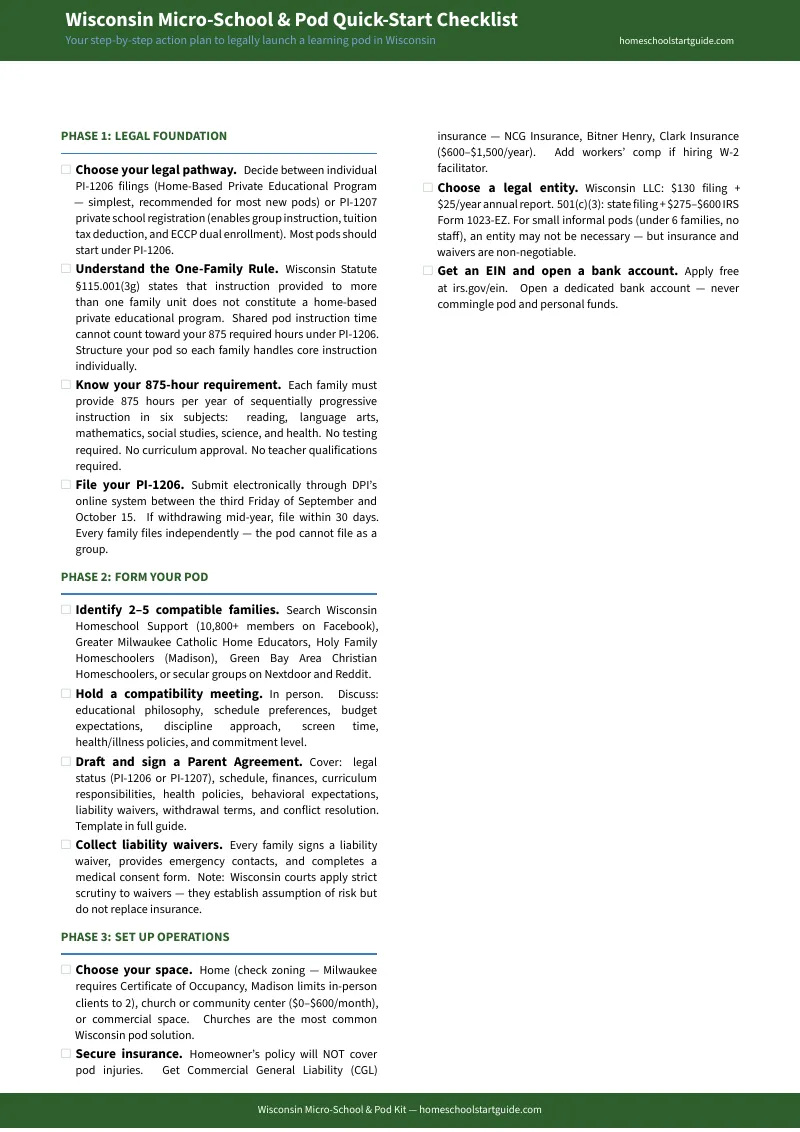
Your download includes 7 printable PDFs: the complete guide (30 chapters covering both legal pathways, One-Family Rule compliance, 875-hour tracking, facilitator hiring, parent agreements, zoning, insurance, budget models, dual enrollment, university admissions, neurodivergent accommodations, bilingual models, and a 30-day launch timeline), the Wisconsin Pod Launch Checklist (one-page print-and-pin), plus 5 standalone templates ready to customise and sign — Parent Participation Agreement, Facilitator Contract, Liability Waiver with Emergency Contact Form, Annual Budget Planner, and the 875-Hour Dual-Ledger Tracking Log. Instant download, no account required.
30-day money-back guarantee. If the Kit doesn't give you the legal clarity and operational confidence to move forward with your pod, email us and we'll refund you. No questions asked.
Not ready for the full Kit? Download the free Wisconsin Homeschool Quick-Start Checklist — a one-page summary of the legal requirements, PI-1206 filing basics, the One-Family Rule, and what you need to know before gathering families. It's enough to understand your rights tonight.
Wisconsin's One-Family Rule makes pod formation legally complex. The Pod Compliance Blueprint makes it operationally simple.