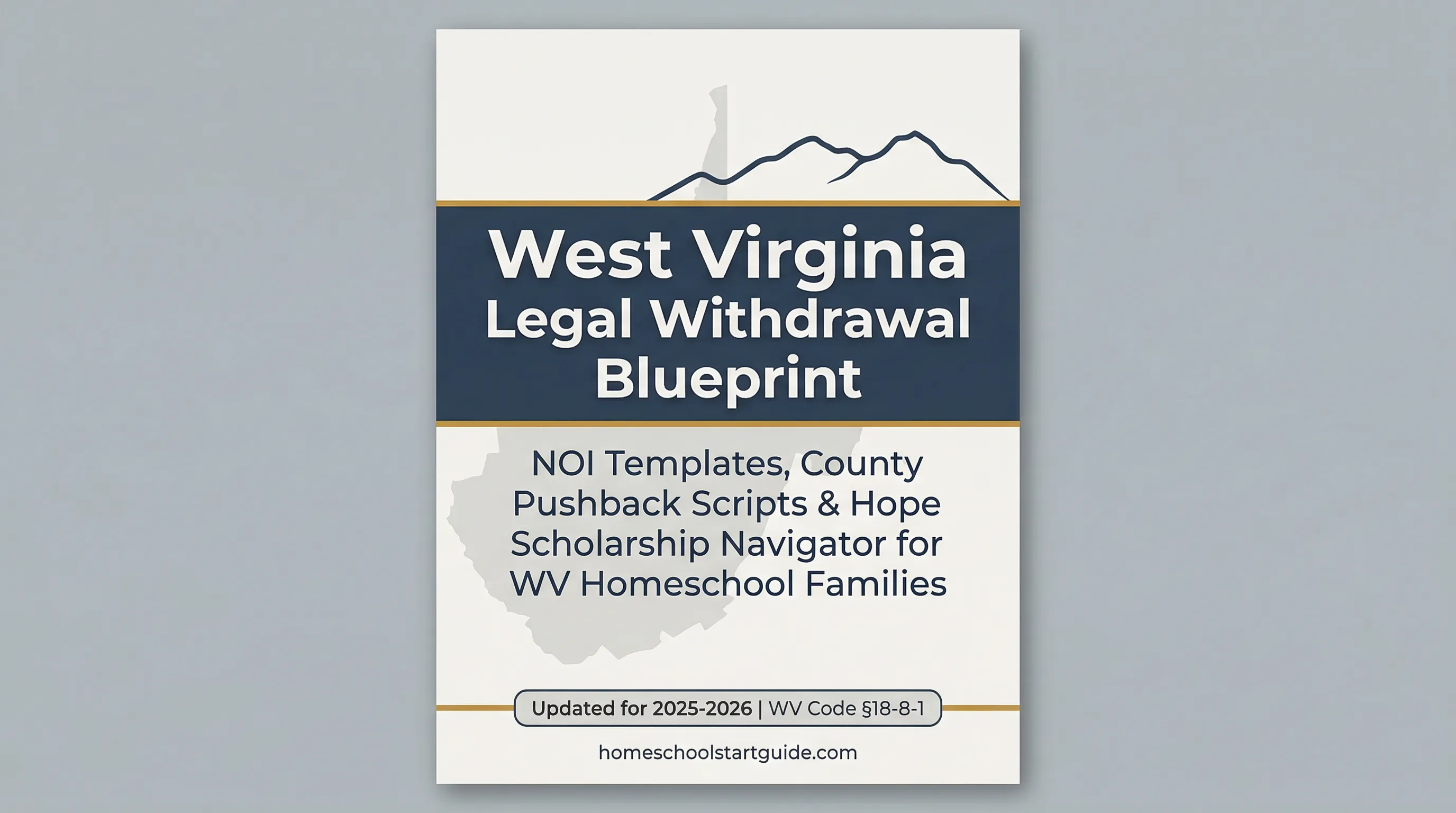
West Virginia Has Two Homeschool Pathways. The County Will Hand You Forms for the Wrong One.
You've made the decision. Your child comes home anxious, defeated, or afraid. Maybe the bullying has escalated and the administration keeps shrugging. Maybe you discovered your fourth-grader reads at a second-grade level while the school insists they're "doing fine." Maybe a safety incident happened today and you said, "We're done." You sat down to research how to legally withdraw your child in West Virginia, and within twenty minutes you found three contradictory answers.
One website says file a "Notice of Intent" with the county superintendent. A CHEWV page says you also need to choose between Board Approval and the Notice pathway — but doesn't explain why you'd ever pick Board Approval (you wouldn't). The WVDE website links to the raw statutory code — WV Code §18-8-1 — and then directs you to your local superintendent's office. The school secretary hands you a county "substitute form" that asks for your daily instructional schedule, the number of minutes per subject, which assessment you'll use at the end of the year, and your social security number.
Here's the problem: that county form is illegal. West Virginia law does not require any of that information. But parents fill it out every day because no one told them they could refuse. And the actual legal requirements — what the Notice of Intent must contain, how to avoid the Board Approval trap, what the "fourth stanine" assessment threshold really means — are buried across government PDFs, CHEWV's religiously-framed legal annotations, and Facebook threads mixing 2019 advice with 2026 law.
The County-Proof Compliance System inside this Blueprint eliminates the guesswork. It walks you through both legal pathways, gives you the exact NOI template that satisfies the law without surrendering a single piece of information the county has no right to demand, and provides word-for-word scripts for when the superintendent's office pushes back — so you never fill out an illegal substitute form or accidentally trigger the Board Approval pathway you don't want.
What's Inside the Blueprint
The Two-Pathway Decision Guide
West Virginia offers two legal pathways to homeschool: Option 1 (Board Approval under §18-8-1(c)(1)) gives the county board subjective power over your homeschool — they can approve or deny your request and impose conditions. Option 2 (Notice of Intent under §18-8-1(c)(2)) is the standard pathway used by the vast majority of West Virginia homeschoolers — you file the NOI and begin. The Blueprint explains why Option 2 is the one you want, what happens if you accidentally trigger Option 1, and how to avoid the county's substitute form that blurs the line between the two.
The Notice of Intent Template
The NOI must contain five specific elements: your child's name, address, and age; assurance of instruction in five core subjects (reading, language, math, science, social studies); assurance of annual assessment; and a copy of your high school diploma, GED, or degree. That's it. The county's substitute form asks for daily instructional minutes, curriculum plans, and assessment selections — information the law does not require you to provide. The Blueprint includes a fill-in-the-blank NOI template that satisfies every legal requirement without giving the county a single piece of information they have no right to demand.
The Withdrawal Letter Templates
Fill-in-the-blank templates for every scenario: standard withdrawal to homeschool, mid-year withdrawal, and withdrawal for a child with an IEP or 504 Plan. Each template includes exactly what to say, what to exclude (your reasons, your curriculum, a request for permission), and a FERPA records request so you get your child's cumulative file automatically. Print, fill in the blanks, send via certified mail — done.
The County Pushback Protocol
When the superintendent's office calls to "discuss" your NOI, emails demanding a meeting, or sends back your NOI claiming it's "incomplete" — you don't panic or call a lawyer. The Protocol provides copy-and-paste response scripts citing WV Code §18-8-1 and the specific statutory language that makes each demand unlawful. West Virginia law does not give any county administrator the authority to approve, deny, or delay your Notice of Intent. The scripts make sure they know it.
The Assessment Decoder
West Virginia requires an annual academic assessment after year one. You have four options: nationally normed standardized test (scoring at or above the fourth stanine), portfolio review by a certified teacher with a face-to-face evaluation, assessment by a licensed psychologist, or an alternative approved by the county superintendent. The "fourth stanine" sounds intimidating until you learn it means the 23rd percentile — not the 40th percentile that most websites incorrectly cite. The Blueprint compares all four options by cost, logistics, and stress level, explains what happens if scores fall below threshold, and provides the two-consecutive-year timeline that governs remediation.
The Hope Scholarship Navigator
West Virginia's Hope Scholarship (ESA) provides up to $4,600 per student for educational expenses — and effective July 2026, the 45-day public school enrolment requirement is eliminated, opening the scholarship to all students including existing homeschoolers. But the withdrawal process for Hope Scholarship families is different from traditional homeschool withdrawal: the school uses a WDHOPE withdrawal code (not WD09), and you must file a Notice of Intent under Exemption M (not Exemption C). Getting this wrong can void your funding eligibility permanently. The Blueprint walks through the exact sequence, code distinctions, and transition process step by step.
The Tim Tebow Act & Sports Access Guide
West Virginia law allows homeschooled students to participate in public school sports and extracurriculars if they meet the 4th stanine assessment threshold and reside in the school's attendance zone. The guide covers WVSSAC eligibility rules, the academic threshold, the annual verification process, and how to handle a school that tries to deny access your child has a legal right to exercise.
Who This Blueprint Is For
- Parents who need to withdraw their child this week — not after months of research — and want the legally correct paperwork ready to file tonight
- Parents who received the county's "substitute form" and sense something is wrong — because it asks for information the law doesn't require
- Parents confused by the two-pathway system who need a clear explanation before they accidentally trigger Board Approval instead of the standard Notice of Intent
- Parents considering the Hope Scholarship and who need to understand the WDHOPE vs. WD09 withdrawal code distinction and Exemption C vs. Exemption M before they file anything
- Parents whose child has an IEP or 504 Plan and who need to understand what happens to special education services after withdrawal
- Secular families who need West Virginia-specific guidance without the religious curriculum recommendations, CHEWV's ministry framing, or HSLDA's $135/year membership requirement
- Rural Appalachian families who can't easily drive to the county seat to ask questions that the superintendent's office isn't legally required to answer
- Military families stationed at or moving to West Virginia who need to establish legal homeschool status quickly
- Parents who've been verbally told by a principal or attendance director that they "can't just withdraw" — and who need the exact statutory language proving they can
Why Not Just Use the Free Resources?
You can. The WVDE website has the statutory code. CHEWV publishes free NOI templates and legal summaries. HSLDA has a state law overview. Here's what actually happens when you try to assemble a withdrawal strategy from free sources:
- The WVDE sends you straight to the county. The state website provides the raw statutory text and a downloadable Letter of Intent PDF — then directs you to your local superintendent to complete the process. That's where parents get handed the county substitute forms demanding daily instructional minutes, curriculum plans, and assessment selections that the law doesn't require. The WVDE doesn't warn you about this trap because the WVDE isn't your advocate.
- CHEWV is thorough but overwhelming and religiously coded. Their colour-coded legal breakdown is genuinely excellent — but it spans multiple dense pages of annotated legal text that a panicked parent doesn't have the bandwidth to parse. Their free NOI template is legally accurate, but the surrounding resources assume a Christian worldview that alienates the growing secular homeschool population in Morgantown, Charleston, and university communities. And they don't provide pushback scripts for when the county challenges your filing.
- HSLDA gates their templates behind $135/year. For a state where the withdrawal process is one NOI filed once — that's a $135 annual subscription for a one-time filing. The Blueprint gives you the same templates and pushback scripts for a fraction of one month's HSLDA fee, with no subscription and no political affiliation.
- Facebook groups give you 2022 advice in 2026. For every accurate comment, there are three that confuse the Board Approval pathway with the Notice of Intent pathway, cite the "40th percentile" myth (it's actually the 23rd percentile — the fourth stanine), or don't know about the 2026 Hope Scholarship universal expansion. One parent in a Kanawha County Facebook group was told to "just call the principal and say you're done" — which triggers an unexcused absence in the WVEIS system and a truancy investigation within days.
— Less Than a School Supply Run
An HSLDA membership runs $135 per year. A CHEWV membership requires a $15 annual donation. A single hour with a family attorney in Charleston or Huntington costs $200-$350. A truancy investigation triggered by an unfiled NOI costs you weeks of anxiety and potentially a magistrate court appearance. The Blueprint costs less than the gas to drive to the county superintendent's office to ask questions they're not legally obligated to answer clearly.
Your download includes 7 PDFs: the complete Blueprint guide (13 chapters), the Quick-Start Checklist, and 5 standalone printables you can use immediately without reading the full guide — the Notice of Intent template, withdrawal letter templates (mid-year and end-of-year), county pushback scripts, the assessment decoder (stanine scale, four methods, reporting schedule), and the Option 1 vs. Option 2 pathway comparison. Everything covers the two legal pathways, the county form trap, Hope Scholarship navigator (2026 universal expansion, WDHOPE vs. WD09, Exemption C vs. M), the PROMISE Scholarship, Tim Tebow Act sports access, IEP guidance, dual enrolment, and county-by-county support networks. Instant download, no account required.
30-day money-back guarantee. If the Blueprint doesn't give you the confidence and legal clarity to execute your withdrawal, email us and we'll refund you. No questions asked.
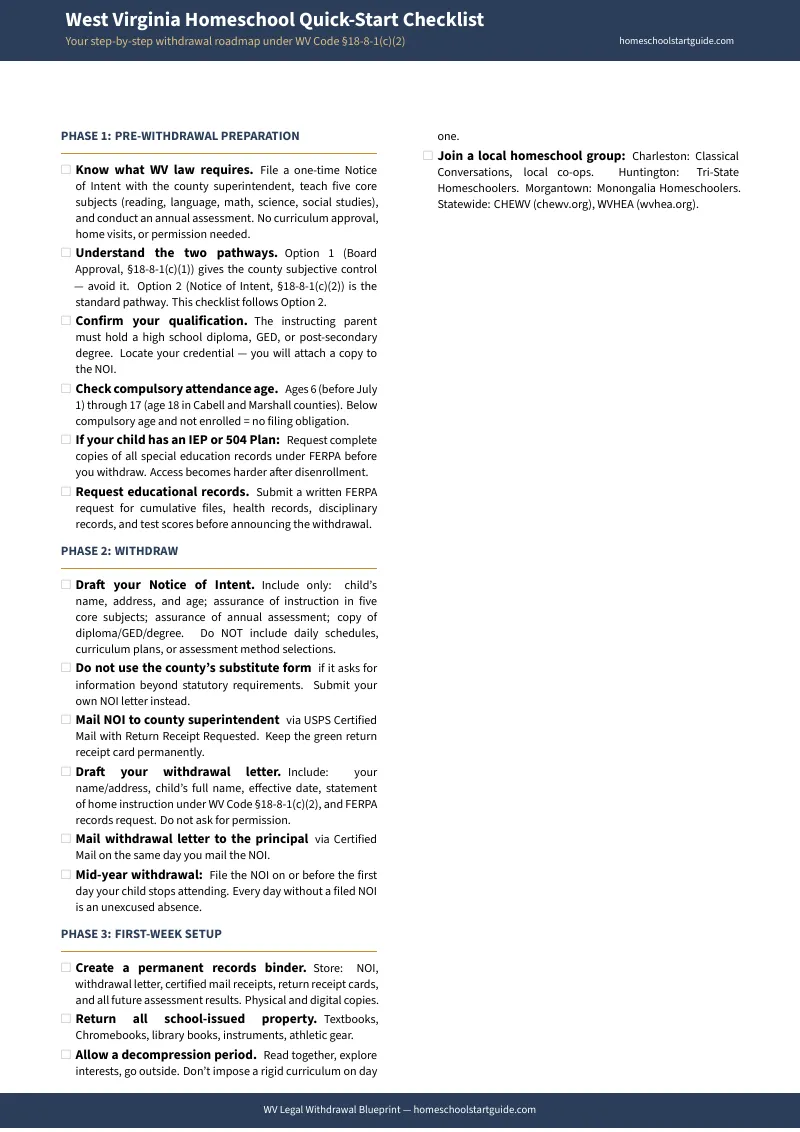
Not ready for the full Blueprint? Download the free West Virginia Homeschool Quick-Start Checklist — a step-by-step action plan covering every phase of withdrawal, the critical county form warning, and the single most important thing to exclude from your Notice of Intent. It's enough to get started, and it's free.
Your child doesn't have to go back on Monday. West Virginia law protects your right to educate at home. The county just hasn't told you how straightforward it actually is. The Blueprint makes sure they can't pretend otherwise.