Your Assessment Is Due June 30. Your Portfolio Isn't Ready. That's About to Change.
You've been homeschooling in West Virginia for months — maybe a full year. Your child is learning, growing, making real progress in reading, math, science, all five mandated subjects. But now spring is here, and you're staring at the annual assessment deadline. You have work samples scattered across binders, Google Drive folders, and a kitchen table pile you keep meaning to organize. You know you need to either score at the 40th percentile on a standardized test or get a certified teacher to review your portfolio and write a formal narrative. What you don't have is a system for assembling the evidence that proves what you already know: your child is thriving.
Meanwhile, every West Virginia homeschool Facebook group has a different opinion about what evaluators expect, whether the 40th percentile means the same thing as the 4th stanine (it does), how to find a certified teacher willing to do portfolio reviews in a rural county, and what happens if you're on the Hope Scholarship and miss the June 8 deadline instead of the June 30 one. CHEWV locks their best resources behind a $25/year membership. WVHEA's forms are view-only Google Docs you have to copy and reformat yourself. Generic Amazon planners don't know that West Virginia requires five specific subjects — and they certainly don't track PROMISE Scholarship core credits or Tim Tebow Act semester portfolios.
The West Virginia Portfolio & Assessment Templates is a Dual-Track Compliance System — 16 chapters covering both homeschool pathways (Exemption C and Exemption M), all four assessment options, grade-banded portfolio frameworks from kindergarten through high school, and every template you need to satisfy your annual assessment — designed to document exactly what § 18-8-1 requires and absolutely nothing more. No over-reporting that invites county scrutiny. No generic planners built for states with different laws. No recurring memberships for forms you should own outright.
What's Inside
Two Pathways Decoded — Exemption C vs. Exemption M
West Virginia now operates two parallel homeschooling systems, and most families don't realize they have different deadlines, submission rules, and oversight levels. Traditional homeschoolers under Exemption C submit assessment results only in grades 3, 5, 8, and 11 by June 30. Hope Scholarship families under Exemption M must submit every year by June 8 — miss it and your funding is automatically terminated. Chapter 2 maps both pathways side by side so you never confuse your track, your deadline, or your submission protocol.
All Four Assessment Options Explained
West Virginia gives you four ways to satisfy the annual assessment: standardized testing, portfolio review by a certified teacher, assessment by a public school, or alternative assessment with county agreement. Chapter 4 breaks down each option — eligibility, cost, preparation requirements, scoring thresholds, and the specific documentation each one produces. If you're trying to decide between testing and portfolio review, this chapter makes the decision for you based on your child's learning style, your budget, and your tolerance for evaluator logistics.
Standardized Testing and the 40th Percentile
If you choose standardized testing, your child must score a mean across all five subjects at or above the 40th percentile (4th stanine). Not the 40th grade level. Not a subject-by-subject pass. The mean across all five. Chapter 4 explains what this actually measures, which approved tests to order (CAT, Iowa Assessments, Stanford 10, Woodcock-Johnson), what "composite mean" means in practice, and why you should submit only the composite score — not individual subject breakdowns that give the superintendent information the law doesn't entitle them to see.
Portfolio Review — What Evaluators Actually Want to See
The alternative to testing is a portfolio review by a West Virginia certified teacher. The evaluator examines work samples, writes a formal narrative covering progress in all five mandated subjects, and notes any areas requiring remediation. But evaluators vary wildly in what they expect — some want thick binders organized by subject, others want a brief narrative with selected samples. Chapters 4 and 7 provide evaluator-ready cover sheets with pre-written statutory language and a clear organization framework, so your evaluator reviews the evidence and signs. Finding an evaluator in rural Appalachian counties is a real challenge — the guide covers strategies for remote evaluations via video call and shared digital portfolios.
When Scores Fall Short — Remediation and the Two-Year Rule
If your child scores below the 40th percentile, you enter a remediation year. It is not an immediate loss of your right to homeschool. Chapter 5 walks through the exact sequence: notification from the superintendent, the remediation plan you must implement, the re-assessment timeline, and what evidence to collect during the remediation year. If a second consecutive year of unacceptable progress follows, the superintendent can petition the circuit court — and your documentation becomes your defence. This chapter also covers the two-year exemption: after two consecutive years of acceptable assessments, you're exempt from submitting results until the next statutory grade (3, 5, 8, or 11).
Grade-Banded Portfolio Frameworks
A kindergartener's portfolio looks nothing like a tenth-grader's. Chapter 8 provides grade-banded documentation frameworks — K-2, 3-5, 6-8, and 9-12 — with specific guidance on what to collect for each of the five mandated subjects, how many samples per subject per term, what "progress in accordance with the child's abilities" looks like at each developmental stage, and how to organize evidence for both testing and evaluation pathways. Each framework includes a weekly 15-minute filing system so you never face a last-minute portfolio panic again.
High School Transcript Templates
The transcript is the highest-stakes document you'll produce as a homeschool parent. WVU, Marshall, Concord, Fairmont State, and the military all expect professionally formatted academic records. Chapter 9 provides a transcript template with fields for course title, credits, grade, grading scale, cumulative GPA, and your signature as the educational administrator. Plus: how to calculate weighted and unweighted GPAs, how to document AP and honours coursework, and how to write course descriptions that West Virginia university admissions offices expect.
PROMISE Scholarship Core Credit Tracking
The PROMISE Scholarship requires a minimum 3.0 core GPA calculated from specific courses: 4 English, 4 Mathematics, 4 Social Sciences, and 3 Natural Sciences (lab-based). Generic planners don't track these requirements. The transcript template in Chapter 9 structurally groups courses into the exact core categories required by the Higher Education Policy Commission, so when you submit the Grade Verification Form, every credit maps cleanly.
Hope Scholarship Compliance
Chapter 12 is built specifically for families receiving Hope Scholarship funds. It covers the Exemption M filing process, the June 8 assessment deadline (not June 30), the WVEIS ID requirement, annual vs. grade-specific submission, expense tracking through the Plaid banking platform, and the transition process for families moving from traditional homeschooling to the Hope Scholarship. With the programme expanding to include existing homeschool students in 2026-2027, this chapter is about to become essential for thousands of additional families.
Tim Tebow Act — Sports Eligibility Documentation
Under Senate Bill 131, homeschooled students can participate in public school sports through the WVSSAC. But eligibility requires a semester-by-semester portfolio proving a 2.0 GPA equivalent, submitted to the member school's athletic director. Chapter 13 provides the specific tracking framework for continuous athletic eligibility — because "reconstruct three months of coursework the night before tryouts" is not a compliance strategy.
Who This Is For
- First-year West Virginia homeschool parents approaching their first annual assessment with no system for organizing what they've been teaching all year
- Parents trying to decide between standardized testing and portfolio review — and wanting a clear comparison based on their child's learning style, not Facebook group opinions
- Parents who chose portfolio review but can't find a certified evaluator in their county and need guidance on remote evaluation options
- Hope Scholarship families who just realized their assessment deadline is June 8, not June 30, and that failure to submit means automatic funding termination
- High school parents who need a PROMISE Scholarship-aligned transcript template that tracks the 4-4-4-3 core credit structure the Higher Education Policy Commission actually requires
- Parents of student-athletes who need Tim Tebow Act semester portfolios proving ongoing 2.0 GPA eligibility for WVSSAC sports participation
- Families who have been over-documenting — keeping daily attendance logs, detailed lesson plans, and curriculum outlines that West Virginia law does not require and that create unnecessary exposure to county scrutiny
- Secular homeschoolers who want a documentation system that isn't locked behind CHEWV's $25/year membership or built around a faith-based curriculum framework
Why Not Just Use the Free Resources?
You can. WVHEA has free forms. The Department of Education publishes the statute. Hope Scholarship has parent handbooks. Here's what actually happens when you try to assemble a documentation system from free sources:
- WVHEA's forms are view-only Google Docs you have to copy and reformat yourself. The association provides Notice of Intent forms, Portfolio Review forms, and an evaluator list. But the file repository is a "View Only" Google Drive folder — you download, copy to your own Drive, and reformat. The evaluator list is maintained by a Facebook group, and WVHEA explicitly disclaims responsibility for its accuracy. When you're stressed and it's May, "copy and reformat a Google Doc" is not the help you need.
- CHEWV locks its best resources behind a $25/year subscription. The transcript templates, portfolio support samples, and legislative updates that would actually help you prepare for assessment season are in the members-only portal. And as their name states, it's a Christian organization — which is fine if that's your community, but secular families are explicitly underserved.
- The WV Department of Education publishes the law — and nothing else. Dense legislative syntax explaining the "what" of homeschooling with zero guidance on the "how." No downloadable forms, no printable templates, no practical instructions for assembling a portfolio. The tone is clinical and intimidating to a first-year parent.
- Generic Amazon planners are a liability in West Virginia. Homeschool planners from Etsy and Teachers Pay Teachers include daily attendance trackers, hourly time logs, and detailed grading rubrics designed for high-regulation states like New York and Pennsylvania. West Virginia does not require daily attendance tracking. Using these templates encourages you to submit documentation the state has no right to demand — and doesn't track the WV-specific requirements you actually need, like the five mandated subjects, PROMISE core credits, or Hope Scholarship Exemption M deadlines.
- Homeschool Tracker costs $5-$10/month and requires daily data entry. These apps demand constant logging to function — a requirement that conflicts with the flexible, organic nature of many homeschooling families. They don't offer one-click WV compliance templates or Hope Scholarship-specific reporting. And users consistently describe the learning curve as overwhelming.
- Facebook group advice predates the Hope Scholarship expansion and the Tim Tebow Act. Parents share portfolio tips from other states, recommend templates designed for Virginia or Pennsylvania, and offer assessment interpretations that confuse the 40th percentile with the fourth grade level. The legislative landscape has shifted materially since 2020 — and most group advice hasn't kept up.
The free resources explain what the law says. These templates are engineered to do exactly what § 18-8-1 requires — and nothing more.
— Less Than a Single Evaluator Rush Fee
A portfolio evaluator in West Virginia charges $30-$55 per student — and adds a $20 surcharge if you submit within 10 days of the June 30 deadline. CHEWV membership is $25/year. Homeschool tracking software runs $60-$120/year. A disorganized portfolio handed to an evaluator means longer review time, potential re-submission requests, and rush fees you could have avoided entirely. These templates cost less than a single evaluator session.
Your download includes the complete guide, the Quick-Start Checklist, and 8 standalone printable tools:
- guide.pdf — The full 16-chapter guide covering both legal pathways, all four assessment options, the 40th percentile explained, portfolio building with the weekly filing system, grade-banded frameworks, high school transcript and GPA calculation, college admissions (WVU, Marshall, Fairmont State, Concord), dual enrollment, Hope Scholarship compliance, Tim Tebow Act sports eligibility, special situations, and the annual compliance calendar.
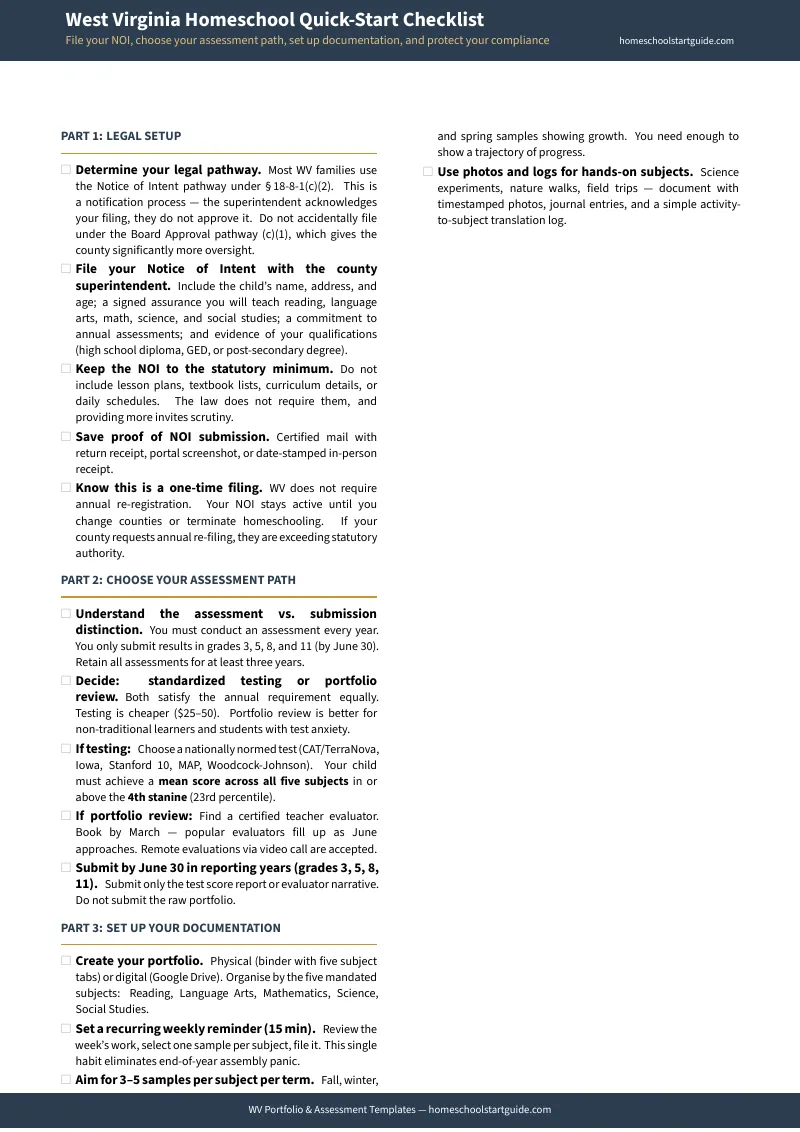
- checklist.pdf — Quick-Start Checklist: a printable action plan covering legal setup, assessment path selection, documentation system setup, high school essentials, and Hope Scholarship compliance.
- dual-track-checklist.pdf — Side-by-side Exemption C vs. Exemption M comparison with separate checklists and deadline trackers for each pathway.
- assessment-prep-checklist.pdf — Testing vs. portfolio review preparation guide with approved test list, evaluator booking timeline, and submission rules.
- evaluator-cover-sheets.pdf — Portfolio review cover sheet with statutory language referencing § 18-8-1, five-subject progress grid, and evaluator narrative template.
- portfolio-frameworks.pdf — Grade-banded documentation frameworks for K-2, 3-5, 6-8, and 9-12 with what to collect for each of the five mandated subjects.
- subject-tracking-grid.pdf — Monthly subject tracking grid for all five required subjects plus a subject-to-activity crosswalk with West Virginia examples.
- transcript-template.pdf — PROMISE Scholarship-aligned high school transcript with 4-4-4-3 core credit tracking, course description template, and GPA calculation worksheet.
- hope-scholarship-tracker.pdf — Exemption M compliance tracker with the June 8 deadline, WVEIS ID tracking, expense documentation, and annual checklist.
- sports-eligibility-tracker.pdf — Tim Tebow Act semester-by-semester sports portfolio with pre-season checklist and 2.0 GPA tracking for WVSSAC eligibility.
- compliance-calendar.pdf — Month-by-month compliance calendar with every deadline from NOI filing through June assessment submission and high school milestones.
Instant download, no account required.
30-day money-back guarantee. If these templates don't give you the structure and confidence to pass your annual assessment, email us and we'll refund you. No questions asked.
Not ready for the full guide? Download the free West Virginia Homeschool Quick-Start Checklist — a printable overview of the legal setup steps, assessment path options, documentation system basics, and key compliance deadlines. It's enough to get oriented, and it's free.
West Virginia doesn't require you to prove you're a perfect teacher. It requires you to prove your child is making progress. These templates make the proof effortless.