Build Your West Virginia Micro-School Legally, Confidently, and Without Surrendering $2,200 of Your Child's Hope Scholarship to a Franchise.
West Virginia formally legalized micro-schools and learning pods in 2022. Senate Bill 268 added Exemption N to WV Code §18-8-1, giving your pod its own legal pathway — separate from traditional homeschooling (Exemption C) and private schools. The Hope Scholarship now provides over $5,400 per student per year, with universal eligibility starting in 2026–2027. The Tim Tebow Law guarantees your micro-school students can play public school sports. On paper, West Virginia is one of the best states in the country to start a micro-school.
In practice, it's a maze. CHEWV's resources are built for traditional single-family homeschooling under Exemption C — they explicitly say learning pods "are not homeschools." The official Hope Scholarship handbook is 40 pages of punitive compliance language that treats you as a liability, not a partner. Facebook groups are full of parents giving contradictory legal advice — one says file NOIs and call it enrichment, another says you need private school registration immediately, a third says just don't tell anyone. The TheoPay purchasing portal rejects legitimate curriculum orders and freezes your funds for weeks. And nobody — not CHEWV, not WVHEA, not the state — publishes a plain-English operational guide for building a compliant micro-school under Exemption N.
The West Virginia Micro-School & Pod Kit is the Hope Scholarship Pod Blueprint — every legal framework, operational template, and compliance tool you need to launch a legally sound learning pod in West Virginia without paying $2,200 per student for a Prenda franchise or $8,000 per year for KaiPod.
What's Inside the Hope Scholarship Pod Blueprint
The Exemption C vs Exemption N Decision Framework
Because the single most confusing question for every new West Virginia pod founder is whether each family files individually under Exemption C (home instruction) or the pod operates under Exemption N (the 2022 micro-school pathway). Exemption C is simpler and familiar — but it's designed for single-family homeschooling. Exemption N was written specifically for learning pods and micro-schools — but it carries compliance requirements that CHEWV doesn't explain and the state doesn't clarify. This framework walks you through the exact criteria for each pathway, the reporting differences, the cost-sharing implications, and the critical special education video camera rule under §18-20-11 that catches founders off guard. Choose the right structure before your first family meeting, not after a county superintendent calls.
The Hope Scholarship Integration Strategy
Because the state gave you $5,400 per student but made it extraordinarily difficult to spend. The TheoPay digital wallet is a source of constant frustration — rejected curriculum orders, frozen accounts, multi-week approval delays. The Kit provides the operational framework for structuring micro-school expenses to maximize Hope Scholarship coverage: which expenses qualify (curriculum, testing fees, educational services), which don't (facility rent, facilitator salaries unless structured as an approved educational service provider), and how to architect your purchasing to avoid the most common TheoPay rejection triggers. This chapter alone can save your pod thousands in misallocated funds.
The Annual Assessment Compliance System
Because West Virginia requires annual academic assessment at grades 3, 5, 8, and 11 — standardized testing at or above the 40th percentile, or portfolio review by a certified teacher — and two consecutive years below standard triggers a mandatory remediation process. In a multi-family pod, coordinating assessments across multiple children at different grade levels requires a tracking system. The Kit provides the assessment timeline, testing options comparison (WV-MAP, CAT, Iowa Basic, Stanford-10), portfolio review frameworks, and the specific documentation you need if a child scores below the 40th percentile and enters the remediation pathway.
Parent Agreements That Prevent Pod Implosions
Because the number one reason micro-schools fail is not legal trouble — it's a family who stops paying, a parent who disagrees with the facilitator's discipline approach, or a philosophical clash that festers until November. Parent agreement templates covering mission, schedule, tuition or cost-sharing terms, payment deadlines, late penalties, withdrawal and refund policy, health exclusion, behavioral expectations, dispute resolution (three-step: direct conversation, mediation, majority vote), and termination. This document separates a pod that lasts three months from one that lasts three years.
Facilitator Hiring — Background Checks, Pay Rates, and Classification
Because West Virginia law requires only a high school diploma or GED for Exemption N instruction, but practical considerations apply when you entrust someone with multiple families' children. IdentoGo fingerprinting and WV CARES background check procedures, hiring channels, interview frameworks, and real compensation benchmarks: $22–$35/hour in Charleston and Morgantown, $18–$28/hour in Huntington and Wheeling, $15–$25/hour in rural counties. Plus the critical employee vs. independent contractor classification — because getting the 1099 vs W-2 decision wrong creates tax liability for the entire pod.
The West Virginia Regional Budget Planner
Because running a pod in Charleston's South Hills costs nothing like running one in Raleigh County. Region-specific budget models covering facilitator compensation, space rental, curriculum materials, insurance, and field trips — with real numbers for the Eastern Panhandle, Monongalia County, Kanawha County, and rural Appalachian communities. Includes cost-sharing models for 3-family, 5-family, and 8-family pods, with per-student breakdowns that you can hand to prospective families at your first parent meeting.
Tim Tebow Law Sports Access Templates
Because the law guarantees your micro-school students can play public school sports — but local athletic directors frequently resist compliance. Pre-written template letters citing WV Code §18-8-1(k) and §18-8-1(d) to hand to a recalcitrant athletic director, WVSSAC eligibility requirements, the specific documentation your student needs, and what to do if the county stonewalls you. Your child shouldn't lose Friday night football because a school administrator doesn't know the law.
The 90-Day Pod Launch Timeline
Because most parents spend months assembling the launch sequence from scattered forum posts, CHEWV factsheets, and Hope Scholarship newsletters. A single-page, print-and-pin document that walks you from "I have an idea" to "the first day of pod school" — legal structure, family recruitment, agreements, filings, space, curriculum, facilitator, insurance, and first-week operations in the correct order.
Who This Kit Is For
- Charleston and Kanawha County parents who've lost confidence in the public school system — safety concerns, overcrowding, chronic staffing shortages — and want to build a small, high-quality alternative with trusted families without paying private school tuition or surrendering their Hope Scholarship to a franchise
- Solo homeschoolers anywhere in West Virginia who've hit the burnout wall — especially parents who withdrew during the pandemic and are now struggling with upper-grade instruction — and need a shared-responsibility model where teaching and socialization are distributed among families
- Morgantown-area parents frustrated by erratic public school calendars with 20 built-in weather days, compressed spring instruction, and schedule chaos that punishes working parents and neurodivergent children who need predictability
- Eastern Panhandle families — Berkeley and Jefferson Counties — where rapid population growth and D.C. commuter demographics create demand for premium educational alternatives without the $20,000 Acton Academy price tag
- Rural Appalachian families where geographic isolation, hour-long bus rides, and unreliable broadband make virtual academies a nonstarter — and a localized micro-pod meeting in a church basement or community center is the only practical alternative
- Parents of neurodivergent children (autism, ADHD, sensory processing) who need an ultra-low-ratio, sensory-friendly environment that public school classrooms structurally cannot provide — and who want structure beyond isolated solo homeschool
- Hope Scholarship recipients who want to maximize their $5,400 allocation for actual educational resources instead of surrendering 40% to a Prenda platform fee before instruction even begins
- Former educators who've left the public system and want to serve their community by running a small paid micro-school — without franchise fees, revenue shares, or rigid pedagogy imposed by a national network
Why Not Just Use the Free Resources?
CHEWV publishes homeschool law summaries. The Hope Scholarship website has parent handbooks. Facebook groups have thousands of West Virginia parents trading advice. Here is exactly what you run into when you try to build a pod from those sources alone:
- CHEWV is built for Exemption C, not Exemption N. Their resources cover traditional single-family homeschooling comprehensively. For micro-schools and learning pods, they explicitly state that "making learning pods subject to home instruction provisions does not make learning pods and microschools the same as homeschooling." They provide the statute text but zero operational frameworks for forming, running, or funding a compliant pod under the 2022 law.
- The state treats you as a compliance risk, not a partner. The Hope Scholarship handbook is 40 pages of non-qualifying expenses, fraud reporting protocols, and punitive enforcement language. There is zero guidance on how to practically structure a micro-school that works within these rules while actually educating children.
- Facebook groups are a liability minefield. One parent says your pod is fine as enrichment. Another says register as a private school immediately. A third says just don't tell anyone. The emotional support is real. The legal guidance could trigger a county investigation — or worse, lead you to accidentally violate the §18-20-11 video camera mandate by enrolling a special needs student without proper compliance.
- TheoPay burns your time and freezes your funds. Parents report rejected curriculum purchases, multi-week approval delays, and vendor denials that leave children without materials when September arrives. Nobody publishes a strategic guide for navigating the system successfully.
- Prenda, KaiPod, and Acton solve the structure problem — at $2,200 to $20,000 per student per year. These franchise networks provide curriculum and operational support, but the financial extraction is severe. Prenda's $2,199 platform fee alone consumes over 40% of the Hope Scholarship before your local educator sees a dollar. The Kit gives you the same operational structure without the annual platform fees.
Free resources give you the statute text and the emotional support. The Hope Scholarship Pod Blueprint gives you the templates, checklists, and operational frameworks to execute this month.
— Less Than One Hour With a WV Education Consultant
A single consultation with an education attorney in Charleston costs $200 to $400 per hour. Private "choice navigators" charge $100 to $150 per hour. The Prenda platform fee is $2,199 per student per year. KaiPod charges $220 per week. Acton Academy tuition exceeds $20,000. The Kit costs less than one hour of expert advice and gives you the operational independence those platforms are designed to prevent.
Your download includes 7 PDFs: the complete 15-chapter guide (covering both legal pathways, Hope Scholarship integration, TheoPay strategy, facilitator hiring, parent agreements, insurance, budget planning, curriculum for multi-age settings, annual assessments, Tim Tebow Law sports access, high school transcripts, PROMISE Scholarship eligibility, dual enrollment, neurodivergent accommodations, rural solutions, national network comparisons, and the 90-day launch timeline), the West Virginia Pod Launch Checklist (one-page print-and-pin), the Parent Participation Agreement template, the Facilitator Contract template, the Regional Budget Planner worksheet, the Liability Waiver and Emergency Contact form, and the Tim Tebow Law Sports Access Letter template. Instant download, no account required.
30-day money-back guarantee. If the Kit doesn't give you the legal clarity and operational confidence to move forward with your pod, email us and we'll refund you. No questions asked.
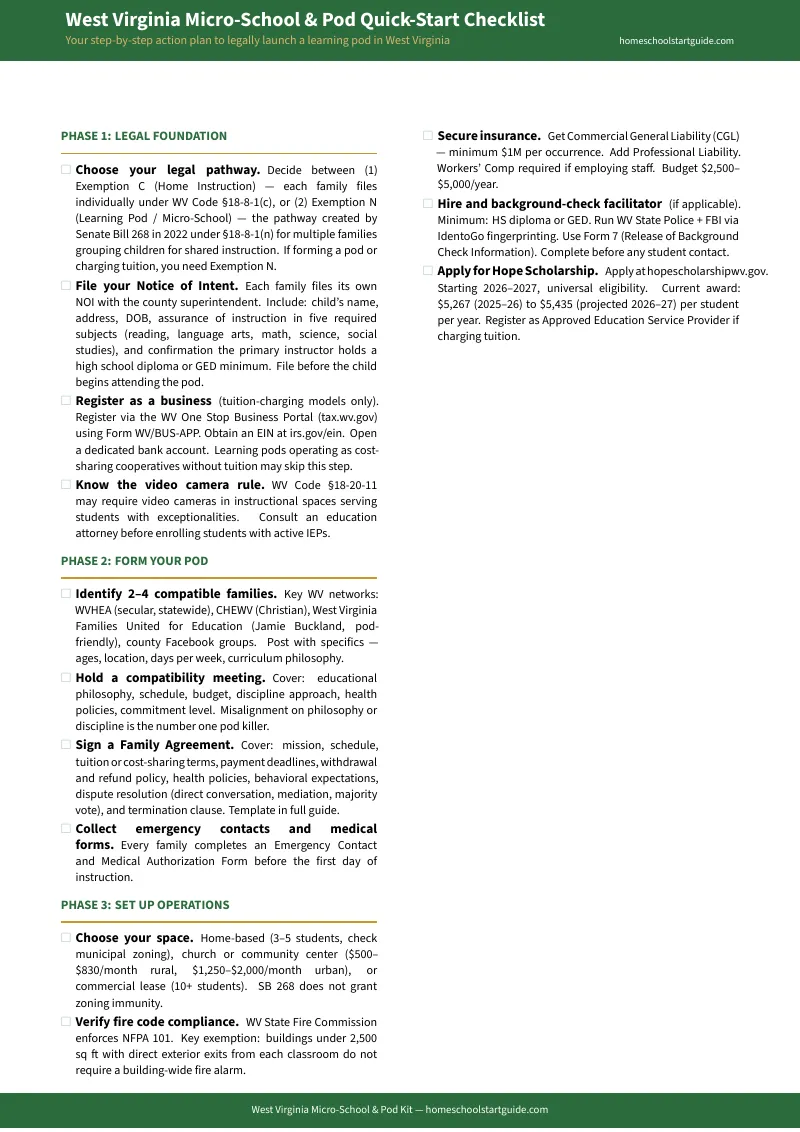
Not ready for the full Kit? Download the free West Virginia Homeschool Quick-Start Checklist — a one-page summary of the legal requirements, NOI filing basics, Exemption C vs Exemption N, and what you need to know before gathering families. It's enough to understand your rights tonight.
West Virginia gave micro-schools their own law and funded them with $5,400 per student. The Hope Scholarship Pod Blueprint shows you how to use both without surrendering your money or your autonomy to a franchise.