Your Evaluator Asks About Occupational Education. Can You Answer?
You've been homeschooling in Washington all year — maybe your first year, maybe your fifth. The daily teaching works. Your child is learning, growing, thriving in ways the local school never supported. But now it's spring, and the annual assessment is approaching. You need to prove compliance with all eleven of Washington's required subjects — reading, writing, spelling, language, math, science, social studies, history, health, occupational education, and art and music appreciation. You have work samples scattered across binders, Google Drive folders, and a kitchen counter pile you keep meaning to organize. Your evaluator — a Washington State certificated teacher — will review your portfolio and determine whether your child is making "reasonable progress." What you don't have is a system that maps what you've actually been teaching to what the law actually requires.
Meanwhile, every Washington homeschool Facebook group has a different opinion about what evaluators expect, whether you need to document every subject every week, and what "occupational education" even means for a seven-year-old. The Washington Homeschool Organization has excellent legal information — but no templates. The OSPI Pink Book explains the statute — in language written by state bureaucrats for school district administrators. And Etsy has $5 aesthetic planners designed for states that don't require annual assessments, don't mandate eleven specific subjects, and don't have the Becca Bill's truancy enforcement looming over every undocumented family.
The Washington Portfolio & Assessment Templates is an 11-Subject Compliance System — 15 chapters covering every documentation requirement under RCW 28A.200, every grade band from kindergarten through high school, and every template you need to pass your annual assessment — designed to document exactly what the law requires and absolutely nothing more. No daily lesson plans your evaluator never asked for. No excessive worksheets that create unnecessary evidence. No generic planners built for states whose requirements Washington doesn't share.
What's Inside
Washington's Four Instructional Options Decoded
Washington offers four legal routes to homeschool — parent-taught (with the 45-credit or qualifying course requirement), certificated teacher, extension programme, and online. One requires filing a Declaration of Intent, documenting eleven subjects, and passing an annual assessment. The others shift administrative burden to a supervising teacher or private school. Chapter 2 maps all four options' requirements side by side so you understand exactly which documentation rules apply to your family — and which don't. Plus the critical ALE versus HBI distinction that trips up families moving between public parent partnerships and true home-based instruction.
Filing the Declaration of Intent Without Over-Submitting
Your DOI is due to the superintendent of your local school district by September 15 or within two weeks of the start of the public school semester. It requires your child's name, age, your name, home address, and signature. What it does not require: curriculum lists, daily schedules, lesson plans, immunization records, or your college transcripts — though many districts request all of these. Chapter 3 gives you the exact required elements with nothing extra, plus guidance on filing for multiple children, mid-year filing after interstate moves, and proof-of-submission strategies that protect you if a district claims they never received it.
The 11-Subject Crosswalk — What "Occupational Education" Actually Means
Washington mandates instruction in eleven subjects. The first nine are intuitive. The last two — "occupational education" and "appreciation of art and music" — are where parents panic. Chapter 4 provides the 11-Subject Crosswalk Matrix: a template that lets you list a single holistic activity (hiking Mount Rainier, building a birdhouse, running a lemonade stand, cooking dinner) and check off every subject it covers simultaneously. The law says these provisions "shall be liberally construed" — but that legal leeway means nothing without a concrete framework for applying it. This chapter turns the statute's vague language into a documentation system.
Grade-Banded Portfolio Frameworks
A kindergartener's portfolio looks nothing like a tenth-grader's. Chapter 6 provides grade-banded documentation frameworks — K-2, 3-5, 6-8, and 9-12 — with specific guidance on what to collect, how to organise evidence by subject or by month, what "reasonable progress" looks like at each developmental stage, and how to build a portfolio that satisfies your evaluator without inviting district scrutiny. Each framework includes a weekly five-minute filing system so you never face a last-minute portfolio panic in spring.
Annual Assessment — Testing vs. Teacher Evaluation
Washington gives you a choice: a nationally standardised test or a portfolio review by a Washington State certificated teacher. Chapter 7 compares every approved testing option — the Iowa Assessments, Stanford Achievement Test, Woodcock-Johnson, CAT, and the Washington Assessment of Student Learning criteria — covering format, cost, stress level, and administration logistics. Then it walks through the non-test evaluation option: what certificated teachers look for, how to find one through WHO or FLO directories, what to prepare, and what happens if the evaluator determines progress is not "reasonable." Most parents don't know: the FLO Digital Freestyle Assessment costs $40 per student — and you still need organised documentation to upload to their portal.
Documenting Non-Traditional Learning
Pacific Northwest homeschoolers hike, garden, build, explore tide pools, volunteer at food banks, and learn through living. Chapter 9 covers documentation strategies for unit studies, project-based learning, Charlotte Mason nature journals, outdoor education, and unschooling — translating experiential activities into evidence that maps to Washington's eleven statutory subjects. Because your evaluator doesn't need to see daily worksheets. They need to see that your child is making progress across the required subject areas — and that progress can look like a mushroom identification journal, a woodworking project, or a community service log.
High School Transcript Templates
The transcript is the highest-stakes document you'll produce as a homeschool parent. Washington universities, community colleges, employers, and the military all expect professionally formatted academic records. Chapter 10 provides a transcript template designed for Washington institutions — with fields for course title, credits, grade, grading scale, cumulative GPA, and your signature as the home educator. Plus: how to calculate weighted and unweighted GPAs, how to document Running Start dual-credit courses with the "R" designation (WAC 392-415-070), and how to write course descriptions that admissions offices at UW, WSU, and community colleges expect.
Running Start and Dual Enrollment
Running Start lets 11th and 12th graders take community college courses tuition-free. But enrollment requires the Running Start Enrollment Verification Form (RSEVF), a current Declaration of Intent, and a parent-issued transcript — and the process confuses even experienced homeschool parents. Chapter 11 walks through RSEVF completion step by step, transcript formatting for community college registrars, credit transfer documentation, and the specific differences between Running Start, College in the High School, and Tech Prep. If your child wants free college credits before graduating, this chapter is the roadmap.
College Admissions — UW, WSU, and Beyond
Chapter 12 covers admissions requirements for Washington homeschoolers at the University of Washington (which requires standardised test scores, a parent-issued transcript, and course descriptions), Washington State University, community colleges, and out-of-state institutions. Plus: FAFSA documentation, the homeschool SAT/ACT code (970000), College Bound Scholarship eligibility (which requires a signed pledge by 8th grade), and the College Academic Distribution Requirements (CADRs) that UW and WSU expect homeschoolers to document.
Special Situations
Chapter 13 covers the scenarios that generic templates completely ignore: military families PCSing to Washington from unregulated states (the JBLM, Naval Base Kitsap, and Fairchild AFB transition playbook), neurodivergent learners (IEP/504 considerations, special education evaluation requests under IDEA), heritage language documentation as world language credit, mid-year transitions from ALE programmes to HBI, public school re-entry procedures, and families in districts with a history of over-reaching superintendent requests.
WIAA Athletic Eligibility
Chapter 15 maps the process for homeschooled students participating in public school athletics and extracurricular activities — eligibility requirements, academic documentation, attendance obligations, and the registration process your district will expect.
Who This Is For
- First-year Washington homeschool parents who just filed their Declaration of Intent and have no system for documenting eleven subjects or preparing for the annual assessment
- Parents approaching the spring assessment with a year of scattered work samples, no subject-tracking grid, and rising anxiety about whether their portfolio demonstrates "reasonable progress"
- Parents who have been over-documenting — keeping daily lesson plans, saving every worksheet, tracking every activity — and need to understand what the law actually requires versus what they've been doing out of fear
- Parents confused by "occupational education" and "appreciation of art and music" — Washington's two most misunderstood subject requirements — who need a concrete crosswalk framework
- High school parents who suddenly realise they need a professional transcript for Running Start, UW, WSU, or community college admissions — and have no template formatted for Washington institutions
- Military families who just PCSed to Joint Base Lewis-McChord, Naval Base Kitsap, or Fairchild AFB from a state with completely different (or no) documentation requirements
- Outdoor, nature-based, and unschooling families in the Pacific Northwest who need documentation strategies that translate experiential learning into evidence of the eleven required subjects
- Secular, eclectic, and post-pandemic homeschoolers who want a documentation system that isn't embedded inside a religious co-op or a monthly tracking app designed for states with different requirements
Why Not Just Use the Free Resources?
You can. The Washington Homeschool Organization has exhaustive legal guides. The OSPI Pink Book publishes the statute. FLO offers assessment services. Here's what actually happens when you try to assemble a documentation system from free sources:
- WHO provides the legal map — but not the vehicle. WHO tells you that records should include "test scores, assessment reports, immunization records, and any other records relating to instructional and educational activities." What WHO does not provide is a downloadable, fillable template to actually organise those records. You're left to design your own spreadsheets or binder system from scratch — and hope you didn't miss a statutory subject.
- The OSPI Pink Book is written by bureaucrats for bureaucrats. It's the legal authority, and it's impenetrable. The section on the eleven subjects says these provisions "shall be liberally construed" because home-based instruction is "less structured and more experiential." That legal leeway causes more confusion than clarity. A stressed parent approaching assessment doesn't want to "liberally construe" the law — they want a checklist that tells them exactly what to put in the binder.
- FLO solves assessment — not documentation. The Family Learning Organization's Digital Freestyle Assessment costs $40 per student and provides an official evaluation letter from a certificated teacher. It's excellent. But you still need to organise, generate, and track your own documentation throughout the year to have anything to upload to FLO's portal in the spring. Without a year-long documentation system, you're assembling evidence retroactively under deadline pressure.
- Etsy planners are a liability in Washington. Generic homeschool planners include daily schedules, attendance charts, and reading logs — features designed for states without eleven specific subject requirements. They lack the 11-Subject Crosswalk Matrix, the grade-banded portfolio frameworks, and the assessment preparation checklists that Washington law demands. Worse, most "homeschool portfolios" on Etsy list generic subjects (Math, Science, English, History) and completely omit "Occupational Education," "Health," and "Art and Music Appreciation" — three subjects your evaluator will specifically look for.
- YouTube walkthroughs are generic and state-agnostic. Blog and video portfolio tutorials provide beautiful binder inspiration built for national audiences. They ignore the Declaration of Intent filing process, Washington's four instructional options, the Becca Bill truancy framework, and the eleven-subject mandate. What works in Texas or Idaho — where no documentation is required at all — does not work in Washington.
The free resources explain what the law says. These templates are engineered to do exactly what the law requires — and nothing more.
— Less Than a Single FLO Assessment
A FLO Digital Freestyle Assessment costs $40 per student per year. Extension programme enrollment runs hundreds to thousands annually. Homeschool tracking apps charge $7-$15 per month. A disorganised portfolio means a longer, more stressful assessment — and a higher likelihood of an evaluator who can't certify "reasonable progress." These templates cost less than a single month of tracking software.
Your download includes the complete guide, the Quick-Start Checklist, and eight standalone printable tools:
- guide.pdf — The full Washington Portfolio & Assessment Templates guide: 15 chapters covering why documentation matters, four instructional options decoded, filing the Declaration of Intent, the eleven required subjects with the Crosswalk Matrix, building your portfolio (work samples, tracking grids, organisation systems), grade-banded frameworks (K-2, 3-5, 6-8, 9-12), annual assessment (testing vs. teacher evaluation), preparing for the non-test evaluation, documenting non-traditional learning, high school transcript creation and GPA calculation, Running Start and dual enrollment, college admissions (UW, WSU, CADRs, College Bound Scholarship), special situations (military, neurodivergent, heritage language), the annual compliance calendar, and WIAA athletic eligibility.
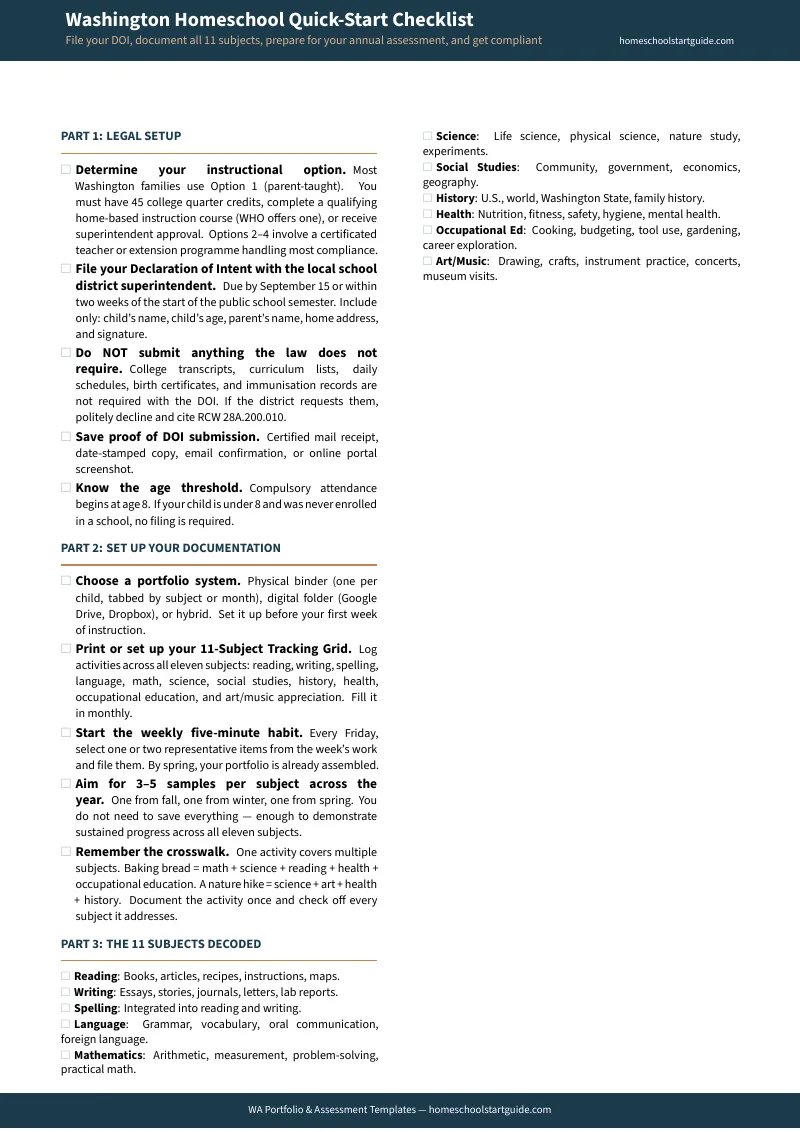
- checklist.pdf — The Washington Homeschool Quick-Start Checklist: a printable action plan from legal setup through documentation systems, 11-subject tracking, assessment preparation, and high school essentials.
- crosswalk-matrix.pdf — The 11-Subject Crosswalk Matrix: log one activity and check off every subject it covers. Includes pre-filled examples and a blank landscape tracking grid you can print weekly.
- grade-banded-frameworks.pdf — Grade-Banded Portfolio Frameworks: what to collect at K-2, 3-5, 6-8, and 9-12 with the weekly filing checklist.
- testing-comparison.pdf — Annual Assessment Comparison: standardized testing vs. certificated teacher evaluation side by side, with approved tests and what to bring to the portfolio review.
- transcript-template.pdf — High School Transcript Template: fillable 9th-12th grade course tables, GPA calculator, grading scale, and CADR requirements for UW and WSU.
- running-start-checklist.pdf — Running Start Enrollment Checklist: RSEVF process, timeline, costs, documents needed, and transcript documentation.
- university-requirements.pdf — University Admissions Reference: UW, WSU, community college, diploma, and College Bound Scholarship requirements on one page.
- compliance-calendar.pdf — Annual Compliance Calendar: month-by-month deadlines from August DOI filing through spring assessment and summer archiving.
- military-pcs-checklist.pdf — Military PCS Transition Checklist: moving into and out of Washington, MIC3 protections, and portable document package for JBLM, Kitsap, and Fairchild families.
Instant download, no account required.
30-day money-back guarantee. If these templates don't give you the structure and confidence to pass your annual assessment, email us and we'll refund you. No questions asked.
Not ready for the full guide? Download the free Washington Homeschool Quick-Start Checklist — a printable overview of the legal setup steps, DOI filing requirements, 11-subject tracking basics, assessment preparation, Running Start essentials, and key contacts. It's enough to get oriented, and it's free.
Washington doesn't require you to prove you're a perfect teacher. It requires an evaluator to confirm that your child is making reasonable progress. These templates make the proof effortless.