Build Your Washington Learning Pod Legally, Confidently, and Without Franchise Fees.
Washington State law says you can only homeschool your own child. That single sentence — buried in RCW 28A.200 — has paralyzed thousands of parents who want to share instruction, hire a facilitator, or pool resources with other families. The Washington Homeschool Organization's official FAQ reinforces it: "Can I hire a teacher or create a microschool? Not in Washington — those would need to be an approved private school." Reddit threads offer contradictory legal advice that could expose you to truancy charges under the Becca Bill. And the OSPI "Pink Book" — 24 pages of dense bureaucratic language — explains the rules but gives you zero templates to follow them.
You want to pull together three or four families in your neighborhood, share the teaching load, and build something that actually fits your children. Maybe Seattle Public Schools just dismantled the Highly Capable program your child depended on. Maybe you're staring at $32,000 Lakeside tuition and wondering if there's a middle path. Maybe you're a military family PCSing to Joint Base Lewis-McChord mid-year, and every school has a waitlist. Maybe you've been homeschooling alone in Spokane for three years and you're exhausted from teaching 11 state-mandated subjects by yourself. Whatever brought you here, you've arrived at the same conclusion: I need to build this myself — but I need to build it legally.
The problem is that the internet gives you fragments. The Pink Book explains the law but doesn't tell you how multiple families can safely share instruction without triggering private school requirements. Facebook groups offer emotionally supportive but legally dangerous advice. The franchise networks — Prenda, KaiPod, Acton Academy — will walk you through launch, but Prenda takes $2,200 per student per year, KaiPod charges up to $9,500 annually, and Acton Academy Bothell runs $16,500. You need a Pod Founder's Playbook — the complete operational framework without the franchise fees and without the legal guesswork.
The Washington Micro-School & Pod Kit is that Pod Founder's Playbook.
What's Inside the Pod Founder's Playbook
The Legal Pathway Decision Tree
Because "can my pod get shut down?" is the question that kills micro-schools before they hold their first meeting. Washington doesn't have a separate legal category for micro-schools — your group operates under either the Home-Based Instruction statute (RCW 28A.200) or approved private school registration (RCW 28A.195). This is a plain-English breakdown of both pathways, with a visual flowchart that tells you exactly which one to choose based on your group's size, structure, and goals. Most pods belong under RCW 28A.200, where each family retains individual responsibility for their child's education while sharing instruction cooperatively. The guide explains exactly how to structure that legally — the framework that WHO and the Pink Book refuse to provide.
The 11-Subject Compliance Matrix
Because Washington mandates 11 specific instructional subjects — reading, writing, spelling, language, math, science, social studies, history, health, occupational education, and art/music appreciation — and tracking all eleven across multiple families and a shared curriculum breaks every generic planner on Etsy. This is a printable matrix specifically designed for pods: map your curriculum choices, unit studies, and group activities against each subject requirement so every participating family can demonstrate compliance at annual assessment time. One project-based activity — like building a raised garden bed — can simultaneously satisfy math, science, and occupational education. The matrix shows you how.
The Declaration of Intent Coordination Guide
Because every family in your pod must file an annual Declaration of Intent with the local superintendent by September 15 (or within two weeks of starting), and coordinating filings across four families who chose different parent qualification pathways creates administrative chaos if you don't plan it. Step-by-step instructions for each family's filing, which qualification pathway to select, and a coordination timeline so your pod's paperwork is complete before the first school day — not scrambled together in October after a superintendent sends a letter.
The Four Parent Qualification Pathways
Because the number-one reason parents abandon micro-school plans is the belief that they need a teaching certificate. They don't. Washington offers four distinct pathways: 45 college quarter credits, a Parent Qualifying Course (completable in a weekend), supervision by a certificated teacher for one hour per week, or certification from the National Center for Home Education. The guide maps exactly which pathway works best for each parent in your pod — including how a single certificated teacher consultant can qualify multiple families simultaneously, making the entire pod compliant for a few hundred dollars split across families.
The Facilitator Hiring Framework
Because hiring a tutor to teach your pod sounds simple until you realize Washington's background check requirements (the WATCH system), the W-2 vs. 1099 classification rules that the IRS enforces regardless of what your Facebook group says, and the pay rates that vary dramatically across regions. Real benchmarks: Seattle/Eastside facilitators command $35–$50 per hour; Tacoma/Olympia runs $28–$38; Spokane and rural areas $22–$30. The guide includes a customizable facilitator contract template and explains the legal relationship between a hired facilitator and each family's individual Home-Based Instruction status.
The Parent Agreement & Liability Waiver Templates
Because a child twisting an ankle in your living room shouldn't end the pod — and it won't, if every family signed the right documents before enrollment. Customizable secular agreements covering cost-sharing, curriculum authority, attendance expectations, sick-day policies, behavioral standards, conflict resolution, and liability. No religious language. No political prerequisites. No mandatory statements of faith. These are the documents that keep adult relationships intact when a scheduling conflict or curriculum disagreement creates friction in month two.
The Seattle & Puget Sound Space Solutions Guide
Because finding affordable space in Seattle for a pod of eight children is its own project. Home-based options with HOA and condo association considerations, community center rentals, church and nonprofit partnerships (secular pods welcome — many churches rent space without religious requirements), library meeting rooms, and the cost benchmarks to budget accurately. Specific guidance for the Eastside, South King County, Tacoma, and Olympia markets.
The Running Start & Dual Enrollment Integration
Because high school pods in Washington have access to one of the strongest dual-enrollment programs in the country — and most parents don't realize their homeschooled teenager can take community college courses tuition-free through Running Start. The guide covers eligibility, application timing, credit transfer to your pod's transcript, and coordination with local community colleges across the state.
Who This Kit Is For
- Parents fleeing Seattle Public Schools — whether because of HCC program cuts, budget-driven school closures, or classroom environments that no longer serve their child — who want a structured alternative with peer-level academics and socialization
- Families priced out of Seattle-area private schools ($20,000–$32,000/year) who want the small-group, project-based outcomes of an independent school at a fraction of the institutional cost
- Military families at Joint Base Lewis-McChord navigating mid-year PCS moves, EFMP waitlists, and the need for a flexible, deployment-resilient learning community
- Solo homeschoolers anywhere in Washington — Seattle, Tacoma, Olympia, Spokane, Vancouver, rural counties — who are exhausted from teaching 11 state-mandated subjects alone and want to share the facilitation load with two or three other families
- Parents of neurodivergent children (autism, ADHD, PDA, twice-exceptional) who need a calmer, self-paced learning environment without the rigid structure of a district placement or the IEP battles that come with it
- Secular or progressive parents who have been excluded from established co-ops that require statements of faith, and who need a legally sound framework for an inclusive, non-denominational learning community
- Former educators who want to serve their community by facilitating a small pod — without the overhead and revenue extraction of a franchise network
After Using the Kit, You'll Be Able To
- Choose the correct legal pathway for your pod (RCW 28A.200 HBI cooperative vs. RCW 28A.195 private school) and explain to every participating family exactly why you chose it — before anyone files paperwork
- Coordinate Declaration of Intent filings for all families in your pod so every household is compliant with the September 15 deadline and the local superintendent has consistent, accurate records
- Demonstrate 11-subject coverage across your pod's curriculum using the compliance matrix — so annual assessment (standardized test or certificated teacher evaluation) confirms every child is making progress
- Hire a facilitator with a proper contract, correct tax classification, completed background check, and pay rate that matches your region — without exposing your pod to IRS misclassification penalties
- Run your first parent intake meeting with signed participation agreements and liability waivers that protect every family — without spending money on an attorney
- Build a realistic budget using region-specific cost benchmarks for Seattle, Tacoma, Spokane, and rural Washington — and split costs transparently across participating families
- Integrate Running Start dual enrollment for high school students, create compliant transcripts, and prepare your student's application for UW, WSU, or out-of-state universities
Why Not Just Use the Free Resources?
The OSPI Pink Book explains Washington homeschool law. The Washington Homeschool Organization lists co-ops and support groups. Reddit and Facebook groups offer peer advice. Etsy sells "micro-school starter kits" for $5. Here is exactly what you run into when you try to build a pod from those sources alone:
- The Pink Book gives you the law — in 24 pages of bureaucratic language — but zero templates. You learn that each parent must file a Declaration of Intent. You do not receive a coordination guide, a parent agreement, a liability waiver, or any framework for operating a multi-family pod under the Home-Based Instruction statute. The Pink Book is a legal reference, not an execution manual.
- WHO explicitly discourages micro-schools. Their FAQ states that hiring a teacher or creating a micro-school requires approved private school registration — full stop. They offer no guidance on structuring a cooperative pod under RCW 28A.200 where families retain individual HBI status while sharing instruction. WHO's directory excludes all drop-off programs. If you're building anything beyond a parent-present co-op, WHO's resources don't cover you.
- Facebook groups and Reddit are echo chambers of contradictory legal anxiety. One commenter says you need a daycare license. Another says you can operate "under the radar." A third says the Becca Bill means truancy charges if you file incorrectly. Following the wrong advice on r/Seattle about RCW 28A.225 can result in a truancy investigation. Free peer advice costs nothing up front and everything when it's wrong.
- The franchise networks withhold the operational details deliberately. Prenda's podcast, KaiPod's webinars, and Acton's marketing explain the vision of micro-schooling. The granular how — the parent agreements, the facilitator contracts, the budget templates, the compliance matrices — is the product they sell for thousands of dollars per year.
- The Etsy "micro-school starter kits" are daily planners with a micro-school label. Canva-template schedules and generic worksheets priced at $3–$25. Not one references RCW 28A.200, Washington's 11 required subjects, the Declaration of Intent process, or the WATCH background check system. They help you organize a classroom. They don't help you form one legally in Washington.
Free resources give you the legal baseline and the inspiration. The Pod Founder's Playbook gives you the templates, checklists, and frameworks to execute this week.
— Less Than One Hour of an Education Consultant
Seattle-area educational consultants charge $50–$150 per hour. A single consultation to explain the Pink Book and your legal options runs $150–$300. Prenda takes $2,200 per student per year in platform fees. KaiPod charges up to $9,500 annually. Acton Academy Bothell is $16,500. The Kit costs less than one hour of a consultant's time and gives you the operational independence those platforms are designed to prevent.
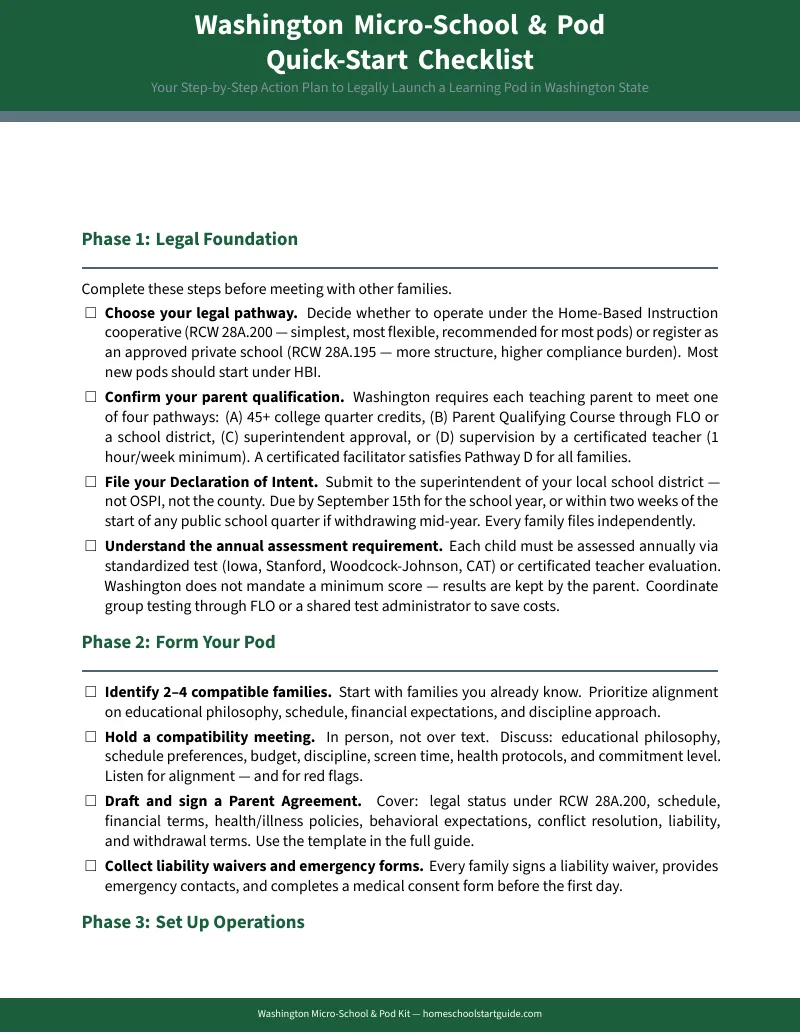
Your download includes the complete 30-chapter guide plus 7 standalone printable tools: the 11-Subject Tracking Matrix, Legal Pathway Decision Tree, Parent Agreement template, Liability Waiver & Emergency Consent form, Facilitator Hiring Checklist (with W-2 vs. 1099 classification), Monthly Budget Tracker, Cost Comparison Reference card, and the Washington Homeschool Quick-Start Checklist. Instant download, no account required.
30-day money-back guarantee. If the Kit doesn't give you the legal clarity and operational confidence to move forward with your pod, email us and we'll refund you. No questions asked.
Not ready for the full Kit? Download the free Washington Homeschool Quick-Start Checklist — a one-page summary of the legal requirements, the four parent qualification pathways, and your rights under Washington's home-based instruction law. It's enough to understand your legal standing tonight.
Washington's home-based instruction law protects your right to educate your child. The Pod Founder's Playbook makes sure you exercise that right correctly — with a community of families beside you.