Your Child's Stanine Score Is Due August 1. Your Portfolio Had Better Be Ready.
You've been homeschooling in Virginia for months — maybe a full year. The daily rhythm works. Your child is learning, growing, making real progress. But now the calendar says June, and you're staring at the annual Evidence of Progress deadline. You have work samples scattered across binders, Google Drive folders, and a kitchen counter pile you keep meaning to organize. You know you need to submit something to the superintendent by August 1 — a standardized test score at the 4th stanine, or a portfolio evaluation from a licensed evaluator. What you don't have is a system for assembling the evidence that proves what you already know: your child is thriving.
Meanwhile, every Virginia homeschool Facebook group has a different opinion about what evaluators expect, whether you need attendance records (you don't), how to calculate a GPA for a ninth-grader, and what happens if your child scores in the 3rd stanine. The VDOE website explains the law in bureaucratic abstractions. HEAV says a portfolio is a "scrapbook" — which is technically true and practically useless when you need a professional-looking binder for a licensed evaluator charging $150-$300 per review.
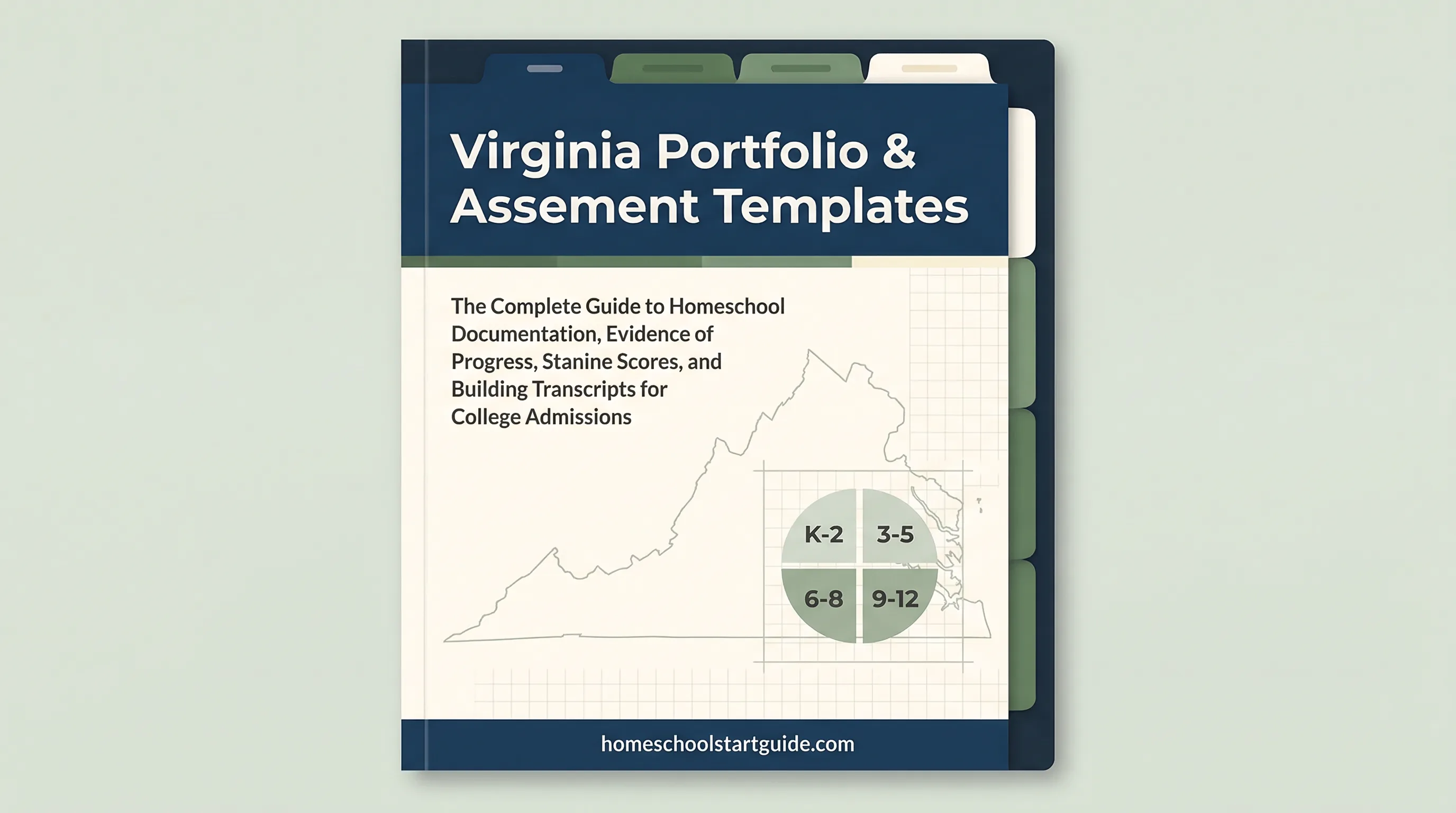
The Virginia Portfolio & Assessment Templates is an Engineered Restraint Documentation System — 14 chapters covering every assessment pathway, every grade band from kindergarten through high school, and every template you need to satisfy Virginia's Evidence of Progress requirement — designed to document exactly what the law requires and absolutely nothing more. No attendance logs the state never asked for. No daily lesson plans that invite superintendent scrutiny. No generic Etsy planners built for states with requirements Virginia doesn't have.
What's Inside
The Four Legal Pathways Decoded
Virginia offers four routes to homeschool legally — Home Instruction (§22.1-254.1), Religious Exemption, Certified Tutor, and Approved Correspondence. Each has different documentation obligations. Home Instruction requires annual evidence of progress. Religious Exemption requires none. Certified Tutor requires a Virginia teaching licence. Correspondence requires programme enrolment. Chapter 2 maps every pathway's requirements side by side so you understand exactly which documentation rules apply to your family — and which don't.
Standardized Testing and the 4th Stanine Explained
If you choose standardized testing as your evidence of progress, your child's composite score must reach the 4th stanine — the 23rd percentile, calculated from math and language arts only. Not the 4th grade level. Not a subject-by-subject breakdown. The composite. Chapter 4 explains what the stanine scale actually measures, how to order and administer approved tests (CAT, Iowa Assessments, Stanford 10), what "composite score" means in practice, and why you should request a composite-only report rather than submitting sub-test details the law doesn't require.
Professional Evaluations — What Evaluators Actually Want to See
The alternative to standardized testing is a review by someone holding a Virginia teaching licence or a master's degree. But evaluators vary wildly in what they expect. Some want a thick binder organized by subject. Others want a brief narrative with selected work samples. Chapter 5 provides evaluator-ready cover sheets with pre-written statutory language asserting that the attached portfolio demonstrates "adequate educational growth and progress" under §22.1-254.1(C). These sheets reduce your evaluator's review to examining the evidence and signing — virtually guaranteeing a frictionless approval.
The Probation Year — What Actually Happens Below the 4th Stanine
If your child scores below the 4th stanine, you enter a one-year probation period with remediation requirements. It is not an immediate loss of the right to homeschool. Chapter 6 walks through the exact sequence: notification from the superintendent, the remediation plan you must implement, the re-testing timeline, and what evidence to collect during the probation year to demonstrate improvement. This chapter alone eliminates the paralysing fear that one bad test day ends your homeschool.
Grade-Banded Portfolio Frameworks
A kindergartener's portfolio looks nothing like a tenth-grader's. Chapters 7 and 8 provide grade-banded documentation frameworks — K-2, 3-5, 6-8, and 9-12 — with specific guidance on what to collect, how many samples per subject per term, what "growth over time" looks like at each developmental stage, and how to organize evidence for both testing and evaluation pathways. Each framework includes a weekly 15-minute filing system so you never face a last-minute portfolio panic again.
High School Transcript Templates
The transcript is the highest-stakes document you'll produce as a homeschool parent. Virginia universities, community colleges, employers, and the military all expect professionally formatted academic records. Chapter 9 provides a transcript template designed for Virginia institutions — with fields for course title, credits, grade, grading scale, cumulative GPA, and your signature as the educational administrator. Plus: how to calculate weighted and unweighted GPAs, how to document AP and honours coursework, and how to write course descriptions that UVA, Virginia Tech, William & Mary, and George Mason admissions offices expect.
VCCS Dual Enrolment Tracker
Virginia's community college system allows homeschooled students to earn simultaneous high school and college credits. Chapter 10 covers the eligibility requirements, the application process at NOVA, TCC, JTCC, and other VCCS institutions, how to document dual-enrolment credits on your transcript, and how to coordinate VCCS courses with your evidence of progress submission. The included tracker lets you map each college course to its high school credit equivalent.
Financial Aid and Scholarship Documentation
Chapter 11 covers the Virginia Guaranteed Assistance Programme (VGAP), the Commonwealth Award, the Virginia Assured Scholarship Award (VASA), FAFSA documentation for homeschoolers, and how pending Virginia ESA legislation could affect funding. Each programme has specific requirements for homeschool applicants — GPA thresholds, SAT/ACT minimums, course documentation — and the chapter maps exactly what records you need to maintain from ninth grade onward to stay eligible.
Special Situations
Chapter 13 covers the scenarios that generic templates completely ignore: neurodivergent learners (Privately Developed Plans, Child Find evaluations, accommodation documentation), military families PCSing to Virginia (30-day NOI filing, cross-state documentation transfer), NoVA enrichment resources (Smithsonian, Library of Congress, National Archives field-trip documentation), heritage language documentation, transitioning from Religious Exemption to Home Instruction (entering the compliance cycle with no prior documentation), public school re-entry procedures, and VHSL athletics eligibility for homeschooled students.
Who This Is For
- First-year Virginia homeschool parents approaching their first Evidence of Progress deadline with no system for organizing what they've been teaching all year
- Parents terrified of the 4th stanine threshold who want a portfolio-based evaluation pathway but don't know what evaluators actually expect to see
- Parents currently using standardized testing who want to pivot to evaluation — and need to build the portfolio structure that makes the switch seamless
- High school parents who suddenly realize they need a professional transcript for dual enrolment applications, university admissions, or scholarship eligibility — and have no template formatted for Virginia institutions
- Parents of VCCS dual-enrolment students who need to track college credits alongside homeschool coursework on a single coherent transcript
- Military families who just PCSed to Virginia from a state with completely different documentation requirements and need to get compliant within 30 days
- Parents who have been over-documenting — keeping daily attendance logs, detailed lesson plans, and hourly time records that Virginia law does not require and that create unnecessary exposure to superintendent scrutiny
- Secular and eclectic homeschoolers who want a documentation system that isn't embedded inside a religious co-op curriculum or a $70/year tracking app designed for states with daily logging requirements Virginia doesn't have
Why Not Just Use the Free Resources?
You can. HEAV has portfolio articles. VaHomeschoolers has an evidence of progress explainer. Etsy has $5 planners. Here's what actually happens when you try to assemble a documentation system from free sources:
- HEAV says a portfolio is a "scrapbook" — and leaves you guessing. Their advice is accurate: there are no standard forms or formats. But when you're a first-year parent staring at August 1 and wondering how many work samples per subject, whether to include photos, how to organize by subject or chronologically, and what the evaluator cover sheet should say, "there are no rules" is the most unhelpful answer possible. You need a framework that makes the decisions for you.
- VaHomeschoolers explains the law brilliantly — but doesn't give you fillable templates. Their evidence of progress page explains the 4th stanine, the evaluation option, and the appeal process. It does not provide the actual checklists, cover sheets, planning templates, or grade-banded frameworks you need to compile the portfolio. You read the legal analysis and then open a blank Word document.
- Etsy planners are a liability in Virginia. Generic homeschool planners from Etsy include daily attendance trackers, hourly time logs, and detailed grading rubrics — features designed for states like New York and Pennsylvania with daily record-keeping requirements. Virginia Code §22.1-254.1 does not require attendance tracking for home instruction. Using these templates encourages you to submit documentation the state has no right to demand, setting a dangerous precedent with your school division.
- Homeschool Tracker and My School Year cost $70-$120/year and require you to upload your child's data to third-party servers. These apps are built for high-regulation states with daily logging mandates. Virginia parents navigating through dozens of irrelevant features are paying a recurring fee to over-document. And in a year when 244 documented privacy violations occurred across Virginia school divisions, a locally stored PDF template you control entirely on your own device has a distinct privacy advantage.
- Facebook group advice is a game of telephone. Parents routinely share portfolio tips from other states, recommend attendance templates Virginia doesn't require, and offer stanine interpretations that confuse percentile with grade level. Three years of legislative changes (SB1031, HB2598, Superintendent's Memo 001-26) have materially altered the compliance landscape — and most group advice predates all of them.
The free resources explain what the law says. These templates are engineered to do exactly what the law requires — and nothing more.
— Less Than Half an Hour With Your Evaluator
A professional evaluator in Virginia charges $150-$300 per review. HEAV membership is $35-$45/year. Homeschool tracking software runs $70-$120/year. A disorganized portfolio means a longer, more stressful evaluator session — and a higher likelihood of follow-up questions you'd rather not answer. These templates cost less than a single standardized test booklet.
Your download includes the complete guide, the Quick-Start Checklist, and 7 standalone printable tools — 9 PDFs:
- guide.pdf — The full Virginia Portfolio & Assessment Templates guide: 14 chapters covering why documentation matters, the four legal pathways decoded, Notice of Intent filing, standardized testing and the 4th stanine threshold, professional evaluations and evaluator cover sheets, the probation year, portfolio organization principles, grade-banded frameworks (K-2, 3-5, 6-8, 9-12), high school transcript creation and GPA calculation, Virginia university admissions (UVA, Virginia Tech, William & Mary, George Mason, JMU), VCCS dual enrolment, financial aid and scholarship documentation (VGAP, Commonwealth Award, FAFSA, ESAs), special situations (neurodivergent learners, military PCS, NoVA enrichment, heritage languages, Religious Exemption transition, public school re-entry, VHSL athletics), and an annual compliance calendar.
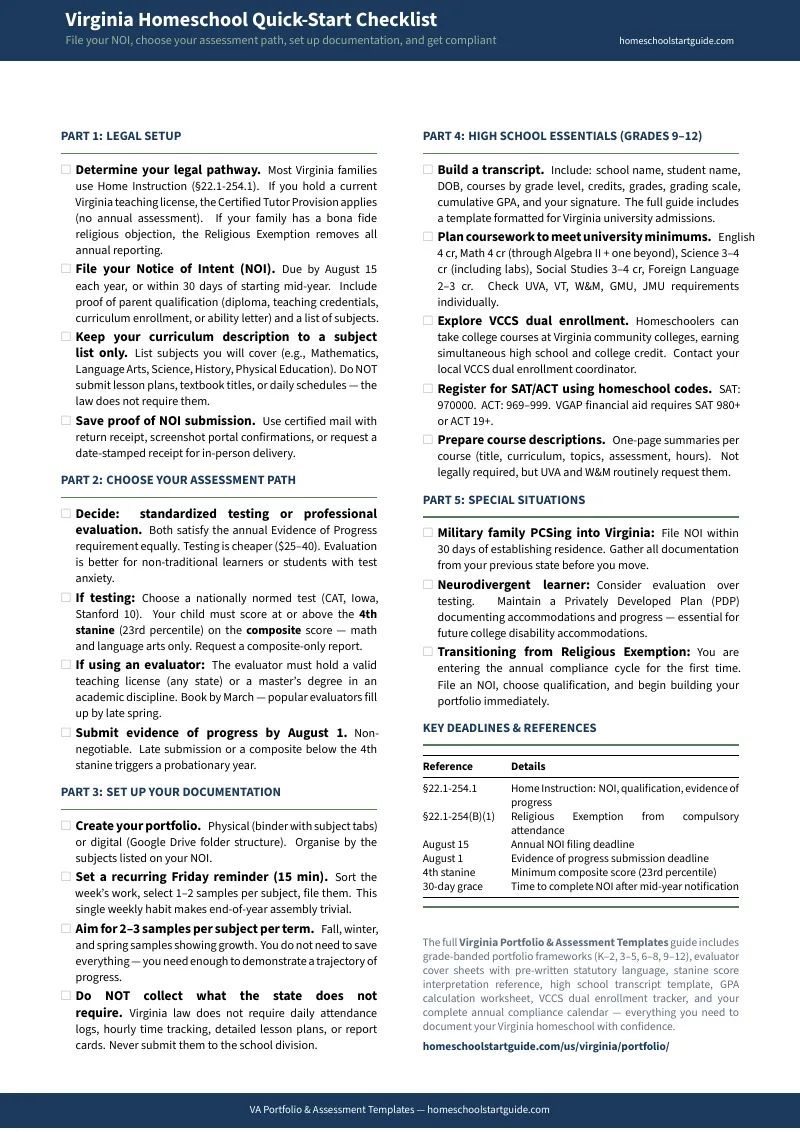
- checklist.pdf — The Virginia Homeschool Quick-Start Checklist: a printable action plan covering legal setup, assessment path selection, documentation system setup, high school essentials, and special situations.
- pathway-comparison.pdf — One-page side-by-side comparison of Virginia's four legal pathways with a quick decision framework.
- stanine-reference.pdf — The stanine scale, composite score explanation, qualifying tests, costs, and what happens below the 4th stanine — on one printable page.
- evaluator-cover-sheets.pdf — Fillable cover sheet with pre-written statutory language asserting adequate educational growth under §22.1-254.1(C). Print and place at the front of your portfolio binder.
- probation-protocol.pdf — The complete probation sequence, your rights, and four strategies for demonstrating improvement during the remediation year.
- grade-banded-frameworks.pdf — What to collect at each grade band (K-2, 3-5, 6-8, 9-12), what evaluators look for, and the weekly filing checklist.
- transcript-template.pdf — Fillable high school transcript formatted for Virginia university admissions, with grading scale, GPA calculation, and certification block.
- compliance-calendar.pdf — Month-by-month compliance calendar with every deadline from August NOI through July evidence of progress submission.
9 PDFs. Instant download, no account required.
30-day money-back guarantee. If these templates don't give you the structure and confidence to pass your evidence of progress review, email us and we'll refund you. No questions asked.
Not ready for the full guide? Download the free Virginia Homeschool Quick-Start Checklist — a printable overview of the legal setup steps, assessment path options, documentation system basics, and key compliance deadlines. It's enough to get oriented, and it's free.
Virginia doesn't require you to prove you're a perfect teacher. It requires you to prove your child is making progress. These templates make the proof effortless.