The Four-Pathway Blueprint: Launch Your Virginia Learning Pod with Legal Confidence and a Complete Operational Framework.
Virginia has four legal pathways for educating children outside the public school system — home instruction under §22.1-254.1, certified tutor under §22.1-254(A), religious exemption under §22.1-254(B)(1), and private school registration. Each pathway has different rules about who can teach, what paperwork to file, what annual assessments are required, and whether individual families or the micro-school itself holds the compliance burden. Most online resources explain these pathways for solo homeschoolers. None of them explain how a group of three to six families sharing instruction in a living room fits into the framework. This guide does.
You want to gather a few neighborhood families, share the teaching load, and build something that actually fits your children. Maybe you're a NoVA parent paying $20,000 a year for private school and wondering why you need an institution to deliver what four committed families could build in a living room. Maybe you're a current homeschooler finding solo teaching unsustainable after two years. Maybe you're secular, and every established co-op in your area requires a statement of faith you can't sign. Maybe you're a military spouse at Norfolk or Quantico who needs an educational model that survives a PCS move. Maybe the TJHSST admissions controversy or the withholding of National Merit honors convinced you that the system no longer rewards your child's effort. Whatever the trigger, you've arrived at the same conclusion: I need to build this myself.
The problem is that Virginia's four-pathway system creates genuine legal complexity for group instruction. The Notice of Intent is filed by individual families, not by pods — so who files what when five families share a facilitator? The certified tutor provision eliminates the NOI and annual testing entirely, but only if your facilitator holds a current Virginia teaching license — and most pod founders don't realize this option exists. Zoning in Fairfax County limits home instruction centers to four students at a time. HOAs under the Virginia Property Owners' Association Act can impose restrictions on home-based educational activity. Liability waivers for minors are generally unenforceable in Virginia courts, unlike states where pre-injury waivers hold up. HEAV provides excellent legal flowcharts but is Christian-focused and built for solo homeschoolers. VaHomeschoolers is inclusive but offers no templates. Facebook groups are full of outdated advice from parents citing requirements that may not apply to your chosen pathway.
The Virginia Micro-School & Pod Kit — the Four-Pathway Blueprint — is the operational framework that consolidates all of this into a single, legally precise, execution-ready guide.
What's Inside the Four-Pathway Blueprint
The Four-Pathway Decision Framework
Because choosing the wrong legal pathway means filing paperwork you don't need, submitting annual assessments that aren't required, or accidentally triggering private school registration when a simpler option exists. Virginia's four pathways — home instruction (§22.1-254.1, each family files individually, annual evidence of progress required), certified tutor (§22.1-254(A), no NOI, no testing, but requires a Virginia-licensed teacher), religious exemption (§22.1-254(B)(1), total exemption from state oversight for families with sincerely held religious convictions), and private school (180 days or 990 hours, handles all compliance in-house) — each have radically different implications for group micro-schools. This section walks you through each with a plain-English decision tree so you choose the right structure for your pod's size, facilitator credentials, and oversight preferences.
The Certified Tutor Advantage
Because if your pod hires a facilitator who holds a current Virginia teaching license, every family in the pod is exempt from filing the Notice of Intent and exempt from annual standardized testing — and almost nobody talks about this. The certified tutor provision under §22.1-254(A) is the single most powerful legal shortcut for Virginia micro-schools, yet it's buried in the statute, confusingly listed on the standard NOI form, and frequently misunderstood by local school division personnel. This section explains exactly how to structure your pod under the certified tutor pathway, what documentation to keep, and how to handle pushback from superintendents who aren't familiar with the provision.
Family Agreement and Liability Waiver Templates
Because the most common reason pods collapse isn't bad curriculum — it's undefined expectations between adults about money, scheduling, and what happens when someone wants to leave mid-year. Customizable templates covering cost-sharing, curriculum authority, health policies, behavioral expectations, dispute resolution, and withdrawal terms. Written without religious language or ideological prerequisites. Virginia courts generally do not enforce pre-injury liability waivers for minors — so the guide also explains what insurance structures and entity formations actually protect your pod, rather than giving you a false sense of security from a waiver that won't hold up.
NoVA Zoning and HOA Compliance Checklist
Because "can my HOA shut down my pod?" is the question that stops NoVA founders before their first meeting — and the answer depends on your county, your declaration, and §55.1-1821 of the Virginia Property Owners' Association Act. Fairfax County limits home instruction centers to four students at a time under the Home Day Care zoning classification (up to seven by-right, twelve with a BZA permit). Loudoun and Arlington have their own residential business rules. This section covers county-by-county zoning constraints, HOA limitations, church and community center alternatives ($250–$1,000/month), and commercial lease considerations for pods scaling beyond fifteen students.
Facilitator Hiring and Background Check Guide
Because hiring someone to teach other people's children in Virginia without running the correct background checks isn't just risky — it's the liability exposure that keeps education attorneys billing at $300/hour. Virginia requires VSP and FBI fingerprint-based criminal history checks, Sex Offender Registry searches, and Child Protective Services central registry searches for anyone working with children in an educational setting. This section covers exactly how to run the checks, how to classify facilitators correctly (W-2 vs. 1099 — misclassification carries IRS penalties), and real Virginia pay benchmarks broken out by region: NoVA ($45,000–$55,000/year), Richmond ($38,000–$44,000/year), and Hampton Roads ($36,000–$42,000/year).
Budget Planning with Regional Benchmarks
Because splitting costs "evenly" between a family with three children and a family with one sounds fair until the first invoice arrives — and financial resentment is the second most common reason pods dissolve. Real Virginia benchmarks for space rental, liability insurance ($1,000,000 CGL at $500–$1,500/year), curriculum ($200–$600/student/year), and facilitator compensation across NoVA, Richmond, and Hampton Roads. Plus cost-sharing formulas for equal-split, per-child, and sliding-scale models — with worked examples showing how a 6-student pod achieves a 6:1 ratio at a fraction of Acton Academy's $20,400/year tuition.
DC-Area Enrichment and Field Trip Playbook
Because no other micro-school market in the country has free access to the Smithsonian Institution, the Library of Congress, the National Archives, and the U.S. Capitol — all within a morning's drive from Northern Virginia. This section shows you how to integrate DC's unmatched educational resources and Colonial Williamsburg's living history programs into your pod's regular schedule, including educator discount passes, group booking procedures, and seasonal programming calendars.
Who This Kit Is For
- Parents who want to form a small learning community of 3–8 students with two to four families — sharing the teaching load, splitting costs, and building something intentional rather than paying $20,000+ per year for a NoVA private school that may not fit their child
- Northern Virginia families (Arlington, Fairfax, Loudoun, Prince William) who want a high-quality 6:1 student-teacher ratio without surrendering $20,400/year to Acton Academy or $2,199/student/year to Prenda's platform fees
- Current homeschoolers who find solo teaching unsustainable and want to share facilitation with other families without losing control of their child's education or joining a co-op that demands full-time parent instruction
- Secular or inclusive families who've been turned away from HEAV-affiliated co-ops and need a legally sound framework for building a non-denominational pod in Richmond, NoVA, or anywhere in Virginia
- Parents of neurodivergent children (autism, ADHD, dyslexia, twice-exceptional) who are exhausted by IEP advocacy and want a calmer, self-paced environment with a small group that actually accommodates their child
- Military families at Norfolk, Quantico, Fort Barfoot, Langley-Eustis, or the Pentagon who need educational continuity that survives a PCS move without losing a semester to school transfer bureaucracy
- Parents of gifted learners frustrated by TJHSST admissions changes, National Merit withholding, or public school gifted programs that can't differentiate between the highest performers and those with the greatest needs
After Using the Kit, You'll Be Able To
- Choose the right legal pathway for your pod — home instruction for maximum flexibility, certified tutor for zero NOI and zero annual testing, religious exemption for faith-based families, or private school for formal recognition — using the decision framework instead of guessing
- Hand any school superintendent, zoning officer, or concerned neighbor the correct legal documentation that establishes your pod's compliance under Virginia law — without spending $300/hour on an education attorney
- Run your first parent meeting using a signed family agreement and liability waiver that sets clear expectations for every family in the pod — covering money, scheduling, health, discipline, and exit terms before tensions arise
- Navigate NoVA zoning constraints (Fairfax County's 4-student limit, HOA restrictions under §55.1-1821, BZA permit requirements) with the specific county-level guidance that prevents the zoning compliance failures that shut down underprepared pods
- Hire a facilitator with the correct Virginia background checks (VSP, FBI, Sex Offender Registry, CPS central registry), proper employment classification, and competitive pay benchmarks — avoiding the liability exposure that sinks underprepared pods
- Build a budget that every family agrees on — using real Virginia cost benchmarks for your specific region and a cost-sharing formula that prevents resentment and financial surprises
- Leverage DC-area resources that no other state can match — integrating Smithsonian programs, Library of Congress workshops, and Colonial Williamsburg field trips into your pod's regular curriculum
Why Not Just Use the Free Resources?
HEAV provides legal flowcharts. VaHomeschoolers explains the four pathways. VDOE has the official code references. Here is exactly what you run into when you try to build a pod from those sources alone:
- HEAV is built for solo homeschoolers with a Christian lens. Their legal flowcharts and NOI guidance are excellent, but every resource is geared toward individual families, not multi-family pods. They provide no family agreements, no cost-sharing templates, no zoning checklists, and no facilitator hiring guidance. And their ideological positioning — explicitly evangelical Christian — alienates the rapidly growing secular homeschool community in Richmond and NoVA.
- VaHomeschoolers is inclusive but gives you no templates. Their tone is trusted by secular parents and their legal explanations are solid. But the site presents vital information in long, unformatted text blocks with no downloadable, fill-in-the-blank documents. You understand what to do but have to build every contract, agreement, and notification letter from scratch.
- VDOE materials are written for school administrators, not parents. The Seat Time Flexibility Action Kit (HB 1477) legitimizes alternative instruction models at the state level, but its documentation is aimed at public school superintendents and district leaders. It signals philosophical openness but offers zero practical utility for independent pod formation.
- Generic Etsy templates are legally irrelevant in Virginia. A $6 "Learning Pod Agreement" from Etsy gives you a waiver written for a different state — no Virginia-specific four-pathway guidance, no certified tutor provision, no NoVA zoning rules. Most Etsy micro-school kits are pedagogical worksheets (alphabet tracing, morning menus) that assume solo homeschooling. None address the legal formation, group administration, or zoning compliance required to run a multi-family pod in Virginia.
- Facebook groups are a wasteland of contradictory advice. Veteran Virginia homeschool advocates describe these forums as "misinformation and often bad advice" regarding state compliance. Parents receive guidance citing requirements that don't apply to their chosen pathway, encouragement to skip filings that are legally mandatory, and outdated information about evidence of progress standards. Sifting through years of disorganized comments to find a legally sound pod contract is not a strategy.
Free resources give you the legal baseline and the inspiration. The Four-Pathway Blueprint gives you the templates, checklists, and decision frameworks to execute this week.
— Less Than One Hour with a Virginia Education Attorney
A single consultation with a Virginia education attorney costs $250–$400 per hour. A NoVA education consultant specializing in gifted and 2e placements charges $2,500 just to start. Prenda charges $2,199 per student per year in platform fees. Acton Academy Falls Church charges $20,400 per year. KaiPod runs $8,000–$10,000 per year. The Kit costs less than a single attorney consultation and gives you the legal clarity, operational templates, and regional guidance those alternatives are designed to sell piecemeal.
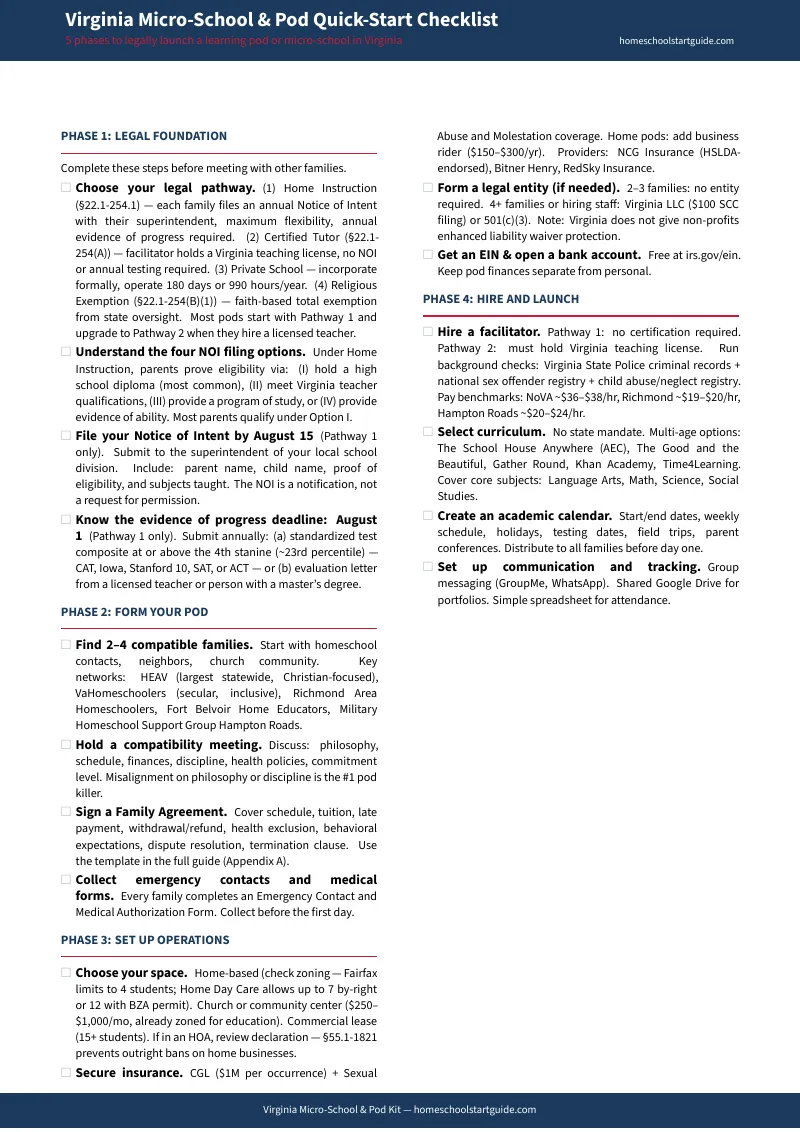
Your download includes the complete 22-chapter guide, the Quick-Start Checklist, and standalone printable templates: a Parent Agreement, a Liability Waiver with emergency contact form, a Facilitator Independent Contractor Agreement, a Notice of Intent template, an Annual Compliance Calendar, and a Budget Planning Worksheet. Instant download, no account required.
30-day money-back guarantee. If the Kit doesn't give you the legal clarity and operational confidence to move forward with your pod, email us and we'll refund you. No questions asked.
Not ready for the full Kit? Download the free Virginia Homeschool Quick-Start Checklist — a one-page summary of the four legal pathways, the certified tutor advantage, and the key legal references that apply to your pod from day one. It's enough to understand your rights tonight.
Virginia parents have the legal right to build this. The four pathways give you options. The certified tutor provision gives you freedom. The Four-Pathway Blueprint makes sure you build it correctly.