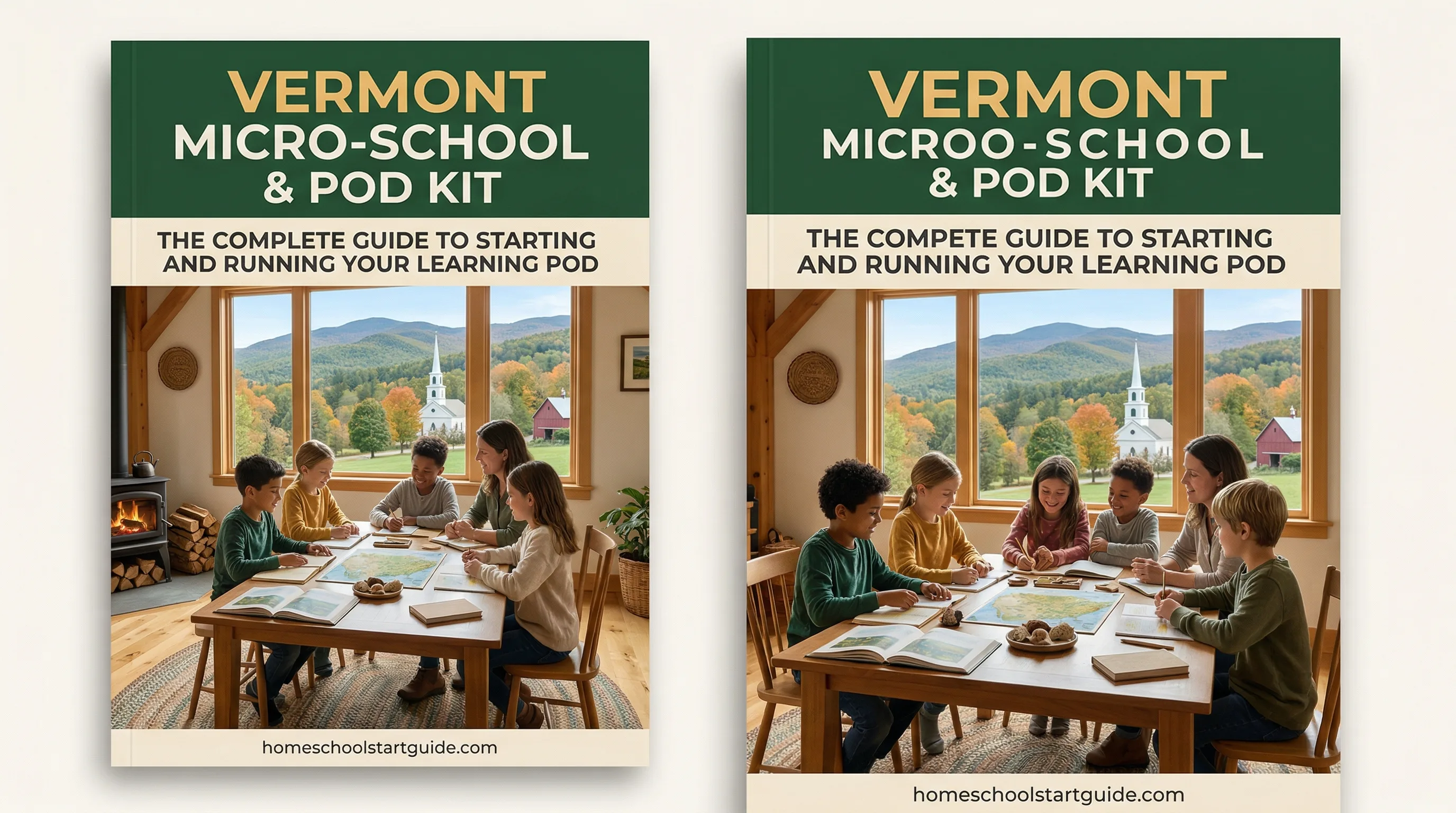
Build Your Vermont Micro-School Legally, Affordably, and Without a Franchise.
Vermont's 2023 home study overhaul (H.461) made it easier than ever for a single family to homeschool. File a Notice of Intent with the Agency of Education, attest that you have a Minimum Course of Study covering Vermont's required subjects, and you are legal. But the moment you invite a second family's children into your living room, everything changes. Under 16 V.S.A. §166b, a home study family can educate their own children plus either two or fewer outside children or children from one other family. Host six kids from four families around a kitchen table, and you have crossed the line from protected home education into what the state may classify as an unlicensed school or childcare facility. That Two-Child Rule is the legal tripwire that stops most Vermont parents from turning a solo homeschool into a genuine learning community.
You want something more than solo homeschooling. Maybe you hit the burnout wall in year two --- teaching every subject every day alone while Vermont's nearest homeschool neighbor is on the other side of a mountain pass. Maybe Act 46 closed your town's school and your child now rides a bus for an hour each way to a consolidated school where they are a number, not a name. Maybe you are in Burlington paying $15,000 to $25,000 annually for private school and wondering whether a micro-school could deliver the same small-group attention for a fraction of the cost. Maybe you have a neurodivergent child who needs a sensory-friendly, low-ratio environment that the public school's IEP process has failed to provide. Maybe you looked at Prenda's $2,199-per-student annual platform fee, KaiPod's 10% revenue share, or Acton Academy's $19,000 licensing fee and decided you would rather keep the money and the curriculum control. Whatever brought you here, you have arrived at the same conclusion: I need to build this myself, and I need to do it legally in Vermont.
The problem is that the internet gives you fragments. The Vermont Agency of Education processes enrollment notices but explicitly operates as "a processor of Home Study programs --- not a school." VHEN provides critical legislative updates but is a political advocacy organization, not an operations manual. Facebook groups in Vermont homeschooling circles confidently advise that pods need no insurance, that zoning does not apply, and that the Two-Child Rule is "just a guideline" --- advice that disintegrates the moment a neighbor files a complaint or the fire marshal visits. You need a Green Mountain Pod Blueprint --- the complete operational framework for navigating Vermont's home study statute, the Two-Child Rule, municipal zoning, and Act 77 dual enrollment without the dangerous guesswork, the franchise costs, or the 40 hours of scattered research.
The Vermont Micro-School & Pod Kit is that Green Mountain Pod Blueprint.
What's Inside the Green Mountain Pod Blueprint
The Two Legal Pathways Framework
Because the first decision every Vermont pod founder must make is whether to operate under 16 V.S.A. §166b (each family files an individual home study enrollment notice with the AOE) or pursue recognition as an approved independent school under §166. The guide walks you through why the independent school pathway is currently blocked by a legislative moratorium, why §166b is the operational reality for Vermont micro-schools, and how to structure your pod so every family remains individually compliant with their enrollment notice and annual assessment obligations --- standardized testing, review by a Vermont-certified teacher, or portfolio with narrative summary and four work samples.
The Two-Child Rule and Space Solutions
Because if you host children from three or more families in a single home, you cross the threshold that separates a protected home study from an unlicensed institution. The guide maps the exact boundary --- how many children, from how many families, in what configuration --- and provides structuring strategies that keep your pod clearly within the law: rotating host homes among participating families, leasing neutral space (churches, Grange halls, community centers at $0--$600/month), and the criteria for commercial space that triggers Vermont Division of Fire Safety building codes.
The Vermont Zoning Navigation Guide
Because Vermont's home occupation rules vary by municipality, and a Burlington zoning board treats a home-based pod differently than a Rutland planning commission. The guide covers home occupation permits, conditional use permits, the distinction between residential and commercial educational occupancy, and how to approach your town's development review board without triggering enforcement you did not anticipate.
The Parent Agreement and Liability Waiver Templates
Because a child breaking an arm in your home should not end the pod --- and it will not, if you are prepared. Customizable parent agreements covering educational philosophy, schedule, tuition, attendance, behavior, conflict resolution, withdrawal, and legal responsibility under §166b. Plus a liability waiver with indemnification, medical consent, and emergency contact forms. Every family signs these before day one. These are not generic Etsy templates --- they are written for the specific legal context of Vermont home education under the AOE enrollment notice framework.
The Vermont Budget Planner
Because running a pod with a hired facilitator in Burlington costs nothing like running a parent-led co-op in the Northeast Kingdom. Budget templates covering facilitator compensation ($20--$35/hour in Vermont), space rental by region, curriculum materials, insurance, and field trips --- with real Vermont cost benchmarks. Includes cost-sharing models for 3-family, 5-family, and 8-family pods, and a tuition calculator that shows how a micro-school delivering professional instruction costs $3,000--$6,000 per student per year compared to $15,000--$25,000 at Vermont private schools.
The Act 77 Dual Enrollment Playbook
Because Vermont's Flexible Pathways Initiative gives your high school micro-school students access to college courses at CCV and UVM at no tuition cost --- and proficiency-based graduation credits for learning that happens outside the classroom. No other micro-school kit in the country covers this. The guide walks you through Personalized Learning Plans, dual enrollment eligibility, early college programs, and how to build a transcript that translates pod learning into recognized credits for UVM, Middlebury, and Vermont State University admissions.
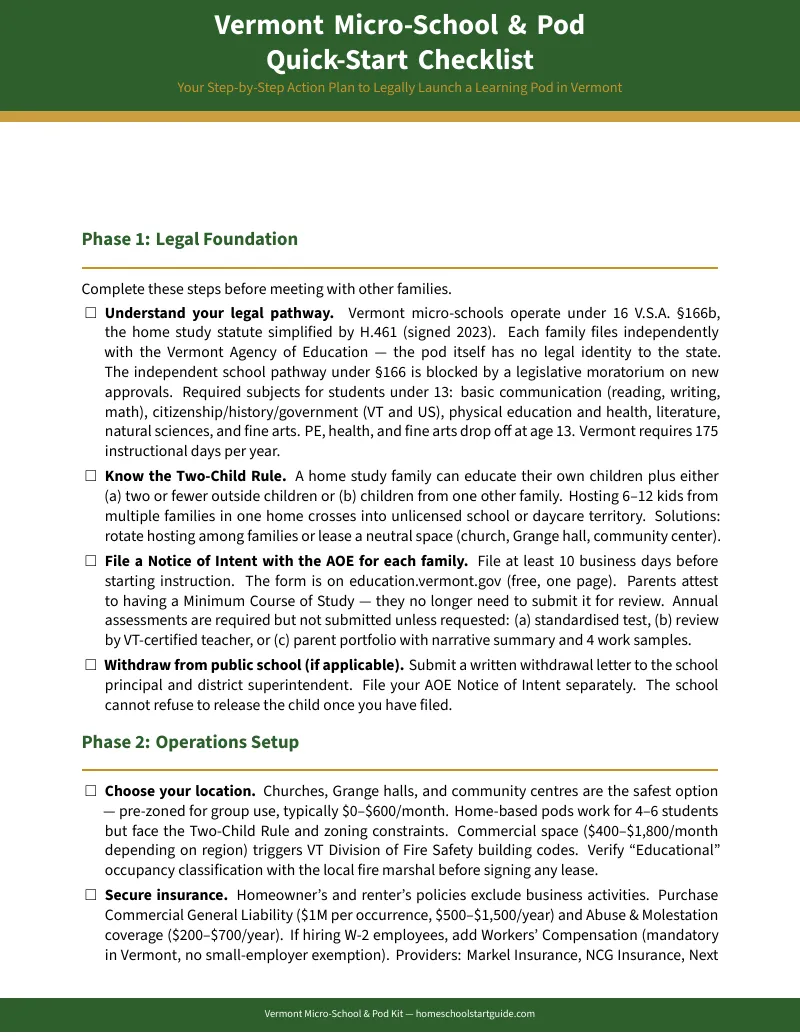
The Vermont Pod Launch Checklist
Because most parents spend forty-plus hours assembling the launch sequence from the AOE's bureaucratic documentation, VHEN's advocacy materials, and contradictory Facebook posts. A single-page, print-and-pin document that walks you from "I have an idea" to "the first day of pod school" --- covering the legal pathway decision, AOE enrollment notices, the Two-Child Rule, family recruitment, space selection, and operational launch in the correct order, with Vermont-specific thresholds and legal references at every step.
Who This Kit Is For
- Solo homeschoolers who have reached the burnout threshold and need a shared-responsibility model where the instructional and social burden is distributed among trusted families --- without losing control of your child's education or triggering state oversight you never signed up for
- Act 46 and Act 73 refugee families whose town school was closed or consolidated, whose children face hour-long bus rides over mountain passes, and who want to keep education local by pooling resources with neighbors to hire a facilitator and run a community micro-school
- Burlington and Chittenden County parents paying $15,000 to $25,000 annually at private schools who want personalized, small-group education for a fraction of the cost --- without the admissions gatekeeping, rigid schedules, and ideological constraints of traditional independent schools
- Parents of neurodivergent children (autism, ADHD, dyslexia, giftedness, 2e) who are exhausted by IEP battles in consolidated schools and want a sensory-friendly, small-group learning environment designed around their child's actual needs
- Former COVID-era pod parents whose informal kitchen-table arrangement has been running for years but never had insurance, a family agreement, or a clear legal classification --- and someone in the group is getting nervous about the Two-Child Rule or zoning
- Former educators who have left the Vermont public school system and want to serve their community by running a small paid micro-school --- without Prenda's $2,199 per-student platform fee, KaiPod's 10% revenue share, or Acton Academy's $19,000 licensing fee
- Northeast Kingdom and rural Vermont families who are geographically isolated, cannot access quality schools without dangerous commutes, and need to build a learning community from the families available within their immediate area --- even if that means starting with just two or three households
- Remote-working parents who relocated to Vermont and need a structured, safe, small-group learning environment that mimics the reliability of a school day while giving them the professional instruction they cannot provide during work hours
After Using the Kit, You'll Be Able To
- Understand both legal pathways --- home study under 16 V.S.A. §166b and approved independent school under §166 --- and know exactly why §166b is the operational reality and how to structure your pod within it
- Navigate the Two-Child Rule that limits how many outside children a single home can host, using rotation schedules and neutral-space strategies that keep every family in compliance
- File AOE enrollment notices correctly for every family in your pod, ensuring each household independently meets Vermont's attestation requirements and annual assessment obligations
- Choose the right space for your pod based on your municipality's zoning rules --- home, church, Grange hall, or commercial space --- and know the thresholds that separate a permitted gathering from a prohibited commercial operation
- Run your first parent intake meeting using a signed Family Agreement and liability waiver that protects every family in the pod --- without spending $200 on a Vermont education attorney
- Hire and background-check a facilitator through the VCIC process, classify them correctly for Vermont tax purposes, and pay them competitively using real local wage benchmarks
- Build a sustainable budget with Vermont cost data, set tuition that families can afford, and split costs equitably across participating households
- Leverage Act 77 Flexible Pathways for high school students --- dual enrollment at CCV and UVM, Personalized Learning Plans, and proficiency-based graduation credits that translate pod learning into recognized credentials
Why Not Just Use the Free Resources?
The Vermont AOE has your enrollment forms. VHEN has been lobbying for homeschool freedom since the early days. Facebook groups have thousands of Vermont parents trading advice. Here is exactly what you run into when you try to build a pod from those sources alone:
- The AOE processes paperwork and walks away. The Vermont Agency of Education explicitly functions as "a processor of Home Study programs --- not a school." It provides enrollment forms, the statutory text of §166b, and the required subject list. It does not tell you how to legally structure a multi-family pod, how the Two-Child Rule affects your physical setup, how to handle zoning, or how to coordinate annual assessments across multiple families sharing one learning space. The AOE answers "what must I file?" but not "how do I build this?"
- VHEN gives you advocacy but not operations. The Vermont Home Education Network is the state's most important homeschool watchdog. They successfully lobbied for the 2023 H.461 simplification. But VHEN is a legislative advocacy organization, not an operational toolkit. Their focus is defending homeschool rights at the statehouse --- they offer no multi-family pod templates, no liability waivers for hosting other families' children, no employment contracts for hiring facilitators, and no strategies for navigating Act 77 dual enrollment from within a micro-school.
- Facebook groups are an echo chamber of pre-2023 advice. Parents in Vermont homeschooling groups confidently claim that the Two-Child Rule is "basically unenforced" (it becomes enforced when a neighbor complains), that you do not need insurance for a pod in your home (your homeowner's policy explicitly excludes business activities), and that Act 46 consolidation is the only thing pushing families to homeschool (it is one of five distinct triggers). A parent who follows Facebook advice discovers the gaps when the fire marshal visits or a child gets injured, not before.
- Etsy templates are generic daily planners with a micro-school label. Canva templates and enrollment forms priced at $5--$24 on Etsy. Not one references 16 V.S.A. §166b, the Two-Child Rule, Vermont's required subjects including citizenship/history/government and fine arts, VCIC background check procedures, or Act 77 Flexible Pathways dual enrollment. They help you organize a schedule. They do not help you form a legally protected pod in a state where the line between home education and unlicensed school is defined by how many families share a living room.
- Prenda and KaiPod solve the problem --- and take your autonomy and revenue. Prenda charges $2,199 per student per year in platform fees (Vermont is direct-pay only --- no ESA funding). KaiPod charges $249 upfront plus 10% of gross tuition revenue for two years. Acton Academy charges a $19,000 licensing fee plus annual revenue share. All three require you to recruit the families, find the space, and build the community yourself. If you are doing the hard work of building local trust in Vermont, you should keep 100% of the revenue and 100% of the curriculum control.
Free resources teach you how to file an enrollment notice for your own family. The Green Mountain Pod Blueprint teaches you how to securely organize, legally structure, and financially manage a cohesive group of five to ten children from multiple families across Vermont's unique regulatory landscape.
--- Less Than One Hour With a Vermont Education Attorney
A single consultation with a Vermont education attorney costs $200 to $350 per hour. Prenda charges $2,199 per student per year. KaiPod takes 10% of your gross revenue. The Kit costs less than one hour of professional advice and gives you the operational independence those platforms are designed to prevent.
Your download includes the complete guide (18 chapters covering Vermont's legal framework under §166b, the Two-Child Rule, step-by-step setup, zoning navigation, hiring educators with VCIC background checks, insurance and liability, budget and cost-sharing models, family agreements and operations, curriculum for multi-age groups covering Vermont's required subjects, Act 77 Flexible Pathways and dual enrollment, public school sports access, special populations, field trips and enrichment across the Green Mountain State, franchise networks vs. independent operation, Vermont organizations and community, scheduling models, conversation scripts, and tax implications), plus the Vermont Pod Launch Checklist and standalone printable tools: the Parent Enrollment Agreement, the Liability Waiver and Emergency Contact Form, the Facilitator Contract, and the Vermont Regional Budget Planner. Instant download, no account required.
30-day money-back guarantee. If the Kit does not give you the legal clarity and operational confidence to move forward with your pod, email us and we will refund you. No questions asked.
Not ready for the full Kit? Download the free Vermont Homeschool Quick-Start Checklist --- a one-page summary of the two legal pathways, the Two-Child Rule, AOE enrollment basics, and the four-phase launch sequence. It is enough to understand your rights tonight.
Vermont built the community-supported farm. Now build the community-supported school. The Green Mountain Pod Blueprint gives you the legal foundation and operational tools to do it right.