You Taught Them Everything. Now You Have to Become Their Guidance Counselor, Too.
You've homeschooled through the multiplication tables, the volcano projects, the entire American Revolution. You can plan a school year in your sleep. But now your child is in high school, and the rules have changed. Everything you do from 9th grade forward gets recorded, weighted, calculated, and judged by people who have never met your family and have never seen your kitchen-table classroom.
You open the Common App and discover you need a "Counselor Account." You're the counselor. You need to write a "School Report" that describes your homeschool like it's an institution. You need a "School Profile" that lists your educational philosophy, grading system, and accreditation status. You need a "Counselor Letter of Recommendation" about your own child — one that sounds objective, not like a parent who thinks their kid hung the moon.
Meanwhile, your child's future roommate at a public school has a guidance counselor with 20 years of experience handling all of this. You have a Google search bar and 47 open tabs of conflicting advice.
Some of those tabs say the SAT is optional. Others say it's required again — but only at certain schools, and only for homeschoolers, and the list changed last month. One blog post from 2021 says you don't need accreditation. A Reddit thread from last week says a parent's transcript got rejected because it wasn't "official." You're not even sure what makes a transcript official when you're the one who grades the papers, teaches the lessons, and signs the document.
You don't need another blog post. You need a system that tells you exactly what to produce, how to format it, and when each piece is due — so that your child's application looks like it came from a professional institution, not a panicking parent.
What's Inside the Framework
The Complete Transcript Builder
Step-by-step instructions for creating a professional, college-ready transcript — including how to assign Carnegie Unit credits, calculate both weighted and unweighted GPAs, title courses so admissions officers understand them, and format the document so it looks like it came from a registrar's office. Covers every edge case: retroactive grading for 9th grade when you didn't give letter grades, documenting co-op classes, listing dual enrollment courses, and translating unschooling projects into credit-bearing coursework.
The Common App Counselor Walkthrough
A visual guide to the Counselor Account — the side of the Common App that parents never see until it's too late. Covers the School Profile (what to write and what to skip), the School Report (how to describe a homeschool without sounding defensive), and the Counselor Letter (templates and angles for writing about your own child without sounding biased). Most guides focus on the student's side. This one walks you through the parent's technical burden.
The 2026 Testing Strategy
The "test-optional" era is ending. Harvard, Dartmouth, Yale, Brown, UT Austin, Caltech, and others have reinstated testing requirements. Meanwhile, 13-15% of "test-optional" colleges still quietly require scores from homeschoolers specifically. This section includes the current required-vs-optional list, a breakdown of SAT vs. ACT vs. CLT (the Classic Learning Test now accepted by 250+ colleges), PSAT/National Merit registration steps for homeschoolers, and AP exam logistics — including the September ordering deadline most parents miss.
Course Description Templates with AI Prompts
Admissions officers at selective colleges want to see detailed course descriptions — not just a list of textbooks. This section includes fill-in templates for every subject area plus copy-paste AI prompts that turn your curriculum list into professional 150-word course descriptions in minutes. No competitor guide teaches this. Most parents spend 20+ hours writing course descriptions by hand; this section reduces that to an afternoon.
The Dual Enrollment Decision Guide
Dual enrollment can save your family thousands in future tuition — or permanently damage your child's GPA if a 15-year-old earns a C in a college class that follows them to medical school applications. This section covers when to start, which courses transfer (and which don't), the financial aid implications of earning too many credits, and how to list DE courses on the transcript so they strengthen rather than complicate the application.
NCAA Eligibility for Homeschool Athletes
If your student-athlete wants to play Division I or II sports, the NCAA requires Core Course Worksheets for every home-taught course, adherence to the 10/7 Rule (10 of 16 core courses completed before senior year), and registration with the Eligibility Center. This section walks you through each requirement with the specific forms, deadlines, and documentation standards the NCAA demands from homeschool families.
Financial Aid and FAFSA Navigation
How to complete the FAFSA as a homeschooler (which completion status to select, what school code to use, how to handle the "high school" fields). Plus: merit scholarship strategy for homeschoolers, homeschool-specific scholarships (HERO, HSLDA, Sonlight), and how strong test scores unlock automatic merit aid at state universities — aid that's invisible without a score on file.
The Homeschool-Friendly College Directory
A curated list of colleges that actively recruit homeschoolers — with their specific documentation requirements, dedicated admissions contacts, and acceptance track records. From Hillsdale and Patrick Henry to state university systems that welcome homeschool transcripts, this directory tells you which schools want your application and what they need to see in it.
Who This Framework Is For
- Parents of 8th-12th graders who just realized that high school transcripts, GPA calculations, and college applications are now their responsibility — and the learning curve feels like a second full-time job
- Families hitting the "Junior Year Panic" — the PSAT window is closing, the SAT/ACT decision needs to happen now, and the Common App is due in months, not years
- Eclectic, classical, and unschooling families who need to translate non-traditional learning into Carnegie Units, professional course titles, and weighted GPAs that admissions officers understand
- Parents who opened the Common App Counselor section and realized they need to write a School Profile, School Report, and Counselor Letter — documents they didn't know existed until that moment
- Homeschool athletes preparing for NCAA Division I or II eligibility who need the Core Course Worksheets, the 10/7 Rule timeline, and the Eligibility Center registration steps
- Families who can't afford a $3,000+ private admissions consultant but need more than a $3 Etsy transcript template with no instructions on how to fill it in
After Using the Framework, You'll Be Able To
- Produce a professional, college-ready transcript that looks like it came from a registrar — not a Word document you formatted at midnight
- Complete the Common App Counselor section without guessing — School Profile, School Report, and Counselor Letter all handled with templates and examples
- Decide whether your child should take the SAT, ACT, or CLT based on current 2026 requirements — not outdated "test-optional" advice from 2021
- Write polished course descriptions in hours instead of weeks using AI prompt templates designed specifically for homeschool coursework
- Calculate weighted and unweighted GPAs correctly — including retroactive grading for years when you didn't assign letter grades
- Navigate dual enrollment decisions without accidentally damaging your child's permanent college GPA or financial aid eligibility
- Complete the FAFSA correctly as a homeschool family and identify merit scholarships your child qualifies for based on test scores
- Stop worrying about whether your homeschool documentation is "official enough" — because it will be
Why Not Just Piece This Together for Free?
You can try. The information exists — scattered across HSLDA's membership-gated templates ($130+/year), Khan Academy's generic college advice, the Common App's technical manuals that explain what buttons to click but not what to write, 200+ Reddit threads with conflicting answers, and blog posts from 2021 that still say the SAT is optional when Harvard, Yale, and Dartmouth have already brought it back.
- Outdated advice is everywhere. The testing landscape changed dramatically in 2024-2025. Schools that were "test-optional" for four years are now test-required — but the blogs ranking on Google haven't updated. One wrong assumption about test-optional status could cost your child a $20,000 merit scholarship at a state university.
- Free resources cover the student's side. Every college prep guide walks through the student application. Almost none walk through the parent's side — the Counselor Account, the School Profile, the School Report. That's the part homeschool parents are blindsided by, and it's the part that has no free walkthrough.
- Templates without strategy are just blank boxes. A $3 Etsy transcript template gives you a formatted spreadsheet. It doesn't tell you how to calculate a GPA when you didn't give letter grades in 9th grade, how to title a self-directed coding project so it reads as "Computer Science I," or how to explain a gap year on the transcript without raising red flags.
- The stakes are higher than curriculum shopping. A wrong curriculum choice wastes a semester. A wrong transcript format, a missed AP registration deadline, or a poorly written counselor letter can close doors that don't reopen. The admissions window is once.
A private college admissions consultant charges $3,000-$5,000. HSLDA membership with transcript access costs $130/year. Even a standalone transcript template from a competitor runs $15-$50 — and it's just the template, not the strategy. This Framework covers transcripts, GPAs, the Common App, testing strategy, course descriptions, dual enrollment, NCAA eligibility, FAFSA, and scholarships in one document.
— Less Than One College Application Fee
A single college application costs $75-$90. The SAT registration fee is $60-$75. One hour with a private admissions consultant runs $150-$300. A mistake on your transcript doesn't come with a price tag — it comes with a rejection letter and the quiet question of whether your homeschool was enough.
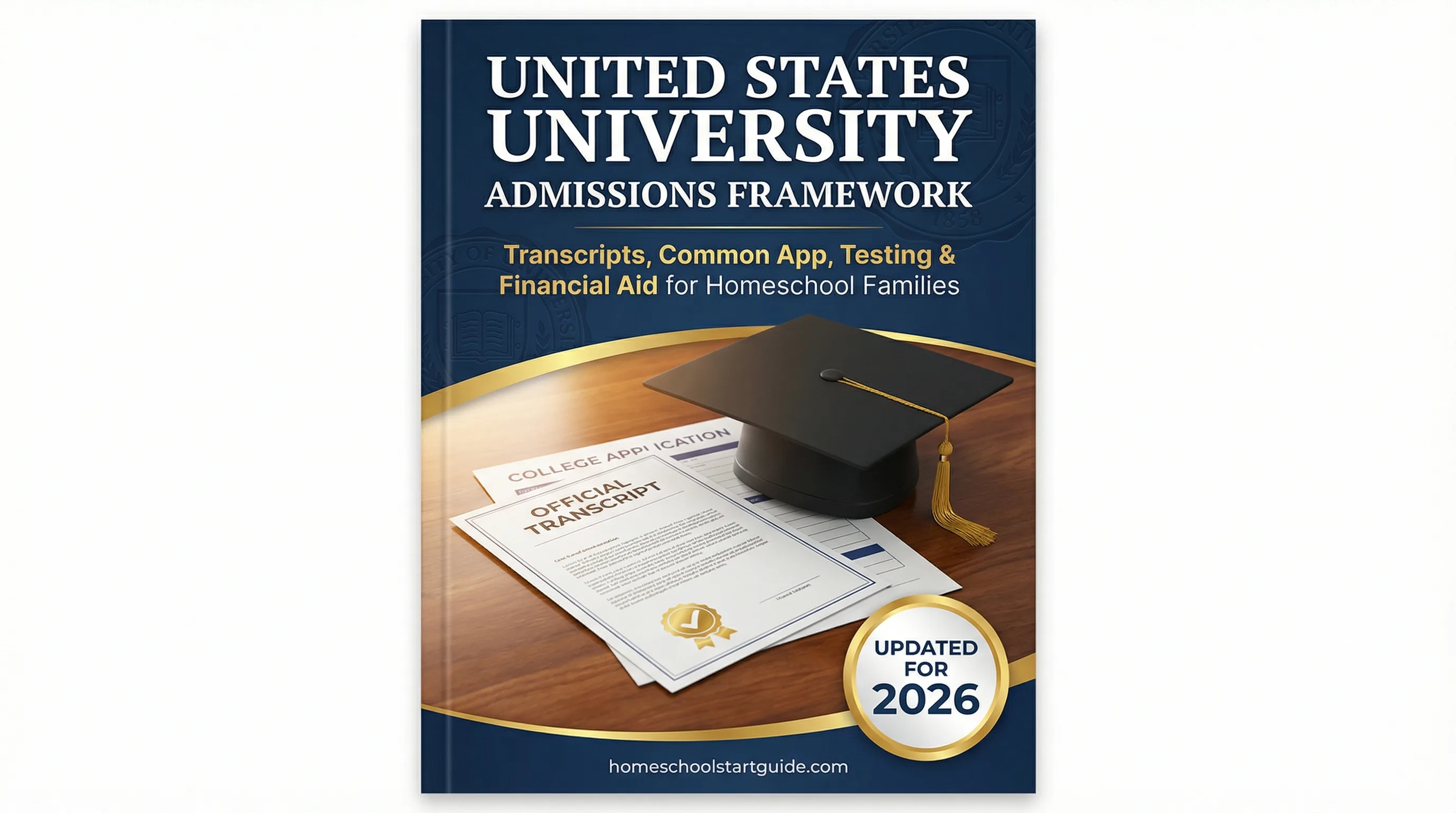
The Framework includes the full 94-page guide, 11 standalone printable reference cards (fillable transcript template, GPA calculator, course description templates with AI prompts, testing strategy reference, Common App counselor guide, NCAA eligibility worksheet, FAFSA guide, scholarship tracker, college directory, grade-by-grade timeline, and quick-reference codes), and the Quick-Start Admissions Checklist for families who need to take action this week. Instant download, no account required — 13 PDFs total.
30-day money-back guarantee. If the Framework doesn't clarify the admissions process for your family, email us and we'll refund you. No questions asked.
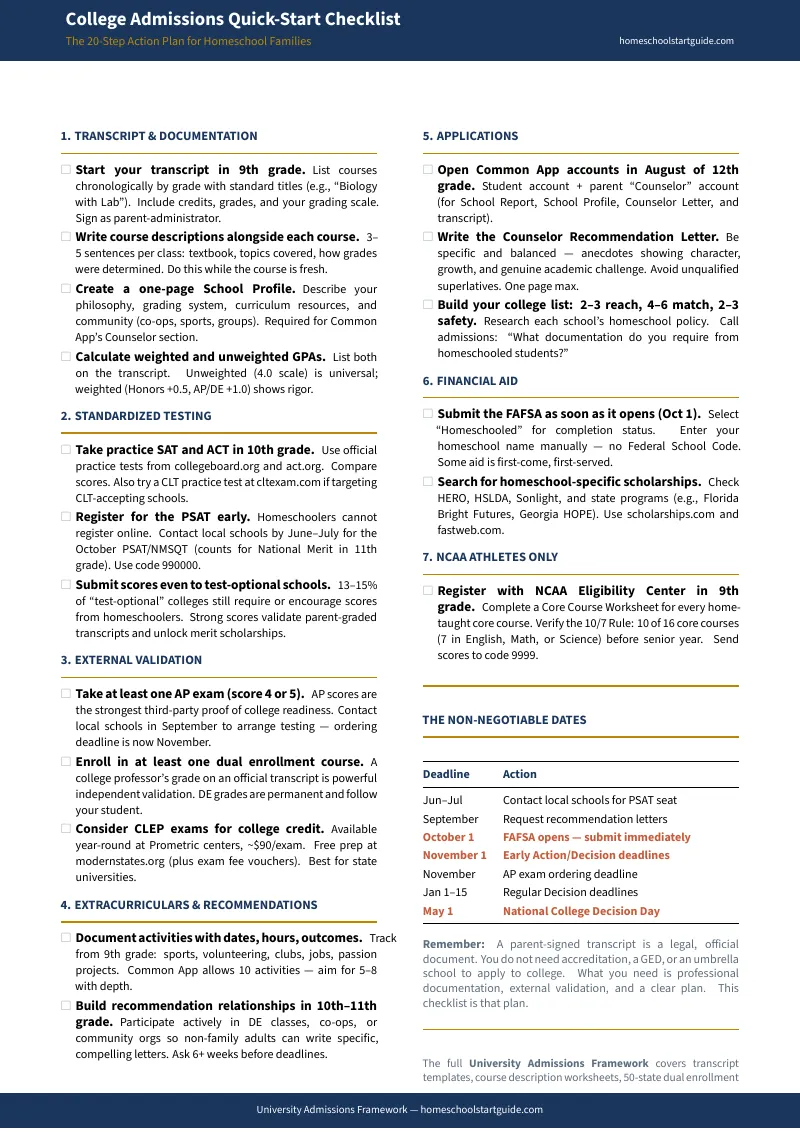
Not ready for the full Framework? Download the free University Admissions Quick-Start Checklist — a grade-by-grade timeline of every deadline, document, and decision point from 9th grade through application submission. It's the "Am I behind?" answer sheet, and it's free.
Your child doesn't need a guidance counselor's office. They need a parent who has the right paperwork, the right deadlines, and the right strategy. The Framework gives you all three — so their application speaks for itself.