Build Your Texas Learning Pod Safely, Legally, and On Your Own Terms.
Texas passed a law to protect you. Your city can't shut you down. Your school district can't inspect your home. Local childcare regulations don't apply. The Texas Learning Pod Protection Act (SB 1955) explicitly exempts home-based learning pods from zoning ordinances, building codes, staff-to-child ratios, and district oversight. But nobody has packaged that protection into a usable, step-by-step guide — until now.
You want to pull together three or four neighborhood families, share the teaching load, and build something that actually fits your child. Maybe you're fleeing a public school that replaced recess with Chromebooks. Maybe you have a neurodivergent child whose IEP battles have exhausted you. Maybe you're secular, and every quality co-op in your area requires a statement of faith. Whatever the reason, you've arrived at the same conclusion: I need to build this myself.
The problem is that the internet gives you fragments. The Texas Home School Coalition tells you the legal baseline — but their co-op manual is written for Christian families, and it doesn't touch the new 2026 TEFA funding rules. The policy blogs explain what SB 1955 says but don't give you templates. The franchise networks (Prenda, KaiPod, Primer) will walk you through launch — for $2,200 per student per year, or a long-term revenue share. You need a Pod Founder's Playbook — the complete operational framework without the ideological prerequisites and without surrendering your tuition to a network.
The Texas Micro-School & Pod Kit is that Pod Founder's Playbook.
What's Inside the Pod Founder's Playbook
The SB 1955 Compliance Checklist
Because "can the city shut me down?" is the question that paralyzes every new pod founder before they hold their first meeting. This is a plain-English breakdown of the Texas Learning Pod Protection Act — what local authorities cannot legally demand from you, what your rights are if they try, and a single document you can hand to a zoning board, HOA, or school district to end the conversation before it starts. Most parents don't know SB 1955 exists. The ones who do can't extract the actionable protections from the statutory text.
The 2026 TEFA Micro-School Playbook
Because the difference between receiving $2,000 in state funding and receiving $0 is an EIN that doesn't match your bank account. Step-by-step instructions for the Odyssey vendor portal, the exact business-name-to-banking alignment the system requires, and the real funding cap for unaccredited pods — not the $10,800 figure circulating on social media. Not a general overview — the specific 2026 checklist that keeps you from losing your funding window to an administrative error.
The Secular & Inclusive Community Charter Templates
Because every co-op you've found requires a statement of faith your family can't sign. Customizable parent agreements, liability waivers, and group operating guidelines written from scratch — no religious language, no political affiliations, no mandatory statements of belief. Clear expectations around attendance, cost-sharing, scheduling, curriculum authority, and liability before the first child walks through your door.
The Pod Liability Protection Framework
Because a child breaking an arm in your living room shouldn't end the pod — and it won't, if you're prepared. This section walks you through securing a micro-school liability insurance policy (typically under $80/month), provides the framework for a participant agreement every parent signs before enrollment, and explains what your homeowner's policy does and does not cover. Liability paranoia is the most common reason parents abandon pod formation after the first planning meeting. This removes it.
The Multi-Age Pod Scheduling Framework
Because trying to lecture five children of different ages simultaneously is the fastest path to burnout by week three. Weekly scheduling frameworks that shift you from "teacher" to "learning guide" — using self-paced curriculum models, transitions between independent work and group sessions, and the same pedagogical principles used by Prenda and KaiPod, without their platform fees.
The TEFA Reality Check
Because making financial decisions based on the $10,800 figure circulating on social media will wreck your first-year budget. The actual cap for unaccredited learning pods is $2,000 per student under the SB 2 rules. This section sets accurate expectations, walks through income and eligibility criteria, and explains the vendor compliance requirements your pod must meet. Transparent, legally accurate, and written to protect you from decisions based on inflated promises.
The Texas Pod Launch Checklist
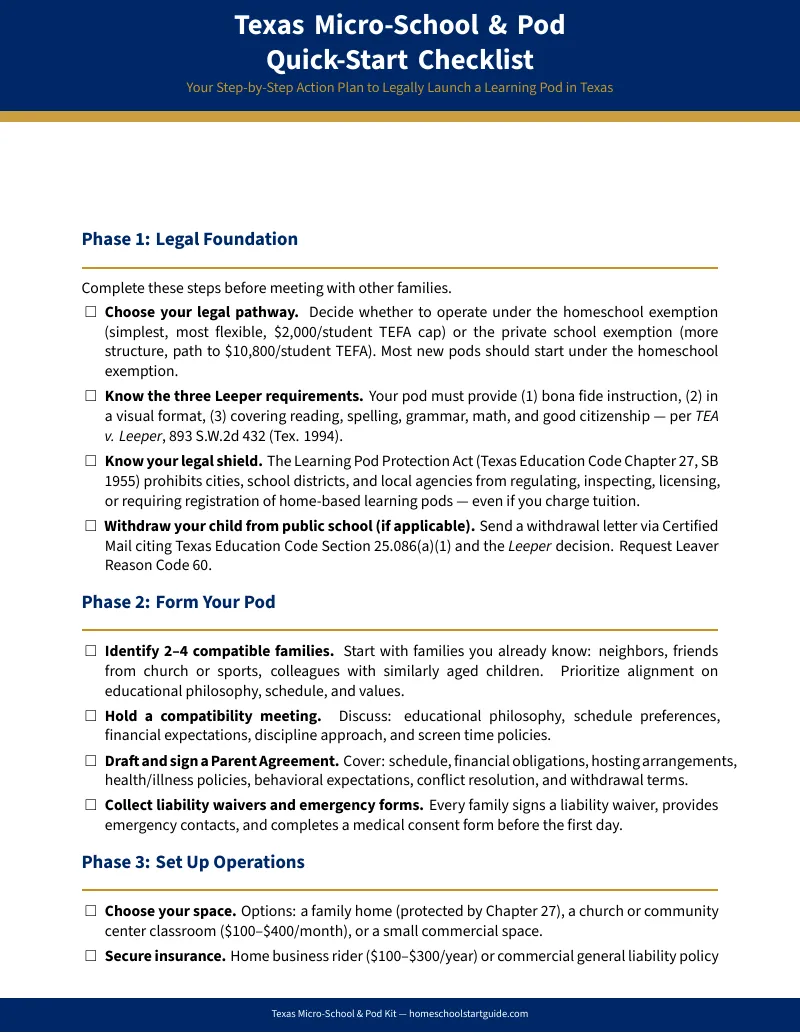
Because most parents spend forty-plus hours assembling the launch sequence from blog posts, Facebook groups, and policy documents. A single-page, print-and-pin document that walks you from "I have an idea" to "the first day of pod school" — covering the legal, operational, financial, and community formation steps in the correct order.
Who This Kit Is For
- Parents who've decided the public school system isn't working for their child — whether because of over-digitization, classroom size, curriculum politics, or rigid special education zoning — and want to build a small, intentional alternative with a handful of like-minded families
- Parents of neurodivergent children (autism, ADHD, dyslexia) who are exhausted by IEP advocacy and need a calmer, self-paced learning environment without the rigid structure of a district placement
- Secular or progressive parents who've been rejected from established co-ops that require statements of faith or ideological conformity, and who need a legally sound charter for an inclusive pod
- Former educators who've left the public school system and want to serve their community by running a small pod — without the overhead and control of a franchise network
- Families who are aware of the 2026 TEFA funding and want to structure their pod correctly from the start to access the $2,000-per-student allocation
- Parents who are currently homeschooling alone and are exhausted — and who want to share the facilitation load with two or three other families without losing control of their child's education
After Using the Kit, You'll Be Able To
- Hand any local official, HOA representative, or district employee the SB 1955 compliance document that legally ends their authority to regulate your pod — before the conversation escalates
- Register on the Odyssey vendor portal and complete the 2026 TEFA application with the exact EIN, banking, and documentation steps required to access the $2,000-per-student funding cap
- Run your first parent intake meeting using a signed participant agreement and liability waiver that protects every family in the pod — without spending money on an attorney
- Facilitate a mixed-age pod of four to eight children across multiple grade levels without chaos — using a scheduling framework that keeps independent learners on task while you work with a small group
- Build a secular, inclusive learning community that explicitly does not require any statement of faith, political affiliation, or religious curriculum — and document that inclusivity in your community charter
- Know the actual TEFA funding cap for unaccredited pods so you make financial decisions based on accurate numbers, not the $10,800 figure circulating on social media
Why Not Just Use the Free Resources?
The Texas Home School Coalition offers a free co-op startup manual. Policy blogs break down SB 1955. Podcasts from Prenda and KaiPod explain the vision of micro-schooling. Etsy sells "micro-school starter kits" for $5. Here is exactly what you run into when you try to build a pod from those sources alone:
- THSC gives you the legal baseline — and then puts you on a conservative political advocacy mailing list. Their co-op materials are written explicitly for Christian homeschool families and assume you share their theological and political framework. The secular parent isn't just left behind — they're actively filtered out.
- Policy blogs explain SB 1955 but provide zero templates. You learn that zoning boards can't regulate your pod. You do not receive the compliance checklist, the parent agreement, or the liability waiver to operationalize that knowledge.
- The franchise networks withhold the operational details deliberately. Prenda's podcast, KaiPod's webinars, and Primer's social content are top-of-funnel marketing designed to route you into their paid platforms. The granular how — the vendor registration steps, the budget templates, the multi-age scheduling frameworks — is the product they sell for thousands of dollars per year.
- The Etsy "micro-school starter kits" are daily planners with a micro-school label. Canva-template schedules, minimalist worksheets, and generic daycare business plans priced at $5–$26. Not one contains a reference to SB 1955, TEFA vendor registration, or Texas-specific liability frameworks. They help you organize a classroom. They don't help you form one legally.
- Almost everything online predates the 2026 TEFA rules. The vendor portal opened December 2025. Applications opened February 2026. Most ranking content was written before these systems existed and does not accurately reflect the current funding landscape or administrative requirements.
Free resources give you the inspiration and the legal baseline. The Pod Founder's Playbook gives you the templates, checklists, and frameworks to execute this week.
— Less Than One Month of a Franchise Platform Fee
Prenda charges approximately $2,200 per student per year in platform fees. The KaiPod Catalyst accelerator starts at $249 upfront plus a monthly subscription or revenue share. A single consultation with a family law attorney about your pod's legal standing costs $200–$400 for one hour. The Kit costs less than a week of that franchise subscription and gives you the operational independence those platforms are designed to prevent.
Your download includes 7 PDFs: the complete guide, the SB 1955 compliance reference (print and hand to officials), the TEFA 2026 vendor registration playbook, a printable parent agreement template, a liability waiver template, a withdrawal letter template, and the Texas Homeschool Quick-Start Checklist — a one-page overview of Texas homeschool law requirements, the five subjects required by the Education Code, and the things a school district cannot legally demand from you. Instant download, no account required.
Money-back guarantee, no time limit. If the Kit doesn't give you the legal clarity and operational confidence to move forward with your pod, email us and we'll refund you. No questions asked.
Not ready for the full Kit? Download the free Texas Homeschool Quick-Start Checklist — a one-page summary of the legal requirements, the TEFA funding basics, and the SB 1955 protections that apply to your pod from day one. It's enough to understand your rights tonight.
Texas passed SB 1955 specifically to protect families like yours. You have the legal right to build this. The Pod Founder's Playbook makes sure you build it correctly.
Frequently Asked Questions
What if the rules change after I buy?
We update the guide when the rules change. Email us any time, even years later, and we'll send you the current edition free.