Build Your South Dakota Micro-School Legally, Affordably, and Without a Franchise.
SDCL §13-27-3 gives you one of the most permissive homeschool frameworks in the country — a one-time notification, instruction in language arts and math, no standardized testing, no portfolio reviews, no curriculum approval, no teacher certification. That freedom is real, and it is why South Dakota had the highest homeschool growth rate of any state in the past decade — a 143 percent increase that pushed alternative instruction enrollment past 12,000 students. But the moment you invite other families' children into your living room, share the teaching load, or charge a single dollar in tuition, you step into questions that the South Dakota Department of Education, FAIRSD, and every Facebook group in Sioux Falls will give you different answers to: Do you operate under alternative instruction or establish a private school? What happens when your pod hits the 22-student cap? Who carries the liability when someone else's child gets hurt?
You want to pull together three or four families in Minnehaha County, share instruction during the week, and build something that actually fits your child. Maybe you are a ranching family east of the Missouri River and your community school consolidated — now the bus ride is ninety minutes each way. Maybe you are burned out on solo homeschooling forty miles from the nearest co-op and need a shared-responsibility model before winter hits. Maybe you just PCS'd to Ellsworth AFB and need a stable learning community in Rapid City before your child falls another semester behind. Maybe you are a Native family near Pine Ridge or Rosebud who wants Lakota language and Oceti Sakowin culture at the center of education, not as a footnote the public school ignores. Whatever the reason, you have arrived at the same conclusion: I need to build this myself.
The problem is that the internet gives you fragments. The SD Department of Education provides the notification form and statutory summary — but zero guidance on pod formation, liability, insurance, hiring facilitators, or the legal difference between a co-op and a private school. FAIRSD defends homeschool rights and tracks legislative threats, but their resources address advocacy, not daily operations. SDCHE runs field trips and graduation ceremonies but requires Statements of Faith that exclude secular families. Facebook groups confidently declare that pods don't need insurance, that the 22-student limit doesn't apply to co-ops, and that you can charge tuition without any legal structure. You need a Pod Founder's Blueprint — the complete operational framework without the dangerous legal guesswork, the franchise costs, or the ideological prerequisites.
The South Dakota Micro-School & Pod Kit is that Pod Founder's Blueprint.
What's Inside the Pod Founder's Blueprint
The South Dakota Legal Framework — Three Pathways
Because the single most confusing question for every new pod founder is which legal pathway to operate under — and getting it wrong can trigger truancy investigations. SDCL §13-27-3 (alternative instruction) requires only a one-time notification and caps you at 22 students per instructor. SDCL §13-27-2 (excused absence) allows temporary arrangements. Establishing a private school gives you the most operational freedom with no student cap and no ongoing state oversight. This framework walks you through the exact criteria for each pathway so you choose the right legal structure before your first family meeting, not after the school district calls.
The 22-Student Scaling Strategy
Because SDCL §13-27-3 caps alternative instructors at 22 students — and every growing micro-school hits this ceiling. While competitors and free resources dutifully report the limit and stop there, this section provides the legal workarounds: multi-instructor LLC structures, tiered co-op boards, and the private school pivot that lets you scale beyond 22 students without triggering regulatory scrutiny. This is the single most requested piece of information in South Dakota homeschool forums, and nobody else provides it.
The SDHSAA Sports and Activities Eligibility Guide
Because Friday night football matters in South Dakota — and the fear of losing athletic eligibility is the single biggest reason parents hesitate to leave the public system. Under open enrollment rules, alternative instruction students can maintain eligibility for SDHSAA-sanctioned sports, fine arts, and extracurricular activities. This guide provides the exact compliance steps, enrollment paperwork, and district contact scripts so your micro-school student never has to choose between educational freedom and the state basketball tournament.
The Hybrid Virtual/In-Person Pod Framework
Because South Dakota is the fifth least densely populated state in America, and your nearest compatible family may be in the next county. This framework provides scheduling templates for pods that meet in person weekly or monthly in central hubs like Sioux Falls, Rapid City, or Aberdeen while connecting daily via virtual platforms for core subjects. Built specifically for dispersed ranching and farming families who cannot drive forty miles each way for daily instruction — with seasonal scheduling around harvest breaks, calving season, and South Dakota's brutal winters.
The Parent Agreement and Liability Waiver Templates
Because a child getting hurt in your home should not end the pod — and it will not, if you are prepared. South Dakota does not have a specific recreational liability waiver statute like some states, which means your waiver language needs to be especially thorough to hold up. Customizable parent agreements covering educational philosophy, schedule, tuition, attendance, behavior, conflict resolution, withdrawal, and media privacy. Plus a liability waiver with risk acknowledgment, indemnification, and medical consent. Every family signs these before day one.
The Facilitator Hiring and Background Check Guide
Because hiring your first facilitator triggers employment classification decisions, tax obligations, and background check requirements. South Dakota DCI criminal history check, FBI fingerprint check, sex offender registry, and DSS child abuse registry must be completed before any student contact. This section covers the W-2 vs. 1099 classification decision (South Dakota has no state income tax, which simplifies payroll), SD facilitator pay benchmarks ($14–$18/hr rural, $16–$20/hr Sioux Falls/Rapid City), contract templates, and scope of duties.
The South Dakota Regional Budget Planner
Because running a pod in Sioux Falls costs nothing like running one in Faith or Murdo. Region-specific budget templates covering facilitator compensation, space rental, curriculum materials, insurance, and field trips — with real numbers for Sioux Falls metro (moderate-cost), Rapid City/Black Hills (moderate), Aberdeen/Brookings (low-moderate), and rural South Dakota (low-cost). Includes cost-sharing models for 3-family, 5-family, and 8-family pods, and a tuition calculator that factors in South Dakota's low cost of living.
The South Dakota Pod Launch Checklist
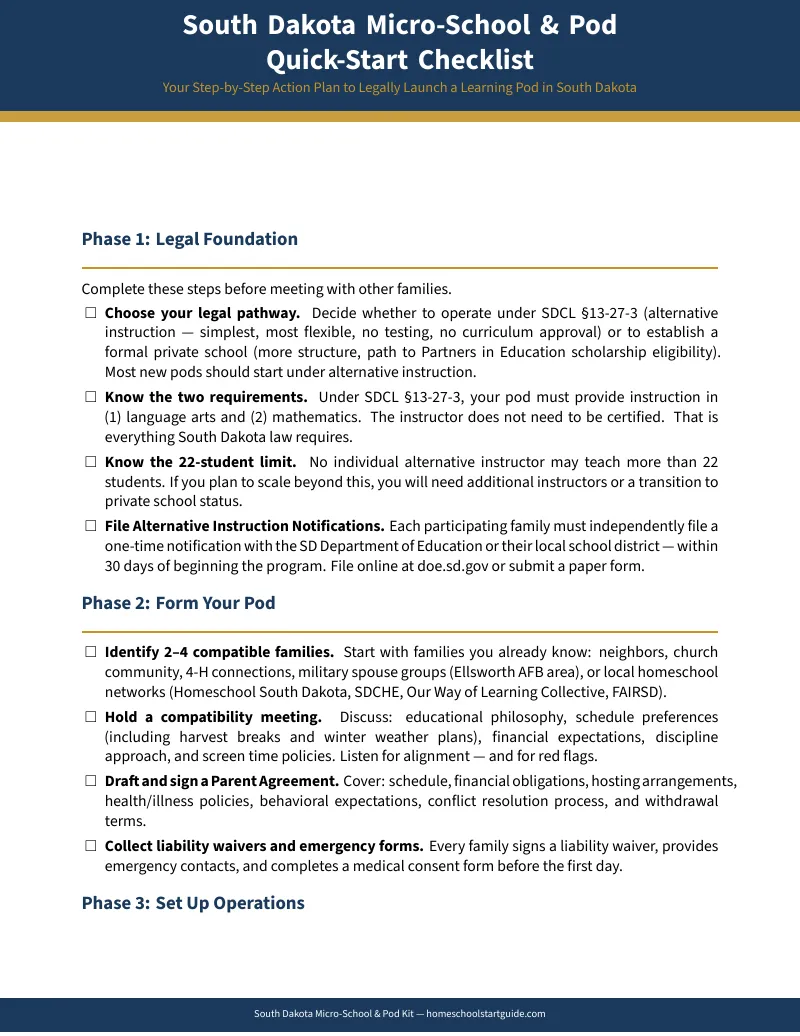
Because most parents spend forty-plus hours assembling the launch sequence from blog posts, Facebook groups, and DOE pages. A single-page, print-and-pin document that walks you from "I have an idea" to "the first day of pod school" — covering the legal, operational, financial, and community formation steps in the correct order.
Who This Kit Is For
- Parents who have decided the public school system is not working for their child — whether because of school consolidation that turned a 20-minute bus ride into a 90-minute ordeal, curriculum concerns, or the feeling that your child is being processed rather than educated — and want to build a small, intentional alternative with a handful of like-minded families
- Solo homeschoolers who have reached the burnout threshold and need a shared-responsibility model where the instructional and social burden is distributed among trusted families — without losing control of their child's education. In South Dakota, your nearest homeschooling neighbor may be in the next county, but a well-structured pod bridges that distance.
- Military families stationed at Ellsworth AFB near Rapid City who need a stable, legally compliant learning pod that provides academic continuity across PCS moves and variable deployment schedules — without starting from zero every time
- Farming and ranching families who need an education model that works with the agricultural calendar — calving season, planting, harvest — rather than one that punishes children for participating in generational work
- Native American families on or near Pine Ridge, Rosebud, Cheyenne River, Standing Rock, or any of South Dakota's nine reservations who want a micro-school centered on Lakota/Dakota language, Oceti Sakowin culture, and kinship-based learning — or families anywhere in the state who want to incorporate Indigenous perspectives into their pod's curriculum
- Parents of neurodivergent children (autism, ADHD, dyslexia, giftedness) who are exhausted by IEP battles and need an ultra-low-ratio, self-paced learning environment that public schools structurally cannot provide
- Parents who want their child to stay in SDHSAA sports and activities while homeschooling — and need the exact eligibility steps to make dual enrollment work
After Using the Kit, You'll Be Able To
- Understand your legal standing under SDCL §13-27-3 and know exactly when a micro-school should operate as an alternative instruction program, when it should pivot to a private school structure, and why the private school pathway gives you more operational freedom with no student cap
- File South Dakota's one-time Alternative Instruction Notification correctly and understand what triggers the 30-day transfer notification if families change resident districts
- Scale past the 22-student threshold legally using multi-instructor structures or the private school pathway — the workaround nobody in the Facebook groups provides
- Maintain SDHSAA eligibility for sports, fine arts, and extracurricular activities through open enrollment — with the exact paperwork and compliance steps
- Run your first parent intake meeting using a signed Family Agreement and liability waiver — without spending $250 on a Sioux Falls education attorney
- Hire and background-check a facilitator legally, classify them correctly for tax purposes (simplified by SD's lack of state income tax), and pay them competitively using real local wage benchmarks
- Build a sustainable budget with region-specific cost data, set tuition that families can afford, and split costs equitably across participating households
- Access dual enrollment at South Dakota Board of Regents institutions at $78.48 per credit hour — giving your high schoolers college credits at a fraction of standard tuition
Why Not Just Use the Free Resources?
The South Dakota Department of Education provides a notification form and statutory summary. FAIRSD tracks legislative threats. SDCHE runs community events. Facebook groups across the state have thousands of homeschool parents trading advice. Here is exactly what you run into when you try to build a pod from those sources alone:
- The DOE gives you a notification form and walks away. The Department of Education confirms that SDCL §13-27-3 requires a one-time notification and instruction in language arts and math. For a solo homeschooler, that is all you need. For a micro-school founder hosting ten children and exploring tuition, it tells you nothing about liability, insurance, employment law, the 22-student cap workaround, or the private school classification pathway.
- FAIRSD gives you legislative defense but not daily operations. FAIRSD has done outstanding work tracking House Bill 1152, House Bill 1158, and Senate Bill 134 — the recent bills attempting to claw back homeschool freedom with mandatory assessments and annual notification. Their alerts protect your rights. But they provide no templates, no legal frameworks, and no guidance on the operational mechanics of running a multi-family pod.
- SDCHE gives you community but requires a Statement of Faith. South Dakota Christian Home Educators and their local chapters run field trips, graduation ceremonies, and networking events. Excellent for their demographic. Completely inaccessible to secular families, military families seeking non-denominational stability, and Native American families building culturally responsive pods.
- Facebook groups are an echo chamber of outdated legal advice. Parents confidently claim that pods don't need insurance, that the 22-student limit doesn't apply to informal co-ops, and that the 2021 deregulation eliminated all oversight. Meanwhile, legislators introduced multiple restrictive bills in 2025 and 2026. A parent who builds a 15-student co-op based on 2021 Facebook advice may discover the regulatory landscape has shifted when the school district files a truancy report, not before.
- Etsy templates are generic daily planners with a micro-school label. Canva templates, enrollment forms, and minimalist worksheets priced at $4–$12. Not one references SDCL §13-27-3, the 22-student threshold, the private school pathway, South Dakota's DCI background check requirements, SDHSAA eligibility rules, or the Board of Regents dual enrollment program. They help you organize a schedule. They do not help you form a legally protected pod.
- Prenda and KaiPod solve the problem — and take your autonomy and revenue. Prenda operates in South Dakota and provides turnkey infrastructure. But you adopt their standardized curriculum — meaning no agricultural integration for your ranch family, no Oceti Sakowin focus for your Native community, and no flexibility around the harvest calendar. If you are doing the hard work of building local trust, you should keep 100% of the revenue and 100% of the curriculum control.
Free resources give you the legal baseline and the inspiration. The Pod Founder's Blueprint gives you the templates, checklists, and frameworks to execute this week.
— Less Than One Hour With a Sioux Falls Education Attorney
A single consultation with a South Dakota education attorney costs $200 to $300 per hour. Prenda charges platform fees per student per month. The Kit costs less than one hour of professional advice and gives you the operational independence those platforms are designed to prevent — plus the 22-student scaling strategy, the SDHSAA eligibility guide, and the Board of Regents dual enrollment framework that extend and fund your entire operation.
Your download includes six files: the complete guide (22 chapters covering South Dakota's three legal pathways, pod formation, facilitator hiring, space options, legal structure and tax implications in a no-income-tax state, insurance and liability, scheduling around agricultural calendars and harsh winters, budgeting by region, zoning, school choice programs, curriculum, SD-specific programming including agricultural education and Lakota/Dakota cultural studies, high school operations and dual enrollment, neurodivergent learners, military families at Ellsworth AFB, scaling past the 22-student cap, disagreements, assessment, marketing your micro-school, and the legislative landscape), the South Dakota Pod Launch Checklist (print-and-pin), and four standalone printable templates — Family Partnership Agreement, Liability Waiver with Emergency Contact Form, Facilitator Contract, and South Dakota Regional Budget Planner. Instant download, no account required.
30-day money-back guarantee. If the Kit does not give you the legal clarity and operational confidence to move forward with your pod, email us and we will refund you. No questions asked.
Not ready for the full Kit? Download the free South Dakota Homeschool Quick-Start Checklist — a one-page summary of the legal framework under SDCL §13-27-3, the private school pathway, the 22-student threshold, SDHSAA eligibility basics, and the key considerations for Sioux Falls, Rapid City, Aberdeen, and Brookings. It is enough to understand your rights tonight.
South Dakota gave you the freedom. The Pod Founder's Blueprint makes sure you use it correctly.