Build Your South Carolina Learning Pod on the Only Legal Framework That Covers All Four Pathways, ESTF Compliance, and the Daycare Trap Your Homeowner's Insurance Won't
You've decided to stop going it alone. Maybe solo homeschooling has you teaching every subject, every day, to every child — and the burnout hit six months ago. Maybe you've priced private schools in Charleston or Greenville and discovered that $15,000 to $25,000 per child per year isn't happening. Maybe you just PCS'd to Fort Jackson or Joint Base Charleston and the local school ratings made your stomach drop. Whatever brought you here, you've arrived at the same conclusion: I need to build something better with other families.
Then you started researching. And you hit the wall that every South Carolina micro-school founder hits.
South Carolina doesn't have one homeschool law — it has three. Option 1 puts you under school district oversight with mandatory SC READY testing. Option 2 is SCAIHS at $385+ per year with compulsory standardized testing for grades 3–11. Option 3 puts each family with an independent accountability association — maximum flexibility, no state-mandated testing, $50–$100 per year. And then there's a fourth pathway: registering as a private school, which is the only route that lets your families access the $7,500 ESTF scholarship. Facebook groups can't agree on which option is "best" for a pod. The SC Department of Education explains the statutes but doesn't tell you how five families running a shared learning space actually fits into any of them.
Meanwhile, nobody online is talking about the thing that could actually destroy your pod: liability. A child breaks an arm during recess in your living room. You call your homeowner's insurance. They deny the claim because operating a learning pod constitutes an uninsured commercial activity. One incident. One denial. One lawsuit. That's the gap between free Facebook advice and an operational playbook.
The South Carolina Micro-School & Pod Kit is the guide built around the Four-Pathway Compliance Framework — a decision system that cuts through SC's three-option confusion, adds the private school pathway most parents don't realize exists, and gives you the legal templates, insurance guidance, ESTF compliance steps, and operational infrastructure to launch a sustainable learning community without a single compliance gap, a single uninsured day, or a single dollar surrendered to a franchise network.
What's Inside the Kit
The Four-Pathway Decision Framework
South Carolina's three homeschool options plus the private school pathway create decision paralysis for every new micro-school founder. Option 1 triggers school district oversight and state testing — and if scores fall below promotion standards, the district can order re-enrollment. Option 2 is SCAIHS with standardized testing, official transcripts, and $385+/year per family. Option 3 gives you maximum curriculum freedom through a 50-member association at $50–$100/year — but each family must file individually, and the micro-school itself cannot register as its own association. The private school pathway has no state registration or teacher certification requirements, but it's the only route to ESTF funding. The Kit walks you through each pathway side by side — what it costs, what it requires, who it's for — and gives you a decision tree so you choose the structure that matches your pod's size, philosophy, and funding strategy.
The ESTF Funding Playbook
South Carolina's Education Scholarship Trust Fund allocates $7,500 per qualifying student for the 2025–2026 school year, rising to $7,634 for 2026–2027. That can cover the entire cost of a micro-school for qualifying families — but only if you're structured correctly. ESTF recipients cannot simultaneously enroll under Option 1, 2, or 3. The micro-school must be set up as an eligible private school, and all expenses flow through the ClassWallet platform. The Kit includes a dedicated ESTF compliance chapter covering eligibility, the structural requirements, the "unbundling" landscape, and the exact steps to position your micro-school as an approved service provider — so families can legally direct state funds toward your pod without risking disqualification or audit penalties.
Insurance and Liability — The Chapter No Etsy Template Includes
Standard homeowner's insurance will not cover learning pod activities. Operating a micro-school in your home constitutes a commercial activity in the eyes of major underwriters. This section covers exactly what coverage you need (commercial general liability, minimum $1,000,000 per occurrence), which providers write homeschool cooperative policies in South Carolina (NCG Insurance, Red Sky Insurance, Church Mutual), what it costs ($150–$350/year), and how to structure your liability waivers. It also covers the "daycare trap" — the specific conditions under which the South Carolina Department of Social Services can classify your pod as an unlicensed childcare facility, and exactly how to stay below that threshold.
Family Agreement and Liability Waiver Templates
Customizable templates covering schedule, financial obligations, curriculum authority, health and illness policies, behavioral expectations, a dispute resolution protocol with a 24-hour cooling-off period, and withdrawal terms. Written without religious language or ideological prerequisites. These are the documents that prevent the most common reason pods collapse — undefined expectations between adults. Every participating family signs before the first day.
Facilitator Hiring Guide with SLED Background Checks
If your pod hires a dedicated facilitator, this section walks you through the entire process: the SLED CATCH background check system ($25 per name-based search, 24–48 hours for results), the optional FBI fingerprint check for maximum rigor, W-2 vs. 1099 classification (misclassification carries IRS penalties), and compensation benchmarks for South Carolina ranging from $15–$35/hour depending on qualifications and region.
Budget Planning with Real SC Benchmarks
Regional cost data for space rental ($150–$800/month for church classrooms depending on metro area), curriculum ($200–$600/student/year), insurance, and facilitator compensation — plus four cost-sharing models (equal-split, per-child, tiered contribution, and host-family offset) with worked examples showing how a pod of 6–8 students splits annual expenses to achieve a small student-teacher ratio at a fraction of private school tuition.
The SC Pod Launch Checklist
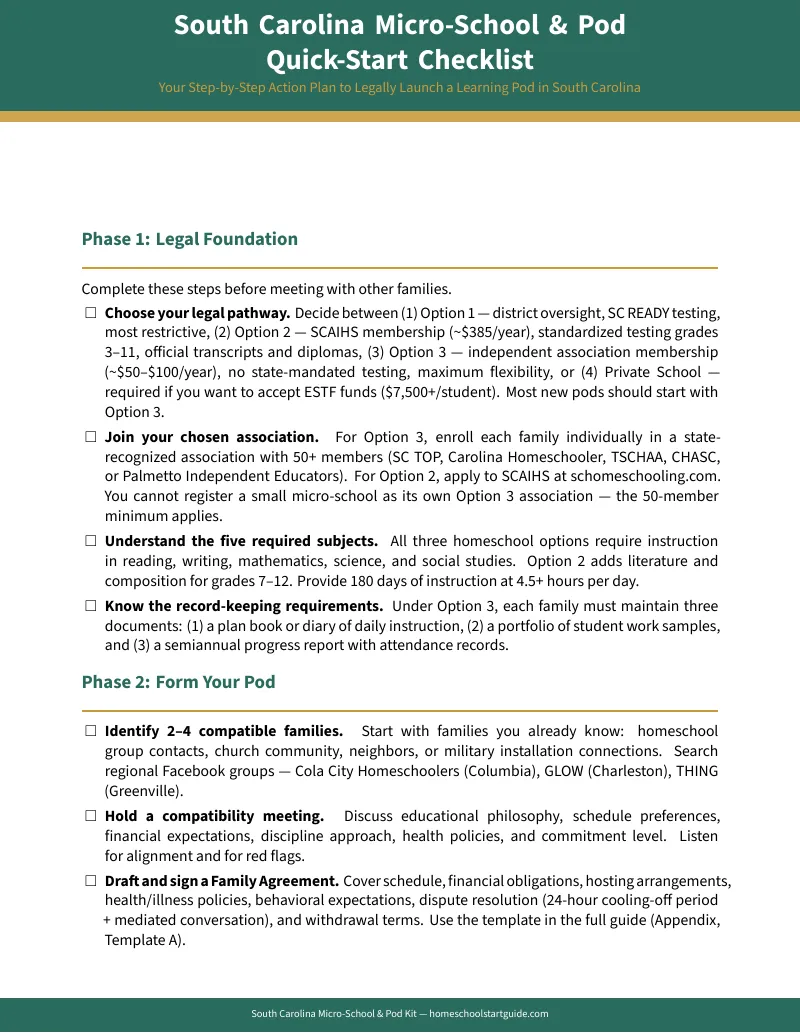
A single-page, print-and-pin sequencing document covering legal foundation, pod formation, operations setup, curriculum selection, staffing, and launch week — in the correct order. Most parents spend forty or more hours assembling this sequence from scattered blog posts, Facebook groups, and state websites. The checklist condenses it to one reference page.
Who This Kit Is For
- Parents burned out on solo homeschooling who want to share the teaching load with two to four other families without losing control of their child's education
- Charleston, Columbia, and Greenville families priced out of private school who want a high-quality small-group environment at a fraction of $15,000–$25,000 annual tuition
- Military families at Fort Jackson, Joint Base Charleston, Shaw AFB, or Parris Island who need a portable, community-based education model that survives PCS moves
- Parents who want to access the $7,500 ESTF scholarship and need to structure their pod correctly to qualify
- Secular or inclusive families who've been turned away from established co-ops that require statements of faith
- Parents of neurodivergent children who are exhausted by IEP battles in overcrowded classrooms and want a calmer, self-paced environment
- Former educators who want to serve their community by running a small pod — without surrendering revenue to Prenda, KaiPod, or another franchise network
Why Not Just Use the Free Resources?
You can absolutely piece this together yourself. Here's what that looks like:
- The SC Department of Education lists the three homeschool options and the statutes — but provides zero guidance on how multiple families operating a shared learning space fit into the framework. No templates, no insurance advice, no ESTF compliance steps.
- SCAIHS provides excellent Option 2 accountability for $385+/year — but their entire model is designed for individual families. They offer no guidance on multi-family operations, shared liability, or tuition structuring.
- SC Homeschooling Connection has solid free content — scattered across dozens of blog posts mixed with affiliate links. A parent in crisis doesn't need a reading assignment spread across 15 browser tabs.
- Facebook groups are full of conflicting advice about Options 1, 2, and 3, dangerous misinformation about the ESTF, and zero coverage of insurance, liability waivers, or the daycare licensing threshold.
- Etsy templates ($3–$10) are state-agnostic planners and attendance trackers — none cite SC Code §59-65-47, none address the private school pathway, and none include liability waivers or ESTF compliance frameworks.
- Prenda charges $2,199 per student per year in platform fees. KaiPod demands $15,000 upfront or 10% of your revenue. Both control your curriculum and capture your tuition. You build the community — they take the margin.
The Kit compresses 40+ hours of research across six different sources into a single document you can read and act on this week.
— Less Than One Hour with an Education Attorney
A single consultation with a South Carolina education attorney costs $200–$400 per hour. SCAIHS charges $385/year per family — for individual compliance only, not pod operations. Prenda charges $2,199 per student per year. KaiPod demands $15,000 upfront or 10% of annual revenue for two years. The Kit costs less than a single attorney consultation and gives you the legal clarity, operational templates, and ESTF compliance guidance those alternatives are designed to sell piecemeal or withhold entirely.
Your download includes the complete 23-chapter guide, the Quick-Start Checklist, and standalone printable templates — the Family Agreement, Liability Waiver with emergency contact form, Facilitator Contract, Budget Planner, and Annual Compliance Tracker. Instant download, no account required.
30-day money-back guarantee. If the Kit doesn't give you the legal clarity and operational confidence to move forward with your pod, email us and we'll refund you. No questions asked.
Not ready for the full Kit? Download the free South Carolina Homeschool Quick-Start Checklist — a one-page summary of the four legal pathways, the key compliance requirements, and the six-phase launch sequence. It's enough to understand your rights tonight.
South Carolina led the nation in homeschool growth last year. Every one of those families figured out the legal framework. Now you have the operational playbook they didn't.