Your Kid Talks Great to Adults. But Can They Navigate a Cafeteria?
Your homeschooler is articulate, thoughtful, and can hold a conversation with any adult in the room. Teachers at co-op say they're "so mature." Grandparents are impressed. And when someone brings up the socialization question at Thanksgiving, you have your answer ready: "They're actually better socialized than most kids their age."
But sometimes, late at night, you wonder. Can they walk into a group of kids their own age and just... fit in? Not perform. Not impress. Just belong. Do they understand the unspoken rules of a teen hierarchy — who to approach, when to stay quiet, how to enter a conversation without accidentally taking over? Or have they learned to interact with adults so well that they've never had to develop the radar that other kids build by navigating hallways, lunch tables, and locker rooms every day?
You're not looking for someone to tell you socialization is a myth. You've read that blog post. You've seen the NHERI stats. You know homeschoolers score higher on social assertiveness. But knowing that doesn't help you figure out whether your specific child is building genuine peer connections — or just performing well in adult-supervised settings where the rules are explicit and the hierarchy is clear.
And then there's the other side: the practical infrastructure. Your 12-year-old wants to play basketball, but you're not sure if your state lets homeschoolers try out for the public school team. You've heard the phrase "Tim Tebow Law" but can't find a straight answer about whether it applies in your state — or what paperwork you'd need to file. Your neighbor's kid just got a soccer scholarship, and you're wondering whether NCAA eligibility even works for homeschoolers, and whether you've already missed a deadline you didn't know existed.
You don't need another article telling you not to worry. You need a system that handles both sides — the social skills your child needs to build and the legal access, sports eligibility, and extracurricular infrastructure that makes it possible.
What's Inside the Playbook
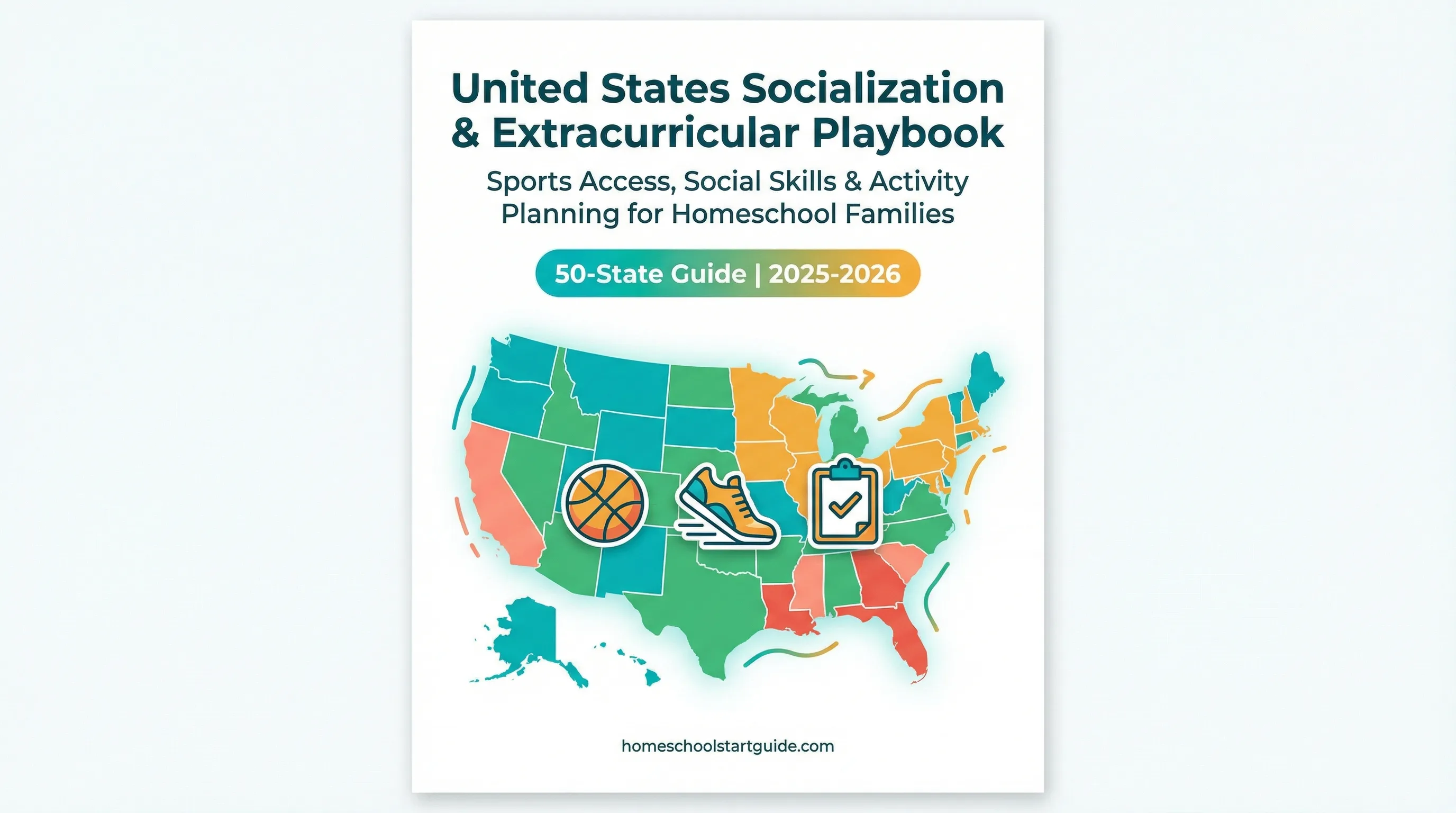
The 50-State Sports Access Matrix
A color-coded breakdown of every state's homeschool sports access policy — which states mandate participation (Tim Tebow laws), which leave it to district discretion, and which effectively block access through enrollment requirements. For "district discretion" states, the Playbook includes email scripts parents can send to Athletic Directors to request tryout access, plus a step-by-step advocacy guide for approaching school boards. Updated for the 2025-2026 school year, including the Texas SB 401 opt-out provision.
The Social Skills Diagnostic
Not an etiquette checklist — a framework for distinguishing between healthy introversion and genuine social skill gaps. Covers the specific blind spots that show up in homeschooled kids: difficulty reading unspoken group hierarchies, "autopilot" social processing (where interactions feel exhausting because every cue is manually decoded), and the gap between performing well in structured adult settings and navigating the unstructured chaos of peer groups. Includes age-specific benchmarks from toddler through teen so you can see exactly where your child stands.
The Co-op Finder & Starter Guide
How to find enrichment, academic, hybrid, and virtual co-ops in your area — with directories, search strategies, and Facebook group naming conventions that actually surface active local groups. If nothing exists nearby, the guide walks you through starting one: legal structure (when to incorporate as a 501(c)(3)), liability insurance ($229+/year baseline), venue negotiations, and parent-rotation teaching models. Every listing is flagged as faith-based or inclusive/secular so you don't waste time discovering the mismatch after you've committed.
The NCAA Eligibility Walkthrough
If your student-athlete wants to play Division I or II college sports, the NCAA requires Core Course Worksheets for every home-taught course, adherence to the 10/7 Rule (10 of 16 core courses completed before senior year), and registration with the Eligibility Center. This section walks you through each requirement with the specific forms, deadlines, and documentation standards — including the 2023 change that eliminated the SAT/ACT requirement for initial eligibility. Miss the 9th-grade planning window and your child may not have enough documented core courses to qualify.
The Extracurricular Portfolio Builder
A structured framework for building a well-rounded activity resume that colleges actually value — covering community organizations (Civil Air Patrol, Sea Cadets, 4-H), STEM competitions (FIRST Robotics, science fairs with ISEF pathways), volunteer service (PVSA certification through approved organizations), performing arts, and dual enrollment as a social bridge. Each activity includes age eligibility, registration steps, cost estimates, and how to document it for college applications.
Homeschool Sports Leagues Directory
For families in states without Tim Tebow laws — or families who prefer homeschool-only competition — this section covers the major independent leagues: NCHBC basketball (400+ teams at nationals), HWSA baseball (World Series qualifying), NHFA football (11-man and 8-man), plus individual sport pathways through USA Swimming, USAG, USTA, and junior golf tours that don't require school affiliation.
Social Events & Milestones Guide
How to organize and find homeschool proms, graduation ceremonies, and group milestones that give your child the shared experiences their peers take for granted. Covers state-level graduation ceremonies through CHEC, NCHE, and THSC, plus practical planning guides for local events — budgeting, venue selection, dress code policies, and the committee structures that actually work.
Who This Playbook Is For
- Parents who are confident in their homeschool academics but privately worry about whether their child is building real peer connections — not just performing well in adult-supervised settings
- Families facing the "socialization question" from relatives and want more than reassurance — they want a documented plan that proves the social infrastructure is real and intentional
- Parents of athletes who need to understand Tim Tebow laws, NCAA eligibility, and the registration deadlines that can make or break a college sports career
- Families in states without public school sports access who need to find or build alternative athletic opportunities through independent homeschool leagues
- New homeschoolers who left public school and need to rebuild their child's social life from scratch — especially post-pandemic families who lost community connections during the transition
- Parents of teens heading toward college who need an extracurricular portfolio that demonstrates leadership, service, and engagement beyond academics
After Using the Playbook, You'll Be Able To
- Know whether your state mandates, allows, or blocks homeschool access to public school sports — and have the email scripts and advocacy steps to pursue access in "district discretion" states
- Distinguish between a child who is introverted (a personality trait that's perfectly healthy) and a child who is missing social cues (a skill gap that needs intentional intervention)
- Find or start a co-op that matches your family's worldview, budget, and schedule — without spending weeks discovering that the "inclusive" group isn't, or the "affordable" one costs $3,000/year
- Build an extracurricular portfolio with the organizations, competitions, and service opportunities that college admissions officers recognize and value
- Navigate NCAA eligibility requirements from 9th grade forward — Core Course Worksheets, the 10/7 Rule, and Eligibility Center registration — without discovering a missed deadline in 12th grade
- Answer the socialization question at Thanksgiving with specifics, not platitudes — because your child's social calendar, activity portfolio, and skill development are documented and intentional
Why Not Just Piece This Together for Free?
You can try. The information exists — scattered across HSLDA's membership-gated resources ($130+/year), state homeschool organization websites that only cover their own state, Reddit threads that oscillate between "socialization is a myth" and trauma stories from r/HomeschoolRecovery, and blog posts that offer reassurance when what you actually need is a registration form and a deadline.
- Tim Tebow law information is contradictory. Some sources say 20 states have equal access laws. Others say 30+. The difference is whether they're counting "mandatory access" states (where the law requires schools to let your child try out) vs. "district discretion" states (where the school board can say no). One wrong assumption could mean your child misses tryout registration in a state that actually allows it.
- NCAA eligibility requirements are buried in bureaucracy. The Core Course Worksheet exists on the NCAA website, but there's no homeschool-specific walkthrough that tells you how to fill it in when you're the teacher, the administrator, and the transcript issuer. Free resources mention it exists. They don't show you how to complete it.
- "Socialization is a myth" doesn't help a lonely child. The blogs are right that the research supports homeschool social outcomes. But research averages don't help the parent whose specific child is struggling with peer dynamics. The generic advice — "just join a co-op" — doesn't address what to do when the co-op doesn't exist, costs $3,000, or doesn't fit your worldview.
- Co-op directories are fragmented and outdated. There is no single national directory. State organizations list their affiliates but miss the informal groups that form and dissolve on Facebook. Finding the right co-op requires knowing the naming conventions, the right search terms, and which directories are actually maintained.
Etiquette curricula charge $195-$595 and teach manners — not sports access, NCAA eligibility, or how to start a co-op. HSLDA membership costs $130+/year for legal resources that don't include social skill frameworks. This Playbook combines the legal infrastructure, the social development tools, and the extracurricular roadmap in one document — the tactical bridge that no competitor builds.
— Less Than One Season of Sports Fees
A single season of youth sports costs $200-$500 in registration, equipment, and travel. One missed NCAA deadline doesn't come with a price tag — it comes with a scholarship opportunity that quietly disappears. An etiquette course for homeschoolers runs $195 at the low end. A year of HSLDA membership for legal access guidance costs $130+.
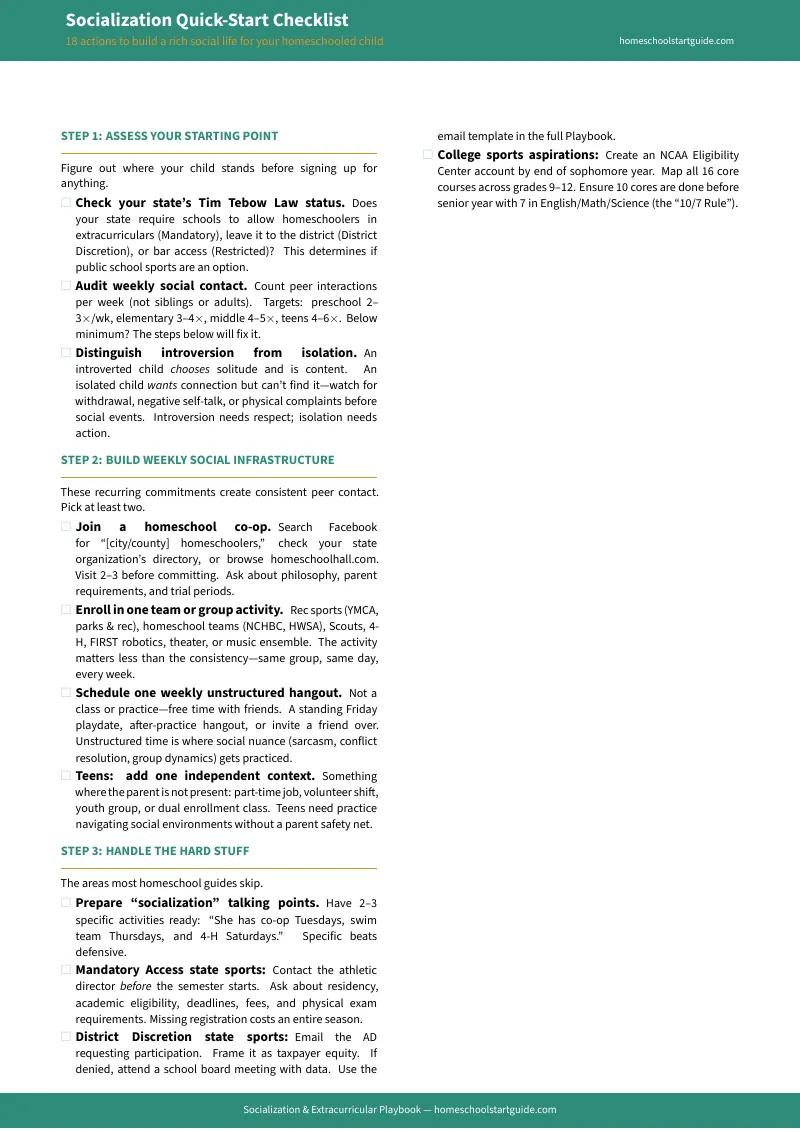
The Playbook includes the full 95-page guide, 11 standalone reference cards and worksheets (sports access matrix, social skills diagnostic, NCAA quick reference, extracurricular planner, sports leagues directory, email scripts, social calendar, age-by-age roadmap, conversation scripts, co-op evaluation checklist, and resource directory), plus the Quick-Start Socialization Checklist. 13 files total — instant download, no account required.
30-day money-back guarantee. If the Playbook doesn't give your family a clearer path to genuine social connection and extracurricular access, email us and we'll refund you. No questions asked.
Not ready for the full Playbook? Download the free Socialization & Extracurricular Quick-Start Checklist — a one-page overview of the key action items: check your state's sports access policy, assess your child's social development by age, and identify the first three activities to pursue. It's the starting point, and it's free.
Your child's education already proves they can learn anything. The Playbook makes sure they also have the social connections, the athletic opportunities, and the extracurricular portfolio to show the world what they've built — on their own terms.