Rhode Island Requires School Committee Approval. Here's How to Get It on the First Try.
You've made the decision. Your child is struggling — academically, emotionally, socially — and you know the public school system isn't working anymore. You want to pull them out and start homeschooling. But then you discovered what makes Rhode Island different from almost every other state: you can't just file a letter and start teaching. You need the local school committee to formally approve your homeschool plan before you can legally educate your child at home.
That word — "approval" — stops most parents cold. You've read conflicting advice on Facebook. One parent says Warwick approved her in a week. Another says Providence demanded a six-page curriculum plan, a daily schedule, and a mandatory in-person meeting before they'd even put it on the agenda. You've looked at the ENRICHri website and the RIDE guidance and found two completely different sets of instructions. You have no idea what your specific district actually requires — or whether the school committee can just say no.
Here's what the state website won't tell you: RIGL §16-19-2 limits the school committee's review to exactly four criteria. If your plan meets those four requirements — the right subjects, substantially equal attendance, attendance records, and thorough-and-efficient instruction in English — the committee is legally obligated to approve it. They are not evaluating your qualifications. They are not grading your curriculum choices. They are checking four statutory boxes. The Rhode Island Legal Withdrawal Blueprint gives you the exact documents, the boundary-setting language, and the School Committee Approval System — a step-by-step process that walks you from first decision through committee vote, covering all 36 districts, so you get approved on the first attempt without over-reporting a single detail the law doesn't require.
What's Inside the Blueprint
The School Committee Approval System
Rhode Island has 36 school districts, each with its own procedures, meeting schedules, and administrative tendencies. Providence processes homeschool requests differently than Barrington, which handles them differently than Cranston. The Blueprint maps the entire approval workflow — from drafting your Letter of Intent through the superintendent's desk to the committee vote — with district-specific intelligence on how high-volume districts actually handle these requests. You'll know exactly what to submit, when to submit it, and what to expect at each stage.
The Fill-in-the-Blank Letter of Intent
The LOI is the most anxiety-inducing document in the entire process. Write too little and the committee sends it back. Write too much and you've just volunteered details that invite micromanagement for the next twelve years. The Blueprint includes templates for three scenarios — start-of-year withdrawal, mid-year withdrawal, and private school transfer — each calibrated to satisfy the four statutory requirements of RIGL §16-19-2 without exposing a single detail beyond what the law demands. Copy-paste your family's information and send it tonight.
The Gap Period Truancy Protocol
This is the piece that no free template, Facebook group, or $25 membership covers. Between the day you submit your LOI and the day the school committee actually votes — which can be two to six weeks depending on when the next meeting falls — your child is technically still enrolled in public school. Every day they don't show up accrues as an unexcused absence. The Protocol tells you exactly what to document at home, what to say if the attendance office calls, and how to protect yourself from a DCYF referral during this legal limbo. It's the single most stressful part of the Rhode Island process, and the Blueprint eliminates the guesswork entirely.
The Pushback & Boundary Scripts
Some Rhode Island districts have created internal "Homeschool Policy" documents that demand things the law never authorized — mandatory in-person meetings with the superintendent, curriculum approval before the committee will consider your plan, home visits, or enrollment in the public school as a prerequisite to processing a withdrawal. None of these have any basis in RIGL §16-19. The Blueprint arms you with pre-written email responses — citing the exact statutes — to politely decline every overreach. Copy, paste, send. No lawyer required.
The Annual Evaluation Planner
Rhode Island requires annual evaluation to demonstrate your child is receiving a "thorough and efficient" education. You have three options: standardized testing, evaluation by a certified teacher, or portfolio review. Each has advantages and risks — and some districts steer parents toward whichever option gives the district the most oversight. The Blueprint compares all three, explains when each makes sense, provides preparation checklists, and shows you the "Minimum Effective Dose" approach to EOY reporting so you satisfy the statute without surrendering data the district has no right to see.
The Appeal & Denial Playbook
If a school committee denies your plan — or imposes conditions that exceed their authority — you have the legal right to appeal directly to the Rhode Island Commissioner of Education under RIGL §16-19-2 and §16-39. The Blueprint walks through the appeal process step by step, includes the documentation you'll need, and explains what happens at each stage. Most parents never need this section. But knowing it exists — and knowing that the committee knows you know — changes the entire dynamic of the approval conversation.
The IEP & Special Needs Exit Guide
The school told you that withdrawing means permanently forfeiting all IEP services. That's a half-truth. When you withdraw, the IEP no longer applies — but your child's right to evaluation under federal Child Find laws continues. The Blueprint explains exactly what happens to your child's IEP, how to document current accommodations before you leave, your continuing rights as a homeschool family, and the Kimberly J. v. Coventry precedent that shapes Rhode Island's obligations to homeschooled children with disabilities.
Who This Blueprint Is For
- Parents whose child is being bullied, having panic attacks, or physically refusing school — and who need to execute a legal withdrawal before the next school committee meeting, not after months of research
- Parents who contacted their district and were told they need to schedule a meeting, submit their curriculum for review, or get "permission" — and who need the exact statutory language to override those demands
- Parents of children with IEPs or 504 plans who need to understand what protections they keep and what they forfeit — before signing anything the school puts in front of them
- Parents withdrawing mid-year who are terrified that keeping their child home during the gap period between submission and committee vote will trigger truancy proceedings or a DCYF referral
- Parents in districts like Providence, Warwick, or Cranston where administrative demands vary wildly and no two families seem to get the same instructions
- Families who want a clean, private withdrawal without joining a religious organisation or committing to a $150/year legal defence subscription
Why Not Just Use the Free Resources?
You can. ENRICHri publishes free templates. RIDE has a homeschooling FAQ. Reddit has dozens of threads from RI parents. Here's what actually happens when you try to piece together a withdrawal strategy from free sources:
- ENRICHri gives you the templates — scattered across 30 pages. Their information is excellent and legally sound. It's also fragmented across dozens of FAQ entries, blog posts, and downloadable Word documents with no sequential flow. You'll spend hours cross-referencing pages to figure out what to do first, what to send, and what to skip. And when your district pushes back with a demand that doesn't appear in any FAQ, you're on your own.
- The RIDE website is written by the state, to protect the state. The largest secular homeschool organisation in Rhode Island publicly warns that the RIDE FAQ contains information that is "at best misleading and in part outright false." The official guidance frames homeschooling as a state-granted privilege rather than a parental right, and it omits critical details about what districts can and cannot legally demand.
- Facebook groups give you 36 different answers for 36 different districts. A parent in Barrington tells you to "just send a simple email." A parent in Providence says she had to submit a twenty-page plan. Both are telling the truth — for their district. Without knowing your specific district's tendencies and the statutory limits on what any district can require, crowdsourced advice is a coin flip between under-compliance and dangerous over-compliance.
- Etsy templates aren't written for Rhode Island's approval system. Generic withdrawal letters designed for notification-only states don't address school committee approval, the gap period, the "thorough and efficient" standard, or the required subjects specific to Rhode Island law. Using one is like filing a Texas tax return with a California form.
Free resources tell you the rules exist. The Blueprint's School Committee Approval System tells you exactly how to satisfy them — district by district, scenario by scenario — without volunteering a single detail that invites further scrutiny.
— Less Than One Hour of a Family Attorney
A family law consultation in Rhode Island runs $200–$400 per hour. HSLDA membership costs $150 per year. The RIGHT membership is $25 per year with no legal templates. A truancy citation in Rhode Island can trigger a DCYF investigation and Family Court proceedings that consume months of your life. The Blueprint costs less than a single copay at your child's therapist — the therapist they need because the school problem hasn't been solved yet.
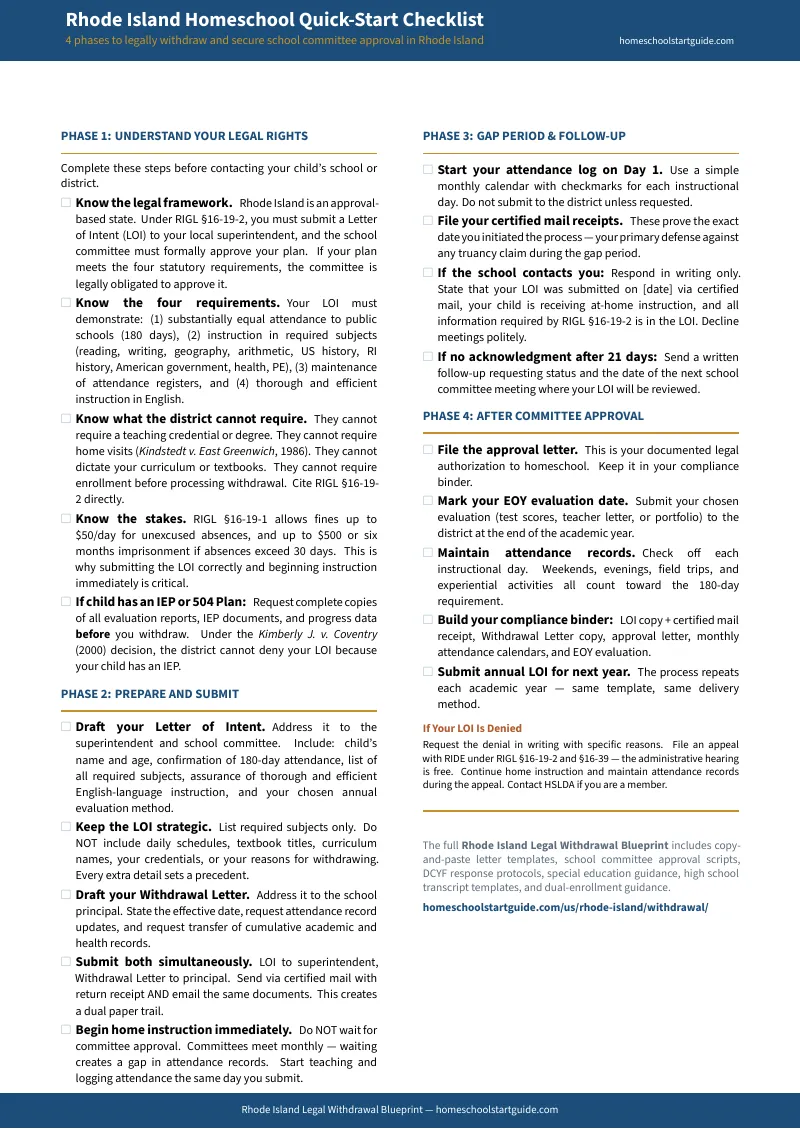
Your download includes 9 documents: the complete Blueprint guide (guide.pdf), the Quick-Start Checklist (checklist.pdf), and 7 standalone printable tools — Letter of Intent & Withdrawal Templates (loi-templates.pdf, ready-to-send letters for all three scenarios), Pushback & Boundary Scripts (pushback-scripts.pdf), the Gap Period Truancy Protocol (gap-period-protocol.pdf), the Annual Evaluation Planner (annual-evaluation-planner.pdf), the Rhode Island Quick Reference card (quick-reference.pdf, required subjects, key statutes, and contacts), the Appeal & Denial Playbook (appeal-process.pdf), and the IEP & Special Needs Exit Guide (iep-exit-guide.pdf). Instant download, no account required.
30-day money-back guarantee. If the Blueprint doesn't give you the confidence and legal clarity to secure your school committee's approval, email us and we'll refund you. No questions asked.
Not ready for the full Blueprint? Download the free Rhode Island Homeschool Quick-Start Checklist — a one-page overview of the four legal requirements, what your school committee can and cannot ask for, and the approval timeline so you know exactly when to submit. It's enough to get oriented, and it's free.
Your child doesn't have to keep going back to a school that isn't working. Rhode Island's approval process has clear, knowable rules — and the school committee has far less power over your plan than they want you to believe. The Blueprint makes sure you know exactly where the line is.