Build Your Rhode Island Micro-School Legally, Affordably, and Without a Franchise.
Rhode Island is the only state in America where homeschooling requires individual approval from the local school committee of the town where the child resides. Not the state. Not RIDE. Your town's school committee --- a group of elected or appointed officials who may or may not understand what a micro-school is, who evaluate your instructional plan against RIGL §16-19-1 through §16-19-3, and who can approve, deny, or send you back with questions you were not prepared for. That is the barrier that stops most Rhode Island parents from even starting. Now multiply that by three or four families from different towns --- each one filing with a different superintendent, each facing a different evaluation method (standardized testing, teacher evaluation, or portfolio review), and each navigating a different committee's temperament --- and you understand why informal pods in Rhode Island fall apart before the first day of class.
You want to build something better than solo homeschooling. Maybe you hit the burnout wall around third grade --- spending entire days triaging the needs of multiple children while carrying every ounce of instructional weight alone. Maybe you are in Providence or Pawtucket and your child's school operated without a nurse or librarian for an entire year. Maybe you are an East Bay parent paying $15,000 to $26,000 annually at a private school in East Greenwich or Newport and wondering whether a micro-school could deliver the same personalization for a fraction of the cost. Maybe you have a neurodivergent child who needs a sensory-friendly, small-group environment that the public school's IEP process has failed to provide. Maybe you looked at Prenda's $2,199-per-student annual platform fee and KaiPod's 10% revenue share and decided you would rather keep the money and the autonomy. Whatever the reason, you have arrived at the same conclusion: I need to build this myself, and I need to do it legally in Rhode Island.
The problem is that the internet gives you fragments. RIDE explicitly says it "does not directly supervise at-home instruction" and pushes everything to the local school committee level --- thirty-six different committees with thirty-six different interpretations. ENRICHri provides excellent advocacy and Letter of Intent templates for individual homeschoolers, but nothing on multi-family pod formation, liability waivers, or commercial structure. Facebook groups in Rhode Island homeschooling circles confidently declare that pods need no insurance, that DCYF will not care, and that school committee approval is "just a formality" --- advice that disintegrates the moment a superintendent pushes back or a neighbor files a zoning complaint. You need a Cross-Town Pod Playbook --- the complete operational framework for navigating Rhode Island's approval-based system without the dangerous legal guesswork, the franchise costs, or the ideological prerequisites.
The Rhode Island Micro-School & Pod Kit is that Cross-Town Pod Playbook.
What's Inside the Cross-Town Pod Playbook
The Two Legal Pathways Framework
Because the first decision every Rhode Island pod founder must make is whether to operate as a homeschool cooperative under RIGL §16-19-1 (each family obtains individual school committee approval) or register as a non-public school with RIDE through the eRIDE system (one registration covers all students). The guide walks you through the exact criteria for each pathway --- number of students, who controls curriculum, whether you hire employees, commercial vs. residential space --- so you choose the right legal structure before your first family meeting, not after the school committee contacts you.
The Cross-Town Pod Strategy
Because Rhode Island's unique approval system means a pod serving families from Providence, Warwick, and Cranston requires those families to navigate three entirely separate school committee approval processes. The guide provides synchronized LOI packets --- fill-in-the-blank templates designed for multiple families to submit identical, legally robust instructional plans to their respective superintendents simultaneously. It covers how to coordinate when one district requires standardized testing while another accepts portfolio review, how to handle the family whose town denies approval while the rest are approved, and how to present a unified front that signals organizational competence to every school committee involved.
The DCYF Childcare Licensing Threshold
Because if you host six children in your living room and collect money to pay a visiting math tutor, the Rhode Island Department of Children, Youth and Families may classify your pod as an unlicensed childcare facility. The guide maps the exact threshold where a learning pod crosses from a protected homeschool cooperative into DCYF-regulated territory --- how many children, what ages, how many hours, and whether payment is involved --- and provides structuring strategies to remain clearly classified as a collaborative educational arrangement.
The Parent Agreement and Liability Waiver Templates
Because a child breaking an arm on your staircase should not end the pod --- and it will not, if you are prepared. Customizable parent agreements covering educational philosophy, schedule, tuition, attendance, behavior, conflict resolution, withdrawal, and legal responsibility under RIGL §16-19-1. Plus a liability waiver with indemnification, medical consent, and emergency contact forms. Every family signs these before day one. These are not generic Etsy templates --- they are written for the specific legal context of Rhode Island home education under the school committee approval framework.
The Rhode Island Budget Planner
Because running a pod with a facilitator in Providence costs nothing like running one from your kitchen table in South County. Budget templates covering facilitator compensation ($20–$32/hour in Rhode Island), space rental, curriculum materials, insurance, and field trips --- with real RI cost benchmarks by region. Includes cost-sharing models for 3-family, 5-family, and 8-family pods, and a tuition calculator that shows how a micro-school delivering professional instruction costs $4,000–$6,000 per student per year compared to $15,000–$26,000 at private schools.
The Rhode Island Pod Launch Checklist
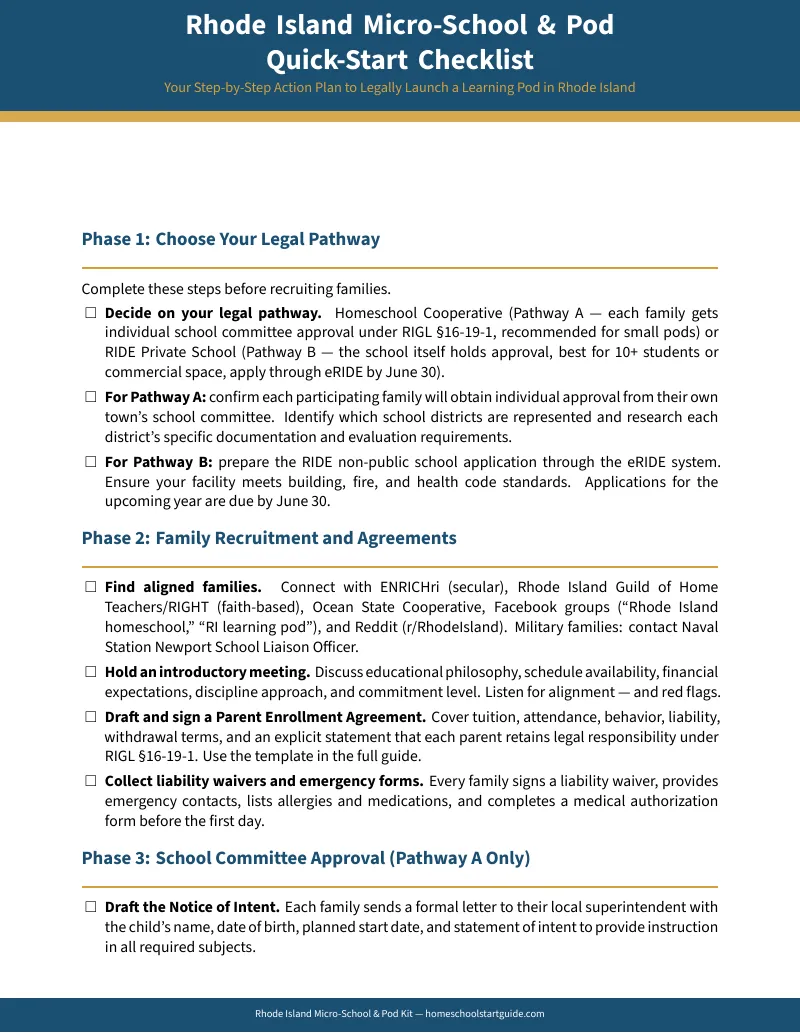
Because most parents spend forty-plus hours assembling the launch sequence from RIDE's bureaucratic documentation, ENRICHri resources, RIGHT fellowship networks, and contradictory Facebook posts. A single-page, print-and-pin document that walks you from "I have an idea" to "the first day of pod school" --- covering the legal pathway decision, school committee approval, DCYF compliance, family recruitment, space selection, and operational launch in the correct order, with Rhode Island-specific thresholds and legal references at every step.
Who This Kit Is For
- Solo homeschoolers who have reached the burnout threshold and need a shared-responsibility model where the instructional and social burden is distributed among trusted families --- without losing control of your child's education or triggering state oversight you never signed up for
- Providence, Pawtucket, and Central Falls parents whose children are in failing public schools --- schools operating without nurses or librarians, chronic absenteeism above 22%, achievement a third of a grade level below 2019 levels --- who want a small-group alternative that does not cost $15,000 a year
- East Bay and Newport parents paying private school tuition of $15,000 to $26,000 annually who want personalized, small-group education for a fraction of the cost --- without the admissions gatekeeping, rigid schedules, and ideological constraints of traditional prep schools
- Parents of neurodivergent children (autism, ADHD, dyslexia, giftedness, 2e) who are exhausted by IEP battles and want a sensory-friendly, small-group learning environment designed around their child's actual needs
- Former COVID-era pod parents whose informal living-room arrangement has been running for years but never had insurance, a family agreement, or a clear legal classification --- and someone in the group is getting nervous about DCYF or zoning
- Former educators who have left the public school system and want to serve their community by running a small paid micro-school --- without Prenda's $2,199 per-student platform fee, KaiPod's 10% revenue share, or Acton Academy's $20,000 licensing fee
- Cross-town families who already tried to form a pod but got stuck navigating school committee approvals from different towns with different evaluation requirements --- and gave up
- Remote-working parents who need a structured, safe, small-group learning environment that mimics the reliability of a school day while giving them the professional instruction they cannot provide during work hours
After Using the Kit, You'll Be Able To
- Understand both legal pathways --- homeschool cooperative under RIGL §16-19-1 and RIDE non-public school registration --- and know exactly which one fits your pod's size, structure, and goals
- Navigate the school committee approval process for every family in your pod, even when families come from different towns with different evaluation requirements, using synchronized LOI packets that present a unified front
- Structure your pod to avoid the DCYF childcare licensing threshold that catches founders operating informally --- so you remain a group of cooperating homeschool families, not an unlicensed childcare facility
- Choose the right space for your pod based on your municipality's zoning rules --- home, church, community center, or commercial space --- and know the thresholds that separate a permitted gathering from a prohibited commercial operation
- Run your first parent intake meeting using a signed Family Agreement and liability waiver that protects every family in the pod --- without spending $200 on a Rhode Island education attorney
- Hire and background-check a facilitator legally through the BCI process, classify them correctly for Rhode Island tax purposes, and pay them competitively using real local wage benchmarks
- Build a sustainable budget with Rhode Island cost data, set tuition that families can afford, and split costs equitably across participating households
- Satisfy Rhode Island's unique required subjects --- including state history and government --- using curriculum designed for multi-age group instruction
Why Not Just Use the Free Resources?
RIDE is the regulatory authority. ENRICHri has been advocating for homeschool families for years. RIGHT serves the Christian community. Ocean State Cooperative runs collaborative programs across Southern New England. Facebook groups have thousands of RI parents trading advice. Here is exactly what you run into when you try to build a pod from those sources alone:
- RIDE pushes everything to the local level and walks away. The Rhode Island Department of Education explicitly states it "does not directly supervise at-home instruction" and insists all approvals occur "exclusively at the local school district level." RIDE has never used the words "micro-school" or "learning pod." A parent searching the RIDE website for instructions on starting a pod finds compulsory attendance statutes and textbook loan program descriptions, not step-by-step guidance on forming a multi-family learning community.
- ENRICHri gives you advocacy but not operations. ENRICHri is Rhode Island's most important secular homeschool organization. They provide excellent Letter of Intent templates and "Homeschooling 101" workshops. But ENRICHri's focus is the individual homeschool family --- they offer no operational frameworks for multi-family pod formation, liability waivers for hosting other families' children, employment contracts for hiring facilitators, or strategies for coordinating school committee approvals across multiple towns.
- Facebook groups are an echo chamber of contradictory legal advice. Parents in Rhode Island homeschooling groups confidently claim that school committee approval is "just a formality" (it is not --- committees can and do deny applications), that DCYF will not care about a small pod (they will if you cross the childcare licensing threshold), and that zoning does not apply to home-based education (it can, depending on your municipality and the number of non-family children present). A parent who follows Facebook advice discovers the gaps when the superintendent calls or a neighbor complains, not before.
- Etsy templates are generic daily planners with a micro-school label. Canva templates and enrollment forms priced at $5–$24 on Etsy. Not one references RIGL §16-19-1, the school committee approval process, DCYF childcare licensing thresholds, Rhode Island's required subjects (including RI history and government), or BCI background check procedures. They help you organize a schedule. They do not help you form a legally protected pod in the only state that requires local school committee approval.
- Prenda and KaiPod solve the problem --- and take your autonomy and revenue. Prenda charges $2,199 per student per year in platform fees. KaiPod charges $249 upfront plus 10% of gross tuition revenue for two years. Acton Academy charges a $20,000 licensing fee plus annual revenue share. All three require you to recruit the families, find the space, and build the community yourself. If you are doing the hard work of building local trust in Rhode Island, you should keep 100% of the revenue and 100% of the curriculum control.
Free resources teach you how to legally withdraw your own child. The Cross-Town Pod Playbook teaches you how to securely organize, legally structure, and financially manage a cohesive group of five to ten children from multiple families across multiple school districts.
--- Less Than One Hour With a Rhode Island Education Attorney
A single consultation with a Rhode Island education attorney costs $150 to $300 per hour. Prenda charges $2,199 per student per year. KaiPod takes 10% of your gross revenue. The Kit costs less than one hour of professional advice and gives you the operational independence those platforms are designed to prevent.
Your download includes the complete guide (14 chapters covering Rhode Island's two legal pathways, the cross-town pod challenge, the DCYF childcare licensing threshold, setting up your physical space, finding families, hiring facilitators with BCI background checks, curriculum for Rhode Island's required subjects including state history and government, budget planning with RI cost data, insurance and risk management, high school operations with CCRI/URI/RIC dual enrollment and Brown University admissions, special populations and specialized models, national micro-school networks in Rhode Island, and scaling from pod to micro-school), plus the Rhode Island Pod Launch Checklist and standalone printable tools: the Parent Enrollment Agreement, the Liability Waiver and Emergency Contact Form, the Facilitator Contract, and the Rhode Island Regional Budget Planner. Instant download, no account required.
30-day money-back guarantee. If the Kit does not give you the legal clarity and operational confidence to move forward with your pod, email us and we will refund you. No questions asked.
Not ready for the full Kit? Download the free Rhode Island Homeschool Quick-Start Checklist --- a one-page summary of the two legal pathways, the school committee approval process, DCYF compliance basics, and the eight-phase launch sequence. It is enough to understand your rights tonight.
Rhode Island gave you the smallest state in America --- close enough that any family can join your pod. The Cross-Town Pod Playbook makes sure you navigate thirty-six school committees without losing a single one.