Pennsylvania Requires a Notarized Affidavit, 180 Days of Instruction, an Annual Evaluator Review, and Standardized Testing. Most Parents Get the Affidavit Wrong.
You've decided to pull your child out of school. Maybe the bullying escalated and the principal's response was another meeting that produced nothing. Maybe the IEP reviews keep generating paperwork while your child keeps falling behind. Maybe you looked at the test scores and realized the gap is widening every semester. Maybe a safety incident made you decide that today is the last day your child walks through those doors.
Here's what you've found so far: Pennsylvania is one of the most heavily regulated homeschool states in the country. PA Homeschoolers has a law guide written by the advocates who passed Act 169 in 1988 — it reads like a legislative briefing. CHAP has sample forms and knowledge base articles — all explicitly faith-based. The PA Department of Education has the raw statute and official forms — written by bureaucrats, for bureaucrats. HSLDA has state-specific templates behind a $180/year membership. And your local Facebook group has dozens of conflicting opinions about whether you need a notary, what your educational objectives should say, and which evaluator to use.
The Pennsylvania Legal Withdrawal Blueprint is an Affidavit-to-Evaluator Compliance System — 24 chapters covering every legal requirement, every filing deadline, every template, and every pushback scenario — so you file the right paperwork under the right statute the first time, without accidentally triggering a truancy investigation, without surrendering information the superintendent has no legal right to request, and without relying on Facebook advice that predates Act 196.
What's Inside the Blueprint
The Two-Pathway Decision Framework
Pennsylvania has two legal routes to educate at home: the Home Education Program under §13-1327.1 (used by 95% of families) and the Private Tutoring provision under §13-1327 (reserved for PA-certified teachers). They operate under entirely different regulatory frameworks — different filing requirements, different ongoing obligations, different legal protections. The Blueprint maps both pathways with a side-by-side comparison table — requirements, supervisor qualifications, annual compliance, pros, cons, and which one applies to your family — so you stop guessing and file correctly.
The Notarized Affidavit — Filed Correctly the First Time
The affidavit is the foundation of everything. It must include your name, your child's name and age, your address, your educational objectives, a criminal background certification, and attached immunization and health records. It must be notarized — or you can use an unsworn declaration that carries the same legal weight without a notary. It's due by August 1 each year, or within 30 days of a mid-year withdrawal. Get the format wrong and the superintendent's office sends it back. Get the objectives wrong and you've invited scrutiny you didn't need. The Blueprint includes fill-in-the-blank templates for both the notarized affidavit and the unsworn declaration, with pre-written educational objectives that satisfy the statute without over-sharing a single detail.
Required Subjects — What the Law Actually Says
Elementary students must study English (including spelling, reading, and writing), mathematics, science, geography, history of the United States and Pennsylvania, civics, safety and fire prevention, health and physiology, physical education, music, and art. Secondary students add world history, English literature, biology, and general science. Districts sometimes demand more — a full curriculum outline, daily schedules, textbook lists. The law prohibits the superintendent from using your objectives to determine compliance. The Blueprint explains what you're legally required to include and — just as importantly — what you're not.
The Mid-Year Withdrawal and the Three-Day Truancy Trap
Pennsylvania counts three consecutive unexcused absences as truancy. If your child stops attending school before your affidavit is on file with the superintendent, you have a three-day window before the district triggers its truancy protocol. The Blueprint walks through the exact sequence: mail the affidavit to the superintendent via Certified Mail, send the withdrawal letter to the school principal on the same day, and ensure your child's last day at school is the same day as — or after — the mailing date. Your filing establishes the homeschool. You do not need to wait for superintendent acknowledgment or approval.
The Evaluator Vetting Checklist
Every year, a Pennsylvania-certified teacher must review your portfolio and issue a certification letter to the superintendent. Under Act 196 of 2014, the superintendent sees only this letter — not your portfolio, not test scores, not work samples. The evaluator is your gatekeeper. But evaluators range from strict traditionalists who expect structured textbook curricula to relaxed advocates of unschooling. A pedagogical mismatch can turn your year-end review into a nightmare. The Blueprint includes a printable evaluator vetting checklist — the exact interview questions to ask before you hire — so you find someone who supports your educational approach, charges transparently, and doesn't blindside you in March.
The District Pushback Defence System
When the school office demands your portfolio (eliminated by Act 196), requests a home visit (not authorized by statute), claims they need to "approve" your homeschool before you can begin, or threatens truancy during the processing window — you don't have to panic or hire an attorney. The Blueprint provides pre-written responses, word for word, for five pushback scenarios. Each response cites the specific section of 24 PA C.S. §13-1327.1 or Act 196 being violated. Some Pennsylvania districts are notoriously hostile to homeschoolers — the Eastern Lancaster County School District was successfully sued by HSLDA for illegally imposing supplementary requirements. These scripts ensure you don't become the next family caught without documentation.
Portfolio, Testing, and Act 196 Protections
You must maintain a portfolio with an attendance log (180 days or 900/990 hours), a reading list, and work samples. In grades 3, 5, and 8, your child must take a nationally normed standardized test — but no minimum score is required. Before Act 196, superintendents could demand to review your entire portfolio. After Act 196, the evaluator reviews the portfolio and the superintendent receives only the evaluator's certification letter. The Blueprint explains exactly what to include in your portfolio, which tests are PDE-approved, where to administer them, and how Act 196 changes the power dynamic in your favour.
Sports, Extracurriculars, Dual Enrollment, and College Admissions
Act 59 of 2022 gives homeschooled students the legal right to participate in public school sports, extracurriculars, and career and technical education programs. Act 55 of 2022 allows part-time public school enrollment for up to 25% of the school day. The Blueprint covers PIAA eligibility requirements for high school athletes, the dual enrollment process at PA community colleges and state universities, and detailed college admissions guidance for Penn State, Pitt, Temple, and Drexel — including transcript formatting, course descriptions, and what homeschool applicants need beyond the standard application.
Who This Blueprint Is For
- Parents whose child is being bullied, anxious, or refusing school — and who need to execute a legal withdrawal this week, not after months of decoding Pennsylvania's multi-step compliance system
- Parents overwhelmed by the affidavit, objectives, evaluator, portfolio, and testing requirements who need a single chronological walkthrough, not forty CHAP web pages
- Parents who already tried filing but got pushback from the superintendent's office demanding information they have no legal right to request — and who need the exact statutory language to shut it down
- Parents withdrawing mid-year who need the three-day truancy protocol and the exact certified mail sequence for an immediate exit
- Parents of children with IEPs or 504 Plans who need to arrange special education pre-approval under §13-1327(d) before filing — and who need to request complete records under FERPA while their child is still enrolled
- Secular families who want religiously neutral paperwork — not CHAP's faith-based objectives templates
- Parents in Philadelphia, Pittsburgh, Lancaster, Harrisburg, or the Lehigh Valley who've heard horror stories about hostile districts and need documented legal protection
Why Not Just Use the Free Resources?
You can. PA Homeschoolers has the Richman law guide. CHAP has sample forms and a knowledge base. The PDE website has the raw statute. Reddit has hundreds of threads from Pennsylvania parents. Here's what actually happens when you try to assemble a withdrawal strategy from free sources:
- The Richman guide is thorough — and overwhelming. Written by the legendary advocates who helped pass Act 169 in 1988, it is exhaustively comprehensive. It successfully details how the law was passed, what every subsequent statute means, and covers esoteric but vital topics like textbook loans and graduation pathways. But when you're trying to pull your child out of school by Friday, you don't need the history of a 1988 standing ovation in the state senate. You need to know what to print, what to sign, what to notarize, and where to mail it.
- CHAP's resources are excellent — and explicitly religious. Their sample forms bake Christian educational objectives directly into the templates. Their knowledge base is segmented clearly by grade level — but spread across dozens of separate web pages. If you're a secular family, or simply want religiously neutral paperwork, their forms don't fit. And piecing together a cohesive action plan from their knowledge base requires clicking through page after page of categorized articles.
- The PDE website gives you the law, not a guide. The official state site provides the raw legal requirements and compliance forms — written by state bureaucrats, for state bureaucrats. There is no strategic advice on how to interact with a hostile superintendent. No warning that some districts illegally demand curriculum lists instead of broad subject objectives. No guidance on what to do when the school claims they need to "approve" your homeschool.
- Facebook groups will get you conflicting advice. Parents routinely advise "just file the affidavit and you're done" without mentioning the educational objectives requirement, the immunization records, the criminal background certification, or the fact that the notarized version must go to the superintendent — not the school. Well-meaning but legally imprecise advice from parents in notice-only states creates dangerous assumptions about Pennsylvania's process.
The free resources give you the ingredients. The Blueprint is the recipe — chronologically ordered, legally cited, ready to execute tonight.
— Less Than One Hour of a Family Attorney
A family law consultation in Pennsylvania runs $250-$400 per hour. HSLDA membership is $180/year. An evaluator review alone costs $30-$100+ per child. A single truancy notice can trigger a superintendent investigation, and a botched affidavit gets sent back — leaving your child in legal limbo. The Blueprint costs less than the gas to drive to a family attorney's office in suburban Philadelphia.
Your download includes the complete Blueprint guide, the Quick-Start Checklist, and 7 standalone reference sheets — 9 PDFs:
- guide.pdf — The full Pennsylvania Legal Withdrawal Blueprint: 24 chapters covering both legal pathways and the decision framework, the notarized affidavit and unsworn declaration, required subjects at elementary and secondary levels, step-by-step withdrawal process, mid-year withdrawal and the three-day truancy trap, fill-in-the-blank templates (affidavit, objectives, withdrawal letters, special education pre-approval), district pushback scripts, evaluator vetting and selection, portfolio preparation and record-keeping, standardized testing in grades 3/5/8, health and immunization requirements, special education and IEP withdrawal, Act 196 protections, Act 59 sports access, cyber charter vs. true homeschooling, diplomas and college admissions (Penn State, Pitt, Temple, Drexel), deschooling, PA support networks, FAQs, first-year calendar, military families, the private tutoring alternative, and religious community education.
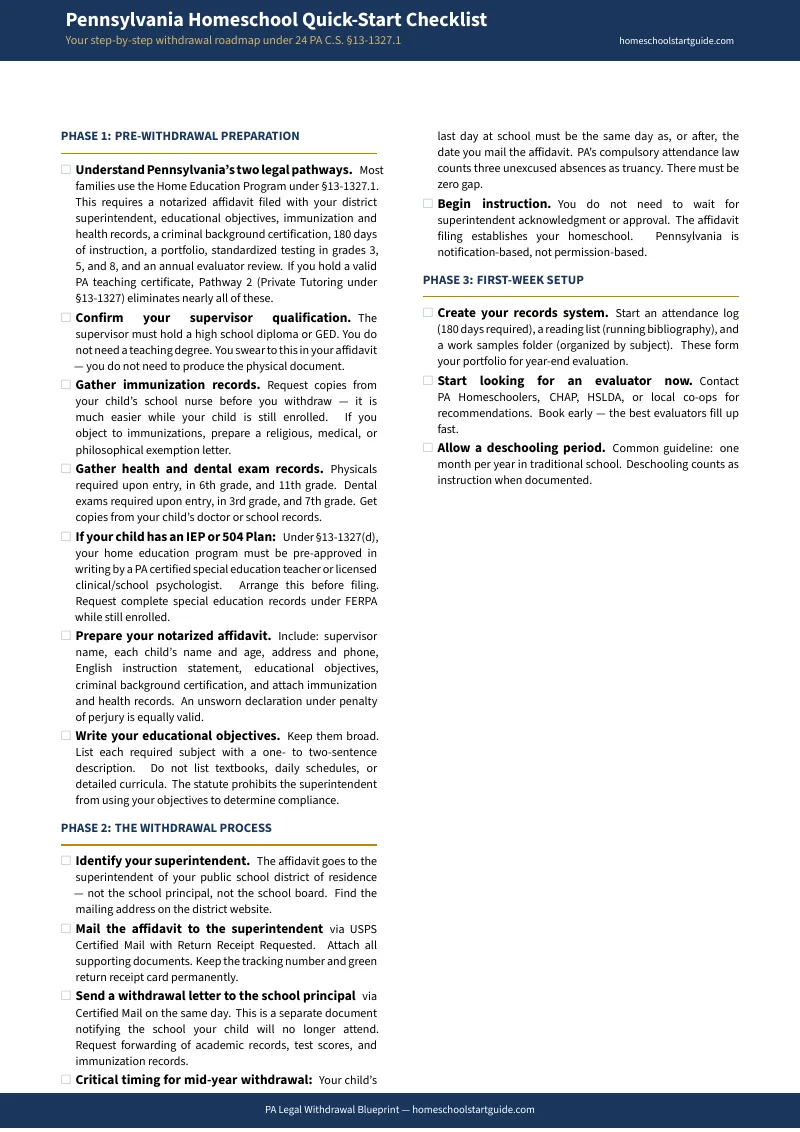
- checklist.pdf — The Pennsylvania Homeschool Quick-Start Checklist: a printable action plan covering every phase from pre-withdrawal preparation through ongoing annual compliance.
- pathway-comparison.pdf — One-page side-by-side comparison of Home Education (§13-1327.1) and Private Tutoring (§13-1327) — requirements, qualifications, ongoing obligations, and which pathway fits your family.
- affidavit-withdrawal-templates.pdf — All fill-in-the-blank templates as a standalone printable: notarized affidavit with educational objectives, unsworn declaration, public school withdrawal letter, private school withdrawal letter, and special education pre-approval request — each using exact statutory language.
- pushback-scripts.pdf — Word-for-word email responses for five district pushback scenarios, each citing the specific section of 24 PA C.S. §13-1327.1 or Act 196 being violated.
- evaluator-vetting-checklist.pdf — Printable interview questions to ask every evaluator before you hire: methodology stance, documentation expectations, fee structure, turnaround time, and red flags to avoid.
- required-subjects-reference.pdf — Required subjects at elementary and secondary levels with sample educational objectives for multiple approaches (traditional, classical, Charlotte Mason, unschooling, eclectic).
- testing-portfolio-reference.pdf — Standardized testing in grades 3, 5, and 8 (PDE-approved tests, no minimum score), portfolio requirements (attendance log, reading list, work samples), and the Act 196 evaluator certification process.
- first-year-calendar.pdf — Every deadline and recommended action for your first homeschool year, plus the mid-year withdrawal timeline and critical dates summary.
9 PDFs. Instant download, no account required.
30-day money-back guarantee. If the Blueprint doesn't give you the confidence and legal clarity to execute your withdrawal, email us and we'll refund you. No questions asked.
Not ready for the full Blueprint? Download the free Pennsylvania Homeschool Quick-Start Checklist — a printable overview of the withdrawal steps, the affidavit process, supervisor qualifications, required subjects, and the key compliance deadlines. It's enough to get oriented, and it's free.
Your child doesn't have to go back on Monday. Pennsylvania law gives you the legal right to homeschool — the compliance process just hasn't been explained clearly until now. The Blueprint makes sure you file the right paperwork, hire the right evaluator, and protect your family from the first day through the first year-end review.