Your Evaluator Arrives in May. Your Portfolio Had Better Be Ready.
You've been homeschooling in Pennsylvania all year — maybe your first year, maybe your fifth. The daily teaching works. Your child is learning, growing, making real progress. But now it's spring, and you're staring at the June 30 evaluator deadline. You have work samples scattered across binders, Google Drive folders, and a kitchen counter pile you keep meaning to organize. You know you need a certified evaluator to review your entire portfolio, interview your child, and write a certification letter to the superintendent. What you don't have is a system for assembling the evidence that proves what you already know: your child is thriving.
Meanwhile, every Pennsylvania homeschool Facebook group has a different opinion about what evaluators expect, whether your reading log needs to be "contemporaneous" (it does — the statute says so), how many work samples per subject, and what happens if the superintendent decides your programme is "inadequate." Ask Pauline has brilliant legal analysis — built on Word templates from 2004. CHAP has free checklists — embedded inside a faith-based framework that doesn't fit every family. And Etsy has $5 aesthetic planners designed for states that don't require annual evaluator reviews, contemporaneous reading logs, or fire safety documentation.
The Pennsylvania Portfolio & Assessment Templates is an Evaluator-Ready Compliance System — 14 chapters covering every documentation requirement under 24 PA C.S. §13-1327.1, every grade band from kindergarten through high school, and every template you need to pass your annual evaluator review — designed to document exactly what the law requires and absolutely nothing more. No daily lesson plans the evaluator never asked for. No excessive worksheets that set a dangerous precedent with your district. No generic planners built for states with requirements Pennsylvania doesn't have.
What's Inside
Pennsylvania's Two Legal Pathways Decoded
Pennsylvania offers two routes to homeschool legally — the Home Education Program (§13-1327.1) and the Private Tutor pathway (§13-1327). One requires annual affidavits, evaluator reviews, and standardized testing. The other eliminates the portfolio, evaluator, and testing requirements entirely — if you hold a valid PA teaching certificate. Chapter 2 maps both pathways' requirements side by side so you understand exactly which documentation rules apply to your family — and which don't.
Filing the Annual Affidavit Without Over-Submitting
Your notarized affidavit is due to the superintendent by August 1 every year. It must include educational objectives by subject, immunization records, and a criminal history certification. What it must not include: your daily schedule, curriculum choices, child's birth certificate, or your high school diploma — though many districts illegally request all of these. Chapter 3 gives you the exact required elements with nothing extra, plus an unsworn declaration option under 18 Pa.C.S. §4904 if you prefer not to notarize.
The Contemporaneous Reading Log — What "Contemporaneous" Actually Means
The statute specifically requires "a log, made contemporaneously with the instruction, which designates by title the reading materials used." This is the single most misunderstood requirement in Pennsylvania homeschooling. It's a bibliography maintained throughout the year, not a daily reading diary. Chapter 5 provides the template and the system — a running list by subject with periodic dates that satisfies the legal requirement without becoming a second full-time job.
Grade-Banded Portfolio Frameworks
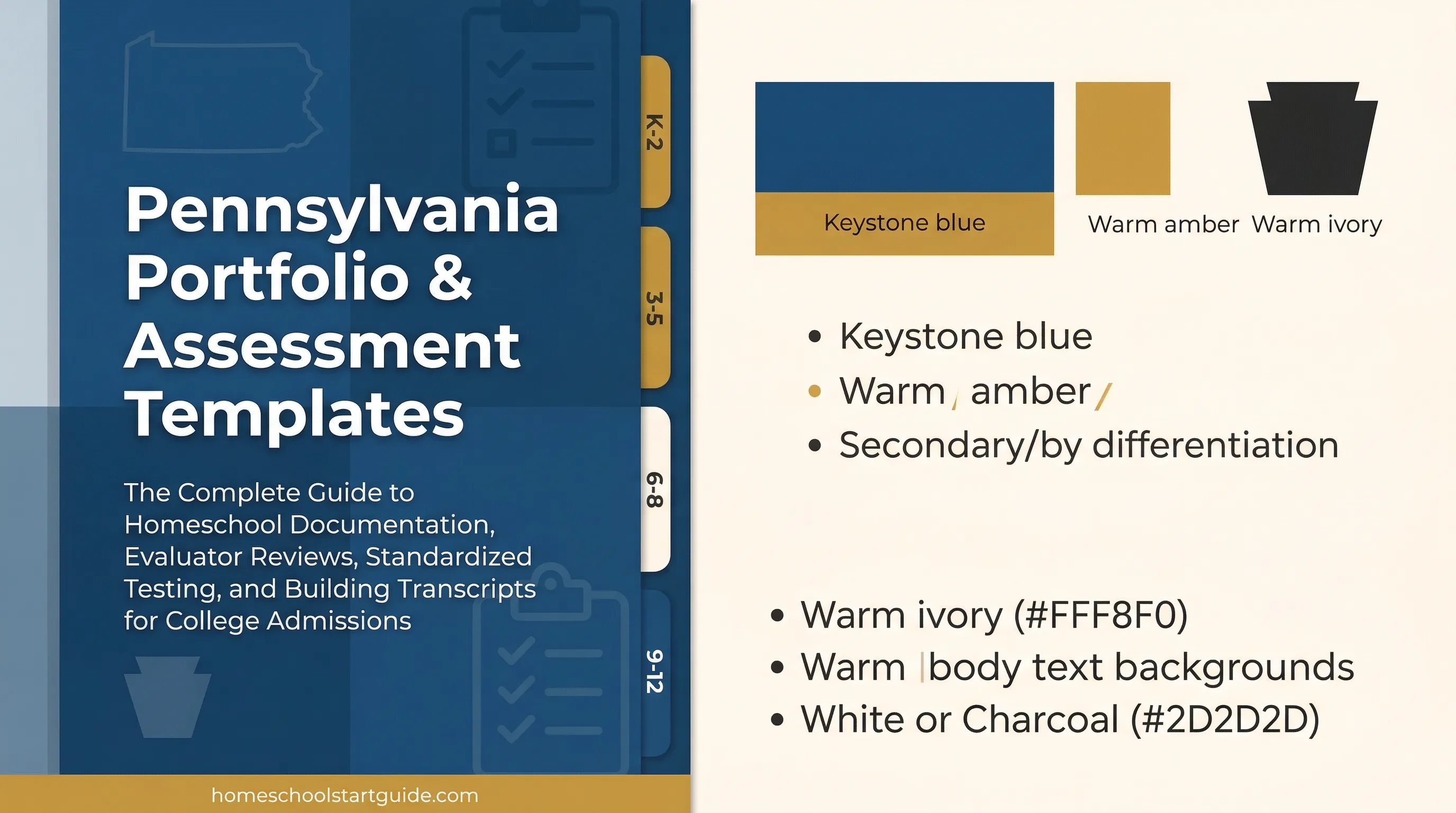
A kindergartener's portfolio looks nothing like a tenth-grader's. Chapter 6 provides grade-banded documentation frameworks — K-2, 3-5, 6-8, and 9-12 — with specific guidance on what to collect, how many samples per subject across the year (beginning, middle, end), what "sustained progress" looks like at each developmental stage, and how to organize evidence that satisfies your evaluator without inviting district scrutiny. Each framework includes a weekly 15-minute filing system so you never face a last-minute portfolio panic in May.
Standardized Testing in Grades 3, 5, and 8
If your child is in a mandatory testing year, you need a nationally normed standardized test administered by a qualified proctor. But which test? The untimed CAT is the most popular low-stress option among PA homeschoolers. The Iowa and Stanford are widely accepted. MAP Growth and Terra Nova work too. Chapter 7 compares every approved test — format, timing, cost, stress level, and ordering logistics — so you can choose confidently. And the fact that most parents don't know: Pennsylvania law does not set a minimum test score for home education. Scores are reviewed by your evaluator as part of the overall portfolio, never submitted to the district.
Finding and Preparing for Your Evaluator
The evaluator is the single most important gatekeeper in your compliance year. They must hold a valid Pennsylvania teaching certificate from an accredited institution. Fees range from $50 to $200+ depending on location and experience. Chapter 8 covers how to find evaluators through PA Homeschoolers, CHAP, and PHAA directories, what questions to ask before booking, how to prepare your portfolio for the visit, what the evaluator interview with your child typically covers, and what to do if an evaluator refuses to certify. Book by March — popular evaluators in Philadelphia, Pittsburgh, and Lancaster fill up by late spring.
District Pushback Scripts
Pennsylvania is notorious for school districts that aggressively over-interpret the law. Act 196 of 2014 removed superintendents from direct portfolio review, placing the evaluator as the sole gatekeeper. But many districts still illegally demand to see raw work, test scores, and daily logs. Chapter 9 provides word-for-word response scripts citing the specific statutory provisions that limit district authority — because a confident, legally grounded response to an overreaching superintendent stops the harassment before it escalates.
High School Transcript Templates
The transcript is the highest-stakes document you'll produce as a homeschool parent. Pennsylvania universities, community colleges, employers, and the military all expect professionally formatted academic records. Chapter 10 provides a transcript template designed for Pennsylvania institutions — with fields for course title, credits, grade, grading scale, cumulative GPA, and your signature as the educational supervisor. Plus: how to calculate weighted and unweighted GPAs, how to document PA Homeschoolers AP Online courses and dual enrolment credits, and how to write course descriptions that Penn State, Pitt, Temple, and Drexel admissions offices expect.
Pennsylvania University Admissions and Financial Aid
Chapter 11 covers the admissions requirements specific to Pennsylvania homeschoolers at the major state universities, PHEAA state grant eligibility, FAFSA documentation, the homeschool SAT/ACT code (993999), and your diploma options — including the PDE-6008 form (signed by you and the 12th-grade evaluator), PHAA accreditation, and Mason-Dixon validation. Each pathway has different implications for financial aid and institutional recognition.
Act 59 and Extracurricular Access
Chapter 12 covers Act 59, which allows homeschooled students to participate in extracurricular activities at their local school district, and Act 55, which extends this to interscholastic athletics. Both come with eligibility requirements, attendance obligations, and documentation your district will request. The chapter maps the application process, the compliance checklist, and the evidence you need to maintain participation.
Special Situations
Chapter 13 covers the scenarios that generic templates completely ignore: neurodivergent learners (IEP/504 considerations, Gifted IEP documentation, IDEA evaluation requests), military families PCSing to Pennsylvania (30-day compliance window, cross-state documentation transfer), mid-year transitions from cyber charter or private school, transitioning between the two legal pathways, public school re-entry procedures, and families in the Philadelphia School District (which operates under its own administrative processes).
Who This Is For
- First-year Pennsylvania homeschool parents who just filed their affidavit and have no system for organizing what they'll need to show the evaluator in May
- Parents approaching the June 30 evaluator deadline with a year of scattered work samples, an incomplete reading log, and rising anxiety about whether their portfolio will pass
- Parents who have been over-documenting — keeping daily lesson plans, saving every worksheet, submitting curriculum details to the district — and need to understand what the law actually requires versus what they've been doing out of fear
- Parents of students in grades 3, 5, or 8 who need to navigate the standardized testing mandate and don't know which test to choose, how to arrange a proctor, or what the scores mean for their evaluation
- High school parents who suddenly realize they need a professional transcript for Penn State, Pitt, Temple, or Drexel admissions — and have no template formatted for Pennsylvania institutions
- Parents dealing with a difficult school district that demands documentation the law doesn't require and need legally grounded response scripts
- Secular, eclectic, and post-pandemic homeschoolers who want a documentation system that isn't embedded inside a religious co-op or a $8/month tracking app designed for states with different requirements
- Military families who just PCSed to Pennsylvania from a state with completely different documentation requirements and need to get compliant before the August 1 affidavit deadline
Why Not Just Use the Free Resources?
You can. Ask Pauline has exhaustive legal breakdowns. CHAP has free checklists. The PA Department of Education publishes the statute. Here's what actually happens when you try to assemble a documentation system from free sources:
- Ask Pauline is brilliant for legal theory — and her templates are from 2004. Pauline provides the most accurate legal interpretation of §13-1327.1 on the internet. Her forms are Microsoft Word tables that break across different operating systems, lack any contemporary design, and require you to hunt through dozens of hyperlinked pages to assemble a piecemeal portfolio. For a stressed parent seeking a quick solution in May, navigating the sprawling website is its own form of overwhelm.
- CHAP offers solid advocacy — inside a sectarian framework. As the demographic of PA homeschoolers shifts toward secular, eclectic, and post-pandemic safety-seekers, many parents actively avoid resources tied to religious organisations. CHAP's templates are bare-bones legal minimums with no visual design elements — functional, but not the kind of document that establishes authority with a sceptical evaluator.
- Etsy planners are a liability in Pennsylvania. Generic homeschool planners include daily schedules, chore charts, and curriculum trackers — features designed for states without evaluator reviews. They lack Pennsylvania's required contemporaneous reading log structure, the 180-day attendance grid, fire safety documentation, and the grade-banded organisation evaluators expect. Worse, some "PA compliant" masterpacks encourage over-documentation, providing so many tracking sheets they violate the golden rule: never give the district more than the legal minimum.
- Homeschool Tracker and My School Year cost $8-$50/year and require a learning curve. Software solutions are built for year-round daily data entry. For a parent hitting the "evaluator visit approaching" panic in May, learning complex new database software to retroactively generate a portfolio is an impossible barrier. They need immediate, simple templates — not a new operating system.
- Facebook group advice is a game of telephone. Parents routinely share portfolio tips from other states, recommend attendance formats the evaluator doesn't need, and offer testing advice that confuses grades 3, 5, and 8 requirements with other states' annual testing mandates. Act 196 changed the compliance landscape in 2014 — and most group advice predates it.
The free resources explain what the law says. These templates are engineered to do exactly what the law requires — and nothing more.
— Less Than Half What Your Evaluator Charges
A certified evaluator in Pennsylvania charges $50-$200+ per student per review. PA Homeschoolers AP Online courses run $400-$650 per course. Standardized test booklets cost $25-$50. A disorganized portfolio means a longer, more stressful evaluator visit — and a higher likelihood of an evaluator who can't certify that an appropriate education occurred. These templates cost less than a single standardized test booklet.
Your download includes the complete guide, the Quick-Start Checklist, and 6 standalone printable tools — 8 PDFs:
- guide.pdf — The full Pennsylvania Portfolio & Assessment Templates guide: 14 chapters covering why documentation matters, two legal pathways decoded, filing the annual affidavit, required subjects and instructional time, building your portfolio (reading log, attendance, work samples, fire safety), grade-banded frameworks (K-2, 3-5, 6-8, 9-12), standardized testing in grades 3, 5, and 8, finding and preparing for your evaluator, district pushback scripts, high school transcript creation and GPA calculation, Pennsylvania university admissions and financial aid (Penn State, Pitt, Temple, Drexel, PHEAA), extracurricular access (Act 59 and Act 55), special situations, and the annual compliance calendar.
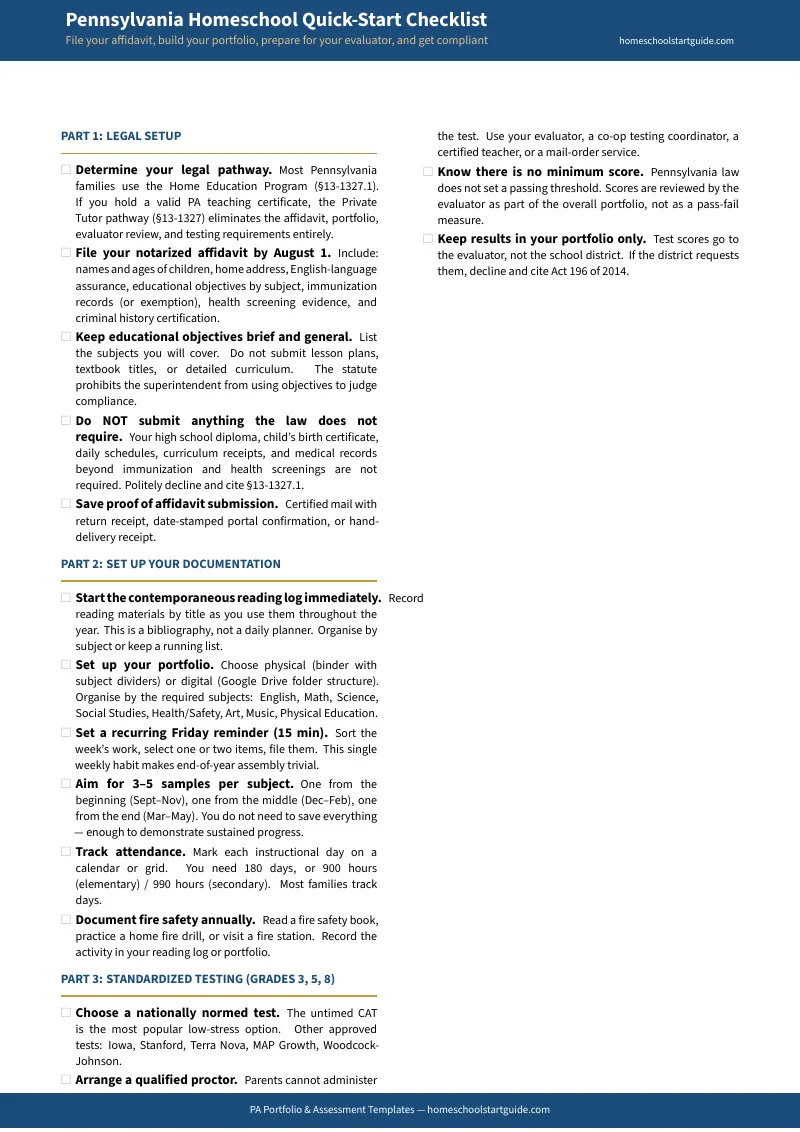
- checklist.pdf — The Pennsylvania Homeschool Quick-Start Checklist: a printable action plan from legal setup through evaluator preparation and high school essentials.
- grade-banded-frameworks.pdf — Standalone printable for K-2, 3-5, 6-8, and 9-12: what to collect, how many samples per subject, what evaluators look for, and the weekly filing checklist.
- evaluator-preparation.pdf — How to find an evaluator, what to ask, how to prepare your portfolio, what the interview covers, and what to do if certification is refused.
- testing-comparison.pdf — Side-by-side comparison of approved standardized tests (CAT, Iowa, Stanford, Terra Nova, MAP Growth, Woodcock-Johnson) with format, timing, cost, stress level, and proctor requirements.
- transcript-template.pdf — Fillable high school transcript formatted for Pennsylvania university admissions with course titles, credits, grades, GPA calculation, and certification block.
- district-pushback-scripts.pdf — Word-for-word response scripts for common illegal district requests, citing the specific statutory provisions that limit superintendent authority after Act 196.
- compliance-calendar.pdf — Month-by-month deadlines from August 1 affidavit filing through June 30 evaluator certification submission.
8 PDFs. Instant download, no account required.
30-day money-back guarantee. If these templates don't give you the structure and confidence to pass your evaluator review, email us and we'll refund you. No questions asked.
Not ready for the full guide? Download the free Pennsylvania Homeschool Quick-Start Checklist — a printable overview of the legal setup steps, affidavit requirements, documentation system basics, evaluator preparation, and key compliance deadlines. It's enough to get oriented, and it's free.
Pennsylvania doesn't require you to prove you're a perfect teacher. It requires your evaluator to certify that an appropriate education is occurring. These templates make the proof effortless.