The ESD Compliance Playbook: Launch Your Oregon Learning Pod with Legal Confidence and a Complete Operational Framework.
Oregon requires every homeschooling family to file a separate notification with their local Education Service District under ORS 339.035 — within 10 days of withdrawal. Then your children must pass standardized testing at grades 3, 5, 8, and 10, scoring at or above the 15th percentile. Now multiply that across three, four, five families in a shared micro-school. Each family files with a different ESD. Each family tracks different testing years. Each family is individually responsible for compliance — but you're teaching together. Nobody has packaged the coordination logistics for this into a usable guide. Until now.
You want to gather a handful of Portland, Eugene, or Bend families, share the teaching load, and build something that actually fits your children. Maybe you're a Portland professional priced out of Catlin Gabel or OES at $28,000–$38,000 per year and looking for a high-quality alternative. Maybe you're a current homeschooler finding solo teaching unsustainable and craving community. Maybe you're secular, and every established co-op in your area leans faith-based when you need fact-based. Maybe you want a nature-based program that uses Oregon's forests, rivers, and coastline as the classroom. Whatever the reason, you've arrived at the same conclusion: I need to build this myself.
The problem is that Oregon gives you two legal pathways — home education cooperative under ORS 339.035 or private school registration — and the internet gives you fragments. The Oregon Department of Education defines testing rules in dense legalese but doesn't explain how five families sharing a living room fits into the framework. OHEN provides basic ESD notification templates but is geared toward traditional solo homeschoolers. Facebook groups like "Homeschooling in Portland" give you emotional support and park meetup dates — but conflicting, unvetted legal advice when you need certainty. Prenda charges $2,199 per student per year in platform fees. You need the operational playbook without the institutional overhead and without surrendering your tuition to a corporate network.
The Oregon Micro-School & Pod Kit — the ESD Compliance Playbook — is that operational framework.
What's Inside the ESD Compliance Playbook
The Two-Pathway Legal Framework
Because choosing the private school pathway when you should be operating under ORS 339.035 means mandatory curriculum oversight, annual attendance reporting, and teacher qualification requirements your pod never needed. Oregon has two distinct legal pathways for micro-schools, each with different rules about who can teach, what testing is required, and how much oversight the state has. This section walks you through each with a plain-English decision tree so you choose the right structure for your pod's size, staffing, and philosophy — and understand exactly what each choice requires.
The ESD Notification and Group Testing Coordinator
Because "did every family file their ESD notification?" is the question that keeps pod founders awake at 2 AM — and the testing logistics across grades 3, 5, 8, and 10 are genuinely complex when you're coordinating multiple families. This section covers exactly how to file with each of Oregon's 19 Education Service Districts, the 10-day withdrawal deadline, the 18-month grace period for new homeschoolers, approved test options (Iowa, Stanford, Terra Nova), the 15th-percentile threshold, and the August 15th submission deadline. Plus a group testing coordination system so one person manages the calendar for every child in your pod — because missed deadlines trigger ESD follow-up that nobody wants.
Family Agreement and Liability Waiver Templates
Because the most common reason pods collapse isn't bad curriculum — it's undefined expectations between adults about money, scheduling, and what happens when someone wants to leave mid-year. Customizable templates covering cost-sharing, curriculum authority, health policies, behavioral expectations, dispute resolution, and withdrawal terms. Written from scratch with progressive, restorative language — no religious prerequisites, no punitive discipline frameworks. Every participating family signs before the first day.
Portland Zoning and Space Guide
Because Portland's home occupation rules cap home-based businesses at 8 client visits per day — and nobody tells you this until a neighbor complains. This section covers the exact zoning rules for Portland, Eugene, Bend, Salem, and rural Oregon, plus alternatives: church spaces ($100–$400/month), co-working spaces, community centers, and outdoor "base camp" models with rain-day backup locations. It includes the Portland 8-visitor limit workaround, Eugene's more flexible home occupation rules, and Bend's relaxed residential activity codes.
Hiring a Facilitator in Oregon
Because pooling resources to hire a guide is what makes a pod sustainable for working parents — but ORS 339.374 requires you to contact the applicant's three most recent educational employers to check for substantiated abuse reports, and Oregon's Ban the Box law means you can't run a criminal background check until after a conditional offer. This section covers the full hiring sequence, pay benchmarks ($20–$30/hour part-time, $35,000–$65,000/year full-time), W-2 vs. 1099 classification, and a customizable facilitator contract template.
Nature-Based and Outdoor Micro-School Models
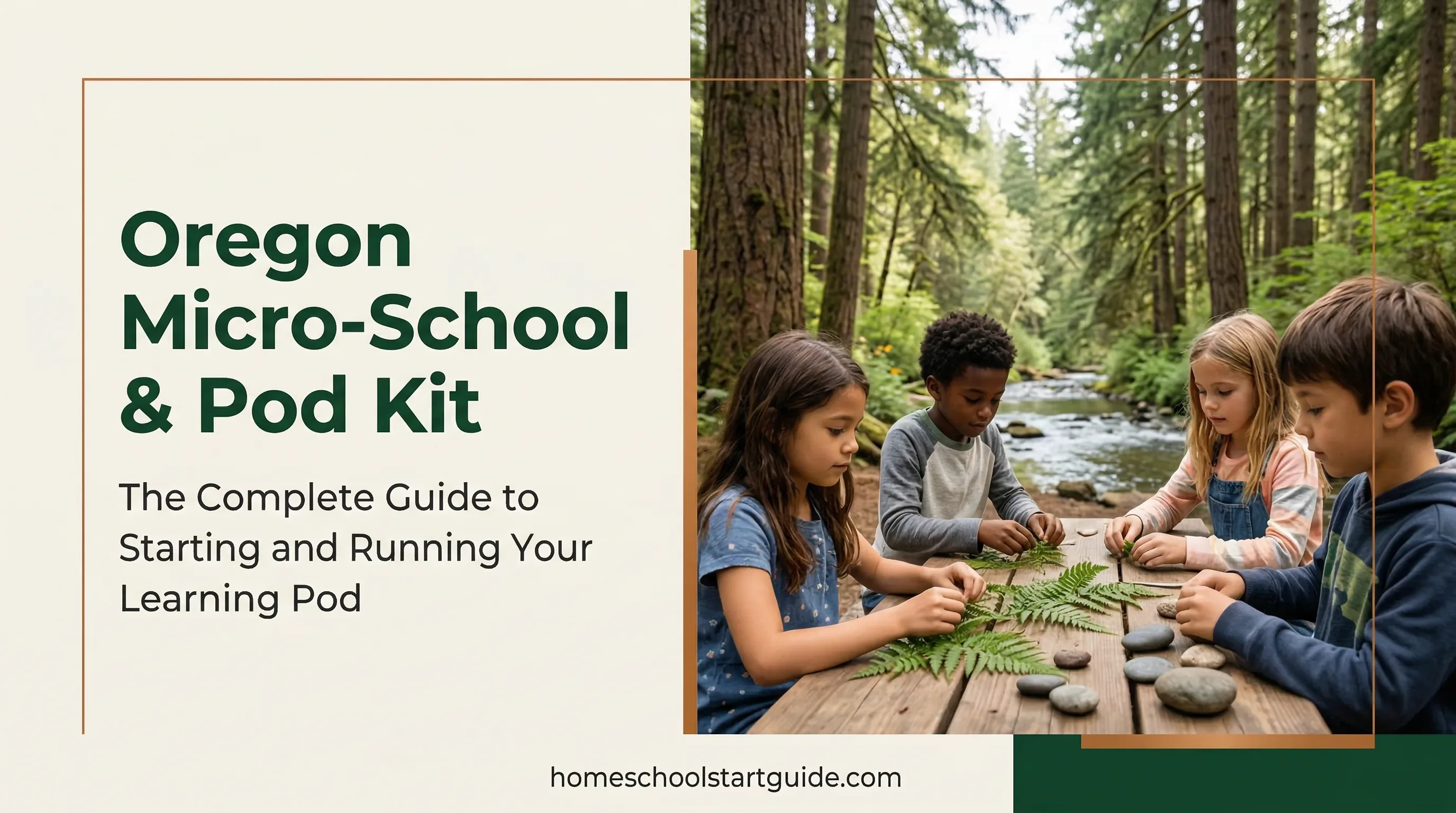
Because Oregon's culture, climate, and landscape make nature-based learning a natural fit — and a dedicated chapter covers how to structure a forest school, outdoor classroom, or expedition-based program using Oregon's public lands, urban forests, and coastal ecosystems. Covers gear lists, weather protocols, risk management for outdoor settings, and how programs like Pacifica, NatureConnect, and Coyote Outdoor School structure their models.
Budget Planning with Regional Cost Tables
Because splitting costs "evenly" between a family with three kids and a family with one sounds fair until the first invoice arrives — and financial resentment is the second most common reason pods dissolve. Real Oregon benchmarks for space rental, insurance ($100–$1,500/year depending on model), curriculum ($200–$600/student/year), and facilitator compensation. Plus equal-split, per-child, and sliding-scale cost-sharing formulas with worked examples for Portland, Eugene, and Bend cost-of-living differences.
The Oregon Pod Launch Checklist
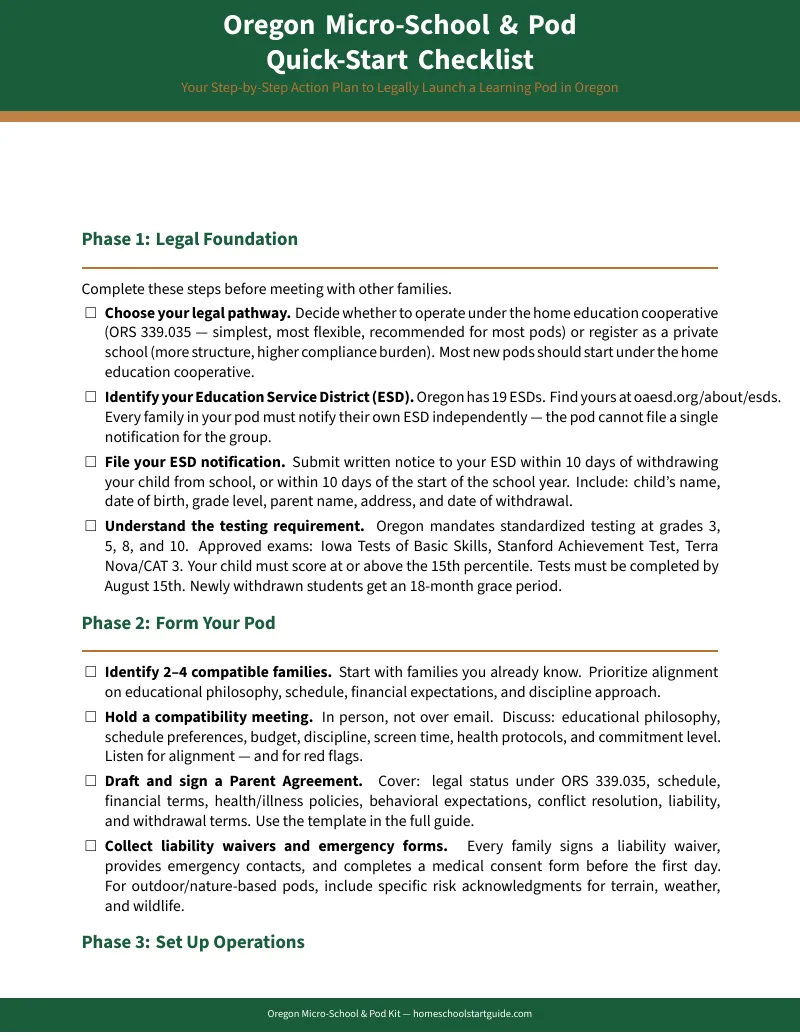
Because most parents spend 40+ hours stitching together the launch sequence from ORS statutes, OHEN templates, OSAA eligibility rules, and scattered Facebook threads — and still aren't sure they got the order right. A single-page, print-and-pin document that walks you from "I have an idea" to "the first day of pod school" — covering legal foundation, pod formation, operations, curriculum, hiring, and launch week in the correct sequence.
Who This Kit Is For
- Parents who want to form a small learning community of 3–8 students with two to four families — sharing the teaching load, splitting costs, and building something intentional rather than defaulting to institutions that don't fit
- Portland, Eugene, Bend, and Salem families priced out of elite private schools who want a high-quality small-group experience at a fraction of the $28,000–$38,000 annual tuition those institutions charge
- Current homeschoolers who find solo teaching unsustainable and want to share facilitation with other families without losing control of their child's education — especially parents who are burned out after going it alone since the pandemic
- Secular or progressive families who've been turned away from established co-ops that require statements of faith, and who need a legally sound framework for building an inclusive, values-aligned pod
- Parents drawn to nature-based, forest school, or outdoor education models who want the structural flexibility to run a pod largely outdoors — using Oregon's forests, rivers, coastline, and urban parks as the primary classroom
- Parents of neurodivergent children (autism, ADHD, dyslexia) who need a calmer, self-paced environment with individualized accommodations that public school IEPs consistently fail to deliver
- Rural Oregon families who face long bus rides, school consolidations, and limited options — and want to combine resources with nearby families to create a viable local alternative
After Using the Kit, You'll Be Able To
- Choose the right legal pathway for your pod — home education cooperative under ORS 339.035 (simplest, most flexible, recommended for most pods) or private school registration — using the decision framework instead of guessing
- File every family's ESD notification correctly, on time, and with the right Education Service District — using the pre-formatted templates and the complete 19-ESD directory in the appendix
- Coordinate group testing across grades 3, 5, 8, and 10 — with approved test options, the 15th-percentile threshold, the August 15th deadline, and a testing calendar that tracks every child in your pod
- Run your first parent meeting using a signed family agreement and liability waiver that protects every family — without spending $250–$400 on a Portland education attorney
- Navigate Portland's 8-visitor zoning cap, Eugene's home occupation rules, and Bend's residential activity codes — so you choose the right space for your pod's size without triggering a zoning complaint
- Hire a facilitator legally under ORS 339.374 — with the background check sequence, Ban the Box compliance, W-2 vs. 1099 classification, pay benchmarks, and a signed contract template
- Build a budget that every family agrees on — using real Oregon cost benchmarks and a cost-sharing formula that prevents resentment and financial surprises
Why Not Just Use the Free Resources?
The Oregon Department of Education defines testing rules. OHEN provides a basic ESD notification letter template. OCEANetwork offers Christian co-op resources. Facebook groups share curriculum reviews and park meetup dates. Here is exactly what you run into when you try to build a pod from those sources alone:
- The ODE website defines the law but provides zero guidance on pods. You learn that ORS 339.035 requires ESD notification within 10 days and testing at grades 3, 5, 8, and 10. You do not learn how five families sharing a living room file their notifications, coordinate group testing, or structure cost-sharing. No family agreements, no budget templates, no testing calendar.
- OHEN is built for traditional solo homeschoolers. Their ESD notification template is valuable, but their resources assume a single family teaching their own children. They do not offer operational infrastructure for multi-family pods — no co-teaching schedules, no facilitator hiring guidance, no liability waivers for hosting other people's children.
- Generic Etsy templates are legally irrelevant in Oregon. A $12–$20 "Learning Pod Agreement" from Etsy gives you a three-page waiver written for a different state — no Oregon-specific ESD notification, no ORS 339.035 framework, no testing coordination. Many of these kits lean heavily Christian, which alienates the secular, progressive parents who dominate the Portland, Eugene, and Bend micro-school market.
- Franchise networks withhold the operational details deliberately. Prenda, KaiPod, and Acton Academy webinars give you the vision. The granular how — the legal structuring, budget templates, scheduling frameworks — is what they sell for thousands per year in platform fees and franchise commitments. Prenda alone retains $2,199 per student per year.
- Facebook groups provide emotional support, not legal certainty. "Homeschooling in Portland" is excellent for park meetups and curriculum opinions. It is dangerously unreliable for legal and financial advice — and when you're dealing with state testing mandates and the liability of hosting other people's children, you need vetted frameworks, not a comment thread.
Free resources give you the legal baseline and the inspiration. The ESD Compliance Playbook gives you the templates, checklists, and decision frameworks to execute this week.
— Less Than One Hour with a Portland Education Attorney
A single consultation with an Oregon education attorney costs $250–$400 per hour. Activate School PDX charges $14,000 per year for elementary tuition. Prenda charges $2,199 per student per year in platform fees. Generic Etsy templates cost $12–$20 and don't address Oregon's ESD notification or testing requirements at all. The Kit costs less than a single attorney consultation and gives you the legal clarity, operational templates, and coordination frameworks those alternatives are designed to sell piecemeal.
Your download includes the complete 25-chapter guide, the Quick-Start Checklist, and standalone printable templates — ESD notification letters, parent agreements, liability waivers, facilitator contracts, and emergency contact forms. Instant download, no account required.
30-day money-back guarantee. If the Kit doesn't give you the legal clarity and operational confidence to move forward with your pod, email us and we'll refund you. No questions asked.
Not ready for the full Kit? Download the free Oregon Homeschool Quick-Start Checklist — a one-page summary of the two legal pathways, the ESD notification process, the testing requirements, and the six-phase launch sequence. It's enough to understand your legal obligations tonight.
Oregon's ORS 339.035 gives you the legal right to educate your child at home — and to share that education with other families. The ESD Compliance Playbook makes sure you do it correctly.