The Two-Classification Compliance System: Launch Your Oklahoma Learning Pod with Legal Confidence, Tax Credit Eligibility, and a Complete Operational Framework.
Oklahoma's constitutional protection of parental education rights is the strongest in the nation. Article XIII, Section 4 recognizes "other means of education" as a constitutionally protected alternative to public schooling. No registration. No notification. No curriculum approval. No mandatory testing. No teacher certification. No annual reports. No home visits. The state does not regulate homeschooling in any meaningful way. But here is what the Facebook groups are not telling you: state educational law and municipal operational law are two completely different systems.
The moment you invite other families' children into your home, charge tuition, or hire a facilitator, you step out of state educational law and into the jurisdiction of municipal zoning codes, commercial liability, fire code occupancy limits, and IRS employment classification rules. A neighbor reporting traffic congestion. A fire marshal citing an occupancy code breach. A family suing you personally after a child's injury because you never signed a liability waiver. An OKC zoning enforcement action because your residential home is hosting what the city classifies as an "educational assembly." Oklahoma's educational freedom is real — but the operational risks of running an unstructured pod are equally real, and no free resource on the internet consolidates both sides of that equation.
You have been thinking about this. Maybe you are a Tulsa parent who spent two years homeschooling alone and your child is thriving academically but asking why they never see other kids. Maybe you are an OKC or Edmond family that pulled out of EPIC after the $22 million embezzlement scandal — and you want the flexibility without the institutional baggage. Maybe you are a former teacher who left the system and sees an opportunity to serve five or six families in your neighborhood. Maybe you are a Native American family wanting to combine tribal education grants with a culturally responsive pod. Whatever brought you here, you have reached the same conclusion: I need to build this myself, and I need to build it correctly.
The problem is that Oklahoma has two distinct legal classifications for micro-schools — and the internet gives you fragments. Homeschool Oklahoma (HSOK) provides fierce legislative advocacy but is built for single-family homeschoolers, not multi-family pods where money changes hands. OCHEC offers community connections but not operational guidance. EPIC Charter enrolls your child as a public school student — subject to state-mandated testing and the very bureaucratic oversight you are trying to escape. Prenda charges $2,199 per student per year in platform fees. Generic Etsy templates sell $8 "Pod Agreements" that contain zero Oklahoma-specific language and know nothing about Form 591-D, the two-classification legal framework, or why hosting eight children in an Oklahoma City living room triggers zoning requirements that Tulsa handles completely differently.
The Oklahoma Micro-School & Pod Kit — the Two-Classification Compliance System — is that operational framework.
What's Inside the Two-Classification Compliance System
The Two-Classification Legal Framework
Because choosing the wrong legal classification means either leaving thousands of dollars in tax credits on the table or triggering compliance obligations you did not expect. Oklahoma has two distinct legal pathways for group instruction — Classification 1 (Constitutional Homeschool Pod, operating under Article XIII §4, each family retains individual homeschool status, maximum autonomy, eligible for the $1,000 PCTC) and Classification 2 (Accredited Private School, triggered when a hired facilitator delivers the majority of instruction, requiring certified teachers, a principal, OkTAP registration, but unlocking $5,000–$7,500 in PCTC and full LNH Scholarship eligibility). This section walks you through each with a plain-English decision tree — including the critical "majority of instruction" threshold that determines which side of the line your pod falls on — so you choose the right classification before your first meeting.
The PCTC Invoice Compliance Guide
Because a family losing their $1,000 Parental Choice Tax Credit because your invoices were improperly formatted makes your pod financially unattractive — and nobody explains how to structure micro-school invoices for Form 591-D compliance. The PCTC provides $1,000 refundable for Classification 1 pods and up to $7,500 for Classification 2 accredited schools. But the Oklahoma Tax Commission requires itemized invoices with specific line items: business name, EIN, date of service, description of educational service, amount per line item, and student name. This section gives you the exact invoice format that satisfies Form 591-D requirements — plus the HB 3388 deduction ordering rules (LNH first, then other scholarships, then PCTC) so families maximize their total financial support.
Family Agreement and Liability Waiver Templates
Because the most common reason pods collapse is not bad curriculum — it is undefined expectations between adults about money, scheduling, and what happens when someone wants to leave mid-year. Customizable templates covering cost-sharing, curriculum authority, health policies, behavioral expectations, dispute resolution, and withdrawal terms. Written without religious language or ideological prerequisites. Every participating family signs before the first day — and Oklahoma's LLC liability protections mean your personal assets stay separate from the pod's obligations.
Facilitator Hiring and OSBI Background Check Guide
Because hiring someone to teach other people's children without running the correct background checks is not just risky — it destroys the trust that holds your pod together. Oklahoma requires OSBI fingerprint-based background checks through IdentoGO before any staff member has student contact. This section covers how to register with IdentoGO using the school employment service code, submit fingerprints at an approved satellite site ($45 payable to OSBI), complete the NCHRC form, and route documentation through the Office of Teacher Certification. Plus W-2 vs. 1099 classification rules — because misclassifying a facilitator whose schedule, location, and methods you control as a 1099 contractor carries IRS penalties.
The Tribal Education Grant Navigator
Because Oklahoma has 39 federally recognized tribes offering education grants that most micro-school operators do not know exist — and no competitor product aggregates them. Choctaw Nation's Student School and Activity Fund ($100 annual grant, homeschoolers explicitly eligible), Chickasaw Nation's tutoring assistance and STEM Academy, Osage Nation's financial assistance for school clothing, supplies, and technology, Muscogee Nation's financial aid programs, Cherokee Nation's education services, and Johnson-O'Malley (JOM) funding through BIE. This section gives you a step-by-step roadmap for helping enrolled Native American families access these funds — making your pod financially irresistible to families who would otherwise leave thousands of dollars on the table.
Budget Planning with Real Oklahoma Numbers
Because splitting costs "evenly" between a family with three children and a family with one sounds fair until the first invoice arrives — and financial resentment is the second most common reason pods dissolve. Real Oklahoma benchmarks for space rental ($200–$800/month for a church classroom, $8–$16/sq ft annually for commercial), liability insurance ($1,000,000 CGL at $150–$1,100+/year depending on enrollment and coverage), curriculum ($200–$600/student/year), and facilitator compensation ($28,000–$42,000/year depending on region and hours). Plus cost-sharing formulas for equal-split, per-child, and sliding-scale models — with worked examples showing how a 6-student pod costs a fraction of private school tuition while families retain their full PCTC eligibility.
Zoning and Space Guide for Tulsa, OKC, and Beyond
Because Oklahoma's educational freedom does not override your city's zoning ordinance — and the zoning rules differ dramatically between municipalities. Tulsa allows up to 12 children in residential zones by right under ZCA-28. Oklahoma City is significantly more restrictive and may require a Special Exception or a church/commercial partnership. Norman, Edmond, Broken Arrow, and rural counties each have their own frameworks. This section covers home-based pods, church partnerships (already zoned for educational use, typically $250–$1,000/month), and commercial leases — with the specific zoning contacts and ordinance references for each major metro.
The Oklahoma Pod Launch Checklist
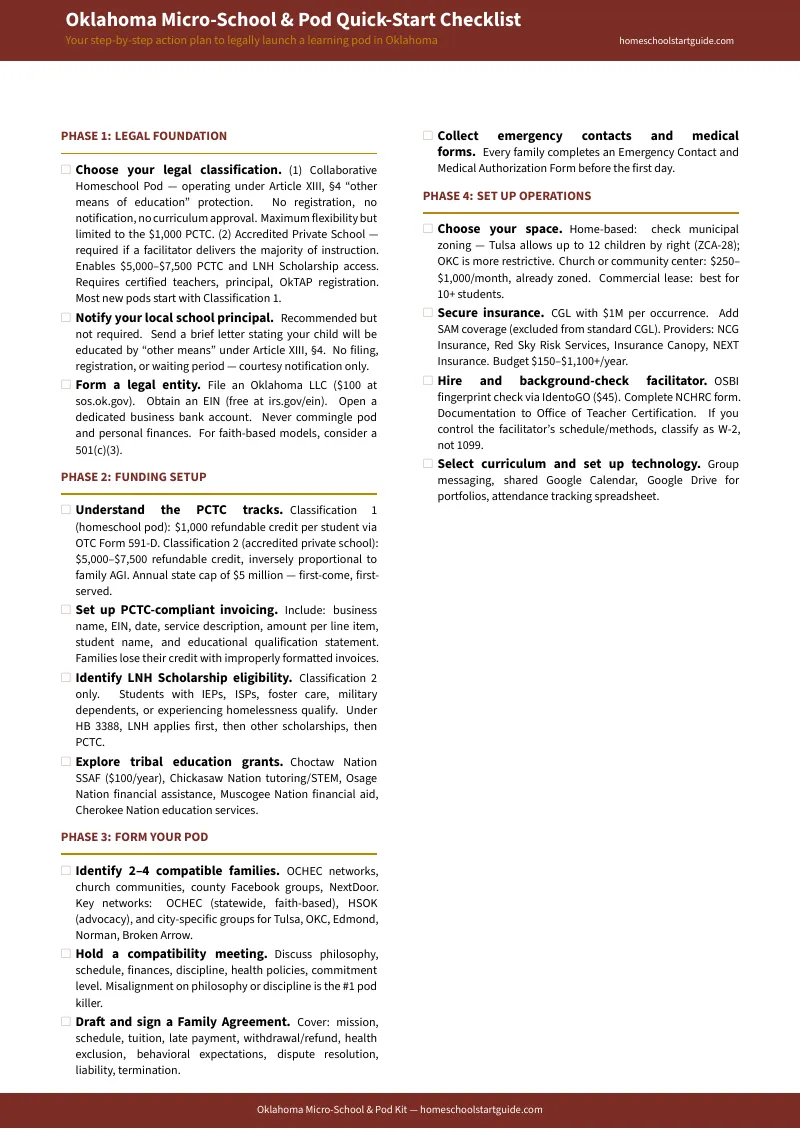
Because most parents spend forty-plus hours stitching together the launch sequence from scattered HSOK resources, OCHEC group threads, OSDE guidance, and contradictory Reddit posts — and still are not sure they got the order right. A single-page, print-and-pin document that walks you from "I have an idea" to "the first day of pod school" — covering legal classification, funding setup, pod formation, operations, curriculum, staffing, and launch week in the correct sequence.
Who This Kit Is For
- Parents who want to form a small learning community of 3–8 students with two to four families — sharing the teaching load, splitting costs, and building something intentional rather than defaulting to institutions that extract franchise fees or public school compliance obligations
- Tulsa metro families (Owasso, Broken Arrow, Bartlesville, Sapulpa) who want a high-quality small-group learning environment without surrendering $2,199/student/year to Prenda's platform fees or paying private school tuition that drains the PCTC benefit
- OKC and Edmond parents who have been priced out of premium private schools or disillusioned by EPIC's post-scandal fallout and want to pool resources with compatible families for a learning environment they actually control
- Current homeschoolers who find solo teaching unsustainable after two or three years and want to share facilitation with other families without losing control of their child's education or autonomy
- Parents of neurodivergent children (autism, ADHD, dyslexia, twice-exceptional) who need a calmer, self-paced environment with a small group that actually accommodates their child — and want to use the LNH Scholarship (expanded by SB 105) to pay for it
- Native American families affiliated with Cherokee, Choctaw, Chickasaw, Muscogee, Osage, or other Oklahoma tribes who want to combine tribal education grants with a culturally responsive micro-school — and need a guide that actually explains how to access those funds
- Faith-based families who want to build a Christ-centered pod with a like-minded community — using the same legal and operational templates as secular pods, with full curriculum autonomy protected by Oklahoma's constitutional framework
- Rural Oklahoma parents who lack nearby private school options and want to create a community-based micro-school centered around a church, community center, or farm cooperative — even if the nearest co-op is an hour away
- Former educators who want to serve their community by running a small pod or micro-school — without the overhead and control of a Prenda, KaiPod, or Acton franchise
After Using the Kit, You'll Be Able To
- Choose the right legal classification for your pod — Constitutional Homeschool Pod for maximum autonomy or Accredited Private School for full funding access — using the two-classification decision framework instead of guessing based on contradictory Facebook advice
- Format your tuition invoices so that every participating family can successfully claim the $1,000 PCTC on Form 591-D — because a single missing line item on your invoice costs each family a $1,000 tax refund
- Run your first parent meeting using a signed family agreement and liability waiver that protects every family in the pod — without spending $200+ on an education attorney consultation
- Hire a facilitator with the correct OSBI background check through IdentoGO, proper W-2 classification, and competitive pay benchmarks — avoiding the liability and IRS issues that sink underprepared pods
- Help enrolled Native American families access Choctaw, Chickasaw, Osage, Muscogee, and Cherokee education grants that subsidize pod tuition, supplies, and technology — giving your micro-school a competitive enrollment advantage that no franchise offers
- Navigate the specific zoning requirements for your municipality — whether you are in Tulsa (residential by right under ZCA-28), OKC (Special Exception likely required), or a rural county — so your pod does not get shut down by a single neighbor complaint
- Build a budget that every family agrees on — using real Oklahoma cost benchmarks for your specific region and a cost-sharing formula that prevents resentment and financial surprises
Why Not Just Use the Free Resources?
The OSDE provides minimal guidance. HSOK explains homeschool rights. OCHEC connects families. Facebook groups share experiences. Here is exactly what you run into when you try to build a pod from those sources alone:
- The OSDE website is written for administrators, not parents starting pods. It tells you that Oklahoma has no homeschool registration, testing, or curriculum requirements. It does not tell you how to form an LLC, structure PCTC-compliant invoices, hire a facilitator through IdentoGO, or navigate OKC's zoning ordinance for a home-based educational assembly. The tone is bureaucratic, minimal, and offers no operational tools.
- HSOK and OCHEC are built for single-family homeschoolers. HSOK provides exceptional legislative advocacy and fierce defense of educational autonomy. OCHEC connects families through conventions and county groups. Neither organization covers multi-family legal structures, PCTC invoice formatting, cost-sharing models, facilitator contracts, or the zoning complexities of running a group learning environment in a residential home. The operational gap between "one family teaches at home" and "five families pool resources and hire a facilitator" is where parents need the most help — and neither organization covers it.
- Generic Etsy templates are legally dangerous in Oklahoma. An $8 "Learning Pod Agreement" from Etsy gives you a three-page contract written for a different state — no Oklahoma-specific legal guidance, no two-classification distinction, no PCTC invoice framework, no "majority of instruction" threshold explanation. Most Etsy micro-school kits do not know the difference between Classification 1 and Classification 2, the Form 591-D requirements, or why OKC and Tulsa have fundamentally different zoning rules for home-based education.
- EPIC Charter Schools is not the answer you think it is. Enrolling in EPIC legally classifies your child as a public school student — subject to state-mandated testing, rigid curriculum oversight, and aligned with an institution reeling from a $22 million embezzlement scandal. The "Learning Fund" is not free money; it is a state subsidy that comes with public school strings. True educational freedom requires total financial and operational independence from the charter system.
- Franchise networks withhold the operational details deliberately. Prenda, KaiPod, and Acton webinars give you the vision. The granular how — the legal structuring, budget templates, scheduling frameworks — is what they sell for $2,199–$11,000+ per student per year in platform fees and tuition. And they keep a cut of every dollar that flows through your pod.
- Facebook groups are well-meaning but legally unreliable. Parents in Oklahoma homeschool groups routinely confuse constitutional protections with operational compliance. They share advice that ignores the EPIC fallout, predates the 2025 LNH expansion (SB 105), and treats all of Oklahoma as having the same zoning rules. Following crowd-sourced legal guidance that does not distinguish between state educational law and municipal operational law is how parents end up with a zoning violation or a family suing them personally after an accident.
Free resources give you the legal baseline and the community connections. The Two-Classification Compliance System gives you the templates, checklists, and decision frameworks to execute this week.
— Less Than One Hour with an Education Attorney
A single consultation with an Oklahoma education attorney costs $150–$300 per hour. Prenda charges $2,199 per student per year in platform fees. The Kit costs less than a single attorney consultation and gives you the legal clarity, operational templates, and tax credit compliance guidance those alternatives are designed to sell piecemeal.
Your download includes the complete 17-chapter guide, the Quick-Start Checklist, and four standalone printable templates: a Family Participation Agreement, a Liability Waiver with emergency contact form, a Facilitator Employment Contract, and an Annual Budget Planner. Instant download, no account required.
30-day money-back guarantee. If the Kit does not give you the legal clarity and operational confidence to move forward with your pod, email us and we will refund you. No questions asked.
Not ready for the full Kit? Download the free Oklahoma Homeschool Quick-Start Checklist — a one-page summary of the two legal classifications, the PCTC funding tracks, and the key legal references that apply to your pod from day one. It is enough to understand your rights tonight.
Oklahoma parents have the constitutional right to build this. The PCTC and LNH Scholarship fund it. The Two-Classification Compliance System makes sure you build it correctly.