Ohio Removed Mandatory Assessments. It Didn't Remove the Consequences of Bad Record-Keeping.
House Bill 33 wiped out Ohio's 900-hour tracking rule, eliminated mandatory portfolio reviews, and removed teacher qualification requirements. Parents celebrated. But then the CCP deadline rolled around and thousands of homeschool families discovered that colleges still want a formal transcript — one that shows course titles, credit hours, grades, and a cumulative GPA. Ohio State doesn't care that the legislature relaxed the rules. They need institutional-quality documentation before they'll let your child through the door.
The Ohio Portfolio & Assessment Templates is the complete documentation system — the portfolio structures, assessment strategy guides, professional transcript framework, and subject-specific documentation examples — built entirely around Ohio's current HB 33 legal requirements and what Ohio universities actually expect from homeschooled applicants. No hour tracking. No attendance logs. No features from states that aren't yours. Just the six required subjects, mapped from kindergarten through graduation.
What's Inside
The HB 33 Documentation Framework
Chapter 1 explains why documentation still matters when the state no longer demands it — and why the parents who stopped keeping records after HB 33 are the ones panicking at CCP enrollment time. Chapter 2 maps exactly what Ohio law requires under ORC §3321.042 (six subjects, annual notification, nothing more) and what it explicitly does not require (hours, testing, teacher credentials, curriculum approval). You'll know exactly what to document and what to skip.
All Four Assessment Options — Compared and Explained
Ohio offers four voluntary assessment paths: standardized testing (ITBS, Stanford-10, CAT), portfolio review by a certified teacher, a written narrative evaluation, or alternative methods approved by your superintendent. Chapter 3 breaks down when each option makes sense, what each costs, how to prepare for each one, and which assessment strategy works best for elementary, middle school, and high school students. Most parents don't know they have options beyond standardized testing. This chapter ends the guesswork.
Grade-Level Portfolio Structures (K-12)
What counts as "good documentation" for a second grader looks nothing like what colleges expect from a junior. Chapter 5 provides grade-level strategies: reading logs and milestone photos for K-2, essay drafts and lab reports for grades 3-8, and full course documentation with graded assignments for high school. Each level includes specific examples of what to save, what to photograph, and what to skip.
Subject-by-Subject Documentation Guide
Ohio requires instruction in six subjects: English language arts, mathematics, science, history, government, and social studies. Chapter 6 shows you exactly what to document for each one — not generic advice, but Ohio-specific examples tied to the subjects the state actually mandates. If you're using a Charlotte Mason approach, an unschooling method, or a textbook curriculum, the documentation examples adapt to your style.
Professional Transcript Creation
Chapter 8 is the transcript chapter — the one that prevents your child's homeschool record from looking like a homemade arts-and-crafts project. It covers course naming conventions (use "Algebra I" not "Math Stuff"), credit assignment (1.0 for full year, 0.5 for semester), weighted and unweighted GPA calculation, the course description supplement that competitive universities expect, and formatting standards that make your transcript look institutional. This is the chapter that saves your child from the "scammy transcript" problem that haunts homeschool alumni.
The College Credit Plus (CCP) Guide
Ohio's CCP program covers tuition, textbooks, and fees at public universities for homeschooled students in grades 7-12. But you need an OH|ID account, a formal transcript, and a completed funding application by the April 1st hard deadline. Chapter 9 walks through every step: creating the OH|ID account, securing college acceptance, submitting the funding application, and formatting your transcript to meet CCP requirements. Miss the deadline and your child loses an entire semester of free college credits.
University-Specific Admissions Requirements
Ohio State wants something different than UC Cincinnati, and both want something different than Case Western. Chapter 10 provides university-specific documentation requirements for major Ohio institutions — what each admissions office expects from homeschooled applicants, how to format course descriptions, and when to submit supplemental materials. Stop guessing what "competitive" means for each school.
The Ohio Homeschool Diploma
Under ORC §3313.6110 (the Diploma Fairness Law), your parent-issued diploma carries the same legal weight as a public school diploma. Chapter 11 explains the legal framework, how to format the diploma professionally, and how to handle employers or institutions that don't understand the law.
Sports, Scholarships, and Special Programs
Your homeschooler can play varsity sports under OHSAA Bylaw 4-3-1. They can access Jon Peterson Special Needs Scholarship funding. They can pursue the Ohio Seal of Biliteracy or EdChoice scholarships. Chapter 12 covers the documentation required for each program — eligibility rules, enrollment deadlines, and what paperwork to have ready before you contact the athletic director or scholarship office.
Who This Is For
- Parents approaching their first annual assessment and unsure which of Ohio's four options to choose — or whether they even need to assess at all after HB 33
- Parents whose child is entering high school and who suddenly realize they need formal transcripts, not a shoebox of worksheets
- Parents who need a CCP-ready transcript before the April 1st funding deadline and don't know where to start
- Parents using the Ohio withdrawal product who now need the ongoing documentation system — the Blueprint gets you out of school, this gets you organized for the years ahead
- Experienced homeschoolers who have been winging it for years and want to professionalize their records before college applications begin
- Parents in Columbus, Cleveland, Cincinnati, or Dayton whose districts are still sending pre-HB 33 assessment demand letters
- Unschooling families who need to translate project-based and interest-led learning into documentation that institutions recognize
- Secular families who want legally accurate templates without the religious framing of CHEO resources
Why Not Just Use the Free Resources?
You can. Here's what you'll find:
- The Ohio DOE (ODEW) explicitly refuses to provide templates. Their FAQ states they "do not provide a template to be used" for transcripts or diplomas. They tell you what's required. They don't give you the tools to do it.
- Ohio Homeschooling Parents (OHP) provides excellent legal guidance — and zero portfolio infrastructure. They'll give you the exemption notification form and fiercely accurate legal primers. But ask "how do I actually organize my portfolio?" and you'll get told to read the statute yourself. Legally sound. Operationally useless.
- CHEO requires a $30 membership and a Statement of Faith. Their record-keeping advice? "Use a notebook." Their transcript template? Non-existent. Their focus is legislative advocacy, not documentation tools.
- Etsy and TPT sell generic $3-7 planners built for every state. They include attendance sheets and hourly trackers that Ohio law explicitly eliminated. They don't align with Ohio's six required subjects. They don't mention CCP, OHSAA, or the Diploma Fairness Law. They solve the "pretty binder" problem while creating the "wrong state" problem.
- Homeschool Tracker charges $65/year for software that tracks attendance you don't need to track and hours you don't need to log. It's a subscription for features Ohio made irrelevant in 2023.
Free resources tell you what Ohio law requires. This guide gives you the exact system to execute it — subject by subject, grade by grade, deadline by deadline.
— Less Than One Hour With a Licensed Assessor
A portfolio review with a certified Ohio assessor runs $40-$160 depending on the number of students. CHEO membership is $30/year. Homeschool Tracker is $65/year. A rejected CCP application because your transcript wasn't formatted correctly costs your child an entire semester of free college tuition — thousands of dollars. This guide costs less than the gas to drive to a testing center.
Your download includes the complete guide, 5 standalone reference printables, and the Quick-Start Checklist — 7 PDFs:
- guide.pdf — The full Ohio Portfolio & Assessment Templates: 16 chapters covering the HB 33 documentation framework, Ohio's six required subjects, all four assessment options, grade-level portfolio structures (K-12), subject-by-subject documentation examples, professional transcript creation with GPA calculation, College Credit Plus enrollment guide, university-specific admissions requirements (Ohio State, UC, Case Western, Ohio University), diploma issuance under the Diploma Fairness Law, OHSAA sports eligibility, Jon Peterson Special Needs Scholarship documentation, unschooling and project-based documentation strategies, district-specific guidance, and a year-round documentation calendar.
- assessment-comparison.pdf — Side-by-side comparison of Ohio's four assessment options with assessor directory, cost ranges, and grade-level recommendations.
- transcript-guide.pdf — Course naming conventions, credit assignment tables, GPA calculation formulas (weighted and unweighted), formatting standards, and the course description supplement template.
- ccp-guide.pdf — College Credit Plus step-by-step: application timeline, April 1st deadline checklist, critical documents, participating colleges, and transcript listing rules.
- university-requirements.pdf — What Ohio State, UC, Case Western, and Ohio University specifically require from homeschool applicants — printed reference for application season.
- documentation-calendar.pdf — Month-by-month tasks from August notification through June compilation, key Ohio deadlines, and the 15-Minute Friday routine.
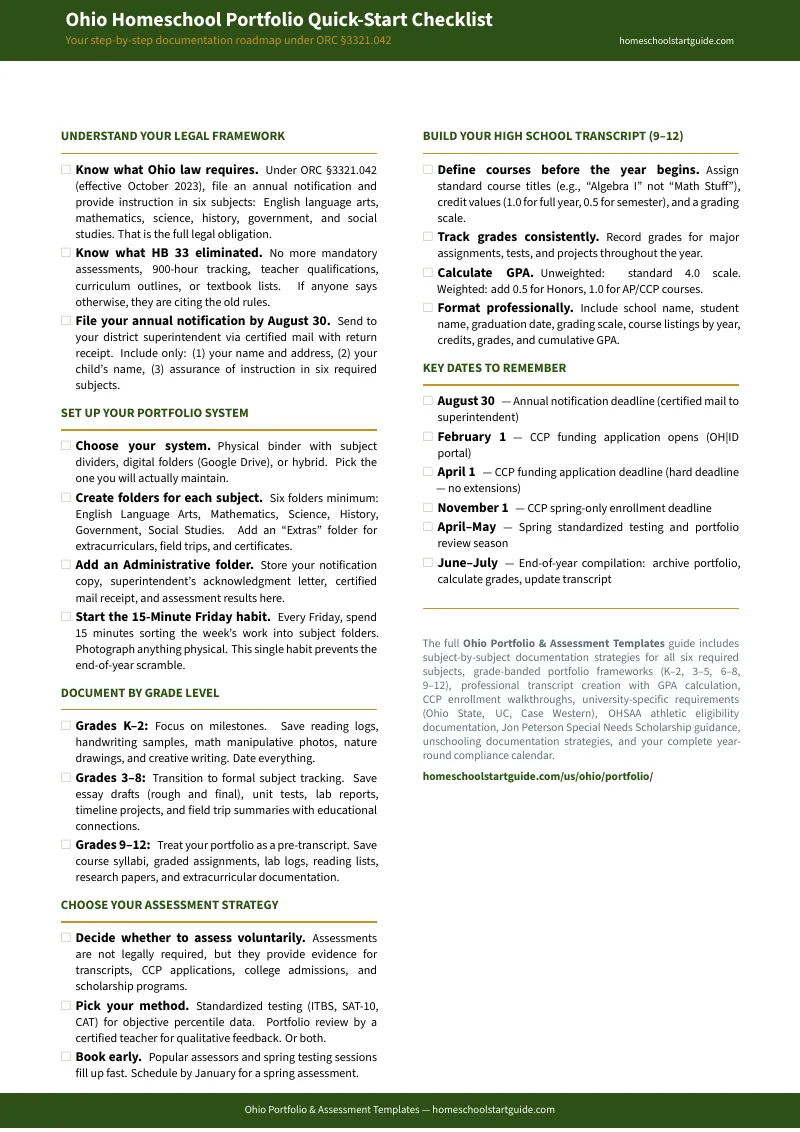
- checklist.pdf — The Ohio Homeschool Portfolio Quick-Start Checklist: a printable action plan covering legal requirements, portfolio setup, grade-level documentation, assessment selection, transcript building, and key Ohio deadlines.
7 PDFs. Instant download, no account required.
30-day money-back guarantee. If the guide doesn't give you the documentation system and transcript framework you need, email us and we'll refund you. No questions asked.
Not ready for the full guide? Download the free Ohio Homeschool Portfolio Quick-Start Checklist — a printable overview of Ohio's legal requirements, portfolio setup steps, assessment options, transcript basics, and key compliance deadlines. It's enough to get oriented, and it's free.
Ohio gave you the freedom to educate your child without state interference. This guide makes sure you have the documentation to prove it was worth every minute.