North Dakota Has No Charter Schools, No Micro-School Law, and Some of the Most Isolated Families in America. The Pod Compliance System Gets Your Group Running Legally.
You're done homeschooling alone. Maybe you've been teaching three kids in your kitchen in Bismarck for two years and you're running on fumes. Maybe you're in the Bakken region and the nearest school is an hour on gravel roads. Maybe you PCS'd to Minot AFB and your child is starting over in a new school for the third time. Maybe your child has ADHD and the local school's rigid schedule is making everything worse. You know a learning pod would solve most of these problems — shared teaching, consistent socialization, and a small-group environment that actually fits your kids.
So you started researching. And within an hour you had more questions than answers. Can you legally hire a tutor to teach your pod? (Yes — if structured correctly. If structured incorrectly, the IRS classifies your tutor as an employee and you owe back taxes and penalties.) Can you call yourselves a micro-school? (No — HB 1472 failed in 2025, so "micro-school" has no legal status in North Dakota. If you operate like one without the right structure, the state can classify you as an unapproved private school.) Do your kids still have to take standardized tests? (Depends entirely on whether you hire a certified teacher — and almost no free resource explains that distinction clearly.)
Here's what makes North Dakota uniquely complicated — and uniquely rewarding — for pod founders: the Pod Compliance System inside this kit solves the three problems that kill most first-year pods before they start. First, it maps the legal structure so every family in your group files correctly under NDCC §15.1-23 as individual home educators — keeping your pod safely below the threshold that triggers private school classification. Second, it includes the tutor contract template specifically designed around IRS independent contractor rules so you don't accidentally become an employer liable for unemployment taxes. Third, it explains the certified teacher advantage: hiring one licensed educator as your pod's facilitator can potentially eliminate the standardized testing requirement in grades 4, 6, 8, and 10 for every family in the group simultaneously.
What's Inside the Kit
The Post-HB 1472 Legal Structure Guide
HB 1472 would have created a legal category for micro-schools in North Dakota. It failed 49-41 in February 2025. That means there is no legal entity called a "micro-school" in the state. Your pod must operate as an aggregate of individually compliant home education programs — each family filing its own Statement of Intent (SFN 16909) with their local superintendent. The guide walks you through exactly how to structure this so your cooperative arrangement never triggers the nonpublic school classification under NDCC §15.1-06, which would require licensed teachers, facility codes, and state approval you don't need.
The Certified Teacher Advantage
North Dakota requires standardized testing in grades 4, 6, 8, and 10 — and your child must score at or above the 50th percentile. Fall below the 50th and a certified teacher monitors your homeschool for a year. Fall below the 30th and you file a remediation plan with the superintendent. But the statute provides explicit exemptions: a parent with a baccalaureate degree, a valid teaching license, or a philosophical/moral/religious objection can bypass testing entirely. This section explains how hiring a certified facilitator can extend that exemption to every family in your pod — the single most powerful structural advantage a North Dakota pod can have.
The W-2 vs. 1099 Tutor Contract Template
Pooling money with neighbors to hire a tutor sounds simple until the IRS gets involved. A homeschool group in another state was audited and fined $4,000 annually for three consecutive years because they misclassified their hired teacher as an independent contractor when the IRS viewed the arrangement as employment. The contract template in this kit is specifically designed around the IRS behavioral control, financial control, and relationship tests — so your pod pays its facilitator correctly from day one, with no back-tax surprises.
The Parent Agreement Template
Most pods that fail don't fail because of legal problems. They fail because two families had different expectations about schedule commitment, sick-child policies, or who cleans the bathroom after co-op day. The parent agreement template covers everything that actually causes blowups: financial obligations, attendance expectations, withdrawal procedures, discipline philosophy, health protocols, and dispute resolution. You fill it in before the first day of instruction, and every family signs it.
The Budget Planner with ND Wage Data
North Dakota's cost of living varies dramatically by region — Fargo is not Williston, and Williston is not the farm country between them. The budget planner uses real regional wage data to help you calculate facilitator compensation, space rental, curriculum costs, and per-family shares. It covers pods of 3 to 15 students, from the parent-only co-op that costs nothing beyond curriculum to the full-time facilitator model that splits $25,000-$35,000 across participating families.
The Complete 16-Chapter Guide
Beyond the templates, the guide covers North Dakota's required subjects (reading, language, mathematics, science, social studies, health, physical education), curriculum selection for multi-age group settings, the child care licensing trigger (the five-child rule and how to stay below it), zoning rules for home-based pods in Fargo and other cities, insurance requirements your homeowner's policy doesn't cover, dual enrollment through the ND University System, NDHSAA sports eligibility for pod students, extreme weather protocols and the HB 1105 virtual instruction provision for blizzard days, micro-school networks (Prenda, KaiPod, Acton Academy) and why you may not need them, and dedicated sections for military families at Minot AFB and Grand Forks AFB, Native American families near Standing Rock and Fort Berthold, and neurodivergent learners who need Student Services Plans.
Who This Kit Is For
- Parents burned out on solo homeschooling who want to share the teaching load with 2-5 other families — without joining a franchise that takes $2,199 per child per year or 10% of your revenue
- Rural and agricultural families in western ND, the Bakken region, or anywhere the nearest school is a long bus ride away and a learning pod is the most practical option
- Parents who want to hire a certified teacher to eliminate the standardized testing requirement in grades 4, 6, 8, and 10 — and need the contract template to do it legally
- Military families at Minot AFB or Grand Forks AFB who need portable, community-based education that doesn't restart every PCS cycle
- Parents of children with ADHD, autism, or other neurodivergent profiles who need a small-group environment their public school can't provide
- Parents who tried traditional co-ops through NDHSA or church groups but want something more structured and academically focused than a once-a-week enrichment meetup
- Anyone looking at Prenda ($2,199/student/year), KaiPod Catalyst ($249 + 10% revenue share), or Acton Academy (private school tuition) and thinking there has to be a more affordable way
Why Not Just Piece It Together From Free Resources?
You can try. Here's what you'll actually find:
- The ND DPI gives you a form and a statute citation. SFN 16909 and a link to NDCC §15.1-23, which opens with compulsory attendance penalties. Zero guidance on how to structure a multi-family pod, how to hire a facilitator without becoming an employer, or how the certified teacher exemption actually works in practice.
- NDHSA provides traditional homeschool support — behind a $45/year membership. Excellent for single-family, faith-based homeschooling. Their guidance covers co-ops in the casual, once-a-week enrichment sense. They provide nothing on the legal structure of a daily learning pod with a hired facilitator, IRS contractor classification, or the five-child licensing trigger.
- Prenda and KaiPod offer free guides — as sales funnels. The free "How to Start a Microschool" PDFs from national networks are genuinely well-written. They're also designed to lead you into a platform that charges $2,199 per student or takes 10% of your gross revenue. They operate on national generalities and completely ignore NDCC §15.1-23, the HB 1472 failure, and ND's specific testing exemptions.
- Facebook groups and Reddit threads mix current law with outdated advice. Parents who formed pods under older rules still advise newcomers based on pre-2023 requirements. A misunderstanding of the certified teacher exemption, the nonpublic school boundary, or the contractor-vs-employee distinction can result in fines, truancy inquiries, or a DPI investigation you could have avoided entirely.
— Less Than One Week of Gas to the Nearest School
A Prenda platform fee runs $2,199 per child per year. A KaiPod Catalyst enrollment costs $249 upfront plus 10% of your pod's gross revenue for two years. A single hour with an education attorney in Fargo or Bismarck costs $200-$350. An IRS misclassification audit — triggered by incorrectly paying your tutor as a 1099 contractor — costs thousands. This kit costs less than a week of gas money for the rural bus commute your pod is replacing.
Your download includes the complete 16-chapter guide (guide.pdf), the Quick-Start Checklist (checklist.pdf), and five standalone printable templates: the Parent and Family Agreement (parent-agreement.pdf), the Facilitator Independent Contractor Agreement (facilitator-contract.pdf), the Liability Waiver and Assumption of Risk (liability-waiver.pdf), the Annual Pod Budget Worksheet (budget-worksheet.pdf), and the Statement of Intent Filing Checklist (soi-filing-checklist.pdf). Instant download, no account required.
30-day money-back guarantee. If the kit doesn't give you the legal clarity and operational templates to launch your pod, email us and we'll refund you. No questions asked.
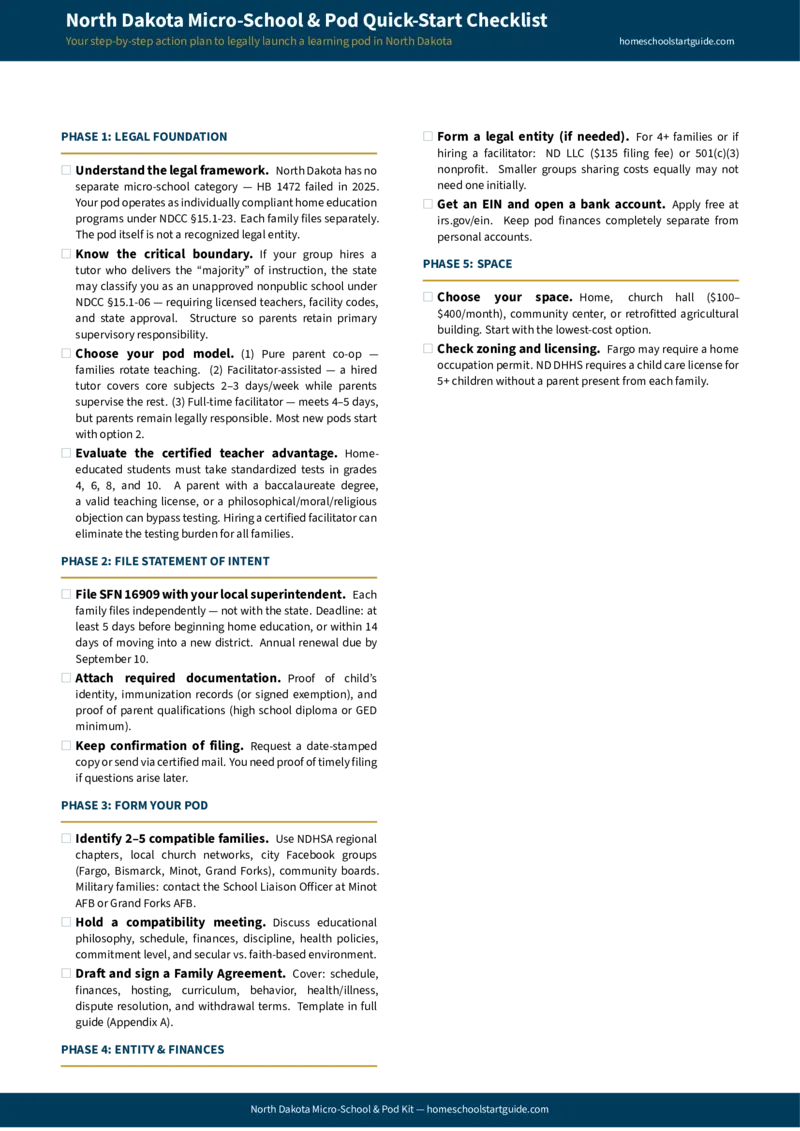
Not ready for the full kit? Download the free North Dakota Homeschool Quick-Start Checklist — a one-page action plan covering every step from understanding the legal framework through filing your Statement of Intent and forming your first pod. It's enough to get started, and it's free.
Your kids don't have to ride the bus for 90 minutes each way. North Dakota's home education statute gives you the legal right to educate cooperatively — and the certified teacher advantage means your pod can operate with less state oversight than a solo homeschooler. The Pod Compliance System makes sure you use that advantage correctly from day one.