The Threshold Blueprint: Start Your North Carolina Micro-School Legally, Unlock State Funding, and Keep 100% of Your Tuition.
North Carolina has 101,880 registered homeschools, universal Opportunity Scholarships worth up to $7,942 per student, and three distinct legal pathways for group learning. But the state also has one of the most specific regulatory thresholds in the country: the moment your pod includes children from a third family, you are no longer running a homeschool — you are operating a private school. Do that without proper DNPE registration, and it is a Class 1 misdemeanor.
Nobody has assembled North Carolina's regulatory maze into a single threshold blueprint — one document that tells you exactly when your pod crosses from homeschool to private school, what each pathway requires, and how to build a compliant, fundable micro-school from scratch. Until now.
You want to pull together a handful of families in your neighborhood, create something small and intentional, and give your children the learning environment the school system refuses to provide. Maybe your child has ADHD and the IEP battles have exhausted you. Maybe you are a former teacher who left the system and wants to serve your community without surrendering control to a franchise network. Maybe you are secular, and every quality co-op in your area requires a statement of faith. Whatever the reason, you have arrived at the same conclusion: I need to build this myself.
The problem is that the internet gives you fragments. The DNPE website presents the law in scattered FAQs and disjointed statutes. NCHE provides excellent co-op directories but zero guidance for founders launching a paid micro-school. The national franchise networks — Acton Academy ($20,000 licensing fee plus 3% of gross revenue), Prenda ($2,199 per student per year), KaiPod (10% of revenue for two years) — will walk you through launch, but only if you surrender your tuition income and curricular freedom. You need the operational playbook without the franchise overhead.
The North Carolina Micro-School & Pod Kit is that blueprint.
What's Inside the Kit
The "2 vs. 3 Family" Legal Matrix
Add one family too many and your perfectly legal homeschool pod becomes a Class 1 misdemeanor — and no national guide, Etsy template, or Facebook group post explains where that line is. Under NC General Statute §115C-563(a), a homeschool can include children from exactly two households. The moment you add a third, you trigger private school registration, fire marshal inspections, sanitation reviews, and child care licensing rules. The kit maps all three legal pathways — the two-family homeschool pod, the church-related school umbrella (CHEF of NC, Grace Community School), and full private school registration — side by side, with requirements, costs, and timelines for each.
The Opportunity Scholarship Funding Roadmap
A micro-school of eight students could qualify for more than $63,000 per year in state funding — but only if you register correctly from the start. North Carolina's universal Opportunity Scholarship now provides up to $7,942 per student per year, with no income caps. The kit walks you through the exact NCSEAA Direct Payment School registration steps, compliance requirements, and timeline. For students with disabilities, the ESA+ program adds $9,000 to $17,000 per student. Most pods never access this funding because they don't know the registration sequence exists.
The DNPE Notice of Intent Walkthrough
File during the system blackout months of May and June, and your NOI sits in limbo. Miss the annual standardized testing requirement, and your homeschool status is at risk. The Notice of Intent is the first legal step for any North Carolina homeschool — and the most common place where new founders make errors that take months to fix. The kit includes a chronological filing checklist, guidance on testing and assessment options, and the exact steps to maintain annual compliance — so you don't learn the rules by breaking them.
The Parent Agreement & Liability Protection Templates
Liability fear kills more pods than bad curriculum — it is the most common reason parents abandon formation after the first planning meeting, because nobody knows what the agreements should say or whether a waiver actually protects them. The kit includes customizable parent enrollment agreements with North Carolina's mandatory immunization language, liability waivers, and a practical guide to micro-school insurance (policies typically cost under $100 a month). Every family signs before the first day, so the undefined expectations that destroy pods never get the chance to form.
The City-Specific Zoning Guide
One neighbor complaint about your home-based pod can trigger a zoning enforcement action — and the rules vary wildly across NC metros. Raleigh's UDO bans non-residents from visiting a home for business purposes, making drop-off pods functionally illegal in standard residential zones. Charlotte, Durham, Greensboro, and Asheville each have their own restrictions. The kit includes municipality-by-municipality guidance so you know what you can operate from home, when you need a commercial or church space, and how to work with your local planning office — before the complaint arrives.
The Budget & Cost-Sharing Framework
Space rental, curriculum, SBI background checks, insurance premiums, fire inspection fees — the costs add up faster than most founders expect, and underestimating them is how pods go broke in their first semester. The kit includes budget templates built for NC micro-schools with realistic local cost ranges and three tuition collection models: equal cost-sharing, per-student tuition, and hybrid. Whether you are two families splitting curriculum costs or a twelve-student operation collecting monthly tuition, the financial framework shows you the real numbers before you commit.
The NC Pod Launch Checklist
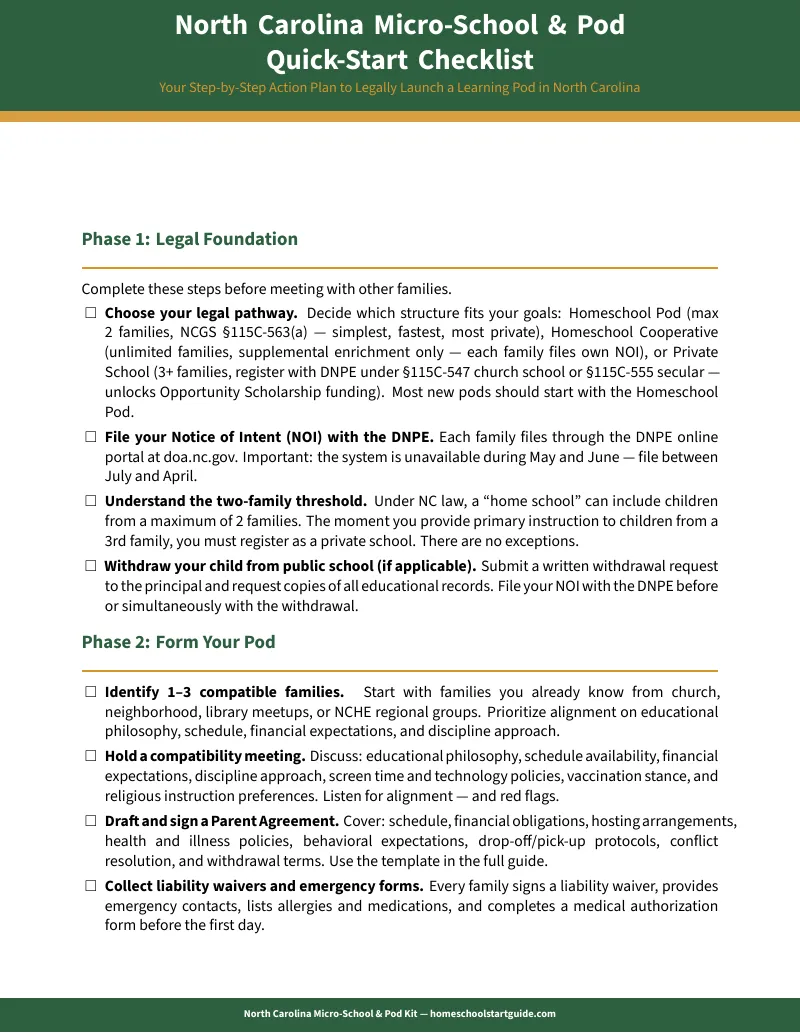
Most parents spend forty or more hours assembling the launch sequence from DNPE pages, NCHE forums, and contradictory Facebook threads — and still are not sure they got the order right. This single-page, print-and-pin document walks you from "I have an idea" to "the first day of pod school," covering the legal, operational, financial, and community formation steps in the correct order for North Carolina.
Who This Kit Is For
- Parents who have decided the public school system is not working for their child — whether because of overcrowding, rigid standardized testing, curriculum concerns, or inadequate special education placements — and want to build a small, intentional alternative with a handful of like-minded families in their NC community
- Parents of neurodivergent children (autism, ADHD, dyslexia) who are exhausted by IEP advocacy and need a calmer, self-paced learning environment where their child is genuinely known — not lost in a class of thirty
- Secular or progressive parents who have been excluded from established co-ops that require statements of faith or ideological conformity, and who need a legally sound framework for building an inclusive pod
- Former educators who have left the North Carolina public school system and want to serve their community by running a small micro-school — without the $20,000 franchise fee, the revenue share, or the curricular control of a national network
- Families who are aware of the Opportunity Scholarship and want to structure their micro-school correctly from the start to qualify as an NCSEAA Direct Payment School
- Military families near Fort Liberty or Camp Lejeune who need a portable, well-documented pod arrangement that survives PCS moves and deployments without falling apart
- Solo homeschool parents who started strong but are drowning in the isolation and instructional load — and who want to share the teaching burden with one or two other families legally and sustainably
After Using the Kit, You'll Be Able To
- Choose the correct legal pathway for your pod — two-family homeschool, church umbrella, or registered private school — and understand exactly what each one requires before you enroll a single student
- File your Notice of Intent with the DNPE correctly, avoid the May–June blackout, and maintain annual compliance with confidence
- Register as an NCSEAA Direct Payment School and access up to $7,942 per student per year in Opportunity Scholarship funding — the exact steps, not the headline number
- Run your first parent intake meeting with a signed participation agreement and liability waiver that protects every family in the pod — without spending money on an attorney
- Navigate your city's zoning rules for Charlotte, Raleigh, Durham, Greensboro, or Asheville and know whether your planned location works before you sign a lease or invite families over
- Facilitate a mixed-age pod of four to twelve children across multiple grade levels without chaos — using a scheduling framework built around sustainable facilitation, not a replicated school day
- Hire a facilitator or teacher legally, with the correct SBI background check, and know whether they should be a W-2 employee or 1099 contractor
- Build a secular, inclusive learning community that explicitly does not require any statement of faith — and document that inclusivity in your community charter
Why Not Just Use the Free Resources?
NCHE offers co-op directories and legislative advocacy. The DNPE publishes the raw statutes. HSLDA provides legal defense. VELA gives startup grants. Here is exactly what you run into when you try to build a micro-school from those sources alone:
- NCHE caters to traditional parent-led homeschoolers, not edupreneurs. Their guidance on co-ops assumes parents volunteer to teach collectively — not founders launching a tuition-charging micro-school that needs insurance, background checks, and NCSEAA provider registration. The business mechanics are entirely absent.
- The DNPE gives you the raw law but zero operational templates. You learn that you need a Notice of Intent and annual testing. You do not receive the chronological filing checklist, the parent agreement framework, or the liability waiver to operationalize that knowledge. The information is scattered across disjointed statutes and bureaucratic FAQs that induce more confusion than they resolve.
- HSLDA provides legal defense, not business setup. They are excellent when you face an active legal challenge. They do not provide the budget templates, zoning guidance, or Opportunity Scholarship registration steps you need to avoid a legal challenge in the first place.
- The franchise networks withhold operational details deliberately. Acton's blog, KaiPod's webinars, and Prenda's social content are top-of-funnel marketing designed to route you into their paid platforms. The granular how — the provider registration steps, the facility checklists, the scheduling frameworks — is the product they sell for thousands of dollars per year.
- Generic Etsy templates do not know North Carolina law. A $5 "Pod Agreement" from Etsy does not address the two-family threshold, DNPE NOI requirements, mandatory immunization language, or NCSEAA registration. It is a blank contract with no state-specific legal context.
Free resources give you the inspiration and the legal baseline. The Kit gives you the templates, checklists, and frameworks to execute this week.
— Less Than One Hour With an Education Attorney
Acton Academy charges a $20,000 licensing fee plus 3% of gross revenue. Prenda takes $2,199 per student per year in platform fees. KaiPod demands 10% of your revenue for two years. A single consultation with a North Carolina education attorney about your pod's legal standing costs $200–$400 for one hour. The Kit costs less than that single consultation and gives you the operational independence those platforms are designed to prevent.
Your download includes six files: the complete guide (22 chapters covering all three legal pathways, DNPE compliance, Opportunity Scholarship funding, curriculum selection, hiring, budgets, insurance, zoning, templates, military family planning, and scaling), the North Carolina Homeschool Quick-Start Checklist, a standalone Parent Participation Agreement template ready to print and customize, a Liability Waiver with emergency contact form, a DNPE Compliance Reference covering setup steps and the annual compliance checklist for all three pathways, and an Opportunity Scholarship Funding Roadmap with NCSEAA Direct Payment School registration steps. Instant download, no account required.
Money-back guarantee, no time limit. If the Kit does not give you the legal clarity and operational confidence to move forward with your micro-school, email us and we will refund you. No questions asked.
Not ready for the full Kit? Download the free North Carolina Homeschool Quick-Start Checklist — a one-page summary of the legal requirements, the Opportunity Scholarship basics, and the two-family threshold that every NC pod founder must understand. It is enough to know your rights tonight.
North Carolina's laws are clear. The state funding is available. The families in your neighborhood are having the same conversation you are right now. The Kit makes sure you build it correctly.
Frequently Asked Questions
What if the rules change after I buy?
We update the guide when the rules change. Email us any time, even years later, and we'll send you the current edition free.