New York Requires More Homeschool Paperwork Than Any Other State. Here's the System That Makes It Manageable.
You've made the decision. Your child is shutting down — anxiety attacks before school, a bullying situation the administration won't address, an IEP that exists on paper but not in practice. You want to pull them out. But then you read the New York homeschool regulations and discovered that this state requires a Letter of Intent, an Individualized Home Instruction Plan, four quarterly reports, and an annual standardized assessment. You found Reddit threads with parents panicking about "Practical Arts" requirements and 900 mandatory hours. You learned that ten consecutive unexcused absences can trigger a report to Child Protective Services.
That fear is understandable — and it's exactly what keeps families trapped in schools that aren't working. New York's regulatory framework under Commissioner's Regulation 100.10 is demanding, but it follows a predictable cycle: file the LOI, submit the IHIP, send quarterly reports, pass the annual assessment. Over 50,000 New York families navigate this system every year without attorneys, without teaching credentials, and without a single home visit.
The New York Legal Withdrawal Blueprint is the 100.10 Compliance System — a fill-in-the-blank procedural manual that translates New York's dense regulatory code into templates, timelines, and plain-English instructions. You don't decode the law. You don't guess what the district wants. You fill in the blanks and file on time.
What's Inside the Blueprint
The Letter of Intent Walk-Through
Your LOI is the legal mechanism that stops the truancy clock. Without it, ten consecutive absences trigger a mandatory report to the Statewide Central Register of Child Abuse and Maltreatment. The Blueprint provides a ready-to-send LOI template with fill-in fields for your child's name, date of birth, grade, and the legally required declaration citing Section 100.10. It tells you exactly what to include, what to leave out (your curriculum, your reasons, your philosophy — the district has no right to any of it), and how to send it: certified mail with return receipt outside NYC, PDF email to the Central Office of Homeschooling inside NYC.
The IHIP Builder — by Grade Band
The Individualized Home Instruction Plan is where most parents freeze. The form asks you to list syllabi for every required subject at your child's grade level — and the required subject list grows dramatically. Grades 1–6 require twelve core subjects. Grades 7–8 add "Practical Arts" and "Library Skills" — two mandates that New York defines nowhere. Grades 9–12 require 22 credit-units across eight academic domains. The Blueprint provides separate IHIP templates for each grade band (K–6, 7–8, 9–12) with sample language you can copy directly. Write your IHIP flexible enough that you never need to file a formal revision, but specific enough that no district clerk can reject it.
The "Vague Subject" Translation Matrix
This is the section no other guide provides. New York requires instruction in "Practical Arts" and "Library Skills" starting in seventh grade, but the state's own regulations never define what these subjects mean. Parents agonize over these mandates for hours. The Blueprint provides a complete translation matrix — 10+ real-world activities that satisfy each vague requirement. Practical Arts: cooking, personal finance, basic home maintenance, sewing, digital literacy, woodworking. Library Skills: public library use, digital database research, source evaluation, note-taking, citation basics. Copy the language directly into your IHIP.
The Quarterly Report System
Four quarterly reports per year, each documenting instructional hours and material covered per subject. Parents stress about the format, the detail level, and whether 80% of planned material is enough. The Blueprint provides a quarterly report template with sample language that satisfies district requirements without over-reporting. It includes hour-tracking strategies — at 5 hours per day, you reach 900 hours in 180 days, and most families exceed this well before June. If you covered less than 80% of planned material in any subject, the template includes the brief explanation language that prevents a follow-up inquiry.
The Mid-Year Withdrawal Protocol
Nearly every withdrawal guide assumes a traditional July 1 start date. In reality, a massive volume of New York withdrawals happen mid-year — a child hits crisis, and the parent needs to act now, not next September. The Blueprint includes the complete mid-year procedure: how to calculate prorated hours (withdrawing in February requires far fewer than 900 hours), which quarterly reports you still owe, the adjusted LOI deadline (within 14 days of starting home instruction), and how to stop the school from marking your child absent while the district processes the paperwork.
The NYC DOE Fast-Track Protocol
New York City parents face an entirely different bureaucracy from the rest of the state. While upstate families deal with local district superintendents, NYC's 14,000+ homeschoolers interact with a single centralized Office of Homeschooling that is notoriously slow and rigid. The Blueprint includes the exact email addresses (LOI to [email protected], everything else to [email protected]), the required subject-line format, the mandatory 9-digit OSIS student ID, PDF-only submission requirements, and how to obtain a Letter of Compliance for OMNY transit card access. Your email timestamp proves legal compliance — even if the office takes months to acknowledge it.
The Annual Assessment Decision Framework
New York offers multiple assessment pathways and the rules change by grade. Grades 1–3: choose between standardized testing or a written narrative evaluation. Grades 4–8: standardized testing required every other year, with narrative evaluation in alternating years. Grades 9–12: standardized testing required every year. The SAT and ACT do not count. The passing threshold is above the 33rd percentile or one year of academic growth. The Blueprint maps every option by grade, explains how to choose a certified evaluator for narrative years, and provides the exact documentation format for your annual assessment submission.
The IHIP Rejection and District Pushback Guide
Some districts — particularly in suburban Long Island and Westchester — push back harder than others. They have a financial incentive: every student who leaves represents lost per-pupil state aid. The Blueprint covers IHIP rejection response procedures, the formal appeal process with 30-day timelines, pushback scripts for when a district demands curriculum approval, teaching credentials, or home visits (none of which the law permits), and the probation and remediation sequence so you know exactly what happens if a district escalates — and why it almost never gets that far.
The High School Graduation Pathway
New York homeschoolers cannot receive a standard Regents diploma, but they have multiple routes to post-secondary education. The Blueprint covers the 22-credit Letter of Substantial Equivalency from the superintendent, the SUNY/CUNY 24-credit Ability-to-Benefit pathway, Regents exam eligibility for homeschoolers who want selective college credentials, transcript creation for college applications, and dual enrollment options at SUNY and CUNY community colleges starting at age 16.
Who This Blueprint Is For
- Parents whose child is having anxiety attacks, being bullied, or refusing to go to school — and who need to execute a legal withdrawal this week, not after months of decoding Regulation 100.10
- Parents who just moved to New York from Texas, Florida, or another low-regulation state and are stunned by the paperwork New York requires
- Parents staring at a blank IHIP form with no idea what to write for "Practical Arts" or "Library Skills" — and who don't want to guess wrong and get the plan rejected
- NYC parents navigating the centralized DOE Office of Homeschooling — who need the exact email addresses, OSIS numbers, and submission protocols that the rest of the state doesn't deal with
- Parents of children with IEPs who need to understand the IESP process for continuing speech therapy, OT, and other services after withdrawal
- Parents of high schoolers who need a graduation pathway — transcript creation, Regents exam access, SUNY/CUNY dual enrollment, and the Letter of Substantial Equivalency
- Families who want a clean, secular, one-time-purchase compliance system without joining LEAH ($50+/year plus local chapter dues and a Statement of Faith) or HSLDA ($130/year built on legal fear)
Why Not Just Use the Free Resources?
You can. NYHEN publishes detailed legal analysis. The NYSED website hosts the full text of Regulation 100.10 and a lengthy Q&A document. The NYC DOE provides bare-bones LOI and IHIP forms. Reddit has hundreds of threads from New York parents who've been through the process. Here's what actually happens when you try to assemble a withdrawal strategy from free sources:
- Regulation 100.10 reads like a tax code. It lists requirements in continuous paragraphs rather than simple checklists. It mandates instruction in "Library Skills" without ever defining what that means. It generates more anxiety than it alleviates. You need a translator, not the raw legal text.
- NYHEN is excellent — and fundamentally an archive. The information you need is scattered across deep blog posts and nested pages on a 1990s-era website. There is no single, downloadable asset that walks you from LOI through annual assessment in chronological order. For a parent in crisis, navigating a sprawling volunteer archive is the opposite of what they need.
- The NYC DOE forms are visually sterile and strategically useless. They provide blank fields. They do not tell you what to write in those fields, how detailed to be, or what language triggers a rejection. The DOE explicitly warns parents not to send follow-up emails because it delays processing. You submit into a bureaucratic void and wait.
- Reddit will get you investigated. One parent says their district never asked for an IHIP. Another says they were threatened with a CPS visit within two weeks of withdrawing. Neither experience represents the law — they represent individual district behavior. Crowdsourcing legal compliance from anonymous strangers is how parents end up on probation.
- HSLDA withholds their best forms behind a $130/year paywall. Their free New York overview is broad and accurate. Their actionable templates, cut-and-paste scripts, and personalized legal guidance are strictly reserved for paid members.
Free resources give you raw information. The Blueprint gives you a fill-in-the-blank implementation system — every template, every timeline, every sample phrase, in the exact order you need them.
— Less Than One Hour of a Family Attorney
A family law consultation in New York runs $300–$500 per hour. HSLDA membership is $130 per year. LEAH charges $50/year for state membership, plus local chapter dues that can reach $135/year — and requires alignment with a Statement of Faith. A single truancy investigation triggered by a missed LOI deadline can take months to resolve and permanently marks your child's school record. The Blueprint costs less than a parking ticket in Manhattan.
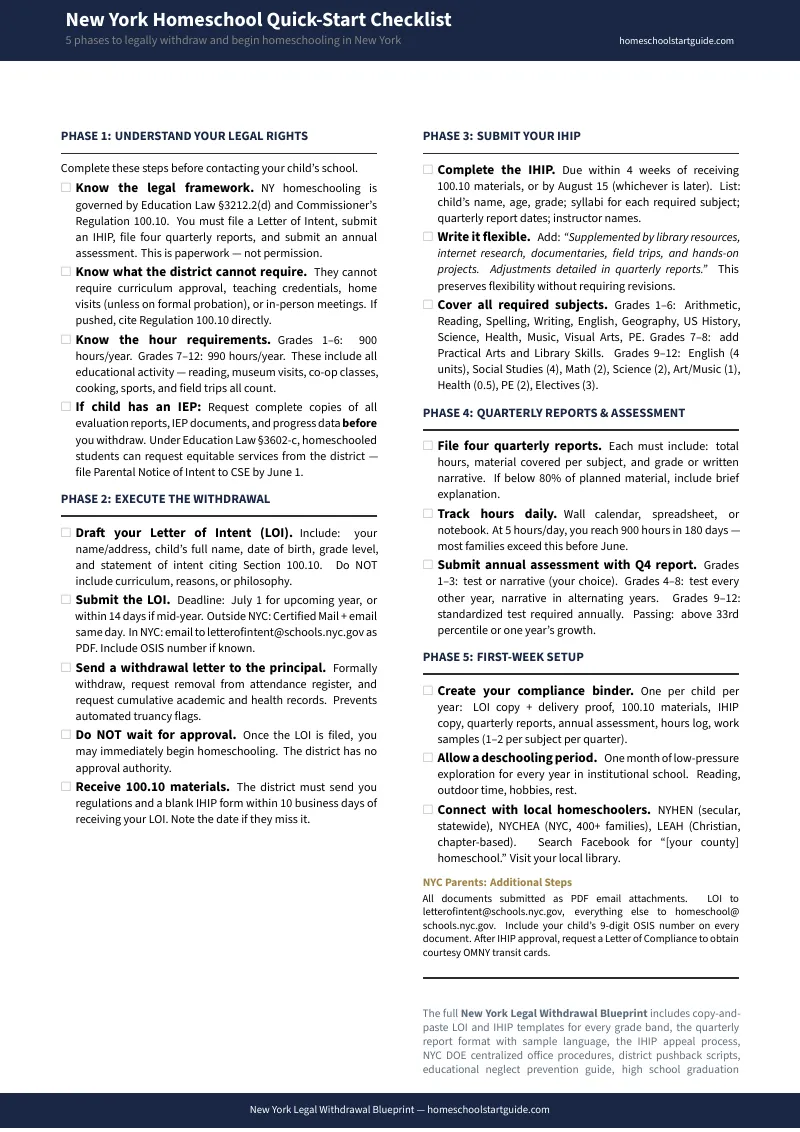
Your download includes the complete Blueprint guide, the New York Homeschool Quick-Start Checklist, and eight standalone printable tools — 10 PDFs total:
- Letter of Intent Templates (loi-templates.pdf) — fill-in-the-blank LOI for standard and mid-year withdrawal, school withdrawal letter to the principal, with delivery instructions for NYC DOE and upstate districts
- IHIP Templates by Grade Band (ihip-templates.pdf) — separate templates for K–6, 7–8, and 9–12 with sample syllabi and the "Vague Subject" Translation Matrix for Practical Arts and Library Skills built in
- Quarterly Report Template (quarterly-report-template.pdf) — sample report structure, hour tracking, subject coverage, and the under-80% explanation language that prevents follow-up inquiries
- Annual Assessment Guide (assessment-guide.pdf) — grade-by-grade decision framework, approved test list, passing thresholds, evaluator selection criteria, and documentation format
- District Pushback Scripts (pushback-scripts.pdf) — seven copy-paste email responses for when the superintendent demands curriculum approval, teaching credentials, or a home visit, plus a CPS/ACS emergency reference card
- NYC DOE Quick Reference (nyc-doe-reference.pdf) — email addresses, OSIS protocol, PDF formatting rules, Letter of Compliance request, and OMNY transit card access
- Quick Reference Card (quick-reference.pdf) — one-page compliance card with key statutes, the full 100.10 timeline, contacts, and an emergency reference card
- Record-Keeping Reference (record-keeping-reference.pdf) — compliance binder setup, portfolio building, and cross-curricular integration tips
30-day money-back guarantee. If the Blueprint doesn't give you the confidence and legal clarity to execute your withdrawal and file every document on time, email us and we'll refund you. No questions asked.
Not ready for the full Blueprint? Download the free New York Homeschool Quick-Start Checklist — a printable action plan covering the LOI deadline, the IHIP subject requirements by grade, the quarterly report schedule, annual assessment options, and a dedicated NYC DOE section. It's enough to understand the full compliance cycle, and it's free.
Your child doesn't have to go back tomorrow. Over 50,000 New York families homeschool legally — the state's paperwork is demanding, but the Blueprint turns Regulation 100.10 from a wall of legalese into a checklist you can actually follow.