The Complete Compliance System for New York Homeschool Documentation
Every New York homeschool parent lives with the same background anxiety: Is my IHIP detailed enough? Will the district accept my quarterly report? Am I logging hours correctly? What happens if I miss a deadline?
Commissioner's Regulation 100.10 gives New York one of the heaviest documentation burdens in the country. You file a Letter of Intent every July. You submit an Individualized Home Instruction Plan by mid-August. You write and submit four Quarterly Reports at evenly spaced intervals. You complete an Annual Assessment — standardized testing or a written narrative — before June 30. Every year. No exceptions.
Miss a deadline, and the district places your program on probation. Word an IHIP poorly, and it gets rejected. Over-share on a quarterly report, and you invite scrutiny you never needed. Get to high school and discover that New York does not issue diplomas to homeschoolers — and suddenly SUNY admissions looks like a wall.
So you download an outdated Word document from a Facebook group. You use the district's proprietary form that asks for far more than the law requires. You hire a consultant at $150 per IHIP because you cannot figure out the formatting. You spend entire weekends writing quarterly reports that could take fifteen minutes with the right template.
The New York Portfolio & Assessment Templates is a Complete Compliance System — not a collection of blank forms, but an integrated documentation workflow that covers every piece of paperwork 100.10 requires. IHIP templates by grade band (1–6, 7–8, 9–12), quarterly report frameworks with district-safe language, annual assessment preparation for both testing and narrative years, and a 22-credit high school transcript builder for SUNY/CUNY admissions. Built for both NYC DOE families and upstate/suburban district filers.
— less than what a consultant charges for a single phone call, and you own the system permanently.
What's Inside
IHIP Construction by Grade Band
- Three Grade-Band IHIP Templates — because the required subjects change at every level and a generic template invites rejections. Separate fill-in-the-blank IHIPs for Grades 1–6 (12 subjects, 900 hours), Grades 7–8 (adds Practical Arts, Library Skills, Career Development — 990 hours), and Grades 9–12 (22-credit framework, 990 hours). Each template uses the broad, district-safe phrasing that gets IHIPs approved on the first submission: "Instruction will include, but is not limited to..."
- Required Subject Master Lists — because the most common IHIP rejection is a missing subject. Complete checklists for each grade band so you never accidentally omit Patriotism and Citizenship (Grades 1–8), Highway Safety (Grades 1–8), or the 0.5-credit Government and Economics requirements (Grades 9–12).
Quarterly Reports That Write Themselves
- District-Safe Report Templates — because the NYC DOE form asks "Was at least 80% of the material planned for this quarter covered? YES/NO" and most parents panic at that question. Templates with pre-written neutral language that satisfies the regulation without over-reporting. Write summaries, not inventories: "Completed units on fractions and measurement" — not a list of every worksheet your child touched.
- Hours Tracking System — because Grades 1–6 need 225 hours per quarter and Grades 7–12 need 247.5, and most parents have no system for tracking this. Weekly logging templates that tally automatically so you are never doing panicked arithmetic the night before a quarterly deadline.
- The Friday 15-Minute Habit — because the families who never stress about quarterly reports are the ones who sort work samples and update their hours log once a week. The guide builds this into your routine so reports assemble themselves over the quarter instead of consuming an entire weekend four times a year.
Annual Assessment Preparation
- Assessment Type Decision Matrix — because the rules change by grade and most free resources get this wrong. Grades 1–3: written narrative only. Grades 4, 6, 8: standardized test required. Grades 5, 7: your choice. Grades 9–12: standardized test every year. A clear visual chart so you know exactly what your child needs this year.
- Written Narrative Templates — because in the years you can use a narrative instead of a test, having a professional template saves you $50–$150 in evaluator fees. Fill-in-the-blank assessment narratives using district-safe language that certifies "adequate academic progress" without inviting critique.
- Standardized Test Logistics Guide — because parents waste weeks figuring out which test to order, where to order it, and what the passing threshold is. The CAT ($25–40, parent-administered) and PASS ($35–50, portfolio-based) are the most popular options. The guide covers ordering timelines, administration rules, and what the 33rd-percentile threshold actually means.
Portfolio Architecture by Grade Level
- Grade-Level Portfolio Frameworks — because a first grader's portfolio looks nothing like a tenth grader's. Separate systems for K–3 (skills emergence, minimal written output), 4–6 (subject deepening, work samples), 7–8 (analytical development, longer-form writing), and 9–12 (transcript-ready documentation with course descriptions). Each framework specifies how many samples per subject per quarter and what "representative work" actually means.
- Non-Traditional Learning Documentation — because the most common question on every NY homeschool forum is "how do I document unschooling for the district?" A translation guide that maps interest-led learning, field trips, museum visits, and project-based work into the state's required subject categories using compliant language.
High School Transcript & College Admissions
- 22-Credit Transcript Builder — because New York homeschoolers do not receive a diploma, and SUNY/CUNY admissions offices need a professional transcript that maps to the state's graduation framework. A fillable template covering all 22 credits: 4 English, 4 Social Studies (incl. Government 0.5, Economics 0.5), 3 Math, 3 Science (with lab documentation), 1 World Language, 1 Art/Music, 0.5 Health, 2 PE, and 3.5 Electives. Includes a GPA calculator and course description templates. Transcript services charge $60–$120; this template lets you produce one in an afternoon.
- SUNY/CUNY Admissions Pathways — because the three routes to public university admission (Superintendent's Letter of Substantial Equivalency, GED/TASC, or 24 college credits) each require different documentation. The guide walks you through each pathway with specific requirements so you start preparing in 10th grade, not scrambling in 12th.
- Dual Enrollment & Regents Exam Guide — because community college dual enrollment provides external academic validation and transferable credits, and sitting for Regents exams gives your transcript the same weight as a public school student's. The guide covers eligibility, documentation requirements, and how to approach districts that resist homeschooler participation.
NYC DOE vs. Upstate Districts
- NYC-Specific Procedures — because the DOE's Office of Homeschooling has its own forms, its own timeline, and its own bureaucratic personality. The guide covers what is different about NYC filings — and what is not — so you use the correct process for your location.
- District Pushback Playbook — because some districts demand daily lesson plans, in-person meetings, or immunization records that 100.10 does not authorize. Scripts and letter templates for responding to overreach politely and effectively, citing the specific regulatory provisions that limit the district's authority.
Who This Is For
The New Homeschooler Overwhelmed by the IHIP
You just filed your Letter of Intent — or you are about to — and now you are staring at a blank IHIP wondering how to describe "curriculum" for 12 subjects when your six-year-old learns through play, nature walks, and library books. The IHIP templates give you fill-in-the-blank frameworks with language broad enough to protect your flexibility and specific enough to get approved on the first submission.
The Parent Dreading the Next Quarterly Report
It is November and the first quarterly is due. You have work samples scattered across the dining table, a half-filled spreadsheet, and no idea whether you have hit 225 hours. The documentation system turns this from a weekend-consuming crisis into a 15-minute task — because you have been logging weekly all quarter.
The Mid-Year Withdrawer in Panic Mode
Something happened at school — bullying, unmet IEP needs, school refusal — and you pulled your child mid-semester. The LOI is due within 14 days, the IHIP within four weeks after that, and you need to prorate the hour requirement and start documenting immediately. The guide walks you through the exact timeline and gives you templates to start using today.
The High School Parent Facing College Applications
Your teenager is approaching 11th grade and you are realizing that New York does not give homeschoolers a diploma. SUNY wants a Superintendent's Letter or a GED. Cornell wants a professional transcript. The Excelsior Scholarship needs documented completion of 22 credits. The transcript builder and admissions pathway guides give you the formats these institutions expect — before the deadline forces you to reconstruct four years from memory.
Why Free Tools Fall Short
NYSED and the NYC DOE provide the raw regulatory text and basic PDF forms. The forms are bureaucratic and intimidating — tiny text boxes, adversarial tone ("If 80% was not covered, provide a written explanation"), and absolutely no guidance on what to write. They provide zero high school transcript templates. You are entirely on your own for the hardest parts.
NYHEN (New York Home Educators Network) offers free IHIP models and legal interpretation, but the website is chronically outdated, the templates are archaic plain-text documents with no modern formatting, and there is no integrated system that connects the IHIP to quarterly reports to assessments.
LEAH (Loving Education At Home) publishes a comprehensive free regulatory manual — genuinely useful. But LEAH is a Christian organization that requires chapter members to sign a statement of faith. Their sample IHIPs feature religious curriculum, and the ideological framing alienates secular, inclusive, and non-Christian families who need the same documentation help.
Etsy templates ($6–$16) solve one piece of the puzzle — usually just the IHIP or just a quarterly report form. You end up purchasing three or four separate products from different sellers, none of which connect to each other, and none of which handle the high school transcript or annual assessment.
Homeschool consultants charge $150 to write a single IHIP and up to $750 for a full-year package. Professional evaluators charge $50–$150 per annual assessment. HSLDA membership runs $130 per year. These are excellent services for families who need them, but if your primary pain point is formatting and language — knowing what to write and how to phrase it — you are paying professional fees for an administrative problem that the right templates solve permanently.
The Complete Compliance System fills these gaps in one place — built around what 100.10 actually requires, organized by the annual cycle you actually follow, and written in the district-safe language that keeps your submissions clean.
After You Have This System
- You will know exactly which documents 100.10 requires — and which common district requests (daily lesson plans, specific curriculum details, in-person meetings) you can politely decline
- You will have a 15-minute weekly habit for logging hours and sorting work samples that keeps you compliant year-round without quarterly panic
- You will submit IHIPs that get approved on the first try — because the templates use the broad, compliant language that district clerks look for
- You will stop dreading the "80% covered" question on quarterly reports — because your IHIP was written broadly enough that the answer is almost always yes
- If you are in a narrative assessment year, you will write the evaluation yourself using professional templates instead of paying $50–$150 for an evaluator
- If your high schooler needs a SUNY/CUNY-ready transcript, you will have a professional-format document with GPA calculator and 22-credit mapping — not a last-minute reconstruction from memory
Instant Digital Download
Your download includes 10 print-ready PDFs:
- The Complete Guide (16 chapters, 70+ pages) — the full documentation system from LOI through college admissions
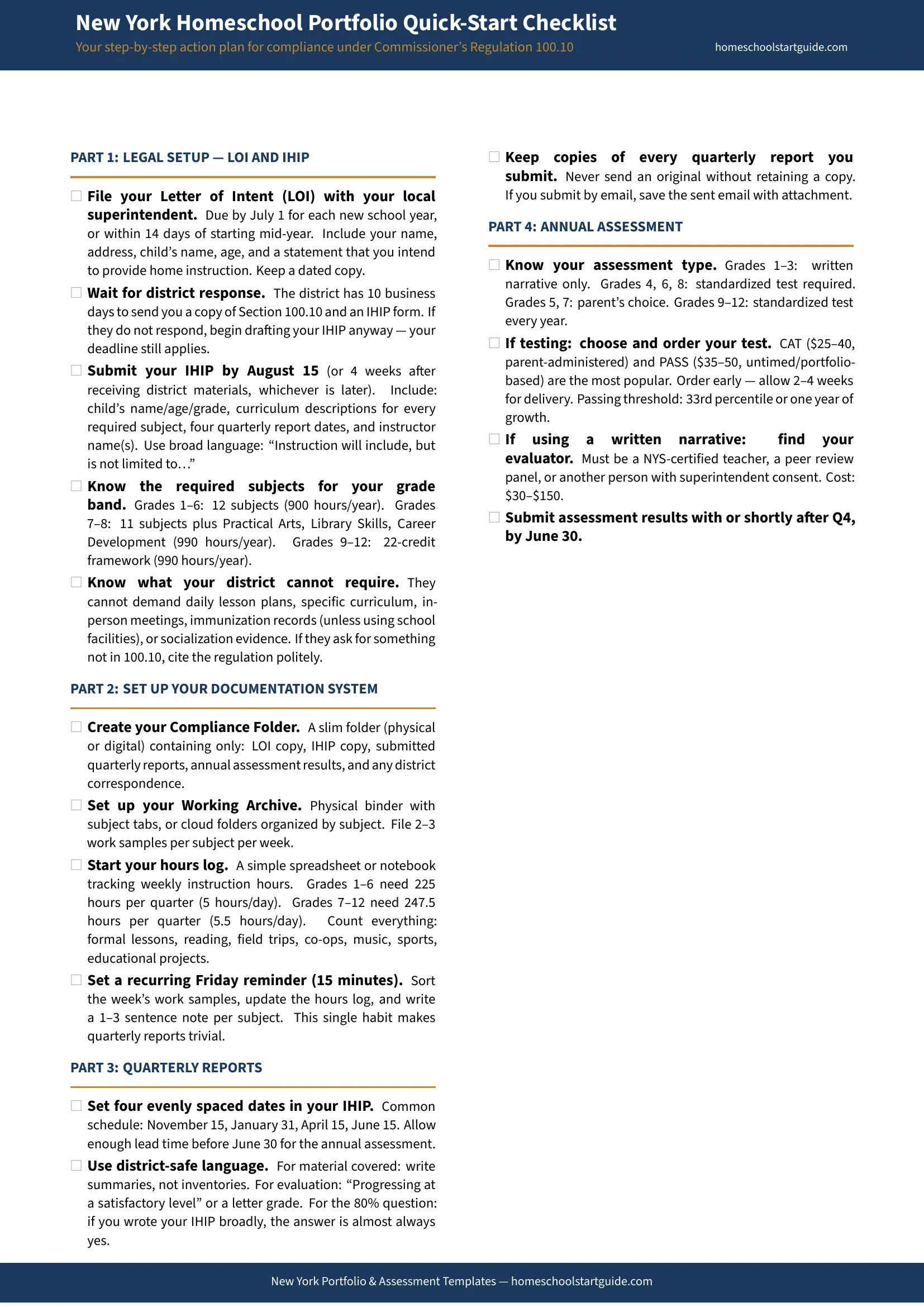
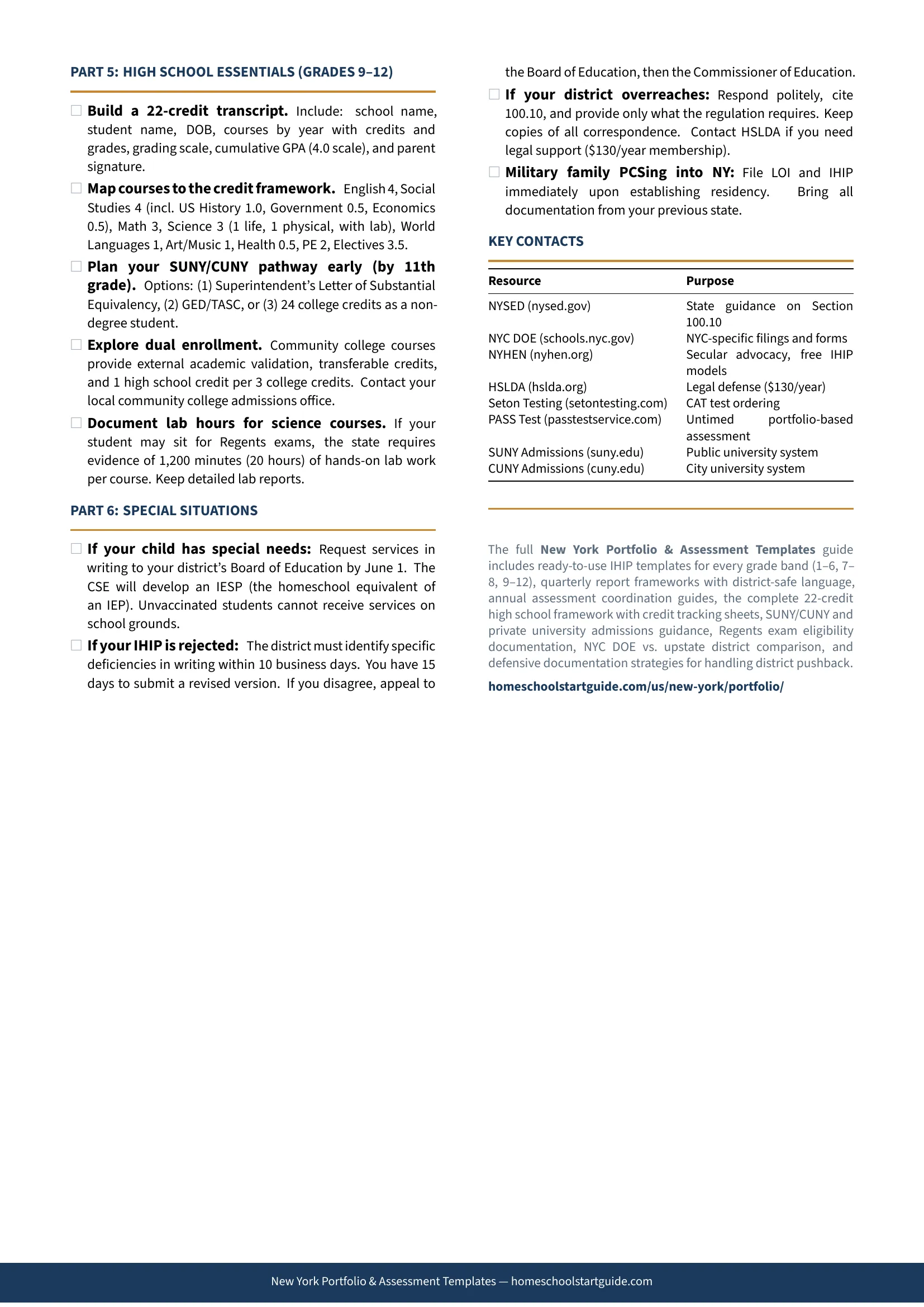
- Quick-Start Checklist — step-by-step compliance roadmap
- IHIP Templates — fill-in-the-blank plans for Grades 1–6, 7–8, and 9–12
- Quarterly Report Template — subject grid, hours section, and 80% coverage statement
- Hours Tracking Log — weekly logging sheet with quarterly totals
- Assessment Decision Matrix — grade-by-grade assessment requirements and approved tests
- Narrative Assessment Template — fill-in evaluation form for narrative years
- 22-Credit Transcript Builder — 4-year transcript with GPA summary and course description template
- District Pushback Letters — response templates for overreach, IHIP rejections, and probation
- Required Subjects Reference — quick reference card with subjects by grade band, hours, and deadlines
Download immediately after purchase. No shipping, no waiting, no account required.