Launch Your New York Micro-School Without Triggering an Unlicensed Private School Classification, a Truancy Audit, or a District Compliance Review.
New York is the hardest state in the country to run a micro-school — and the most rewarding to get right. Every family must file an Individualized Home Instruction Plan (IHIP) with their local school district. Every family must submit quarterly reports. Every student must take a standardized test annually and score above the 33rd percentile. You must teach 12 mandatory subjects including patriotism, highway safety, and fire prevention. And if a hired tutor delivers a "majority of instruction" for your pod, NYSED doesn't consider it homeschooling anymore — it considers you an unlicensed private school, subject to the state's "substantial equivalence" reviews, fire safety mandates, and invasive superintendent oversight.
You want to gather three or four families, share the teaching load, and build something that fits your children — whether you're a Brooklyn parent who just looked at the $68,000 annual tuition at Chapin or Spence, an upstate family in Buffalo or Syracuse who can't find a secular co-op that isn't run through LEAH's Statement of Faith, or a solo homeschooler in Westchester who's burned out after two years of doing everything alone. Whatever the reason, you've arrived at the same conclusion: I need to build this myself.
The problem is that New York's regulatory landscape is a maze of education law, district-level enforcement, and NYSED guidance — and the internet gives you fragments. NYHEN explains the regulations but offers no operational templates for group learning. LEAH has an excellent regulatory manual but requires a Christian Statement of Faith. The NYSED website lists the raw legal code but provides zero guidance on how to apply it in a multi-family setting. Prenda charges $219.90 per student per month. KaiPod's Catalyst program costs $249 upfront plus 10% of your revenue for two years. You need the operational playbook without the institutional overhead and without surrendering your autonomy to a network.
The New York Micro-School & Pod Kit is that playbook — the New York Compliance Framework that translates §3212, §100.10, the "majority of instruction" rule, and district-specific filing protocols into step-by-step action plans with templates you can execute this week.
What's Inside the Kit
The Two-Pathway Legal Framework
New York doesn't have a "micro-school" category. Your pod operates under one of two legal frameworks: home instruction under Commissioner's Regulations §100.10 (each family files independently with their district, maintains their own IHIP, and submits their own quarterly reports) or registered nonpublic school through NYSED (far more burdensome, requiring state registration, fire safety certification, and exposure to "substantial equivalence" reviews). This section walks you through both options with a plain-English decision tree — and explains why almost every small pod should operate under home instruction, not private school registration, to maintain maximum autonomy and minimum district oversight.
The "Majority of Instruction" Compliance Guide
This is the section no other micro-school resource covers — because no other resource is New York-specific. When multiple families pool resources to hire a tutor who delivers more than 50% of the instructional program, NYSED considers it an unlicensed nonpublic school, not home instruction. That classification triggers substantial equivalence reviews, fire safety mandates, and direct superintendent control. This chapter explains the threshold, provides three structuring models (part-time co-op, full-time pod with rotating parents, hybrid model) that keep your pod safely under the line, and gives you the documentation strategy to prove compliance if the district ever asks.
The Complete IHIP and Quarterly Reporting System
Every family in your pod must file a Notice of Intent, an Individualized Home Instruction Plan, four quarterly reports, and an annual assessment — on schedule, every year. This section provides the complete annual timeline from the July 1 Notice of Intent through the June 30 annual assessment, with fillable templates for each document. It covers the 12-subject breakdown across grade bands, the district response process (including what to do when a district rejects your IHIP), and the critical difference between NYC Central Office of Homeschooling protocols and upstate district superintendent procedures.
NYC vs. Upstate District Interaction Guides
New York City families file through the Central Office of Homeschooling in Long Island City — a centralized bureaucracy that processes thousands of IHIPs using standardized procedures. Upstate and suburban families deal directly with their local superintendent, whose approach varies wildly from district to district. This chapter covers both systems: the NYC DOE's specific form requirements and timeline expectations, and the strategies for handling upstate districts that overreach by demanding home visits, curriculum approval, or in-person interviews — none of which are required under §100.10.
Family Agreements, Liability Waivers, and Facilitator Contracts
Customizable templates covering schedule, cost-sharing, curriculum authority, health and illness policies, behavioral expectations, dispute resolution (mediation before litigation), and withdrawal terms. Plus a separate facilitator contract template for pods that hire a part-time teacher — with employee classification guidance (W-2 vs. 1099 under New York labor law) and regional pay benchmarks ($25–$45/hour upstate, $35–$60/hour in NYC metro). Written without religious language or ideological prerequisites. These are the documents that prevent the most common reason pods collapse — undefined expectations between adults.
Budget Planning for New York's High-Cost Environment
Real New York benchmarks across three regional tiers: NYC metro ($15,000–$22,000/student/year for a full-time pod), suburban ($10,000–$16,000), and upstate ($6,000–$12,000). Covers space rental (apartments, community centers, churches), insurance, curriculum, facilitator compensation, and enrichment costs. Plus cost-sharing formulas for equal-split, per-child, and sliding-scale models — with worked examples showing how a 6-student pod in Brooklyn splits $72,000–$96,000 in annual expenses to achieve a 6:1 student-teacher ratio at roughly $12,000–$16,000 per family — a fraction of Manhattan private school tuition.
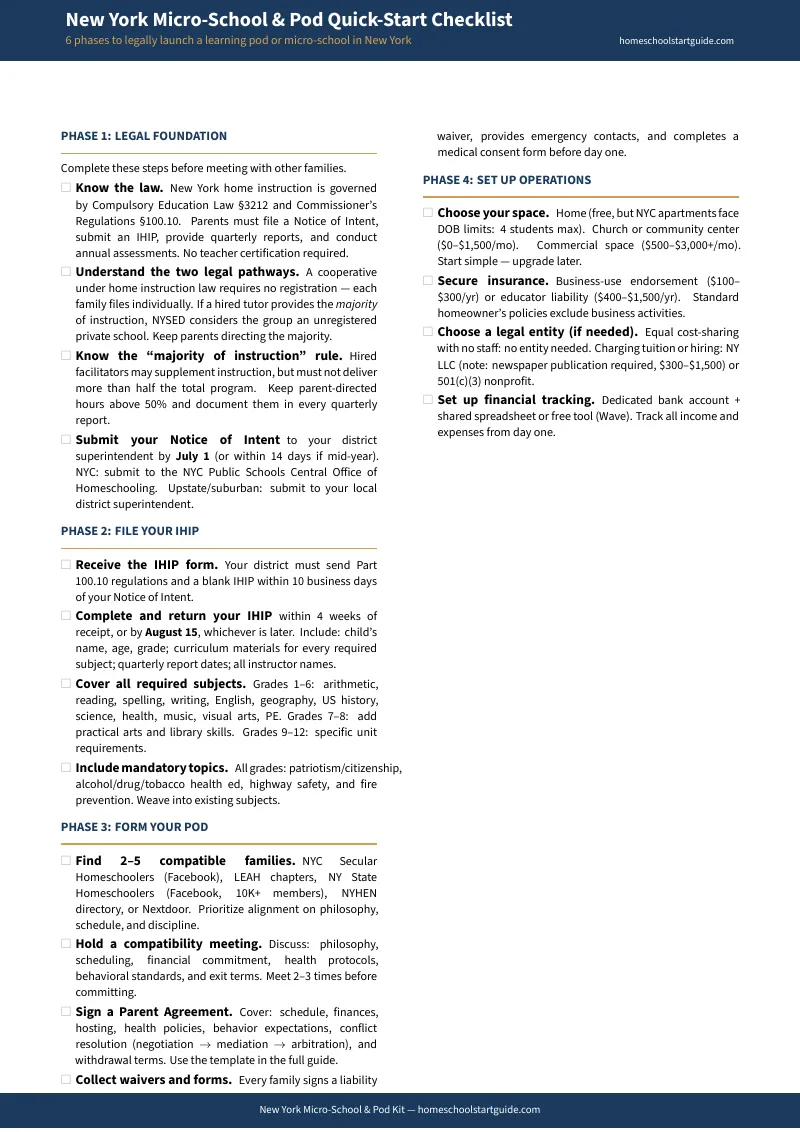
The New York Micro-School Quick-Start Checklist
A single-page, print-and-pin sequencing document that walks you from "I have an idea" to "the first day of pod school" — covering legal foundation, pod formation, business and legal setup, facility and safety, curriculum and schedule, and launch week in the correct order. Most parents spend forty or more hours assembling this sequence from NYSED pages, NYHEN articles, LEAH manuals, and Facebook groups. This checklist condenses it to a single reference.
Who This Kit Is For
- Parents who want to form a small learning community of 3–8 students with two to four families — sharing the teaching load, splitting costs, and building something intentional rather than defaulting to institutions that don't fit
- NYC families priced out of elite private schools who want a high-quality 6:1 student-teacher ratio at a fraction of the $60,000–$69,000 annual tuition that Trinity, Chapin, Spence, Brearley, and Riverdale charge
- Solo homeschoolers in Westchester, Long Island, or the Hudson Valley who are burned out after years of doing everything alone and crave structured community and shared responsibility
- Upstate families in Buffalo, Syracuse, Albany, or Rochester who want a secular, inclusive co-op framework outside LEAH's Christian affiliation requirements
- Parents of neurodivergent children (autism, ADHD, dyslexia, gifted) who are exhausted by IEP advocacy and want a calmer, self-paced environment designed around their child's actual needs
- High school families building a micro-school with transcript creation, CUNY/SUNY dual enrollment, Regents exam preparation, and college-prep pathways including the Superintendent's Letter of Substantial Equivalence
- Multilingual families in NYC building Mandarin-English, Spanish-English, or other dual-immersion pods — leveraging New York's diversity in a small-group setting
- Former educators leaving the public system who want to serve their community by running a small pod or micro-school — without the overhead and control of a franchise network
Why Not Just Use the Free Resources?
NYHEN explains the regulations. LEAH has templates. NYSED publishes the law. Here is exactly what you run into when you try to build a multi-family pod from those sources alone:
- NYSED is a legal code dump, not an operational guide. Section 100.10 lists the requirements for home instruction — Notice of Intent, IHIP, quarterly reports, annual assessment — but provides zero templates, no timeline coordination for group settings, and no guidance on the "majority of instruction" threshold that determines whether your pod is legal homeschooling or an unlicensed private school. The state requires compliance but abandons you on implementation.
- NYHEN is an advocacy archive, not a pod-building toolkit. Their legal breakdowns are accurate and their support group directory is useful, but NYHEN is designed for individual homeschooling families. They don't offer family agreements, cost-sharing frameworks, facilitator contracts, or liability waiver templates — all of which are essential when multiple families share space, money, and children.
- LEAH requires a Christian Statement of Faith. LEAH's regulatory manual is genuinely excellent — but every chapter leader must sign a Statement of Faith, and all participating co-op teachers must pledge not to teach anything contrary to specific Biblical interpretations. For secular, diverse, or non-denominational families — the majority of families searching in NYC, Westchester, and the Capital District — LEAH is structurally inaccessible.
- Etsy IHIP templates cover one family, not a pod. A $7 IHIP prep pack helps you fill out paperwork for your own child. It provides zero guidance on how multiple families coordinate their IHIPs for a group setting, how to structure facilitator hours to stay under the majority-of-instruction threshold, or how to handle the legal, financial, and liability frameworks a multi-family pod requires.
- Franchise networks withhold the operational details deliberately. Prenda and KaiPod webinars are top-of-funnel marketing. The granular how — the legal structuring, majority-of-instruction compliance, budget templates, district interaction strategy — is the product they sell for thousands per year plus a perpetual share of your revenue.
Free resources give you the legal baseline and the inspiration. The Kit gives you the templates, checklists, and compliance frameworks to execute this week.
— Less Than One Session with a New York Education Attorney
A single consultation with a New York education attorney costs $300–$500 per hour. Private educational consultants in the NYC metro charge $150–$500 per session, with comprehensive packages easily exceeding $5,000. Prenda charges $219.90 per student per month in platform fees. KaiPod's Catalyst program costs $249 upfront plus 10% of your revenue for two full years. The Kit costs less than a single attorney consultation and gives you the §100.10 compliance framework, IHIP filing system, majority-of-instruction structuring guide, family agreements, and liability waivers those alternatives are designed to sell piecemeal.
Your download includes the complete 25-chapter guide, the Quick-Start Checklist, and standalone printable templates — the Family Agreement, Liability Waiver, Facilitator Contract, and Withdrawal Letter. Instant download, no account required.
30-day money-back guarantee. If the Kit doesn't give you the legal clarity and operational confidence to move forward with your pod, email us and we'll refund you. No questions asked.
Not ready for the full Kit? Download the free New York Homeschool Quick-Start Checklist — a one-page summary of the two legal pathways, IHIP filing requirements, the majority-of-instruction threshold, and the key New York-specific regulations that affect your pod from day one. It's enough to understand your rights tonight.
New York doesn't require teacher credentials for home instruction. The law allows you to educate your children your way. The Kit makes sure you do it correctly — and that your pod stays on the right side of the line.