The Community School Blueprint: Start Your New Mexico Micro-School Legally, Keep Full Control of Your Curriculum, and Build the Bilingual, Inclusive Pod Your Family Deserves.
New Mexico consistently ranks near the bottom of national education metrics. The Yazzie/Martinez ruling found the state systematically failed Native American students, English language learners, and low-income families. Years later, implementation remains uneven. Fourth-grade reading proficiency hovers around 21 percent. Class sizes in Albuquerque climb past thirty. Schools in Las Cruces lack adequate counselors. And the dominant homeschool infrastructure — CAPE-NM — requires adherence to a Statement of Faith that locks out secular, progressive, and culturally diverse families.
Meanwhile, the corporate micro-school networks want your money and your autonomy. Prenda charges $2,199 per student per year in platform fees and forces guides into their proprietary screen-heavy curriculum. KaiPod runs $8,000 to $15,000 per student annually. Both models turn educational founders into franchise operators — you teach their way, on their platform, while they collect the bulk of the revenue.
But New Mexico's regulatory framework gives parents far more freedom than most realize. The state offers two clear legal pathways for micro-schools: the Homeschool Cooperative route (each family files a Notice of Intent with NMPED, no curriculum approval, no mandatory testing, no teacher certification required) and the Private School route (no state registration or approval required under NMSA §22-2-2, but you form a business entity and handle centralized administration). Neither pathway requires you to pay a franchise, surrender your curriculum choices, or subject your children to standardized testing.
The problem is not the legal framework. The problem is the gap between knowing you are legally allowed to educate your children and knowing how to safely manage a multi-family operation — the liability waivers, the zoning defense, the facilitator employment classification, the financial agreements, and the cultural curriculum integration that no state website, Etsy template, or Facebook group can give you accurately.
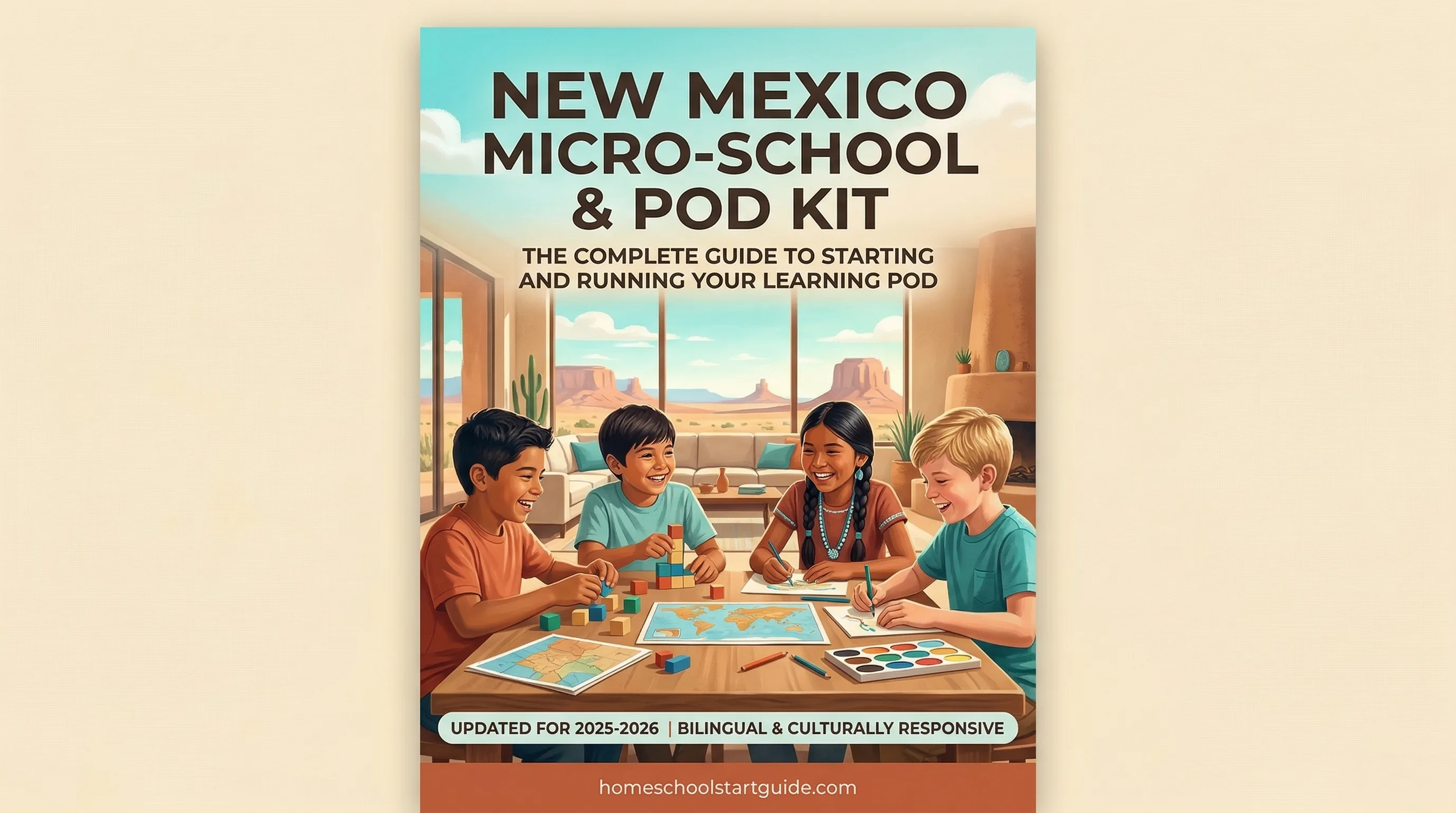
The New Mexico Micro-School & Pod Kit gives you the Community School Blueprint — the complete legal, operational, and cultural framework to launch and run an independent micro-school in New Mexico, from NMPED filing through your first year of operation.
What's Inside the Kit
The Two Legal Pathways Primer
New Mexico does not have a separate legal category for micro-schools. Your pod operates under one of two existing frameworks, and choosing the wrong one creates obligations you did not need. The Homeschool Cooperative pathway gives maximum autonomy — each family files independently, the group co-learns, no state testing, no curriculum approval. The Private School pathway gives you the ability to charge tuition, accept 529 withdrawals, issue transcripts, and apply for grants — but requires a business entity and centralized administration. This section breaks down both pathways in plain English, explains which one fits your situation, and walks you through the filing mechanics for each.
NMPED Filing and Compliance
Each family on the Homeschool Cooperative pathway files a Notice of Intent through the NMPED online portal within 30 days of establishing the home school. The instructing parent must hold a high school diploma or equivalent. Instruction covers five core subjects (reading, language arts, mathematics, social studies, science) for 180 days or 1,140 hours annually. Renewal deadline: August 1 each year. The Private School pathway has no state registration requirement — but you need an LLC ($50 filing fee) or nonprofit ($25 filing fee + IRS Form 1023-EZ). This section walks you through the exact portal steps, common filing mistakes, and what to say if your current school pushes back on your withdrawal.
Funding Without an ESA
New Mexico has no Education Savings Account program. But families have more funding options than they realize. 529 plan withdrawals cover up to $10,000 per year in K–12 private school tuition — and New Mexico offers a state income tax deduction for 529 contributions. VELA Education Fund microgrants of $2,500 to $10,000 explicitly support micro-schools serving underrepresented communities, multilingual families, and rural areas. HB 177 provides a homeschool curriculum materials income tax credit. The Daniels Fund supports education innovation in New Mexico. This section gives you the complete funding landscape and application guidance.
Family Agreements and Conflict Prevention
The number one reason learning pods collapse is not legal trouble — it is undefined expectations between adults. Someone's child is disruptive. A family stops paying on time. Two parents disagree on whether instruction should be bilingual or English-only. The customizable Family Agreement template covers every friction point before it surfaces: financial obligations, curriculum authority, discipline approach, health and vaccination policies, dispute resolution via mediation, and withdrawal terms with required notice. Every participating family signs before the first day.
Municipal Zoning Defense
Bringing multiple families' children into your home triggers zoning questions that Facebook groups cannot answer safely. Albuquerque's Integrated Development Ordinance treats home-based education as a home occupation with restrictions on signage and traffic. Santa Fe is stricter in historic districts. Rio Rancho restricts non-family employees in some zones. Las Cruces has its own framework. SB 96 (2026) protects licensed child care from restrictive zoning, but micro-schools serving school-age children may not qualify. This section tells you exactly what to check, who to call, and what question to ask your city planning department — with specific guidance for each major NM municipality.
Insurance and Liability Protection
Standard homeowner's insurance does not cover injuries to non-family students learning in your home. You need Commercial General Liability ($1,000,000 per occurrence minimum, $400–$1,200 per year from providers like Markel or Philadelphia Insurance). The liability waiver template in the Kit includes the specific language required for enforceability under New Mexico law — generic Etsy waivers typically omit this. This section covers CGL, field trip liability, safety essentials for your space, and emergency procedures.
Facilitator Hiring and Background Checks
New Mexico does not require teacher certification for micro-school facilitators. But NMPED's IdentoGO fingerprint-based background check system (Service Code 2BH23R, $59 fee) is the gold standard, and family expectations demand thorough screening for any adult with unsupervised access to children. If you control the facilitator's schedule, location, and methods, they are a W-2 employee — not a 1099 contractor. Misclassification carries IRS penalties. This section covers the background check process, W-2 versus 1099 classification, payroll setup, and realistic compensation benchmarks.
Bilingual and Culturally Responsive Curriculum
New Mexico's cultural diversity — 63% Hispanic/Latino, 11–13% Native American — is not a footnote; it is the core reason many families build micro-schools. This section covers bilingual curriculum selection (Flip Flop Spanish, Llamitas Spanish for elementary; AP/IB for high school), the NM State Seal of Bilingualism-Biliteracy that micro-school students can earn, culturally responsive materials integrating Native American heritage and New Mexico history, and how to structure dual-language instruction in a multi-age setting.
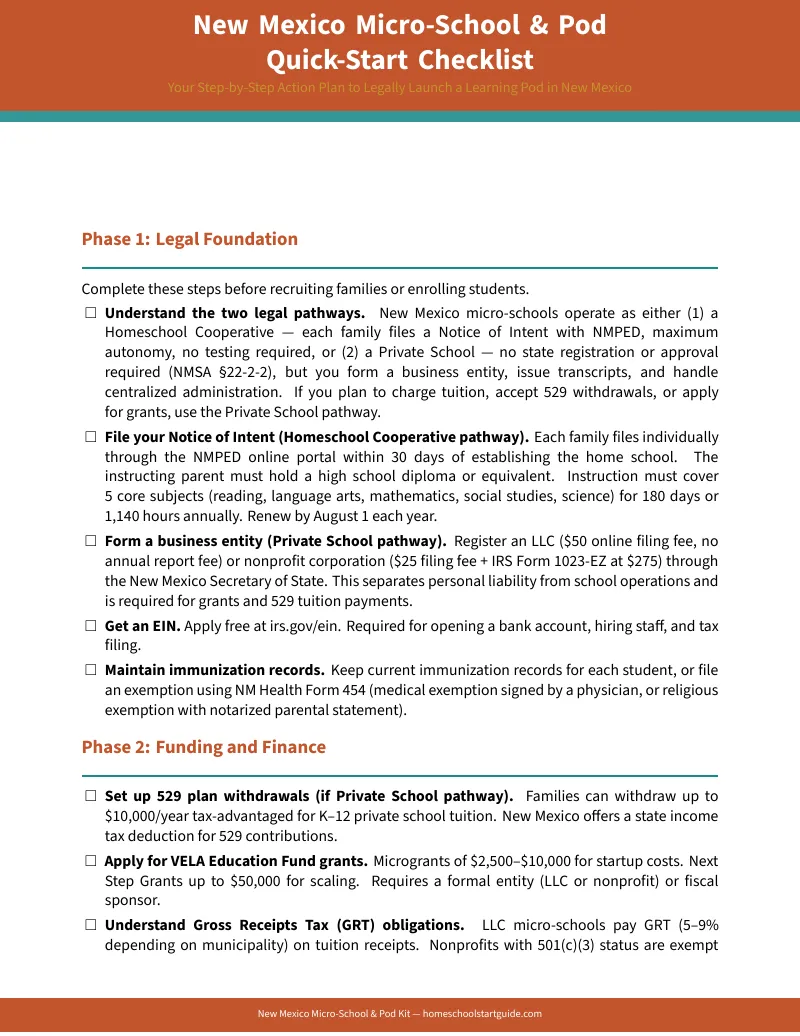
The Quick-Start Checklist
A single-page, print-and-pin document covering seven phases: legal foundation (pathway selection, NMPED filing, business formation), funding (529s, grants, GRT), pod formation (compatibility meetings, Family Agreement, waivers), operations (space, zoning, insurance), curriculum and scheduling, staffing, and launch week. Most parents spend forty or more hours assembling this sequence from NMPED pages, CAPE-NM resources, Facebook groups, and policy documents. This checklist condenses it to one reference you can work through in an afternoon.
Who This Kit Is For
- Parents in Albuquerque, Santa Fe, Rio Rancho, or Las Cruces who are dissatisfied with public school quality and want to build a small, intentional learning community — without surrendering control to a franchise network or submitting to ideological gatekeeping
- Secular, progressive, or interfaith families who have been excluded from CAPE-NM-affiliated co-ops that require a Statement of Faith — and who need a legally sound framework for an inclusive pod
- Hispanic, Latino, and Native American families who want bilingual or culturally responsive education that centers their children's language, history, and cultural identity — something large public school systems consistently fail to deliver
- Military families at Kirtland AFB, Holloman AFB, Cannon AFB, or White Sands who need flexible, PCS-proof educational continuity that transfers across state lines
- Parents of gifted, twice-exceptional, or neurodivergent children who need personalized pacing, sensory-aware environments, and instruction approaches that overwhelmed public schools cannot accommodate
- Former teachers who left the NM public school system and want to serve their community by running a small, autonomous learning environment — without the overhead and curricular control of Prenda or KaiPod
- Parents on or near tribal lands who want to build a micro-school that integrates indigenous knowledge, language revitalization, and community resources — and who need guidance on navigating the intersection of state law and tribal jurisdiction
Why Not Just Use the Free Resources?
- CAPE-NM is explicitly fundamentalist. Their mission is tied to Biblical principles, and their leadership requires adherence to a Statement of Faith. If you are secular, progressive, interfaith, or building a culturally diverse pod, the state's most powerful homeschool network is not built for you. Their resources are extensive — for families who share their worldview. For everyone else, there is a massive gap between what you need and what they provide.
- NMPED gives you the raw statutes but not the execution. You learn that you file a Notice of Intent within 30 days and cover five subjects for 180 days. You do not learn how to structure a cooperative where multiple families file independently while learning together, how to track 1,140 instructional hours across five families, or what happens when the city code enforcer asks about the cars parked outside your house every morning. The state tells you what to submit. It does not tell you how to build a school around it.
- Facebook groups give you dangerous legal advice for free. Someone in an Albuquerque homeschool group tells you zoning does not matter for a small pod. Someone else says you do not need insurance because it is just a co-op. A third person recommends paying your facilitator as a 1099 contractor to avoid payroll taxes. Any one of these recommendations could result in a municipal violation, an uninsured liability claim, or IRS penalties. Well-meaning advice from strangers is not a substitute for a professionally structured framework.
- Generic Etsy templates do not know New Mexico law. A $12 "Pod Agreement" from Etsy does not address the Homeschool Cooperative versus Private School pathway distinction, NMPED Notice of Intent requirements, the 180-day / 1,140-hour instruction mandate, Albuquerque IDO zoning rules, or the specific liability language required for enforceability under New Mexico law. It is a document that looks professional and protects nothing.
- Corporate franchise webinars withhold the operational details on purpose. Prenda and KaiPod will inspire you with statistics about the micro-school movement. The granular how — the NMPED filing mechanics, the facilitator employment classification, the insurance and zoning frameworks — is the product they sell for thousands of dollars per student per year. Their free content is designed to make you feel informed while keeping you dependent enough to sign up.
Free resources tell you what the state demands. The Community School Blueprint tells you how to actually manage the families, the money, the zoning, and the cultural considerations without losing your mind.
— Less Than One Student's Month on a Franchise Platform
Prenda charges $2,199 per student per year in platform fees. KaiPod runs $8,000 to $15,000 per student annually. A single consultation with an education attorney about your pod's legal standing costs $200–$400 for one hour. The Kit costs less than a single month of a franchise subscription — and gives you the operational independence those platforms are designed to prevent.
Your download includes the complete guide (25 chapters covering both legal pathways, NMPED filing, funding strategies, family agreements, facilitator hiring, cost-sharing, municipal zoning defense for Albuquerque, Santa Fe, Las Cruces, and Rio Rancho, insurance, bilingual and culturally responsive curriculum, dual enrollment, the Legislative Lottery Scholarship, neurodivergent learners, tribal land considerations, military family strategies, scaling from pod to academy, and templates), the New Mexico Homeschool Quick-Start Checklist, plus six standalone printable templates: Family Agreement, Facilitator Agreement, Budget Planner, NMPED Filing Checklist, Emergency Contact and Medical Authorization Form, and Weekly Hour Tracking Log. Instant download, no account required.
30-day money-back guarantee. If the Kit does not give you the legal clarity and operational confidence to move forward with your micro-school, email us and we will refund you. No questions asked.
Not ready for the full Kit? Download the free New Mexico Homeschool Quick-Start Checklist — a single-page summary of the two legal pathways, NMPED filing basics, and the seven-phase launch sequence. It is enough to understand your legal rights tonight.
New Mexico's families deserve better than what the system is delivering. The Community School Blueprint makes sure you build the alternative correctly.