The Pod Compliance Blueprint: Start Your New Jersey Micro-School Legally, Dodge the DCF Threshold, and Keep 100% of Your Tuition.
New Jersey doesn't require registration, notification, or testing for homeschooling — N.J.S.A. 18A:38-25 only asks for "equivalent instruction." That's the most deregulated framework on the East Coast. But the moment you gather other people's children into a regular group, entirely different rules apply. Cross six students or operate on a set schedule, and the Department of Children and Families can reclassify your living room as an unlicensed childcare facility. Your district — already known for aggressive overreach — can send letters demanding curriculum reviews they have no legal authority to conduct. Your homeowner's insurance will deny any claim the moment they discover you've been running what they consider a home-based business.
You want to pull together a handful of families in Bergen County, or Central Jersey, or the South Jersey suburbs, and build something intentional for your children. Maybe the $19,000 average private school bill is out of reach — especially with two or three kids. Maybe you've been homeschooling solo and the isolation is crushing you. Maybe your child is neurodivergent and the IEP battles have worn you out. Maybe every quality co-op in your area requires a statement of faith, and you just need a secular, academically rigorous option. Whatever brought you here, you've arrived at the same conclusion: I need to build this myself.
The problem is that the internet gives you fragments. The NJHA website reads like a defensive legal manual from 2005. The NJDOE publishes the raw statute but doesn't explain what happens when six families show up at the same house every Tuesday. ENOCH has great community infrastructure — if you're willing to sign a statement of faith. Facebook groups are 40% useful advice and 60% mom-drama, political arguments, and confidently wrong legal opinions. Prenda charges $2,200 per student per year in platform fees before your educator is even paid. KaiPod takes a 10% revenue share for two years if you use their Catalyst program. You need the operational sequence without the ideological prerequisites and without surrendering your tuition to a franchise network.
The New Jersey Micro-School & Pod Kit gives you the Pod Compliance Blueprint — the exact sequence from understanding your legal rights under 18A:38-25 to enrolling your first student, with the templates and checklists to execute each step correctly under New Jersey law.
What's Inside the Kit
The Six-Student DCF Threshold Matrix
This is the compliance trap that nobody warns you about. New Jersey's homeschool law is deregulated — but the Department of Children and Families regulates childcare facilities, and a pod that exceeds six children or operates on a regular schedule can be reclassified as one. The matrix maps exactly how to structure your pod's enrollment, hours, and family rotation to stay below the DCF licensing trigger. It also explains when registering as a nonpublic (private) school under N.J.A.C. 6A:11 is actually the smarter path — and walks you through the filing process if you choose it.
The District Overreach Defense Kit
New Jersey districts are notorious for overstepping their legal authority with homeschooling families. Superintendents send letters demanding curriculum samples. Attendance clerks insist on exit interviews. School boards claim they need to "approve" your homeschool plan. None of this is required by law — State v. Massa (1967) established that "equivalent instruction" is the only standard, and school boards are neither authorized nor required to review or approve your curriculum. The Defense Kit includes pre-written response letters for every common overreach scenario, the exact statutory citations to shut down unlawful demands, and escalation protocols if a district refuses to back down.
The Parent Agreement and Liability Protection Templates
Liability paranoia kills more pods than curriculum disagreements. Someone asks "what happens if a kid gets hurt in my house?" and the planning meeting dies. This section provides customizable parent agreements covering cost-sharing, scheduling, curriculum authority, attendance, behavior expectations, media/photo consent, and conflict resolution — plus enforceable liability waivers and assumption-of-risk documents built for New Jersey law. Not downloaded from a generic template marketplace. Not written for Florida or Texas. Built for your state.
The VELA Grant Application Playbook
Most NJ pod founders assume tuition is their only funding source. They're unaware that the VELA Education Fund has distributed over $24 million in micro-grants — $2,500 to $10,000 per award — specifically to parents starting learning pods and micro-schools. This playbook explains who qualifies, how to structure your mission statement and budget to optimize approval, and the application timeline. The guide could pay for itself 100 times over with a single successful application.
The NJ Cost-Sharing and Budget Framework
New Jersey's cost of living changes everything about pod economics. Facilitator pay in NJ runs $25–$45/hour (not the $15–$20 you'll find in national guides). Venue rental for a church basement or community center in Bergen County costs $500–$1,500/month. Even liability insurance premiums are higher. This section provides NJ-calibrated budget templates covering every line item — facilitator compensation, space, curriculum materials, insurance, background checks, technology — with cost-sharing formulas for three to eight families. It also includes the comparison math: what your pod costs per student versus the $19,000 average private school tuition versus the $6,000+ annual cost of Prenda's Direct Pay model.
The Secular Community Charter Templates
If every co-op in your area requires a statement of faith, you already know the problem. These are customizable governance documents — bylaws, shared values statements, and group operating guidelines — written from scratch without religious language, political affiliations, or ideological gatekeeping. They establish clear expectations around curriculum philosophy, decision-making processes, financial transparency, and community conduct before the first family meeting.
The New Jersey Homeschool Quick-Start Checklist
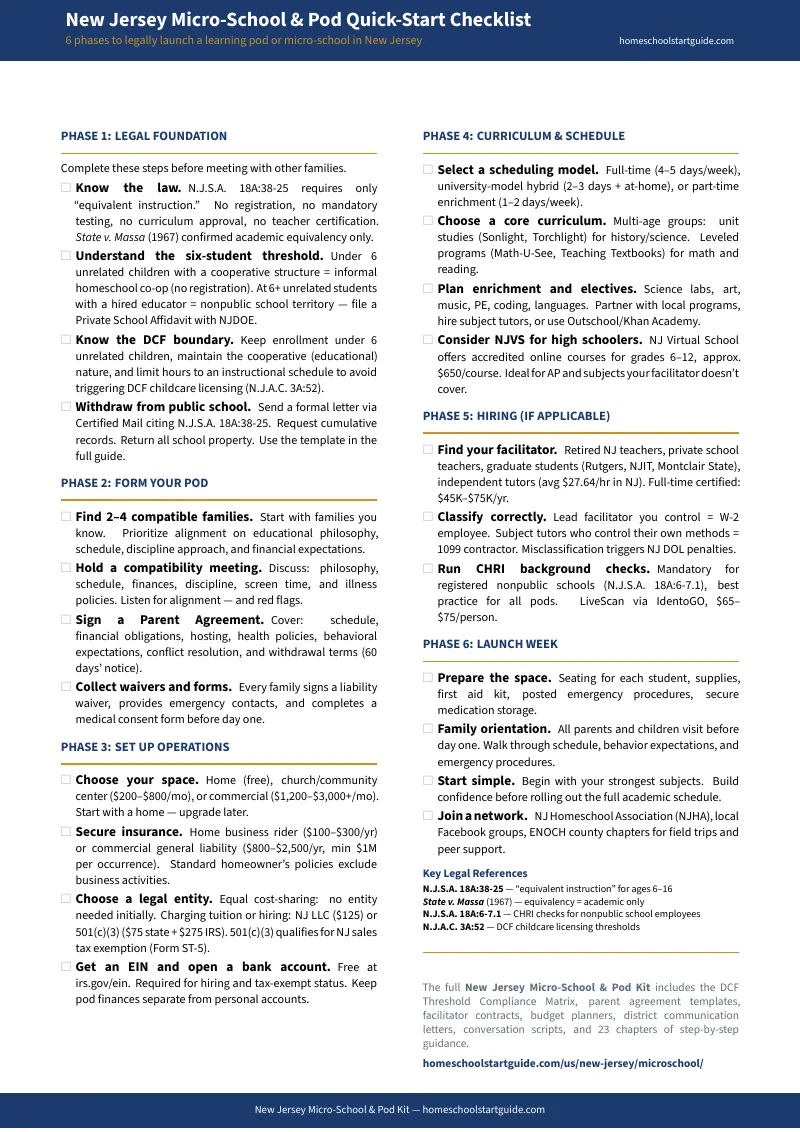
A single-page, print-and-pin reference covering the legal rights under N.J.S.A. 18A:38-25, the things a school district cannot legally demand from you, the DCF threshold to monitor, the CHRI background check requirement for hired educators, and the key operational steps from first planning meeting to first day of pod school.
Who This Kit Is For
- Parents who've decided the public school system isn't working for their child — whether because of curriculum concerns, class sizes, standardized testing mandates, or the district's refusal to accommodate their child's needs — and want to build a small, intentional alternative with a handful of like-minded families in their NJ community
- Parents facing private school sticker shock — NJ averages $19,000/year, elite schools exceed $33,000 — who need a high-quality alternative at a fraction of the cost by pooling resources with other families
- Parents of neurodivergent children (autism, ADHD, dyslexia) who are exhausted by IEP advocacy, want a calmer learning environment, and need to understand how Chapter 192 and Chapter 193 services remain accessible even after withdrawal from public school
- Solo homeschoolers who are burned out from carrying the entire educational load alone and want to share facilitation with two to five other families without losing control of their child's education
- Secular or progressive parents who've been excluded from established co-ops that require statements of faith and need a legally sound charter for an inclusive, academically focused pod
- Former educators who've left the NJ public school system and want to serve their community by running a small micro-school — without the overhead, revenue share, and curricular control of a franchise network like Prenda or KaiPod
After Using the Kit, You'll Be Able To
- Explain exactly what N.J.S.A. 18A:38-25 does and does not require — and hand any district official a response letter that legally terminates their involvement in your homeschool or micro-school
- Structure your pod's enrollment, schedule, and family rotation to stay below the DCF childcare licensing threshold — or register as a nonpublic school if your group grows beyond it
- Run your first parent intake meeting with a signed participation agreement, liability waiver, and cost-sharing plan that protects every family in the pod — without spending money on an attorney
- Build a realistic NJ-calibrated budget that accounts for the actual cost of facilitators, space, insurance, and materials in this state — not generic national estimates that undercount by 40%
- Apply for a VELA Education Fund micro-grant of $2,500 to $10,000 using a structured proposal framework designed for pod founders
- Hire a facilitator or educator with confidence — including the CHRI background check process, the W-2 vs. 1099 classification decision, and NJ-specific pay benchmarks
- Facilitate a mixed-age pod of four to twelve children across multiple grade levels using scheduling frameworks built for sustainable facilitation, not a replicated school-day format
Why Not Just Use the Free Resources?
The NJHA has a Quick Start Guide. The NJDOE publishes the compulsory education statute. ENOCH runs annual conventions. Facebook groups exist. Here is exactly what you run into when you try to build a micro-school from those sources alone:
- The NJHA focuses on solo homeschooling defense, not school founding. Their resources are designed for individual families navigating truancy officers and asserting their rights under 18A:38-25. If you're launching a multi-family pod that needs liability waivers, a DCF compliance strategy, a facilitator contract, and a cost-sharing framework, the NJHA doesn't cover any of that. It's not their mission. You'll spend hours reading content designed for a completely different path.
- The NJDOE gives you the raw statute but not the operational map. You learn that "equivalent instruction" is the legal standard and that no registration is required. You don't learn what happens when your five-family pod crosses the DCF threshold, how to handle the district letter demanding your curriculum, or how to structure the parent agreement so a liability claim doesn't bankrupt the host family. The NJDOE tells you what the law says. It does not tell you how to build an operational school around it.
- ENOCH has the community infrastructure — if you sign the statement of faith. It's a Christian ministry. Their conventions, county networks, and sample withdrawal letters are excellent — for families who share that mission. If you're secular, progressive, or non-denominational, the organizational landscape in New Jersey simply doesn't serve you. You're left assembling your own community charter from scratch, with no templates designed for inclusive governance.
- Facebook groups are unreliable and socially exhausting. Veteran NJ homeschoolers openly warn that regional forums are rife with "mom-dramas, political divisions, and strong opinions." You'll find conflicting legal advice, religiously motivated curriculum recommendations, and heated arguments about testing requirements that don't actually exist in NJ law. Extracting accurate, actionable guidance requires dozens of hours of filtering — and even then, you're relying on anonymous strangers, not verified legal frameworks.
- The franchise networks withhold the operational details on purpose. Prenda's blog posts and KaiPod's webinars are marketing funnels. They'll inspire you with statistics about the microschool movement — but the granular how (the compliance checklists, the scheduling frameworks, the parent agreements) is the product they sell for $2,200 per student per year in platform fees, or a 10% revenue share for two years. Their free content is designed to make you feel informed while keeping you dependent enough to sign up.
Free resources give you the legal baseline and the inspiration. The Pod Compliance Blueprint gives you the templates, checklists, and NJ-specific operational steps to execute this week.
— Less Than One Day of Private School Tuition
NJ private schools average $19,000 per year — that's roughly $100 per school day. Prenda charges approximately $2,200 per student per year in platform fees before the educator is even paid. KaiPod's Catalyst accelerator costs $249 upfront plus a 10% revenue share on your school's total income for two years. A single consultation with a New Jersey education attorney about your pod's legal standing runs $250–$500 for one hour. The Kit costs less than a single day of private school tuition and gives you the operational independence those platforms are designed to prevent.
Your download includes the complete 23-chapter guide covering NJ legal framework, DCF threshold compliance, district overreach defense, pod formation, facilitator hiring (including CHRI background checks), scheduling models, NJ-calibrated budgets, multi-age curriculum, county college dual enrollment, Rutgers and NJIT admissions pathways, neurodivergent accommodations (Chapter 192/193 services), multilingual pod models, insurance and liability, zoning, VELA grants, and conversation scripts for every situation — plus the printable quick-start checklist and six standalone templates: parent agreement, liability waiver, withdrawal letter, district response letter, budget planning worksheet, and facilitator contract. Each template is a separate PDF you can print and customize immediately. Instant download, no account required.
30-day money-back guarantee. If the Kit doesn't give you the legal clarity and operational confidence to move forward with your micro-school, email us and we'll refund you. No questions asked.
Not ready for the full Kit? Download the free New Jersey Homeschool Quick-Start Checklist — a one-page summary of your legal rights under 18A:38-25, the DCF threshold to watch, and the key steps from idea to first day of pod school. It's enough to understand your rights tonight.
Also planning to withdraw your child from public school? The New Jersey Legal Withdrawal Blueprint covers the exact withdrawal process, district pushback scripts, and the documentation framework your county superintendent requires — including mid-year withdrawal timing and IEP exit procedures.
New Jersey gave you the legal right to educate your children on your own terms. The Pod Compliance Blueprint makes sure you exercise that right correctly — with the templates, compliance maps, and NJ-specific operational steps to build something your children will remember.