New Hampshire Has Three Agencies You Can Notify. The State Doesn't Tell You Which One Protects Your Privacy — Or Which One Puts You in a Database.
You've made the decision. Your child is struggling — bullied at school in Manchester, trapped in an IEP that exists on paper but never materializes in the classroom, or stuck in a district that's moving in a direction you can't support. Maybe you discovered the Education Freedom Account program and realized the state will fund a customized education for your child — if you file the right paperwork. Maybe you simply looked at the "Live Free or Die" motto on your license plate and wondered why withdrawing your child feels so complicated. You sat down to research how to legally withdraw in New Hampshire, and within thirty minutes you had four different answers.
GSHE has an exhaustive website and a 45-minute YouTube walkthrough. HSLDA offers forms — behind a $130/year membership. The NHHC sells a physical guidebook for $15 that takes three weeks to arrive by mail. And the NH Department of Education website lists your obligations in dense statutory language that reads like it was written to intimidate, not to inform. Every source tells you to notify a "participating agency" — but none of them clearly explain that choosing the wrong one can put your child's name in a local school district database, while choosing a different one keeps your family entirely off the government radar.
Here's the problem: New Hampshire law gives you three options for your participating agency — the local superintendent, the NH Department of Education, or a participating nonpublic school — and the privacy, oversight, and practical implications of each choice are dramatically different. The Participating Agency Decision System inside this Blueprint breaks down the pros, cons, and privacy trade-offs of each option so you make the right strategic choice before you file a single piece of paper.
What's Inside the Blueprint
The Participating Agency Decision Matrix
This is the section that prevents the most consequential New Hampshire homeschool mistake. The law requires you to notify a participating agency — but it doesn't tell you that notifying the local superintendent puts your child's records in the district's database, while using a participating nonpublic school keeps your family entirely out of the government system. The Matrix lays out the cost, privacy level, Equal Access eligibility, and practical implications of each option in a simple comparison grid so you can decide in minutes, not weeks.
The 5-Day Notification Protocol
New Hampshire gives you exactly five business days from the start of your home education program to notify your participating agency. Miss the deadline and you're in truancy territory. The Blueprint includes a fill-in-the-blank notification letter that contains exactly what Ed 315.07 requires — names, addresses, dates of birth, and commencement date — and excludes everything it doesn't. No curriculum plans. No grade levels. No reasons for withdrawal. Send what the law demands and nothing more.
The School Withdrawal Letter
A separate letter to your child's current school principal, written to establish a clean, documented break. Includes a records request for cumulative files, IEP documents (if applicable), and immunization records. The template tells you what to say, what to exclude, and why you should never appear in person to hand-deliver.
The EFA vs. RSA 193-A Pathway Flowchart
The Education Freedom Account program distributes an average of $4,266 per student per year — but EFA enrollment (RSA 194-F) and traditional homeschooling (RSA 193-A) are mutually exclusive. You cannot do both simultaneously. If you file as a traditional homeschooler but later want EFA funds, you must formally terminate your RSA 193-A program first. If you enroll in the EFA but want Equal Access to public school sports, you lose that right. The flowchart walks you through which pathway matches your family's priorities — and the exact paperwork sequence for each.
The Annual Evaluation Guide
New Hampshire mandates an annual evaluation by the end of each program year. You have four options: standardized testing, state assessment, portfolio review by a certified teacher, or another method agreed upon with your participating agency. The guide explains each option in detail — including how to find a certified teacher evaluator in New Hampshire, what happens if an evaluation shows "inadequate progress," and how to navigate the 30-day remediation period without panic.
The Administrative Pushback Scripts
When the superintendent demands information beyond what Ed 315.07 requires — curriculum plans, attendance records, a meeting to "discuss" your decision — you don't argue and you don't comply. The Scripts provide copy-and-paste responses citing RSA 193-A and Ed 315 that politely but firmly establish the boundary between legal requirements and administrative overreach.
Who This Blueprint Is For
- Parents who need to withdraw their child this week — not after three weeks waiting for NHHC's physical guidebook — and want the legally correct paperwork ready to file tonight
- Parents who don't understand the participating agency concept and need to know which of the three options protects their privacy before they file anything
- Parents considering the Education Freedom Account who need to understand the RSA 193-A vs. RSA 194-F distinction before filing the wrong paperwork and jeopardizing thousands in funding
- Parents whose child has an IEP or 504 Plan and need to understand what happens to special education services and records after withdrawal
- Parents facing an annual evaluation for the first time who need to understand their four options and how to find a certified teacher evaluator
- Military families at Pease or other NH installations who need New Hampshire-specific compliance procedures before their next PCS cycle
- Secular families who need NH-specific guidance without the religious framing of faith-based organizations or the $130/year commitment of HSLDA
- Parents who've been told by their district that they need approval, curriculum plans, or a meeting — and need the exact statutory language to demonstrate otherwise
Why Not Just Use the Free Resources?
You can. GSHE has extensive information. The DOE has sample forms. HSLDA has legal summaries. Here's what actually happens when you try to assemble a withdrawal strategy from free sources:
- GSHE's information is scattered across multiple web pages, FAQ sections, and a 45-minute introductory video. There is no single, consolidated, printable blueprint. Their resources are excellent for community and ongoing support — but when you need to file paperwork this week, you're spending hours synthesizing information from a dozen different pages.
- The NHHC physical guidebook costs $15 and takes three weeks to arrive by mail. You send a check to a PO Box and wait. If you're withdrawing a bullied child mid-semester, you don't have three weeks. The guidebook is comprehensive, historically deep — and trapped in a distribution model from 1995.
- HSLDA gates their forms behind $130/year. The membership includes real legal representation — valuable for edge cases — but most NH parents just need the withdrawal paperwork completed correctly. Paying $130 annually for a one-time administrative task is the wrong tool for the job.
- The NH DOE website reads like it was written by the agency's legal counsel, not by a parent advocate. The technical advisories use dense statutory language, conditional logic, and jargon like "commensurate standard of progress" without explanation. The site tells you the three participating agency options exist but doesn't explain the privacy, cost, or strategic implications of each choice. It tells you that an annual evaluation is required but doesn't explain the remediation process if you fail.
- Facebook groups and Reddit give you anecdotes, not law. Well-meaning parents share advice based on how they withdrew their child five years ago — before the 2025 universal EFA expansion removed income caps and changed the compliance landscape. Following outdated advice could jeopardize your EFA eligibility or trigger a truancy audit.
— Less Than the NHHC Guidebook (and You Get It Instantly)
An HSLDA membership runs $130 per year. The NHHC physical guidebook is $15 and takes three weeks by mail. A single hour with a family attorney costs $250-$400. A truancy investigation triggered by a missed 5-day notification deadline costs you weeks of anxiety and a potential DCYF visit. The Blueprint costs less than a school lunch — and you can print your notification letter tonight.
Your download includes the complete Blueprint guide covering all 20 chapters — plus the Quick-Start Checklist you can use immediately. The guide covers the legal framework (RSA 193-A and Ed 315), the participating agency decision, the 5-day notification process with sample letters, the school withdrawal letter, compulsory education ages, required subjects, the EFA pathway, annual evaluation options, record-keeping, Equal Access sports, transcripts and diplomas, dual enrollment through Running Start and eStart, administrative pushback scripts, truancy and DCYF procedures, special populations (IEP, military, rural), support networks and co-ops, moving between states, and a 30-day action plan. Seven documents, instant download, no account required: the complete guide, quick-start checklist, notification letter template, withdrawal letter templates, participating agency decision matrix, pushback scripts, and truancy/DCYF response templates.
30-day money-back guarantee. If the Blueprint doesn't give you the confidence and legal clarity to execute your withdrawal, email us and we'll refund you. No questions asked.
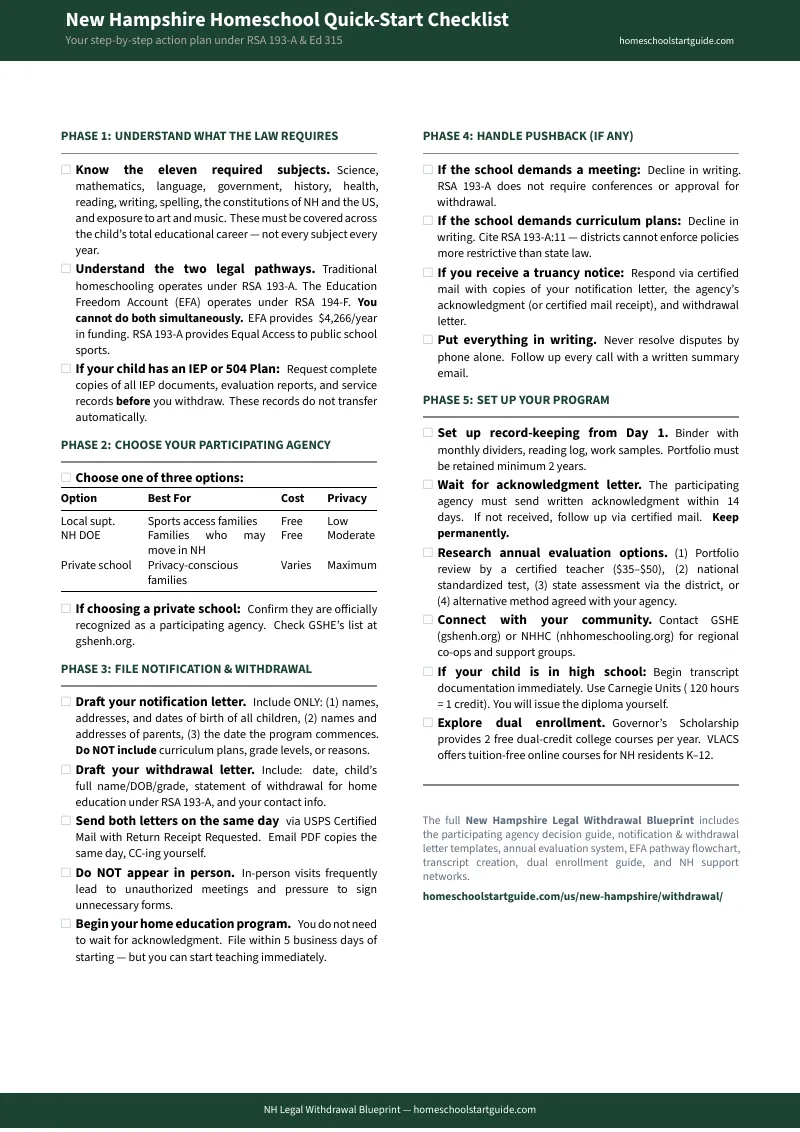
Not ready for the full Blueprint? Download the free New Hampshire Homeschool Quick-Start Checklist — a one-page overview of the five phases of withdrawal, the participating agency decision, and the 5-day notification deadline. It's enough to get started, and it's free.
Your child doesn't have to go back on Monday. New Hampshire law has protected your right to educate at home since RSA 193-A was enacted. The "Live Free or Die" state really does protect your freedom — but only if you file the right paperwork with the right agency in the right window. The Blueprint makes sure you do.