
Launch Your New Hampshire Micro-School Without Triggering Ed 400 Private School Rules, Zoning Enforcement, or EFA Compliance Failures.
New Hampshire is one of the best states in the country for micro-school formation — and one of the most confusing to structure correctly. RSA 193-A lets parents "direct or coordinate" education "through others," which means cooperative learning pods are legal under the home education statute. No teacher credentials. No mandatory standardized testing. No curriculum approval. But there's a critical threshold: if your pod crosses from "families cooperating" to "an entity assuming attendance responsibility and collecting institutional tuition," you've triggered Ed 400 private school rules — fire inspections, health department approval, formal state oversight. Most parents don't know where that line is. The internet won't tell you. GSHE and NHHA can point you in the right direction, but neither provides the templates, agreements, or municipal zoning scripts to actually execute.
You want to gather three or four families, share the teaching load, and build something that fits your children — whether you're a Manchester-Nashua corridor parent who needs a drop-off model because the commute to Boston already consumes your mornings, a Seacoast family seeking a progressive alternative to $16,000-per-year private schools, or a North Country homeschooler whose nearest co-op is an hour's drive away. Whatever the reason, you've arrived at the same conclusion: I need to build this myself.
The problem is that New Hampshire's regulatory landscape is a patchwork of state education statutes, municipal zoning ordinances, and a participating agency system that adds a layer of confusion no other state has. Each family in your pod might use a different participating agency — the local superintendent, the NH DOE Commissioner, or an approved nonpublic school like Harkness House — and each agency has different expectations. The NHDOE website gives you raw statutes but zero guidance on running a pod. GSHE provides community support but not operational templates. Prenda charges $219.90 per student per month. KaiPod takes 10% of your gross revenue for two years. You need the operational playbook without the institutional overhead and without surrendering your tuition to a network.
The New Hampshire Micro-School & Pod Kit is that playbook — the NH Compliance Blueprint that translates RSA 193-A, Ed 400, municipal zoning, and EFA vendor requirements into step-by-step action plans with templates you can execute this week.
What's Inside the Kit
The RSA 193-A vs. Ed 400 Legal Framework
New Hampshire doesn't have a "micro-school" category. Your pod operates under one of two legal frameworks: RSA 193-A home education (each family files individually, no institutional oversight) or RSA 193/Ed 400 nonpublic school registration (formal state approval, fire and health inspections, annual reporting). This section walks you through the exact threshold between them — what triggers Ed 400, what keeps you safely under RSA 193-A, and why structuring each family as an independent homeschooler with a cooperative teaching arrangement is the approach that preserves maximum autonomy. Most pods should stay under RSA 193-A. This chapter makes sure you understand why and how.
The Participating Agency Navigation Guide
New Hampshire's participating agency system is unlike any other state's. When a family files their Notice of Intent, they choose one of three participating agencies: the local school superintendent, the NH DOE Commissioner, or an approved nonpublic school. Families in the same pod can — and often do — have different participating agencies, each with different expectations for annual evaluations, record-keeping, and communication. This chapter explains the practical differences between the three options, which agency works best for pod families, and how to coordinate when your pod members have filed with different agencies.
Education Freedom Account Integration
This is the section that justifies the entire kit. New Hampshire's EFA program, expanded universally by SB 295, provides $3,700 to $5,200 per student in state funding — but there's a critical trade-off most families miss. EFA recipients cannot simultaneously hold RSA 193-A homeschool status. They must submit a notification of termination to their participating agency, which means they lose the guaranteed public school sports access under RSA 193:1-c. This chapter explains the EFA eligibility process, the exact trade-off, how to register as an approved vendor with the Children's Scholarship Fund NH via ClassWallet, and how to structure your pod's invoicing so EFA and non-EFA families can participate in the same group without compliance issues.
Municipal Zoning Guides for Manchester, Nashua, Concord, and the Seacoast
Zoning is the most common way informal pods get shut down in New Hampshire. A neighbor complaint triggers an inspection, the town discovers an unpermitted "home occupation," and the pod closes overnight. The rules vary wildly by municipality: Manchester allows up to 4 pupils for home instruction, Concord limits it to 1, Nashua requires a Special Exception for 3 or more weekly visits, and Portsmouth uses a tiered permit system for 4 to 8 students. This section covers the specific zoning rules in each of the four major metro areas, plus the safest default option — churches and community centers, which are pre-zoned for group use at $0–$500 per month.
Family Agreements, Liability Waivers, and Enrollment Forms
Customizable templates covering schedule, tuition and cost-sharing, educational philosophy, EFA disbursement handling, health and illness policies, behavioral expectations, dispute resolution (mediation before litigation), withdrawal terms, and assumption of risk. Written from scratch without religious language or ideological prerequisites. These are the documents that prevent the most common reason pods collapse — undefined expectations between adults. Every participating family signs before the first day.
Hiring Educators in New Hampshire
If your pod hires a facilitator or teacher, RSA 189:13-a requires fingerprint-based criminal background checks through the NH DOE or DMV — $33.50 per person, 1–2 weeks processing. This chapter covers background check requirements, W-2 vs. 1099 classification (most pod educators are W-2 employees, not independent contractors), compensation benchmarks ($20–$45/hour depending on credentials and region), and the employment paperwork needed to stay compliant with NH labor law.
Budget Planning for New Hampshire's Cost Environment
Real New Hampshire benchmarks: space rental ($0–$500/month for a church or community center, $800–$3,000 for commercial), liability insurance ($500–$1,500/year), curriculum ($200–$800/student/year), and educator compensation ($20–$45/hour). Plus cost-sharing formulas for equal-split, per-child, and sliding-scale models — with worked examples showing how a 6-student pod with a hired facilitator splits $12,000–$24,000 in annual expenses to achieve a 6:1 student-teacher ratio at a fraction of private school tuition, with EFA covering a substantial portion.
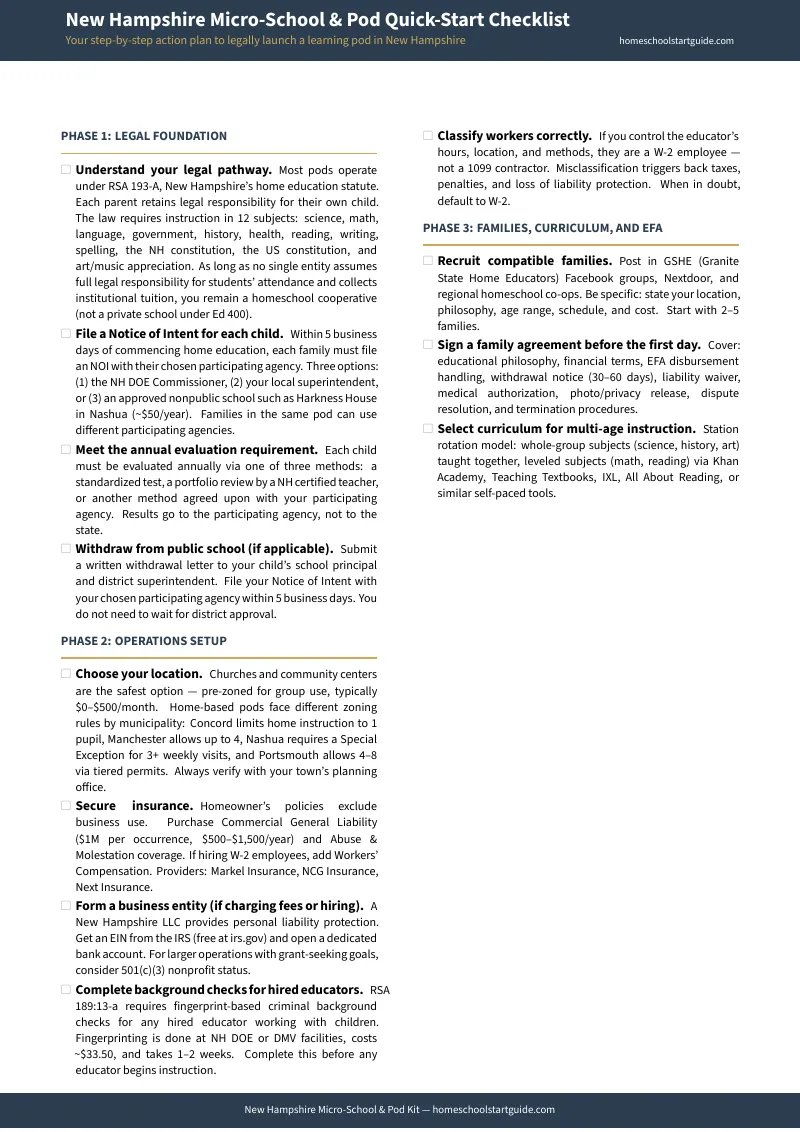
The New Hampshire Micro-School Quick-Start Checklist
A single-page, print-and-pin sequencing document that walks you from "I have an idea" to "the first day of pod school" — covering legal foundation, operations setup, family and curriculum selection, EFA integration, and launch week in the correct order. Most parents spend forty or more hours assembling this sequence from scattered NHDOE pages, GSHE Facebook threads, and Reddit posts. This checklist condenses it to a single reference.
Who This Kit Is For
- Parents who want to form a small learning community of 3–8 students with two to four families — sharing the teaching load, splitting costs, and building something intentional rather than defaulting to institutions that don't fit
- Manchester-Nashua corridor families who need a drop-off model because the Boston commute already consumes their mornings — a pod with a hired facilitator gives their children daily education and socialization while both parents work
- Rural New Hampshire families in the North Country, Lakes Region, or Monadnock area who crave the socialization of group learning but face 30–60 minute drives to the nearest co-op — a neighborhood pod eliminates the commute
- Post-COVID pod families who've been running an informal arrangement since 2020 and need legal structure, proper insurance, and a real agreement between families before the zoning board or a liability incident forces the issue
- Parents who want to use EFA funding ($3,700–$5,200 per student) for micro-school tuition but don't know how to become an approved vendor, handle the RSA 193-A termination requirement, or structure invoicing through ClassWallet
- Parents of neurodivergent children (autism, ADHD, dyslexia, gifted/2e) who are exhausted by IEP advocacy and want a calmer, self-paced environment designed around their child's needs
- Seacoast families seeking a progressive, pedagogically advanced alternative to private schools in the Portsmouth-Dover-Exeter corridor — without the $16,000+ annual tuition
- Former educators leaving the public system who want to serve their community by running a small paid micro-school — without the overhead and revenue-sharing of a franchise network
- Military families near Pease Air National Guard Base who need educational continuity that survives a PCS move and isn't dependent on district enrollment
Why Not Just Use the Free Resources?
The NHDOE website hosts the statutes. GSHE provides community support. NHHA and NHCHE serve their member communities. Here is exactly what you run into when you try to build a multi-family pod from those sources alone:
- The NHDOE is a legal archive, not an operational guide. It publishes the raw text of RSA 193-A, Ed 400, and the participating agency rules. It provides zero templates for Notice of Intent filing, family agreements, liability waivers, or the record-keeping required for annual evaluations. The state requires compliance but abandons you on implementation.
- GSHE is built for individual homeschool families. Their Pod Connections Facebook group is invaluable for finding families, and their advocacy helped clarify that pods are legal under RSA 193-A. But GSHE doesn't offer family agreement templates, cost-sharing frameworks, EFA vendor application walkthroughs, or liability waiver templates — all of which are essential when multiple families share space, money, and children.
- Generic Etsy planners are legally useless in New Hampshire. A $7 "Micro-School Planner" from Etsy tracks daily schedules and curriculum logs. It provides zero guidance on the RSA 193-A vs Ed 400 threshold, participating agency selection, municipal zoning variance by town, EFA vendor registration through CSFNH, or the RSA 189:13-a background check requirement for hired educators. Using one gives you the appearance of organization without the substance of compliance.
- Franchise networks withhold the operational details deliberately. Prenda, KaiPod, and Acton Academy webinars sell the dream. The granular how — legal structuring, zoning navigation, family agreements, budget templates, EFA integration — is the product they sell for thousands per year plus a perpetual share of your revenue. KaiPod's Catalyst program costs $249 upfront plus 10% of your gross revenue for two years. Prenda charges $219.90 per student per month in platform fees.
Free resources give you the legal baseline and the community. The Kit gives you the templates, checklists, and compliance frameworks to execute this week.
— Less Than One Consultation with a NH Education Attorney
A single consultation with a New Hampshire attorney costs $200–$400 per hour. A single municipal zoning violation fine starts at $275 per day. Prenda charges $219.90 per student per month in platform fees. KaiPod takes 10% of your gross revenue for two years — on a $50,000 annual operation, that's $5,000 per year handed to a corporate network. The Kit costs less than a single attorney consultation and gives you the RSA 193-A compliance framework, EFA vendor walkthrough, municipal zoning guides, family agreements, and liability waivers those alternatives are designed to sell piecemeal.
Your download includes the complete 18-chapter guide, the Quick-Start Checklist, and standalone printable templates — the Family Agreement, Liability Waiver, and Withdrawal Letter. Instant download, no account required.
30-day money-back guarantee. If the Kit doesn't give you the legal clarity and operational confidence to move forward with your pod, email us and we'll refund you. No questions asked.
Not ready for the full Kit? Download the free New Hampshire Homeschool Quick-Start Checklist — a single-page summary of the RSA 193-A framework, participating agency options, annual evaluation requirements, and the four-phase launch sequence. It's enough to understand your rights tonight.
New Hampshire doesn't require teacher credentials, state testing, or curriculum approval for homeschoolers. RSA 193-A explicitly protects cooperative learning. The Kit makes sure you use that protection correctly.