The Pod Compliance Playbook: Launch Your Nevada Micro-School Without Accidentally Running an Illegal Daycare.
Nevada's homeschool law is famously relaxed. File a Notice of Intent with your school district superintendent under NRS 392.070, cover English, math, science, and social studies, and you're legal. No testing. No curriculum approval. No portfolio reviews. No annual evaluations. It's one of the simplest homeschool frameworks in the country.
But the moment you invite three other families into your living room, share the teaching load, and start collecting $200 per month per child to pay a facilitator — you've crossed out of "simple homeschool" and into a legal gray zone that the Nevada Department of Education, the free Facebook groups, and the franchise network webinars never explain. Is your pod a homeschool cooperative or an unlicensed childcare facility under NRS 432A? Does Clark County zoning allow structured education in your HOA-governed townhouse? What happens financially when a family drops out mid-semester after you've committed to six months of commercial lease payments?
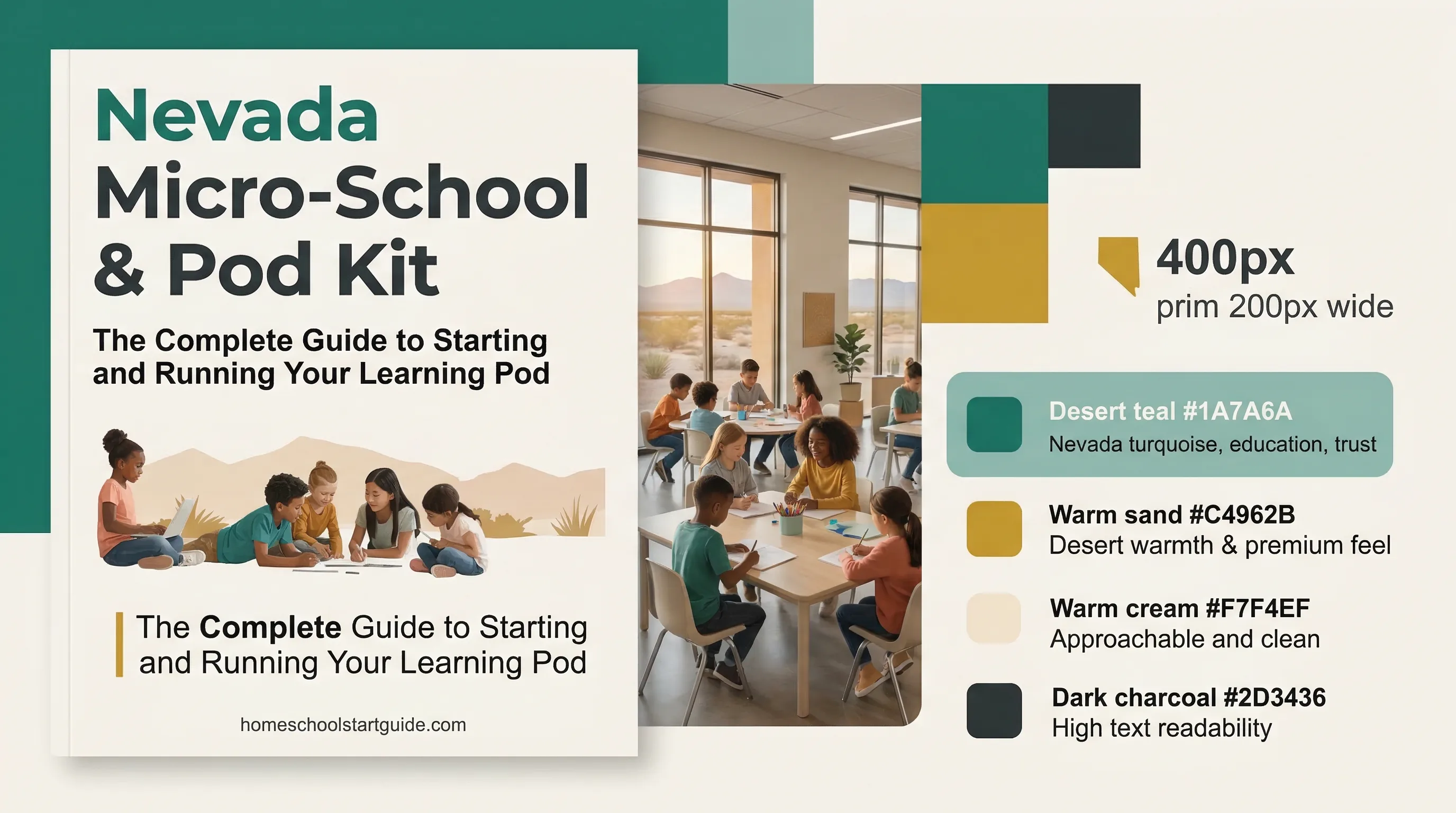
These are the questions that kill pods before they start — not bad curriculum, not unmotivated children, but unresolved legal and financial ambiguity between adults. The Nevada Micro-School & Pod Kit — the Pod Compliance Playbook — is the operational framework that answers every one of them.
What's Inside the Pod Compliance Playbook
The Two-Pathway Legal Framework
Because Nevada has two distinct routes to running a micro-school — the homeschool exemption (NRS 392.070, each family files an NOI, zero oversight) and the licensed private school pathway (NRS 394, teacher licensing, 180-day calendar, facility inspections) — and choosing the wrong one means either unnecessary regulation or inadequate legal protection. This section walks you through both with a plain-English decision tree so you choose the right structure for your pod's size, staffing plans, and growth trajectory.
The NRS 432A Compliance Guide
Because "am I running an illegal daycare?" is the question that stops most pod founders before their first parent meeting. Nevada's childcare licensing statutes draw specific lines around how many children from different families can be hosted, for how many hours, and under what financial arrangements. This section maps the exact boundaries between a legal educational gathering and a facility that triggers state licensing requirements — so you structure your pod to stay clearly on the right side of the law.
Family Agreement and Liability Waiver Templates
Because the most common reason pods collapse isn't bad curriculum — it's undefined expectations between adults about money, scheduling, and what happens when someone wants to leave mid-year. Customizable templates covering cost-sharing, curriculum authority, health policies, behavioral expectations, dispute resolution, and withdrawal terms. Written without religious language or ideological prerequisites. Every participating family signs before the first day.
The ESA Myth-Buster and Real Funding Guide
Because half the parents in your future pod believe Nevada hands out $5,000–$7,000 per child in Education Savings Account funds — and they don't. The 2015 universal ESA (SB 302) was defunded and has never distributed a dollar. The Opportunity Scholarship exists but is strictly income-capped and only available at registered private schools — not homeschool-based pods. This section cuts through the political noise and internet rumors, then provides the real alternative: practical cost-sharing models that make your pod financially sustainable without waiting on government programs that don't exist.
HOA, Zoning, and SB 153 Protections
Because in Las Vegas, your HOA board is often a bigger obstacle than the state government. SB 153 explicitly prohibits HOAs from banning home-based instruction, but enforcement depends on knowing your rights and documenting your structure correctly. This section covers HOA pushback strategies, Clark County and Washoe County zoning rules for home-based education, and when a commercial lease makes more financial sense than fighting your neighborhood association.
Budget Planning and Cost-Sharing Frameworks
Because splitting costs "evenly" between a family with three kids and a family with one sounds fair until the first invoice arrives — and financial resentment is the second most common reason pods dissolve. Real Nevada benchmarks for space rental ($300–$1,200/month for a church classroom or commercial space), liability insurance ($400–$1,200/year), curriculum ($200–$600/student/year), and facilitator compensation ($20–$40/hour). Plus cost-sharing formulas for equal-split, per-child, and sliding-scale models — with a worked example showing how a 6-student pod achieves a 6:1 ratio at a fraction of private school tuition.
Scheduling Models for the 24-Hour City
Because Las Vegas hospitality workers, military families at Nellis and Creech, and parents working swing shifts don't fit into a standard 8-to-3 school schedule — and traditional homeschool resources assume that they do. Five scheduling models including the university model (two to three full days per week), afternoon/evening sessions, and year-round calendars designed for Nevada's extreme summer heat and the flexible schedules of a service-industry workforce.
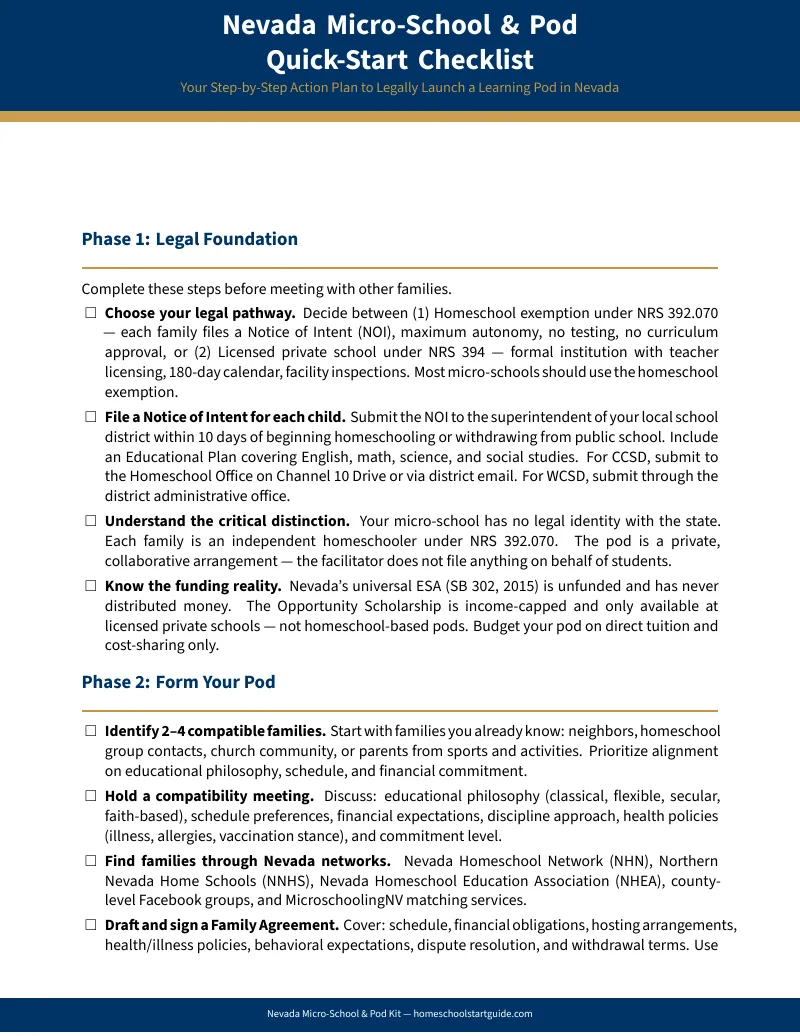
The Nevada Pod Launch Checklist
Because most parents spend forty-plus hours stitching together the launch sequence from NRS statutes, Nevada Homeschool Network directories, and scattered Facebook threads — and still aren't sure they got the order right. A single-page, print-and-pin document that walks you from "I have an idea" to "the first day of pod school" — covering legal foundation, pod formation, operations, and launch week in the correct sequence.
Who This Kit Is For
- Parents who want to form a small learning community of 3–8 students with two to four families — sharing the teaching load, splitting costs, and building something intentional rather than defaulting to institutions that don't fit
- Las Vegas and Henderson families burned out on CCSD's 40-kid classrooms, chronic absenteeism, and safety concerns who want a high-quality 6:1 student-teacher ratio without the $10,000–$25,000 annual tuition of Meadows, Bishop Gorman, or Pinecrest
- Current homeschoolers who find solo teaching unsustainable and want to share facilitation with other families without surrendering control to a franchise network that charges $2,199 per student per year in platform fees
- Reno and Sparks families — especially Northern California transplants — seeking rigorous, secular, progressive micro-school environments that integrate with dual enrollment at UNR or TMCC
- Parents of neurodivergent children (autism, ADHD, severe anxiety) who are exhausted by IEP advocacy in overcrowded classrooms and want a calmer, self-paced environment with a 3:1 or 4:1 ratio
- Military families at Nellis AFB, Creech AFB, or NAS Fallon who need educational continuity that survives a PCS move and operates on a schedule compatible with deployment and shift rotations
- Hospitality and gaming industry workers whose swing shifts, graveyard schedules, and weekend rotations make traditional school schedules impossible — and who need a pod that operates on their family's timeline
- Former educators who want to serve their community by running a small pod or micro-school — keeping 100% of the tuition revenue instead of giving 10% to KaiPod Catalyst or $2,199 per student to Prenda
- Hispanic/Latino families in the Las Vegas Valley interested in launching bilingual or dual-language micro-schools that preserve heritage language while building academic English
After Using the Kit, You'll Be Able To
- Choose the right legal pathway for your pod — homeschool exemption (NRS 392.070) for maximum autonomy or licensed private school (NRS 394) for formal recognition — using the decision framework instead of guessing
- Structure your pod so it stays clearly within the legal boundaries of an educational gathering rather than triggering NRS 432A childcare licensing requirements — the single most dangerous legal mistake Nevada pod founders make
- File a Notice of Intent correctly with CCSD, WCSD, or any rural Nevada district — including the exact Educational Plan requirements, the 10-day filing window, and the common mistakes that trigger unnecessary follow-up from district offices
- Run your first parent meeting using a signed family agreement and liability waiver that protects every family in the pod — without spending $150+ per hour on a private educational consultant
- Budget your pod accurately using real Nevada cost benchmarks and a cost-sharing formula that prevents financial resentment when a two-child family and a one-child family split costs
- Navigate HOA pushback in Las Vegas using SB 153 protections and proper documentation — so your governing board cannot shut down your pod
- Operate a mixed-age pod of 4–8 children across multiple grade levels without chaos — using scheduling frameworks for full-time, university model, afternoon/evening, and year-round models designed for Nevada's climate and workforce
- Explain to every family in your pod exactly why the Nevada ESA doesn't exist, what the Opportunity Scholarship actually requires, and how to build a financially sustainable pod on direct cost-sharing alone
Why Not Just Use the Free Resources?
The Nevada Department of Education provides the Notice of Intent forms. The Nevada Homeschool Network lists co-op groups. MicroschoolingNV matches families with educators. Here is exactly what you run into when you try to build a pod from those sources alone:
- The NV DOE website covers single-family homeschooling only. You learn that parents must file a Notice of Intent and provide instruction in four core subjects. You do not learn what happens when five families gather in one living room, collect tuition, and hire a facilitator. No family agreements, no budget templates, no childcare licensing boundaries.
- Nevada Homeschool Network and NNHS are built for traditional solo homeschoolers. Their co-op directories and Facebook groups are excellent for park days and support. They deliberately avoid providing business frameworks, liability waivers, or financial templates — because they operate on a volunteer, non-commercial ethos that doesn't apply to a structured, fee-based micro-school.
- Generic Etsy templates are legally dangerous in Nevada. A $12 "Learning Pod Agreement" from Etsy gives you a three-page waiver written for a different state — no Nevada-specific zoning guidance, no NRS 432A childcare licensing analysis, no HOA pushback strategies. Using it creates a false sense of security.
- Franchise networks withhold the operational details deliberately. Prenda, KaiPod, and Acton Academy webinars give you the vision. The granular how — the legal structuring, budget templates, scheduling frameworks — is what they sell for $2,199 per student per year in platform fees, 10% revenue shares, or $15,000+ in annual franchise tuition.
- Most online content repeats the dead ESA myth. National homeschool blogs and out-of-state guides still cite Nevada's 2015 universal ESA as if it's distributing funds. It's not — the funding mechanism was struck down and the program has never paid a single family. Parents who budget their pod on ESA money that doesn't exist are the ones whose pods collapse in October.
Free resources give you the legal baseline and the community connections. The Pod Compliance Playbook gives you the templates, checklists, and operational frameworks to execute this week.
— Less Than One Hour with a Private Education Consultant
A single consultation with a Las Vegas educational consultant costs $150 per hour. The Fultwood LLC Full Microschool Setup Package costs $2,500. Prenda charges $2,199 per student per year in platform fees. Acton Academy Red Rock charges $13,500–$21,065 in annual tuition. The Kit costs less than a single consultant hour and gives you the legal clarity, operational templates, and financial frameworks those alternatives are designed to sell piecemeal.
Your download includes the complete 23-chapter guide, the Quick-Start Checklist, and five standalone templates — Family Participation Agreement, Liability Waiver with Emergency Contact Form, Facilitator Contract, Monthly Budget Worksheet, and Annual Compliance Calendar. Seven PDFs total. Instant download, no account required.
30-day money-back guarantee. If the Kit doesn't give you the legal clarity and operational confidence to move forward with your pod, email us and we'll refund you. No questions asked.
Not ready for the full Kit? Download the free Nevada Homeschool Quick-Start Checklist — a one-page summary of the two legal pathways, the NOI filing requirements, the ESA funding reality check, and the six-phase launch sequence. It's enough to understand your rights tonight.
Nevada law gives you the right to homeschool with zero testing, zero curriculum approval, and zero government oversight. The Pod Compliance Playbook makes sure your micro-school is built on the same solid legal and operational foundation.