The Exempt-School Cooperative Blueprint: Start Your Nebraska Learning Pod Legally, Keep 100% of Your Tuition, and Build the Community Your Kids Deserve.
Nebraska voters killed the ESA program. Referendum 435 passed in November 2024 with 57% of the vote, repealing LB 1402 and eliminating the $10 million Education Scholarship Account fund before it could fully launch. The corporate micro-school networks that were marketing ESA-funded enrollment to Nebraska parents — Prenda at $2,200 per student per year, KaiPod at $8,000 to $15,000 — lost their financial lifeline. Their pricing assumed state subsidies that no longer exist.
But here is what Referendum 435 did not touch: Nebraska's Rule 13 exempt school framework. LB 1027, passed in 2024, actually expanded your freedom — stripping the Department of Education's authority to conduct school visitations or mandate achievement testing. No curriculum approval. No standardized testing. No teacher certification. No home visits. Each family files Form A with the Commissioner of Education, designates a Parent Representative, and meets the annual instruction hour requirement (1,032 hours for elementary, 1,080 for secondary). That is the entire legal obligation.
Nothing in Nebraska law prevents multiple exempt-school families from co-learning in the same physical space. That legal gap is the foundation of every grassroots micro-school in this state. You want to pull together four or five neighborhood families, share a facilitator, split costs, and give your children a learning environment the public school system cannot provide. Maybe you have been homeschooling alone for two years and the isolation is wearing you down. Maybe your child is twice-exceptional and the classroom setting that was supposed to help them is making things worse. Maybe you are a former teacher who left the system and wants to serve your community without surrendering control to a franchise network. Whatever brought you here, you have arrived at the same conclusion: I need to build this myself, and I need to build it correctly.
The Nebraska Micro-School & Pod Kit gives you the Exempt-School Cooperative Blueprint — the exact legal framework, operational templates, and step-by-step sequence to launch a Nebraska learning pod that is legally sound, financially sustainable, and built to last beyond the first semester.
What's Inside the Kit
The Rule 13 / Rule 14 Legal Primer
Most Nebraska parents know they need to file paperwork. Almost none understand the critical difference between operating as a cooperative of individual exempt schools under Rule 13 (each family files Form A independently, the group gathers under a shared Parent Representative via Form B) versus establishing an approved nonpublic school under Rule 14 (certified teachers, state curriculum requirements, annual reporting). Choosing the wrong path locks you into obligations you did not need. This section gives you the plain-English breakdown of both frameworks, explains why 95% of Nebraska pods should choose Rule 13, and walks you through the exact filing sequence — including the July 15 priority deadline that most families learn about too late.
The Post-Referendum 435 Financial Reality Check
If you built your micro-school budget around ESA funding, it is gone. If you are considering a corporate network that marketed ESA-subsidized enrollment, their pricing no longer makes financial sense for Nebraska families. This section provides the honest math: what Prenda, KaiPod, and Acton charge per student versus what a self-funded cooperative costs when you split a facilitator, space, and curriculum across five families. The difference is not incremental — it is thousands of dollars per child per year. Three budget tiers (bootstrap at $500–$1,500 per student, standard at $1,500–$4,000, and premium at $4,000–$8,000) give you realistic cost models for your specific situation.
The Cooperative Filing Mechanics
Nebraska's cooperative model is powerful but administratively opaque. Each family must independently satisfy Rule 13 as their own exempt school — but the group shares space, instruction, and costs. This section walks you through exactly how this works: which forms each family files, how the Parent Representative role functions, what the NDE online portal looks like, and how to track instruction hours across multiple families without losing your mind. The hour tracking spreadsheet alone saves you dozens of hours of manual calculation against the 1,032/1,080 annual requirement.
The Parent Agreement and Conflict Prevention Framework
The number one reason learning pods collapse is not legal trouble — it is undefined expectations between adults. Someone's child is disruptive. A family stops paying on time. Two parents disagree on curriculum. The pod dissolves in awkward silence by October. The customizable Family Agreement template covers every point of friction before it happens: tuition and cost-sharing terms, late payment penalties, withdrawal and refund policy (30 days' notice minimum), health and illness exclusion policies, behavioral expectations, discipline approach, curriculum authority, dispute resolution via mandatory mediation, and termination clause. Every participating family signs before the first day.
The Zoning, Insurance, and Liability Framework
Bringing 8 to 12 children from multiple families into your home triggers questions that Facebook groups cannot answer safely. Omaha residential zones cap non-resident students for Home Occupations — exceeding the limit may require a variance or special use permit. Lincoln has different rules. Churches and community centers are already zoned for educational use. This section tells you exactly what to check, who to call, and what to say. It also covers the insurance gap that most pod founders do not discover until something goes wrong: standard homeowner's insurance does not cover educational activities with non-family children. You need Commercial General Liability with $1,000,000 per occurrence, Sexual Abuse and Molestation coverage, and Workers' Compensation if you hire a facilitator. Budget: $300–$1,500 per year depending on size. The liability waiver template includes the explicit negligence language required for enforceability under Nebraska law — generic Etsy waivers typically do not include this.
The Facilitator Hiring and Background Check Guide
Nebraska Rule 13 does not require teacher certification. You can hire a former teacher, a retired professional, a college student, or a skilled parent to facilitate your pod. But if you control their schedule, location, and methods, they are a W-2 employee under Nebraska labor law — not a 1099 contractor. Misclassifying them exposes you to back taxes, penalties, and workers' comp violations. This section covers the Nebraska State Patrol criminal history check (~$15.50), FBI fingerprint-based national check (~$40–$50), W-2 versus 1099 classification rules, payroll setup, and realistic compensation benchmarks ($15–$20/hr entry-level, $20–$27/hr experienced).
The Nebraska Pod Launch Checklist
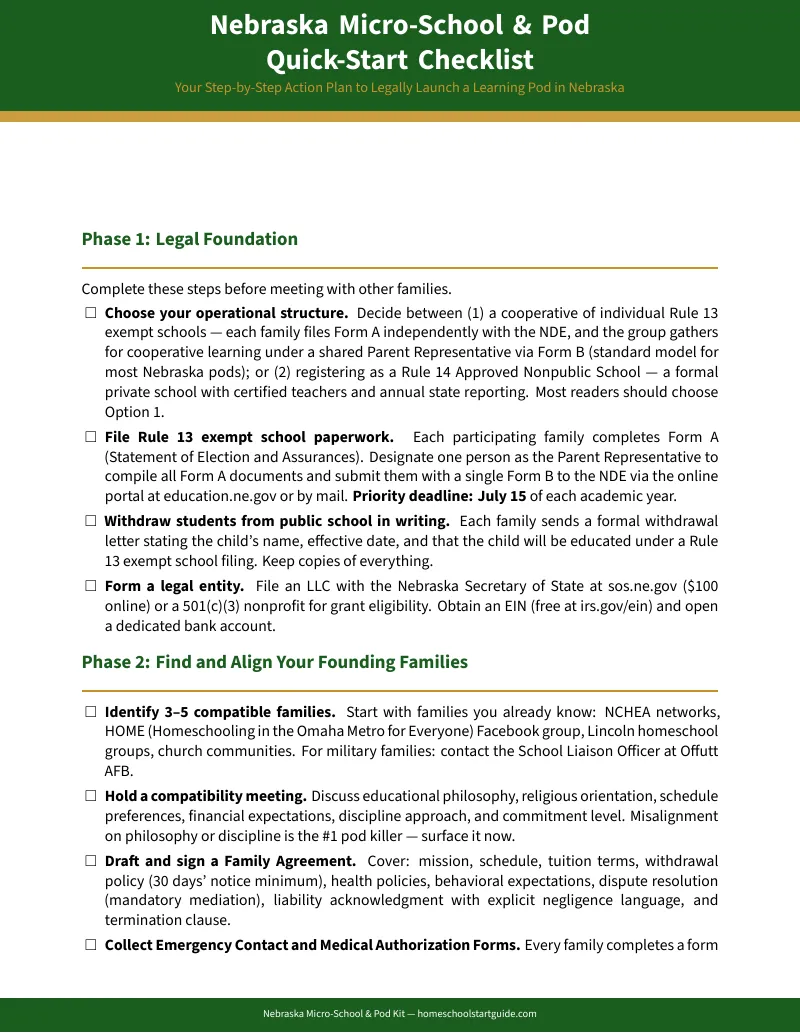
A single-page, print-and-pin document covering four phases: legal foundation (Rule 13 filing, LLC formation, withdrawal letters), family alignment (compatibility meetings, Family Agreement signing, emergency forms), operations setup (space selection, zoning check, insurance, facilitator hiring, curriculum selection, hour tracking), and launch milestones (soft launch, monthly reviews, quarterly assessments, annual renewal by July 15). Most parents spend forty or more hours assembling this sequence from NDE pages, NCHEA resources, Facebook groups, and policy documents. This checklist condenses it to one reference you can work through in an afternoon.
Standalone Printable Templates
Six ready-to-use documents you can print, customize, and put to work immediately — without extracting pages from the main guide:
- Family Agreement — the complete parent contract covering tuition, withdrawal, behavioral expectations, dispute resolution, and the Nebraska-specific liability release with explicit negligence language
- Emergency Contact & Medical Authorization Form — one per student, kept on-site during all instructional hours
- Weekly Hour Tracking Log — tracks daily instructional hours against the 1,032/1,080 annual requirement with year-to-date running totals and subject coverage
- Annual Budget Planner — revenue and expense tracking with per-student cost calculations, calibrated to Nebraska's regional cost of living
- Facilitator Agreement — employment terms, W-2 vs. 1099 classification, background check requirements, compensation, confidentiality, and termination clause
- Rule 13 Filing Checklist — the cooperative filing sequence step by step, plus key Nebraska contacts for the NDE, State Patrol, Secretary of State, and support organizations
Who This Kit Is For
- Parents who have been homeschooling alone in Nebraska and are burned out by the isolation — who want to share the teaching load with two or three other families without losing control of their child's education
- Parents who built their micro-school budget around ESA funding that Referendum 435 eliminated — and who need a realistic self-funded model that does not require $4,000 to $15,000 per student in corporate franchise fees
- Former teachers who left the Nebraska public school system and want to serve their community by running a small, intentional learning environment — without the overhead and curricular control of a franchise network
- Military families at Offutt AFB who need flexible, transient-proof educational continuity for children in the Exceptional Family Member Program or who face disrupted schooling from frequent relocations
- Families in Grand Island, Lexington, or South Sioux City who want to build bilingual micro-schools that serve their children's language needs in ways the public school system's capacity constraints cannot
- Secular or progressive parents who have been excluded from established co-ops that require statements of faith — and who need a legally sound framework for an inclusive pod without ideological gatekeeping
- Parents whose children are begging to leave a school environment that feels unsafe, overstimulating, or hostile — and who need the operational confidence to build something better
Why Not Just Use the Free Resources?
The NCHEA offers directories and legislative updates. The Nebraska Department of Education publishes the Rule 13 forms. Facebook groups have opinions. Here is exactly what you run into when you try to build a micro-school from those sources alone:
- The NCHEA is explicitly fundamentalist. Their stated mission is tied to Biblical principles, and their leadership requires adherence to a strict Statement of Faith. If you are secular, progressive, interfaith, or simply looking for legal and operational guidance without religious prerequisites, the NCHEA is not built for you. Their resources are extensive — for families who share their worldview. For everyone else, there is a massive tone gap between what you need and what they provide.
- The NDE gives you the raw forms but not the sequence. You learn that you need Form A and Form B. You do not learn how cooperative filing actually works — that each family files independently as their own exempt school while learning together under a shared Parent Representative. You do not learn how to track 1,032 instructional hours across five families using a shared spreadsheet, or what happens if one family's hours fall short while the others exceed the requirement. The NDE tells you what to submit. It does not tell you how to build a school around it.
- Facebook groups give you dangerous legal advice for free. Someone in a Nebraska homeschool group tells you that zoning does not matter for a small pod. Someone else says you do not need insurance because "it's just a playdate." A third person recommends paying your facilitator as a 1099 contractor to avoid payroll taxes. Any one of these recommendations could result in a municipal violation, an uninsured liability claim, or a tax penalty. Well-meaning advice from strangers is not a substitute for a professionally structured framework.
- Generic Etsy templates do not know Nebraska law. A $12 "Pod Agreement" from Etsy does not address Rule 13 cooperative filing, the Form A/Form B structure, Nebraska's instruction hour requirements, the explicit negligence language required for enforceable liability waivers under Nebraska law, or the zoning differences between Omaha, Lincoln, and rural municipalities. It is a document that looks professional and protects nothing.
- Corporate franchise webinars withhold the operational details on purpose. Prenda's content and KaiPod's Catalyst program will inspire you with statistics about the microschool movement. The granular how — the cooperative filing mechanics, the facilitator employment classification, the insurance frameworks — is the product they sell for thousands of dollars per student per year. Their free content is designed to make you feel informed while keeping you dependent enough to sign up.
Free resources tell you what the state demands. The Exempt-School Cooperative Blueprint tells you how to actually manage the humans, the money, and the physical risks without losing your mind.
— Less Than One Month of a Franchise Platform Fee
Prenda charges approximately $2,200 per student per year in platform fees — and that pricing assumed ESA subsidies that no longer exist in Nebraska. KaiPod runs $8,000 to $15,000 per student annually. A single consultation with an education attorney about your pod's legal standing costs $200–$400 for one hour. The Kit costs less than a week of a franchise subscription and gives you the operational independence those platforms are designed to prevent.
Your download includes the complete guide (15 chapters covering legal frameworks, cooperative filing, business formation, parent agreements, facilitator hiring, cost-sharing, zoning, insurance, curriculum for multi-age groups, public school access rights, dual enrollment, special populations, micro-school networks, and templates), the Nebraska Homeschool Quick-Start Checklist, plus six standalone printable templates: the Family Agreement, Emergency Contact & Medical Authorization Form, Weekly Hour Tracking Log, Annual Budget Planner, Facilitator Agreement, and Rule 13 Filing Checklist with key Nebraska contacts. Eight PDFs total. Instant download, no account required.
30-day money-back guarantee. If the Kit does not give you the legal clarity and operational confidence to move forward with your micro-school, email us and we will refund you. No questions asked.
Not ready for the full Kit? Download the free Nebraska Homeschool Quick-Start Checklist — a single-page summary of the Rule 13 requirements, the cooperative filing basics, and the four-phase launch sequence. It is enough to understand your legal rights tonight.
Nebraska gave you the legal freedom to build this. LB 1027 expanded it. The Exempt-School Cooperative Blueprint makes sure you build it correctly.