The Mississippi Pod Operations Blueprint: Launch Your Learning Pod with Legal Clarity, Financial Protection, and a Complete Operational Framework.
Mississippi's homeschool law is one of the simplest in the country. File a Certificate of Enrollment with your local school attendance officer by September 15th, and you're legal. No curriculum approval. No standardized testing. No teacher certification. The state doesn't tell you what to teach, how to teach it, or who can teach it.
But "simple law" doesn't mean "simple to run a pod." You want to gather three or four families, share the teaching load, and build something intentional for your children. The moment you go from solo homeschooler to multi-family pod, a new set of questions appears — and Facebook groups, MHEA resources, and the Mississippi Department of Education don't have the answers. How do multiple families file their Certificates of Enrollment when sharing one instructor? Do you need an LLC? What happens if you accidentally trigger Mississippi Department of Health daycare licensing? How do you split costs fairly when one family has three kids and another has one? What about liability if a child gets hurt at your house?
Maybe you're in the Jackson metro watching your district struggle and discovering that private school tuition runs $6,000 to $15,000 per child per year — unsustainable with more than one kid. Maybe you're in rural Mississippi where the nearest co-op is a 35-minute drive and reliable internet is inconsistent. Maybe you tried solo homeschooling and found that being the only teacher, every day, for every subject is a fast track to burnout. Maybe you're a secular family in a state where almost every established co-op requires a statement of faith.
Whatever brought you here, you've arrived at the same conclusion: I need to build this myself — and I need a framework that's built specifically for Mississippi.
The Mississippi Micro-School & Pod Kit — the Pod Operations Blueprint — is that framework. Two compliant legal pathways decoded in plain English. Ready-to-sign family agreements and liability waivers. Budget templates calibrated for Mississippi's cost of living. The exact steps to go from kitchen-table conversation to open doors — all built exclusively for Mississippi law.
What's Inside the Pod Operations Blueprint
Mississippi's Two Legal Pathways — Decoded
Because choosing the wrong pathway means either unnecessary paperwork or discovering mid-year that your pod's structure doesn't match the legal framework you filed under. Mississippi gives you two fully compliant ways to organize a micro-school: the individual home instruction pathway under §37-13-91 (each family files independently, then pools resources for shared instruction) and the church-affiliated school pathway (your pod organizes under a legitimate church school exempt from state regulation). The kit includes a decision flowchart that maps your pod's specific situation — number of families, faith alignment, whether you want to hire a teacher, whether you have access to church facilities — to the pathway that fits. You'll know exactly which structure to use before you fill out a single form.
Certificate of Enrollment — Filed Correctly the First Time
Because missing the September 15th deadline or using black ink instead of blue can trigger truancy concerns — and nobody at the school district office will walk you through the process for a multi-family pod. The kit walks you through the exact filing steps: where to find your district's attendance officer, what information the certificate requires, the blue-ink requirement, and how each family in a pod handles their individual filing. Plus a template notification letter for families withdrawing from public school, covering the 10-day MDE withdrawal window so you don't inadvertently create a compliance gap.
Family Agreement and Liability Waiver Templates
Because the most common reason pods collapse isn't bad curriculum — it's undefined expectations between adults about money, scheduling, and what happens when someone wants to leave mid-year. Without formal agreements, you're exposed to financial disputes, liability risk, and friendship-ending conflicts that could have been prevented with a single signed document. The templates cover financial contributions, withdrawal procedures, conflict resolution, health and safety protocols, behavioral expectations, and what happens when a family leaves. Written without religious language or ideological prerequisites — usable by any family regardless of faith background.
The Daycare Line — Staying on the Right Side
Because the fastest way to shut down a well-intentioned pod is to accidentally trigger Mississippi Department of Health childcare licensing — which requires facility overhauls, specific adult-to-child ratios, and inspections you never needed. The line between "educational micro-school" and "regulated childcare" is one that every pod founder needs to understand clearly. The kit explains how to structure your pod's hours, activities, and documentation to stay firmly within the educational exemption.
Zoning and Local Regulation Navigation
Because Jackson's zoning code requires a 5-acre minimum or a Special Use Permit for operations classified as "schools," and Harrison County's home occupation rules prohibit client visits — and discovering this after you've announced your pod to the neighbors is expensive. The kit includes practical guidance on what to look for in your municipality's code, how to handle questions from officials, and when renting church or community space is the simpler path forward.
Budget Templates Built for Mississippi's Cost of Living
Because splitting costs "evenly" between a family with three kids and a family with one sounds fair until the first invoice arrives — and financial resentment is the second most common reason pods dissolve. Real Mississippi benchmarks for facilitator wages, space rental, curriculum, and insurance. Sample cost breakdowns for pods of 3–8 students at multiple price points — from a bare-bones parent-led pod under $100 per family per month to a fully staffed micro-school with a dedicated teacher. Every template is calibrated for Mississippi wages and prices, not national averages.
The Mississippi Pod Launch Checklist
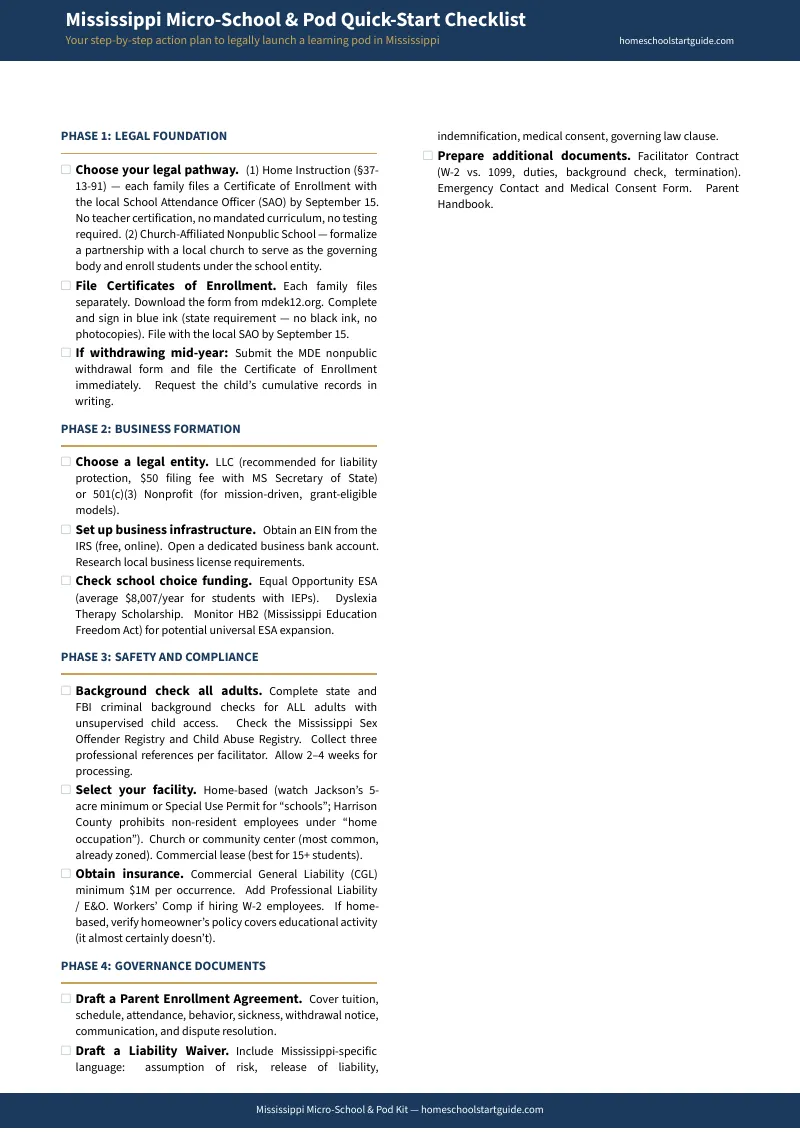
Because most parents spend forty-plus hours stitching together the launch sequence from Mississippi statutes, MHEA directories, and scattered Facebook threads — and still aren't sure they got the order right. A print-and-pin document that walks you from "I have an idea" to "first day of pod school" — covering legal foundation, entity formation, safety compliance, governance, curriculum, and launch week in the correct sequence.
Who This Kit Is For
- Parents who want to form a small learning community of 3–8 students with two to four families — sharing the teaching load, splitting costs, and building something intentional rather than defaulting to institutions that don't fit
- Jackson metro families watching their district struggle who can't afford $6,000–$15,000 per child per year in private school tuition and want a high-quality alternative at a fraction of the cost
- Current homeschoolers who find solo teaching unsustainable and want to share facilitation with other families — or pool resources to hire a facilitator — without losing control of their child's education
- Secular or interfaith families who've looked at every co-op in their area and found they all require statements of faith or doctrinal alignment — and who need a legally sound framework for building a welcoming community on their own terms
- Rural Mississippi families where the nearest co-op is a 35-minute drive and reliable broadband is inconsistent — and a neighborhood pod with three families is the most practical path to socialization and shared instruction
- Military families near Keesler AFB, Columbus AFB, Camp Shelby, or NCBC Gulfport who need educational continuity that survives a PCS move
- Parents of neurodivergent children who need a calmer, self-paced environment with intentionally small student-to-teacher ratios that public schools cannot provide
- Former educators who want to serve their community by running a small pod or micro-school — as an independent business, not a franchisee paying platform fees
After Using the Kit, You'll Be Able To
- Choose the right legal pathway — individual home instruction or church-affiliated school — using the decision framework instead of guessing, and file every family's Certificate of Enrollment correctly before the September 15th deadline
- Run your first parent meeting using a signed family agreement and liability waiver that protects every family in the pod — without spending $250+ on a Mississippi education attorney
- Structure your pod's hours, activities, and documentation so you stay clearly within the educational exemption and never accidentally trigger daycare licensing
- Navigate your municipality's zoning code and know whether your home-based pod needs a permit, a conversation with the planning department, or a move to church space
- Build a budget that every family agrees on — using real Mississippi cost benchmarks and cost-sharing formulas for equal-split, per-child, and sliding-scale models
- Hire a facilitator with proper Mississippi background checks, a legally sound contract, and fair pay benchmarks that reflect Mississippi's labor market
- Facilitate a mixed-age pod of 4–8 children using scheduling frameworks for full-time, hybrid, enrichment, and block-schedule models
Why Not Just Use the Free Resources?
MHEA provides excellent directories for solo homeschooling families. The Mississippi Department of Education provides the Certificate of Enrollment form and the raw legal text of §37-13-91. Homeschool blogs discuss the philosophical benefits of micro-schools. Here is exactly what you run into when you try to build a multi-family pod from those sources alone:
- The MDE provides the form but zero operational guidance. You learn that you must file a Certificate of Enrollment by September 15th. You do not learn how five families sharing one instructor handle their individual filings. No family agreements, no budget templates, no decision flowchart for choosing between the two legal pathways.
- MHEA is built for traditional solo homeschoolers. Their support groups serve 100 to 600 families and are optimized for individual families teaching their own children. They do not offer operational infrastructure for multi-family pods — no co-teaching schedules, no cost-sharing frameworks, no facilitator contracts, no conflict-resolution agreements.
- Generic Etsy templates are legally dangerous in Mississippi. A $5–$24 "Learning Pod Agreement" from Etsy gives you a generic waiver written for a different state — no Mississippi-specific legal guidance, no Certificate of Enrollment filing steps, no daycare licensing distinction, no zoning navigation for Jackson or Harrison County.
- Franchise networks charge thousands for what this kit provides. Prenda charges $2,199 per student per year in platform fees and doesn't provide your space. Acton Academy demands $20,000 upfront plus 4% of revenue perpetually. KaiPod requires a three-year revenue-sharing agreement. These networks give you the vision and take your tuition — the operational how-to is what they sell.
- Facebook groups give you fragments and anecdotes. Parents in Mississippi homeschool groups share personal experiences, but the advice is fragmented, often contradictory, and occasionally legally inaccurate. A single compliance mistake — like not understanding the daycare line or missing the blue-ink requirement — can create problems that cost far more than the guide.
Free resources confirm that homeschooling is legal in Mississippi. The Pod Operations Blueprint gives you the templates, checklists, and operational frameworks to actually execute — this week.
— Less Than One Hour with a Mississippi Education Attorney
A single consultation with a Mississippi education attorney costs $200–$400 per hour. Private school tuition in Mississippi runs $6,000 to $15,000 per child per year. Franchise micro-school networks charge $2,199 to $20,000+ just to get started. Even large co-op annual dues run $35–$100 on top of mandatory volunteer hours. The Kit costs less than a single attorney consultation and gives you the legal clarity, operational templates, and financial frameworks those alternatives are designed to sell piecemeal.
Your download includes 7 PDFs: the complete 28-chapter guide, the Quick-Start Checklist, and 5 standalone print-ready templates — Family Participation Agreement, Liability Waiver and Emergency Contact form, Facilitator Contract, Withdrawal Notification Letter, and Annual Budget Planner. Instant download, no account required.
30-day money-back guarantee. If the Kit doesn't give you the legal clarity and operational confidence to move forward with your pod, email us and we'll refund you. No questions asked.
Not ready for the full Kit? Download the free Mississippi Homeschool Quick-Start Checklist — a one-page summary of the two legal pathways, the Certificate of Enrollment filing steps, and the eight-phase launch sequence. It's enough to understand your legal obligations tonight.
Mississippi's law makes this remarkably straightforward. No curriculum approval. No standardized testing. No teacher certification. What's been missing is the operational playbook — and that's exactly what this kit is.