Minnesota Requires Annual Testing, Annual Reporting, and Ten Documented Subjects. Generic Planners Track None of That.
Every October 1, you file an annual report with your superintendent. Every spring, your child takes a nationally normed standardized test. If the composite score falls at or below the 30th percentile, you enter a remediation process that requires an additional professional evaluation. And through all of it, you maintain a private portfolio documenting instruction across ten specific subjects — reading, writing, literature, fine arts, math, science, history, geography, government, and health/PE. Miss any of these, and you are out of compliance with Minnesota Statute §120A.22.
The Minnesota Portfolio & Assessment Templates is a complete documentation system — the 10-subject tracking grids, annual report preparation guides, testing preparation strategies, high school transcript framework, and K-12 tax credit expense tracker — built entirely around Minnesota's current legal requirements and what Minnesota colleges actually expect from homeschooled applicants. No hourly logs. No daily attendance sheets. No features borrowed from states that aren't yours. Just the ten mandated subjects, mapped from kindergarten through graduation.
What's Inside
The Minnesota Legal Framework
Chapter 1 explains why documentation matters when the state doesn't prescribe curricula but does demand annual proof of instruction. Chapter 2 maps all four instructor qualification pathways — parent as instructor (no degree required), bachelor's degree holder, supervised by licensed teacher, and accredited curriculum — with the documentation requirements for each. You'll know exactly which pathway applies to your family and what it obligates you to file.
Annual Report Filing — What the Superintendent Needs and What They Don't
Chapter 3 walks through the Initial Report and Letter of Intent to Continue, line by line. What the law requires: child's name, birth date, instructor qualifications, planned standardized test, immunization records. What the law does not require: curriculum lists, daily schedules, test scores, work samples. District forms routinely ask for more than the statute mandates. This chapter shows you how to file exactly what's legally required — and not a word more.
The 10-Subject Compliance Matrix
Minnesota doesn't require hourly tracking or daily attendance. It requires documented instruction across ten specific subjects. Chapter 4 decodes each one — what counts as "literature" versus "reading," how a single field trip can cover history, geography, and fine arts simultaneously, and how to use the crosswalk approach so one activity checks off multiple subjects. The 10-Subject Tracking Grid makes this a five-minute weekly task instead of an end-of-year scramble.
Grade-Level Portfolio Structures (K-12)
What counts as portfolio evidence for a first grader looks nothing like what colleges expect from a junior. Chapters 5 and 6 provide grade-banded strategies: reading logs and milestone photos for K-2, essay drafts and project documentation for grades 3-8, and full course portfolios with graded assignments for high school. Each level includes specific examples of what to save, what to photograph, and what to skip.
Annual Standardized Testing — Without the Panic
Chapter 7 covers the five approved test options (Iowa Assessments, Peabody Individual Achievement Test, NWEA MAP, Stanford Achievement Test, CAT), how to choose between them, how to prepare your child for the format without teaching to the test, and how to interpret percentile scores correctly. Chapter 8 addresses the 30th percentile rule head-on — what actually happens if your child scores below the threshold, what the required additional evaluation looks like, and why it's a diagnostic tool, not a punishment. The remediation process is far less scary than parent forums make it sound.
Professional Transcript Creation
Chapter 10 is the transcript chapter. Course naming conventions (use "Algebra I" not "Math"), credit assignment (1.0 for full year, 0.5 for semester), unweighted GPA calculation, the course description supplement that competitive universities expect, and formatting standards that make your transcript look institutional. This is the chapter that prevents your child's homeschool record from looking like a DIY arts project when college admissions opens the envelope.
The PSEO Guide
Minnesota's Postsecondary Enrollment Options program lets homeschoolers take free college courses starting in eleventh grade — tenth grade at some institutions. The University of Minnesota requires an unweighted GPA of 3.6 for general PSEO admission. Chapter 11 walks through every step: eligibility requirements, the Notice of Student Registration (NOSR) form, application timelines, and how to integrate PSEO courses into your homeschool transcript. Miss the March–May application window and your child loses a semester of free college credits.
College Admissions — U of M, St. Olaf, Carleton, and Beyond
Chapter 12 provides university-specific documentation requirements for major Minnesota institutions. What the University of Minnesota expects from homeschooled applicants is different from what St. Olaf wants, and both differ from Carleton or Macalester. Stop guessing what "competitive" means for each school.
The K-12 Tax Credit Expense Tracker
Minnesota offers one of the most generous homeschool tax incentives in the country — a refundable credit covering 75% of qualifying expenses (up to $1,500 per child) plus a subtraction from taxable income. Chapter 13 explains exactly which expenses qualify, how to categorize them for Schedule M1ED, and how to track them throughout the year so you aren't excavating a shoebox of receipts in April. No competitor includes this. Most Minnesota homeschool families leave hundreds of dollars unclaimed every year because they don't know what qualifies.
Who This Is For
- Parents filing their first annual report and unsure what the superintendent actually needs — versus what the district form is trying to extract
- Parents approaching spring testing season and anxious about the 30th percentile threshold
- Parents whose child is entering high school and who suddenly need a formal transcript for PSEO or college admissions
- Parents who've been homeschooling for years without organized records and want to professionalize before the documentation gaps become a problem
- Parents in the Twin Cities (Minneapolis, St. Paul, Bloomington, Edina, Woodbury), Rochester, or Duluth whose districts ask for more than the law requires
- Unschooling, Charlotte Mason, and eclectic families who need to translate non-traditional learning into documentation that satisfies Minnesota's ten-subject requirement
- Secular families who want legally accurate templates without the religious framing of MACHE resources
- Families claiming the K-12 Education Credit who need an organized expense tracker aligned to Schedule M1ED
Why Not Just Use the Free Resources?
You can. Here's what you'll find:
- District-provided forms routinely ask for more than the law requires. They request curriculum lists, daily schedules, test scores — none of which Minnesota Statute §120A.24 mandates. Veteran advocates and legal defense organizations warn against using district forms because they invite regulatory overreach. Our templates give the superintendent exactly what the law requires, nothing more.
- Homeschool Sherpa provides excellent free Letter of Intent forms — and nothing else. You'll get the filing form. Then you need a portfolio system from somewhere else, a transcript template from somewhere else, a tax tracker from somewhere else, and testing guidance from somewhere else. The free ecosystem is fragmented across a dozen websites.
- MACHE charges $52.50/year and requires alignment with their Christian mission. Their resources are legally sound but explicitly tied to a Judeo-Christian heritage framework. For the growing secular and inclusive homeschool community, that's an immediate mismatch.
- Etsy and TPT sell generic $3-8 planners built for every state. They include hourly logs and daily attendance trackers that Minnesota law explicitly does not require. They don't map to Minnesota's ten specific subjects. They don't mention PSEO, the 30th percentile rule, or the K-12 tax credit. They solve the "pretty binder" problem while creating the "wrong state" problem.
- Homeschool Tracker charges $60/year for software that tracks daily assignments and hourly logs you don't need. It's geography-agnostic — it doesn't cross-reference Minnesota's ten required subjects or flag missing documentation.
Free resources tell you what Minnesota law requires. This guide gives you the exact system to execute it — subject by subject, grade by grade, deadline by deadline.
— Less Than One Hour of a Licensed Evaluator's Time
A professional portfolio evaluation runs $75-$200 per session. MACHE membership is $52.50/year. Homeschool Tracker is $60/year. And the K-12 Education Credit you've been leaving unclaimed? That's up to $1,500 per child per year. The tax tracker alone pays for this guide many times over — and you get the complete documentation system with it.
Your download includes the complete guide, the Quick-Start Checklist, and 5 standalone printable tools — 7 PDFs:
- guide.pdf — The full Minnesota Portfolio & Assessment Templates: 15 chapters covering Minnesota's legal framework, all four instructor qualification pathways, annual report filing, the ten required subjects with the compliance matrix, grade-level portfolio structures (K-12), standardized test selection and preparation, the 30th percentile remediation process, non-traditional learning documentation, professional transcript creation with GPA calculation, PSEO enrollment guide, university admissions requirements (U of M, St. Olaf, Carleton, Macalester), K-12 Education Tax Credit expense tracking, special situations, and a year-round compliance calendar.
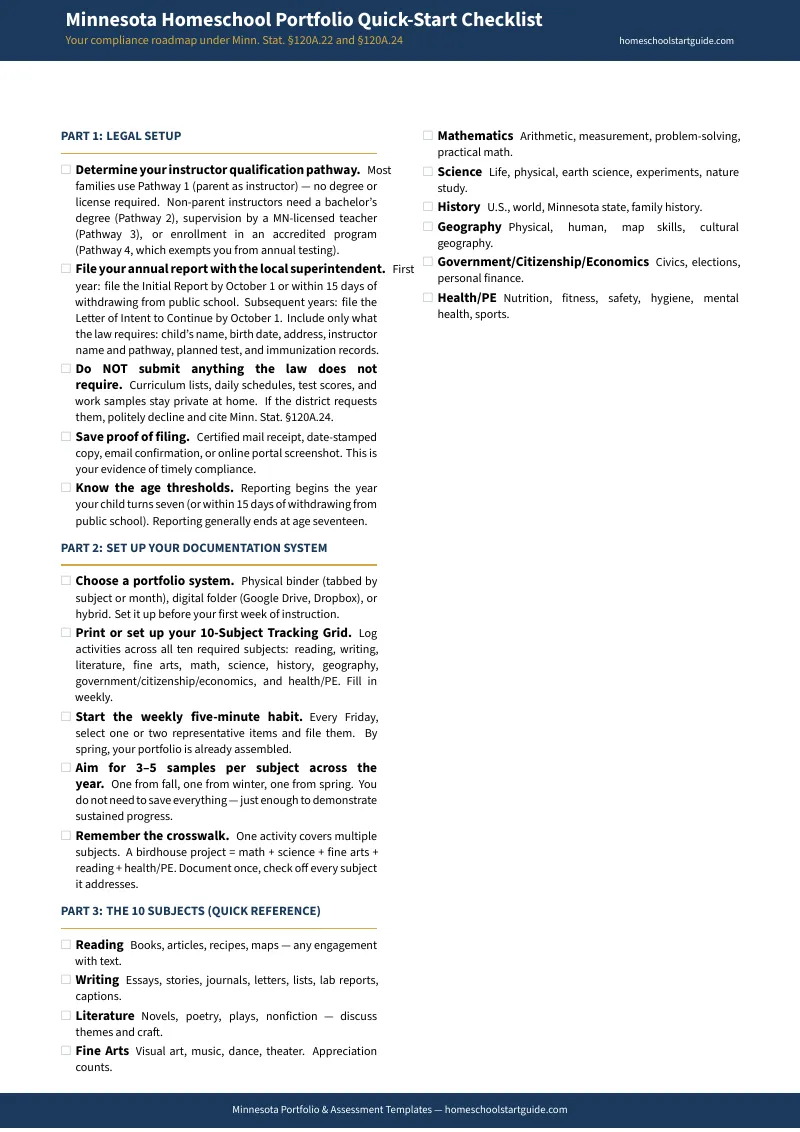
- checklist.pdf — The Minnesota Homeschool Quick-Start Checklist: a printable action plan covering legal setup, documentation system setup, the ten subjects decoded, standardized testing, high school transcripts, PSEO and college prep, and the tax credit.
- 10-subject-tracking-grid.pdf — The weekly crosswalk worksheet: log activities and check off every subject they cover. Print multiple copies — one per week or one per month.
- compliance-calendar.pdf — Every deadline, every filing, mapped month-by-month from July through tax season. Pin it on the refrigerator.
- transcript-guide.pdf — Course naming conventions, credit assignment, the 4x4 plan, unweighted and weighted GPA calculation, and formatting standards for institutional credibility.
- pseo-guide.pdf — Step-by-step PSEO enrollment: eligibility, the NOSR form, application timeline, key deadlines, and documentation requirements.
- tax-credit-tracker.pdf — Fillable expense tracker aligned to Schedule M1ED: categorize purchases as Subtraction-qualifying, Credit-qualifying, or both. Year-end totals ready for filing.
7 PDFs. Instant download, no account required.
30-day money-back guarantee. If the guide doesn't give you the documentation system and compliance framework you need, email us and we'll refund you. No questions asked.
Not ready for the full guide? Download the free Minnesota Homeschool Quick-Start Checklist — a printable overview of Minnesota's legal requirements, documentation setup steps, the ten required subjects, testing basics, and key compliance deadlines. It's enough to get oriented, and it's free.
Minnesota gives you the freedom to educate your child your way. This guide makes sure you have the documentation to prove it — to the superintendent, to college admissions, and to the Department of Revenue.